Kimi K3.1 Pro was just released, and the community immediately erupted: it is faster than K3, with performance approaching Opus, but all available quota was fully depleted in just 10 minutes.
On October 24, Kimi officially released Kimi K3.1 Pro, the first model in its K3.1 series. This is Kimi's most powerful 3-trillion-parameter model to date, supporting a million-token context window, with significantly enhanced capabilities in coding, 3D creation, financial research and long-horizon agents. At the same time, Kimi also launched the K3.1 Pro Highspeed version, which delivers around 2 to 3 times higher output speed while maintaining the same level of model intelligence.
According to the data published by Kimi, K3.1 Pro has reached or approached the performance of the current top closed-source models on coding, agent and knowledge benchmarks. Compared with K3, the most obvious change of K3.1 Pro is the further increase of post-training computation volume, and the expansion of reinforcement learning (RL) to hundreds of downstream domains. To support this large-scale joint training, Kimi has carried out systematic transformation on its RL framework, long-context inference, training efficiency, sandbox infrastructure, scheduling system and environment quality inspection platform.
K3.1 Pro has now covered Kimi's main product lines. Regular users can directly use it in kimi.com and Kimi App; Kimi Work desktop end provides model capabilities for Windows and Apple silicon Macs; Kimi Code allows users to use K3.1 Pro for programming in terminal and desktop environments. Kimi stated that the full model weights of K3.1 Pro will be released before November 4.
In terms of API, the price of Kimi K3.1 Pro for cached input per million tokens is 1.3 yuan, the price for non-cached input is 13 yuan, and the output price is 68 yuan. The high-speed version Kimi K3.1 Pro Highspeed has the same model capabilities, and its price is about twice that of the standard version.
In addition to directly providing model APIs, Kimi also launched the Hosted Agents managed agent service, which provides the Harness that supports long-running agents as cloud infrastructure to enterprises and developers. It can run 7×24 hour long-horizon tasks and support multi-agent collaboration.
This further illustrates the main direction of K3.1 Pro's upgrade this time: Kimi has begun to invest more post-training computing power in agent environments that can truly work continuously, including programming, financial research, 3D tool invocation and long-duration task execution.
1 Coding capability has surged, but "uneven performance" and excessive verbosity still draw attention
Coding and long-horizon agents are one of the most prominent directions of K3.1 Pro's upgrade this time.
In Terminal-Bench 4.0, K3.1 Pro scored 65.7%. This benchmark tests the ability of programming agents to complete complex tasks through a real, resource-constrained terminal environment, with special tests set for each task. For comparison, the results published by Kimi show that GPT-6 Astra scored 58.2% and Claude Opus 5.5 scored 66.4%. This means that K3.1 Pro has surpassed GPT-6 Astra in this test, with a gap of less than 1 percentage point from Claude Opus 5.5.
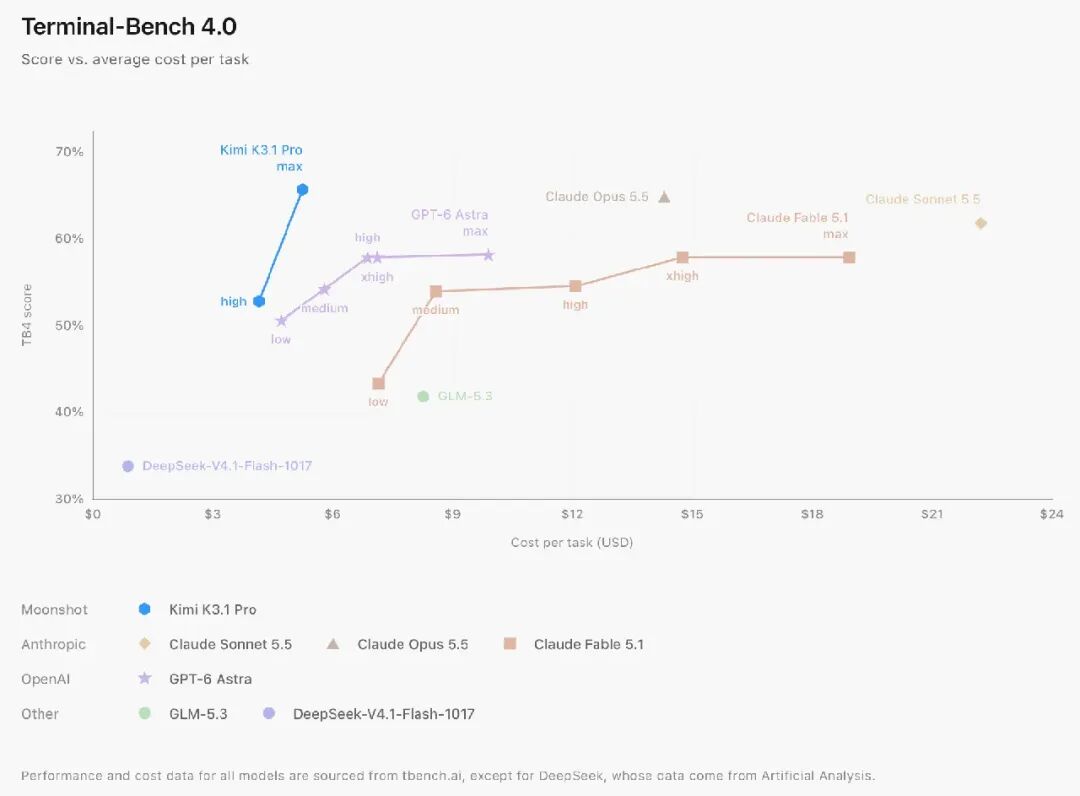
In Kimi's internal Kimi Code Bench 3.0 Long-horizon long-duration coding test, K3.1 Pro scored 61.2%, which is further improved compared with K3's 55.95%. This test covers multiple engineering fields, focusing on evaluating the model's capabilities of multi-step execution, tool invocation and end-to-end problem solving.
Compared with simply generating code, Kimi this time emphasizes more on K3.1 Pro's execution capability for complete software engineering tasks. The model can not only locate and fix problems in real code bases, but also build complete projects from scratch, and independently invoke external professional tools such as Unity, Unreal Engine, Godot and Blender.
For example, K3.1 Pro uses Unreal Engine 5.8 to build an Eastern myth celestial palace game scene above sea of clouds, invokes Blender for procedural modeling, and combines Nanite, Lumen, external 8K textures and NASA lunar data to complete scene production. In another case, it uses Godot 4.7.2 to build a 3D action adventure game from scratch, which includes 5 exploration areas, procedural terrain, third-person combat, two-stage boss, day-night cycle and fast teleportation system.

Kimi also tested a longer-horizon engineering task: letting K3.1 Pro build a human walking dynamics simulation system based on an open-source human anatomy model containing 296 bone components and 402 muscle components.
Throughout the whole process, the model completed 167 tasks and 420 independent reviews, continuously analyzed experimental results, located problems and modified the controller, so that the simulated human, who fell down in the first few steps at the beginning, gradually evolved to be able to step alternately and walk continuously for 11.2 seconds. It is worth noting that when adjusting the reward function could no longer improve the arm movement, the model did not keep tweaking parameters blindly, but turned to check the simulator dynamics, finally found and fixed 36 errors in the calculation of shoulder muscle moment arms, and then retrained the controller.
After the model was released, many users tested it immediately. Some users said that they got good results when using Kimi for assembly and embedded reverse engineering, and thought that although the model is more verbose than Claude Opus, it has strong execution willingness. Other users directly regarded K3.1 Pro as one of the few models that can truly compete head-on with Opus 5.5 at present.
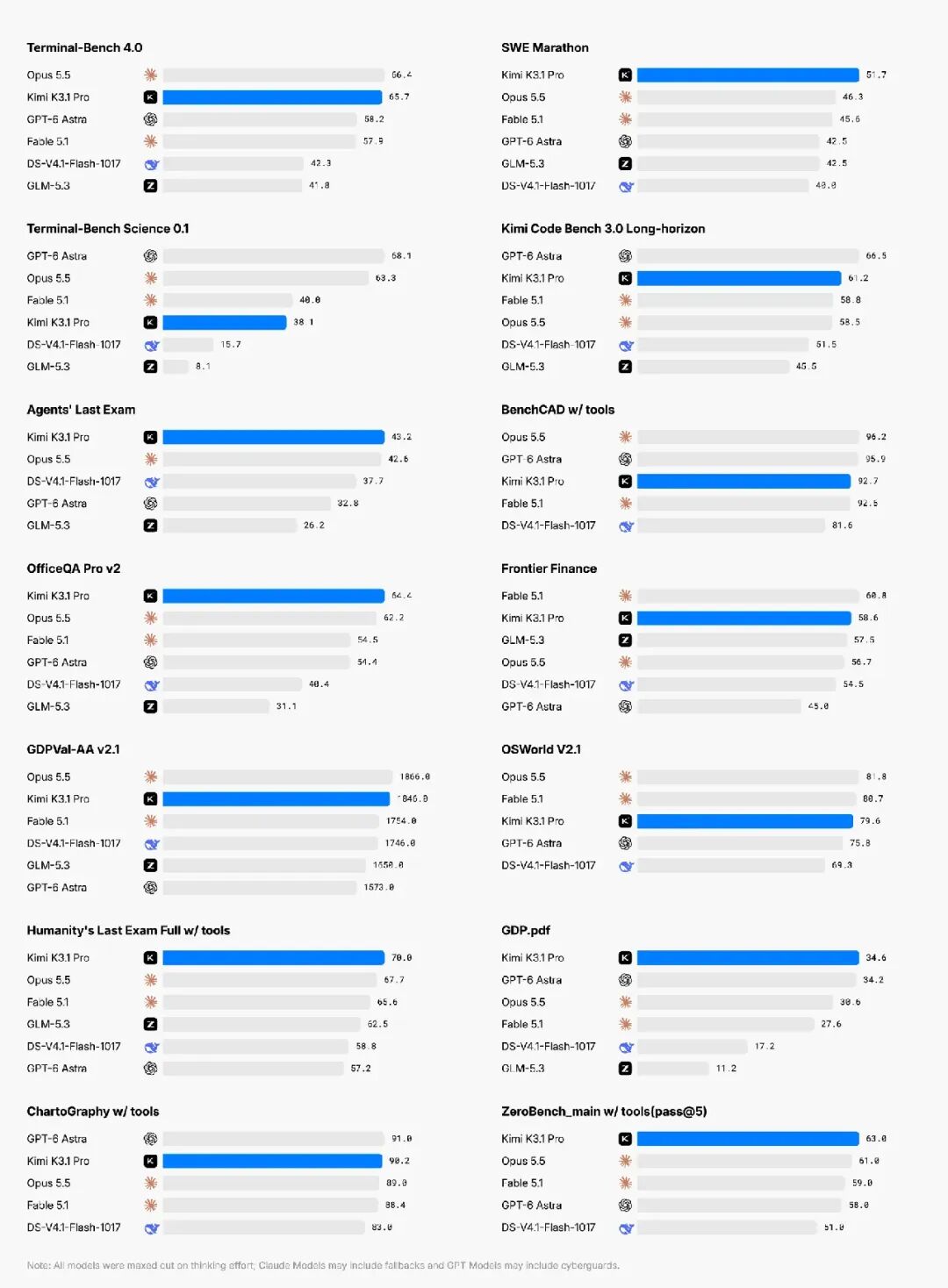
However, K3.1 Pro does not achieve synchronous improvement in all fields. Artificial Analysis data shows that Humanity's Last Exam increased from 47% to 52%, CritPt from 23% to 25%, and SciCode from 59% to 61%, with the improvement significantly smaller than the agent-related indicators. This makes some community users believe that K3.1 Pro still has obvious "uneven performance" at present: its coding, agent, front-end and 3D capabilities may be very strong, but it cannot be simply considered that all capabilities have fully caught up with the top closed-source models.
2 3D capabilities are well received, but it cannot produce high-quality 3D works with a single prompt
3D is one of the capabilities that Kimi promoted the most this time, and it has also attracted much attention from the community.
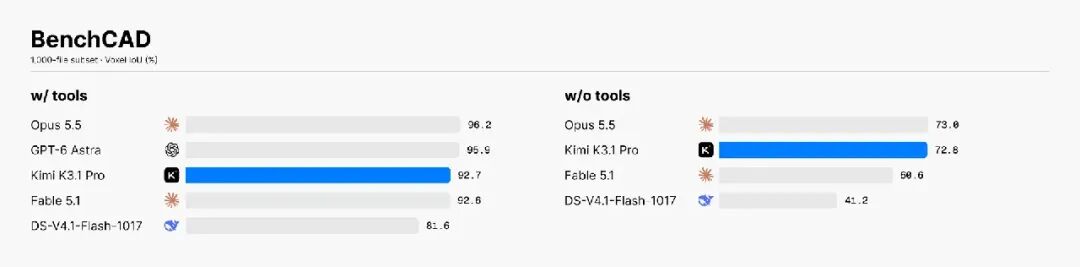
In the BenchCAD test, K3.1 Pro scored 92.7% with the help of tools, close to Claude Opus 5.5's 96.2% and GPT-6 Astra's 95.9%. BenchCAD mainly tests the model's ability to reconstruct 3D objects from rendered images of multiple perspectives. The model needs to generate CAD code, infer the shape, proportion of objects and the spatial relationship between various components.
Kimi said that users can provide K3.1 Pro with text descriptions, sketches or reference images, and let the model reconstruct an editable 3D model. It can also directly generate and run software scripts for Blender, CAD and other tools, modify specific parts, geometric structures, materials and scene layouts, without relying on additional MCP connectors.
In one official FreeCAD case, K3.1 Pro built a turbofan engine with Python, which includes fans, reduction gearboxes, compressors, combustion chambers, turbines and external pipelines, containing 2100 entities in total, and generated step-by-step assembly diagrams, internal exploded views and rotation animations of multiple rotors. In another task, the model used trimesh to design a 3D-printable table lamp composed of 5 components, whose design inspiration comes from Fujian Tulou (earth buildings).
Kimi has also integrated this capability directly into its products. At present, the "3D Make" function has been launched on kimi.com and Kimi App. Users can preview and edit models online, download them for 3D printing after completion, or export videos or live photos.
In fact, before the official release, the suspected K3.1 model codenamed "Kibitz" had already appeared on Arena, and some testers noticed that it performed prominently in 3D scenes, color selection, water surface reflection and overall composition. After the official release, developers have also begun to test it in real 3D workflows.
An AI game developer used K3.1 Pro and pi.dev Harness to generate a high-precision 3D scene of "a pelican riding a bicycle", and believed that the soon-to-be weight-open model can already produce quite good 3D effects. However, his test also revealed a gap: K3.1 Pro did not get the final result directly with one prompt, but required multiple rounds of "continue to enhance" instructions; in contrast, when he tested Claude Opus 5.5 earlier, he got a more complete finished product with one prompt.
3 Actively "cuts off" cyber attack and defense capabilities, and open weights trigger more debates
With the rapid improvement of the model's coding and agent capabilities, Kimi also devoted a lot of content this time to explaining K3.1 Pro's cybersecurity capabilities, and why it actively reduced part of the offensive security capabilities before releasing the open-weight version.
Kimi stated that in the process of expanding the post-training scale, the team observed that the model's vulnerability research capability was significantly enhanced. After further tracking, it was found that part of the cyber attack and defense data was mixed into the general corpus for mid-term training, and the reinforcement learning environment also contained corresponding tasks.
Internal experiments show that if these cyber attack and defense data are not deleted in both the mid-term training and reinforcement learning stages, the model's downstream attack capabilities will be greatly enhanced. Therefore, when preparing the open-weight version of K3.1 Pro, Kimi identified and deleted relevant cyber attack and defense data from these two training stages at the same time, while trying to retain the general capabilities required for ordinary programming.
To measure the effect, the team built the xdev-bench-hard test, which contains source code-based vulnerability discovery and exploitation tasks, covering recently publicly disclosed vulnerabilities of software such as Linux kernel, Node.js, JavaScriptCore, Exim and VirGL.
In the test, the agent needs to read the vulnerable source code, prompts and binary files, develop exploits by itself, and achieve arbitrary code execution in an isolated sandbox. If the cyber attack and defense training data is not deleted, the pass@3 of the model generated by the same training process on xdev-bench-hard can reach 90.5%, while the final released version K3.1 Pro drops to 81.0%.
According to Kimi's own evaluation, K3.1 Pro's current cyber attack and defense capabilities still lag behind the cutting-edge closed-source models that have been publicly released for at least 3 months. This directly affects Kimi's judgment on whether to release open weights. One of its principles is that it does not want an open-weight model to directly push the forefront of offensive cybersecurity capabilities; on the other hand, Kimi believes that as long as the capability diffusion speed is controlled, allowing models with dual-use capabilities to run on users' own infrastructure can also help more teams review legacy systems and code that lacks professional security audits.
In response to this, some developers believe that this is equivalent to Kimi admitting that it can train a stronger version internally, but chooses not to release it; others worry that if the model reduces security knowledge in order to reduce attack capabilities, it may instead affect its ability to discover vulnerabilities and write secure code. Other people believe that for the 3-trillion-parameter model that is about to fully open its weights, this progressive release is a realistic security compromise.
A problem that few open models needed to face before has emerged here: as open-weight models are getting closer and closer to the closed-source cutting edge, "how much capability to open" itself has become part of model design.
4 Financial research capability is improved, factual error rate drops from 23.4% to 8.3%
In addition to coding and 3D, finance is also a field where K3.1 Pro has been significantly enhanced.
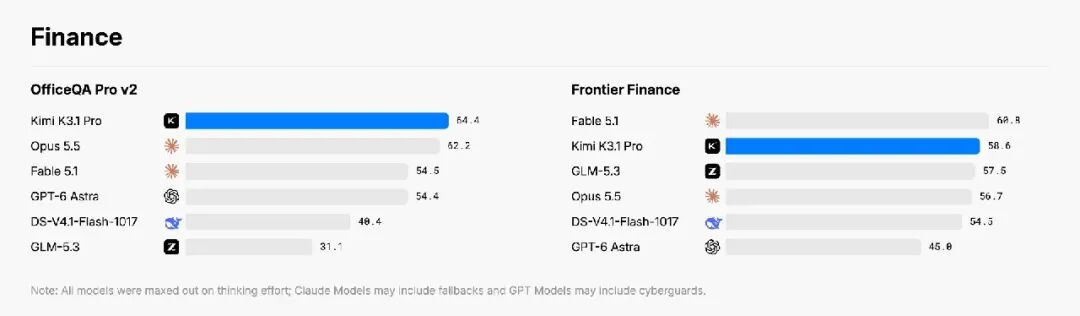
In the OfficeQA Pro v2 test, K3.1 Pro scored 64.4, achieving the current best result according to the data published by Kimi. This benchmark is designed based on real financial documents, focusing on testing the model's capabilities of information retrieval, cross-document verification and multi-step numerical reasoning. In the Frontier Finance test that measures the complete investment research process, K3.1 Pro also improved compared with K3.
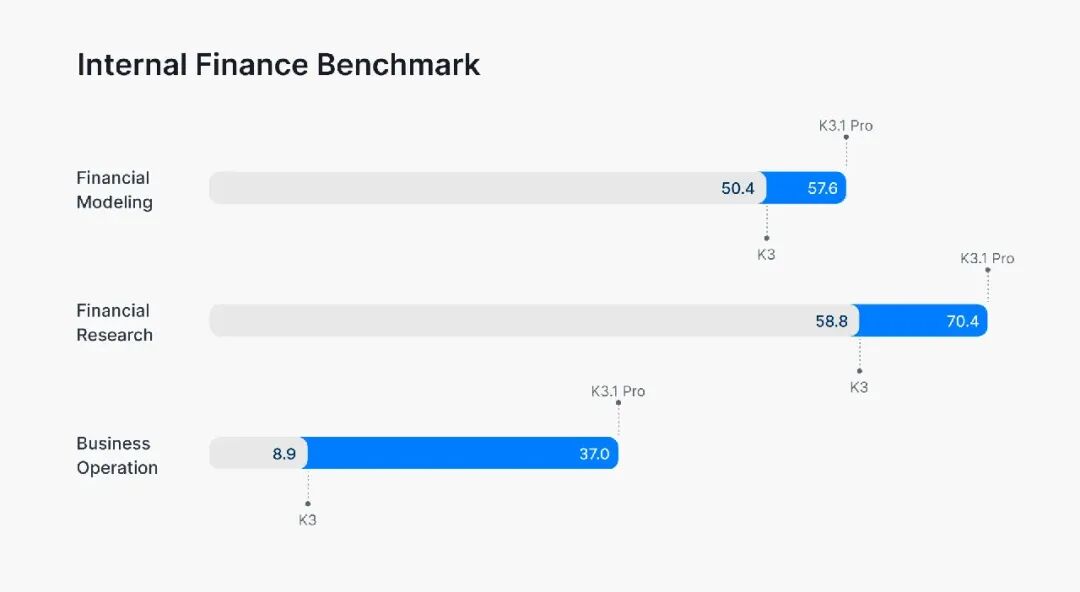
Kimi also announced the results of 3 internal financial benchmarks. Among them, K3.1 Pro improved by 14% in the Financial Modelling test compared with K3, and improved by 20% in Financial Research; in the Business Operation test that simulates enterprise operation management and decision-making, its score is about 4.2 times that of K3.
In practical cases, K3.1 Pro can end-to-end generate NVIDIA financial models, including business drivers, scenario assumptions and valuation sensitivity analysis; it can also produce investment committee reports for CATL, analyze the difference between market consensus expectations and actual operations, and form investment logic combined with financial reports, guidelines and potential catalysts.
For financial agents, the real difficulty is not just calculation, but factual accuracy. To this end, Kimi has specially optimized factual accuracy for highly difficult financial and research scenarios.
In the internal Kimi Hallu Bench Hard stress test, the single factual statement error rate of K3 was 23.4%, while K3.1 Pro dropped to 8.3%; the proportion of responses with at least one factual error dropped to about 42.4% of that of K3.
However, Kimi also emphasized that this is a stress test that specially selects samples that the model is prone to make mistakes, and the above error rate cannot represent the overall performance in ordinary usage scenarios.
5 "Quota is exhausted in a few minutes" becomes the biggest complaint
In sharp contrast to the positive feedback on capabilities is Kimi's subscription quota, which has almost become the most concentrated negative feedback in discussions.
One user said that he subscribed to the Kimi plan of 99 US dollars per month, only ran one session, did not start the agent group, and triggered the 5-hour quota limit in about 47 minutes. Another user with the 19 US dollar plan said that one task may consume the full 5-hour quota, and obviously erodes the weekly quota. Some developers directly said that no matter how strong