Will talents such as Wang Hong and Wei Dongyi also be "slaughtered" by AI?
A professor who has won the top award in the mathematics field was moved to tears by AI.
"I cried on Tuesday night and woke up my daughter."
On October 8, French mathematician Hugo Duminil-Copin shared his experience during an online conference. He is the 2022 Fields Medalist, who has long stood at the peak of mathematical research. What made him cry was a large number of mathematical research results just released by OpenAI.
Among them, 16 problems are directly related to his research.
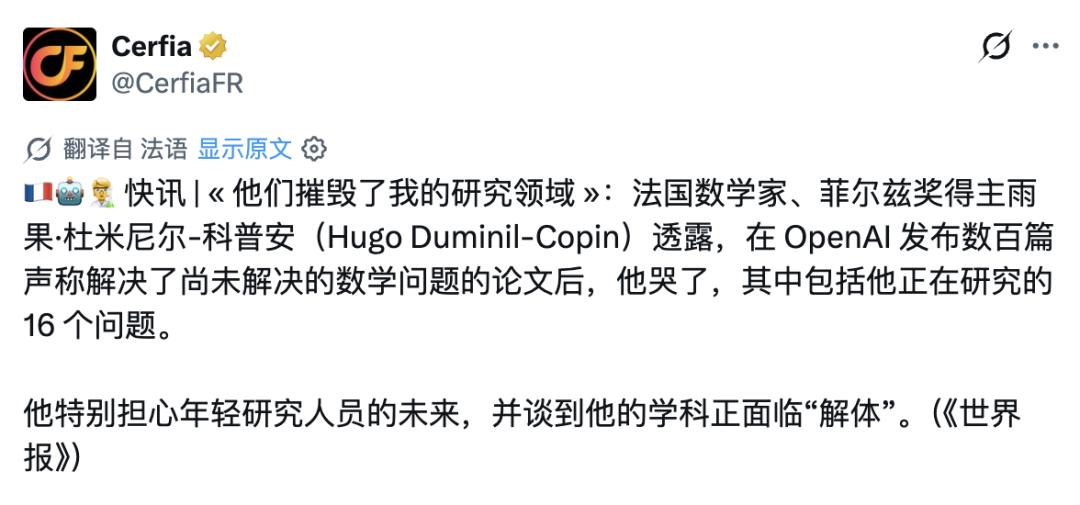
In a subsequent radio interview, he said that AI was like a bulldozer, flattening all the problems he was studying. It only took 0.1 second for people who have been working for years to empathize with the top mathematician's workplace dilemma. It is equivalent to --
You spent many years learning and accumulating, and finally found a business opportunity that could make you a fortune, when someone suddenly tells you:
This entire set of business models was implemented by AI at zero cost half a day ago.
Hugo Duminil-Copin is certainly not the only victim.
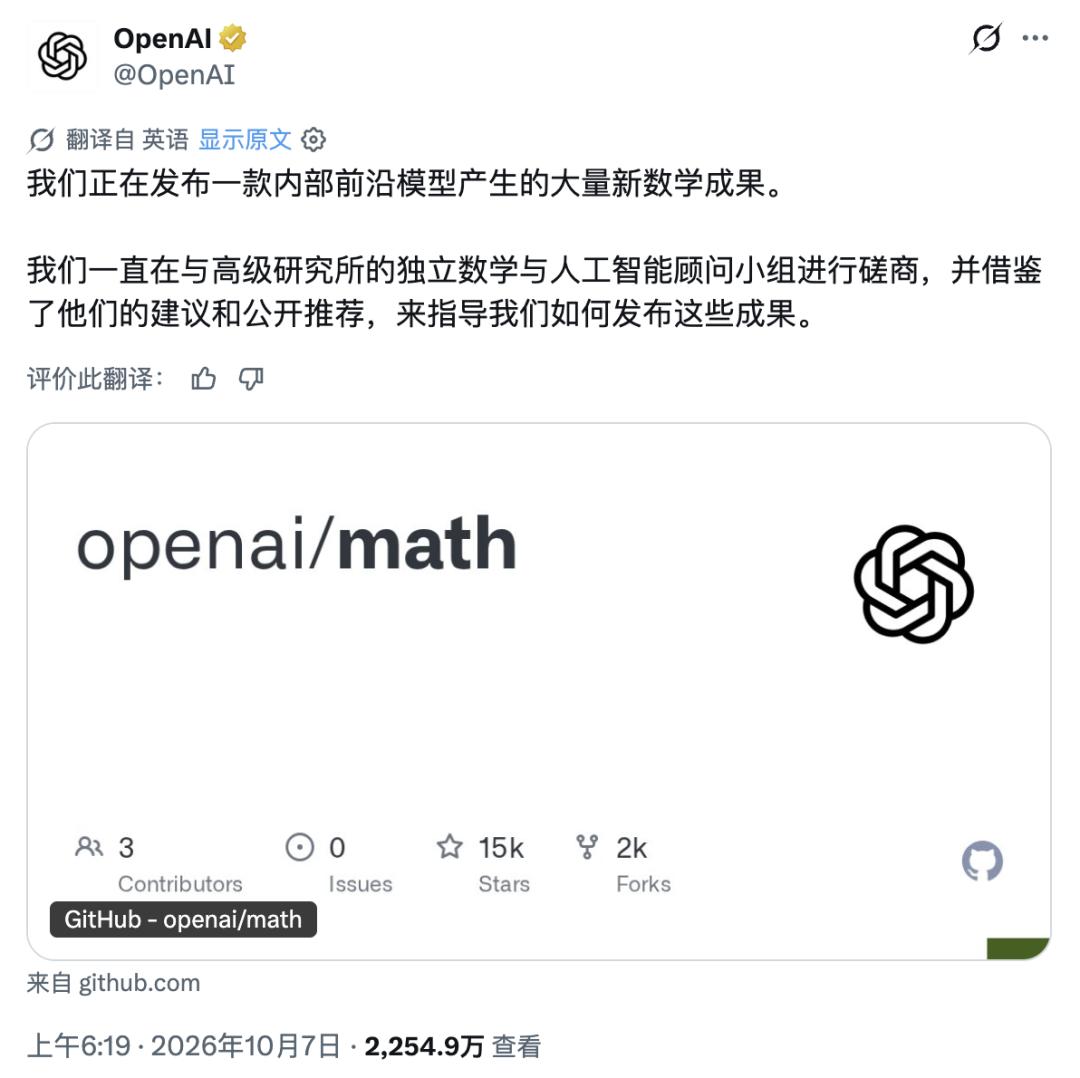
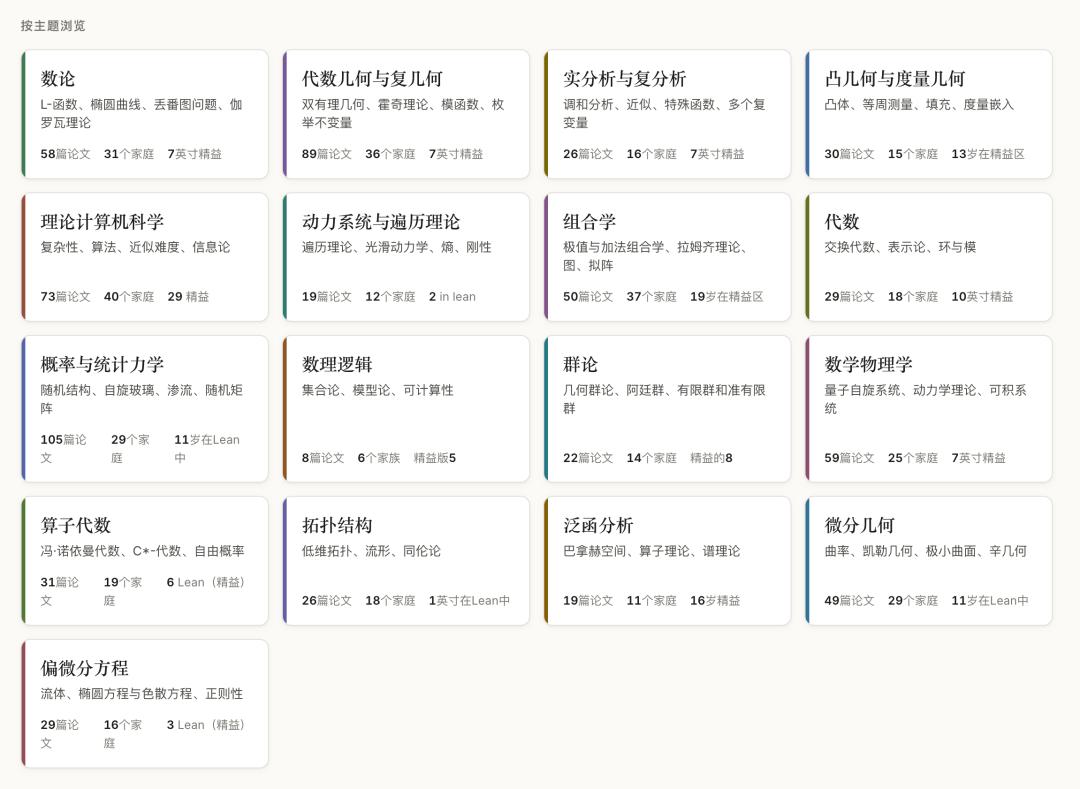
OpenAI released 722 mathematical papers at one time, involving hundreds of mathematical achievements, covering number theory, geometry, theoretical computer science and many other fields.
On the famous preprint paper platform arXiv, a person can only upload 2 papers per month. If you want to upload all these papers, you need at least more than 300 accounts.
Some of these quite difficult problems have plagued scientists for a hundred years.
For example, the Riemann Hypothesis proposed in 1859 has passed 167 years and is still unsolved. OpenAI said that it has made important progress this time and given a stronger result of "zero-free region";
Whether the Catalan's constant is an irrational number has also plagued mathematicians for more than 100 years. OpenAI said they have successfully proved that it is indeed an irrational number;
The Kakeya conjecture, for which Wang Hong won the Fields Medal this year, was proposed in 1917. It was not until 1971 that the two-dimensional proof was given, and in 2025 Wang Hong gave the three-dimensional proof. Only one year later, AI gave the four-dimensional proof.
Among the results listed this time, there are many similar heavyweight breakthroughs.
What is even more overwhelming is that OpenAI solves these mathematical problems that have plagued mankind for a hundred years extremely fast:
The average amount of computation consumed by each achievement is equivalent to 3 hours of thinking by ChatGPT Pro.
It's incredibly powerful.
01
The three AI giants are frantically snatching mathematicians' jobs
Frankly speaking, this is the closest moment ordinary people have ever been to mathematicians.
Although we still can't understand those complex formulas, ordinary people fully understand the feeling of "I have worked so hard for so many years, and suddenly I fall behind".
In the past decade or so, we stayed up late for exams and worked overtime, while mathematicians stayed up late for exams and proofs. All of us once naively hoped that our efforts would bring a stable future.
But overnight, even people standing at the top of the intellectual pyramid have their jobs taken away by AI.
Seeing this batch of papers from AI, mathematicians reacted with shock and slump, as if witnessing an atomic bomb explosion.
No matter from the quantity, breadth or breakthrough speed of the achievements, this is an unprecedented major event in the history of mathematics.
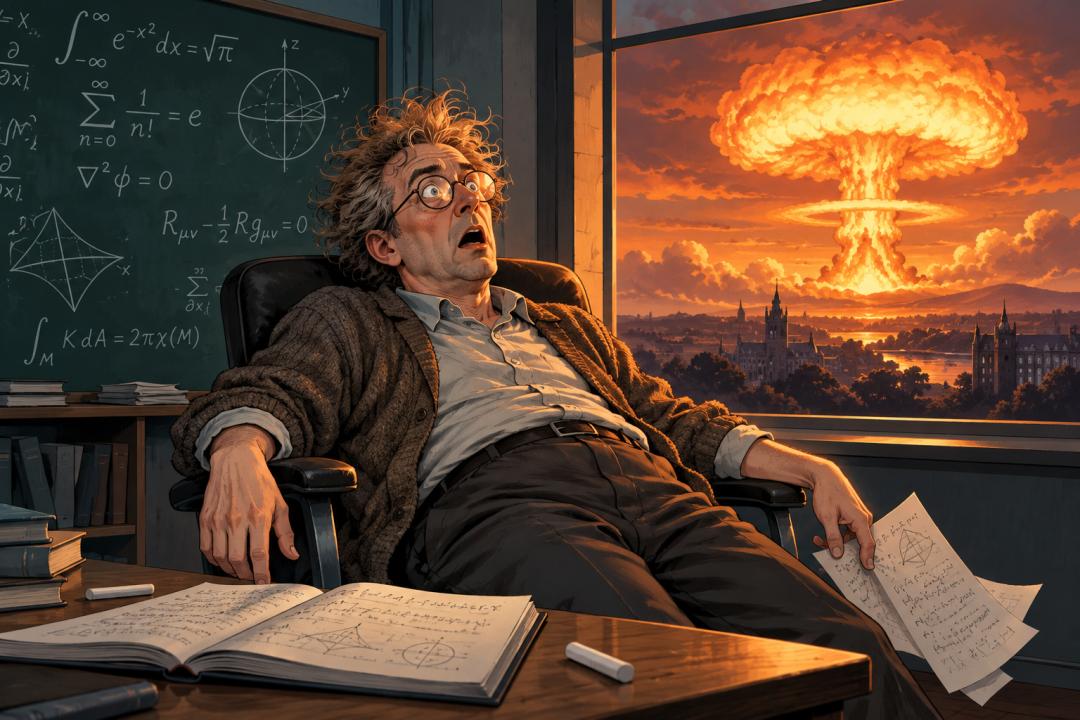
Generated by AI
Although it is said that AI stands on the shoulders of giants, the problem is that everyone stands on the shoulders of giants...
Although it is said that the research results of AI have not yet gone through peer review in the academic circle, and their reliability remains to be confirmed, this crushing of efficiency and quantity still puts almost all practitioners under great pressure.
Of course, OpenAI doesn't care about human feelings, it just keeps throwing bombs into the mathematics circle.
This round of mathematical arms race has been going on in the AI circle for some time.
The first to sound the horn was Anthropic.
On July 19, the night of the World Cup final, a researcher at Anthropic posted a tweet on X, roughly saying that he had falsified the Jacobian conjecture.
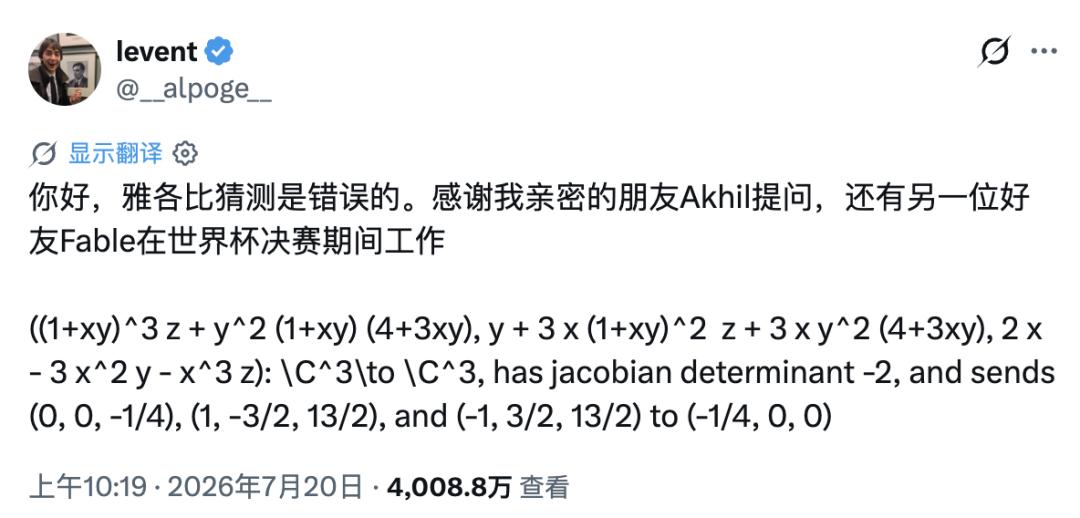
The Jacobian conjecture is no trivial matter, it is an important problem that has plagued mathematicians for more than 80 years.
The problem can be described in one sentence: If the Jacobian determinant of a polynomial mapping is a non-zero constant, then the mapping must have a polynomial inverse function.
This problem is very simple, but the answer is quite difficult. The simple puzzle has attracted countless mathematicians to get into it, and then they never got out.
In the decades of history, many mathematicians have announced that they have solved this problem, but then it was pointed out that their proofs were wrong...

Including the Chinese mathematician Zhang Yitang, many mathematicians have been tortured to develop PTSD. After tormenting mathematicians for decades, this conjecture was easily falsified in a tweet...
Competitor OpenAI refused to show weakness and also joined this mathematical "arms race".
In a few months, the mathematical problems claimed to be solved by both sides include but are not limited to:
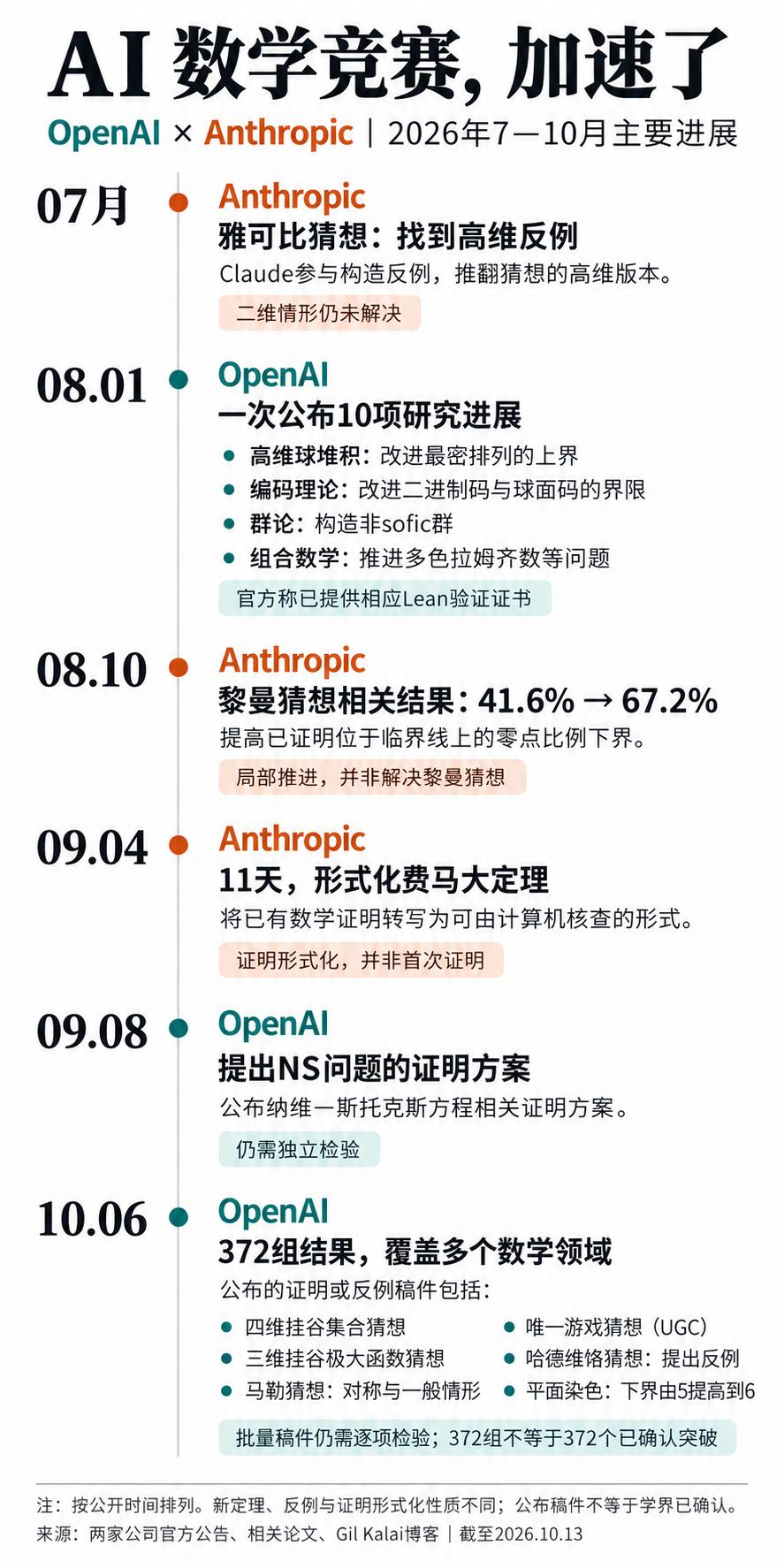
This is probably the most powerful few months in the history of mathematics.
However, being extremely powerful is not necessarily a good thing, many mathematicians have expressed deep concerns about this.
First of all, AI's unethical overtaking has put the work of many mathematicians, which they have devoted a lot of effort to, at risk of being abandoned halfway.
AI not only puts some mathematicians at risk of losing their jobs, but also makes them doubt their own abilities.
For example, OpenAI has produced a batch of results in operator algebra this time. A mathematician in the relevant field came to the conclusion after reading them:
AI is right, and humans have wasted 30 years in the wrong direction.
Some people are also facing more practical livelihood problems.
Some people find that the direction they are working on has been completely broken through, and they don't know what to do with the project funding next; others have not finished writing their papers, and it is uncertain whether they can get their degrees.
On Reddit, a PhD student who claims to study operator algebra left a message saying that he and his classmates have solved the special case of a certain problem, and discussed with their supervisor to develop the more general case into a doctoral thesis. After OpenAI announced the results, they began to rush to sort out their existing work, hoping to publish it in the form of independent research. He thinks that the topic still has research value, but the original excitement has been greatly reduced.
When grand technological progress falls on specific individuals, it always makes people sigh.
After making this big news, OpenAI CEO (Sam Altman) finally stopped being shocked and slumped, and began to look up at the stars.
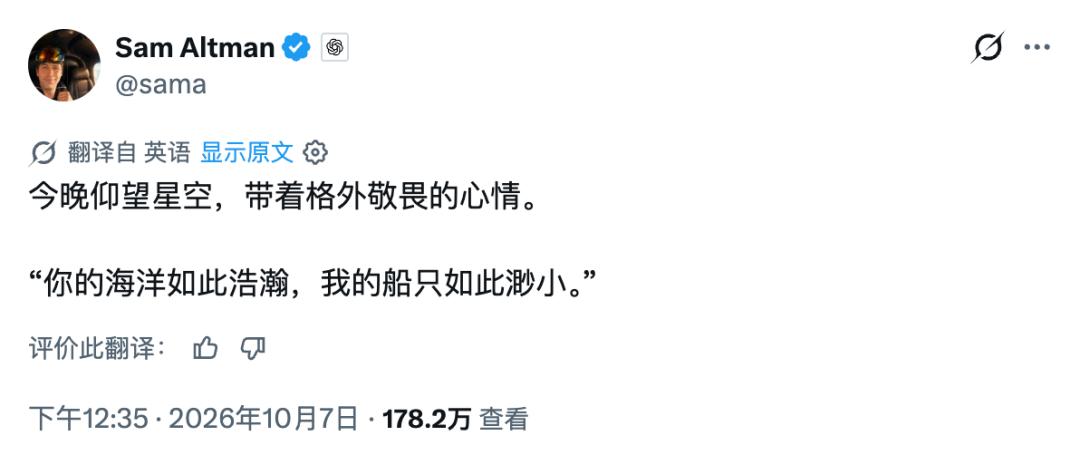
Last year, AI could not even tell which is larger between 9.8 and 9.11, but this year it can challenge the Riemann Hypothesis.
I dare not even imagine what it wants to do next year.
When Wang Hong and Deng Yu won the award, some people said that this might be the last Fields Medal awarded purely to humans.
At that time we didn't believe it, but now we have to.
02
The first batch of people replaced by AI are all top students?
So, what did mathematicians do to offend AI companies, that the latter insist on smashing their jobs?
The answer is that there is no enmity between them. On the contrary, all major large model companies are seriously recruiting mathematical talents.
After all, in the AI war, nothing is more suitable for military exercises than mathematics.
Mathematicians just happen to stand in the way of AI companies fighting for global dominance.
If you are not used by AI, you will be eliminated by AI.
Jacob Zimmerman, who won the Fields Medal together with Wang Hong and Deng Yu this year, has now joined OpenAI to participate in AI safety work.

Alpöge, who cracked the Jacobian conjecture some time ago, is his student and currently works at Anthropic.
Zimmerman once said: I do mathematics mainly because I enjoy it and I am good at it.
AI companies are frantically breaking through mathematical achievements, not because they love mathematics.
It is because mathematics has precise formal logic, which is very suitable for AI to show its capabilities. More importantly, it meets the demand of AI companies to make big news every once in a while.
In this AI competition, mathematics is the "beauty who brings disaster" pushed to the forefront. AI giants seem to attach great importance to mathematics, but in fact they are competing for technological leadership, as well as users, capital and markets behind the leading position.
The research that mathematicians regard as a lifelong career is actually just a billboard in the competitive logic of AI companies.
After all, the intensity of current AI competition is, no exaggeration, sprinting at the speed of a 100-meter race, but no one knows where the end point is.
If a company stops to catch its breath, it may be eliminated directly. It's not that you will fall behind if you don't advance, it's that progressing too slowly is equivalent to regressing.
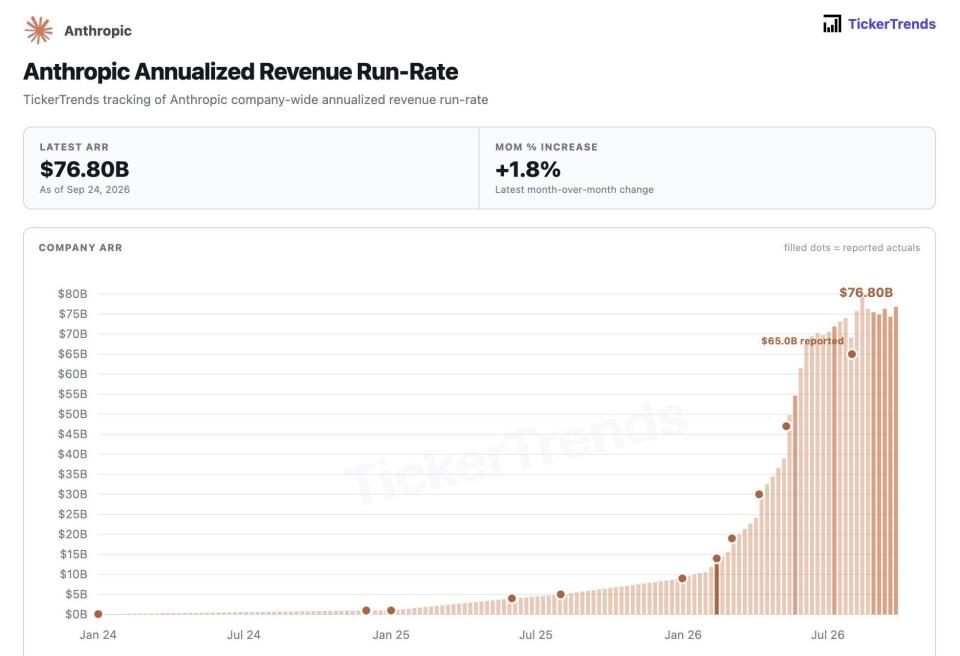
Anthropic is sprinting for an IPO
From GPT3 to GPT6, the iteration time of each major version is 3 years, 2 years and 1 year respectively, and the minor versions are even updated almost every week.
AI companies must continuously open up new tracks and continuously provide new eye-catching achievements to maintain their position in the leading group.
Google's Gemini fell behind due to one or two key versions, and was demoted by netizens as "American soybean bag", and has not been able to return to the first echelon until now.
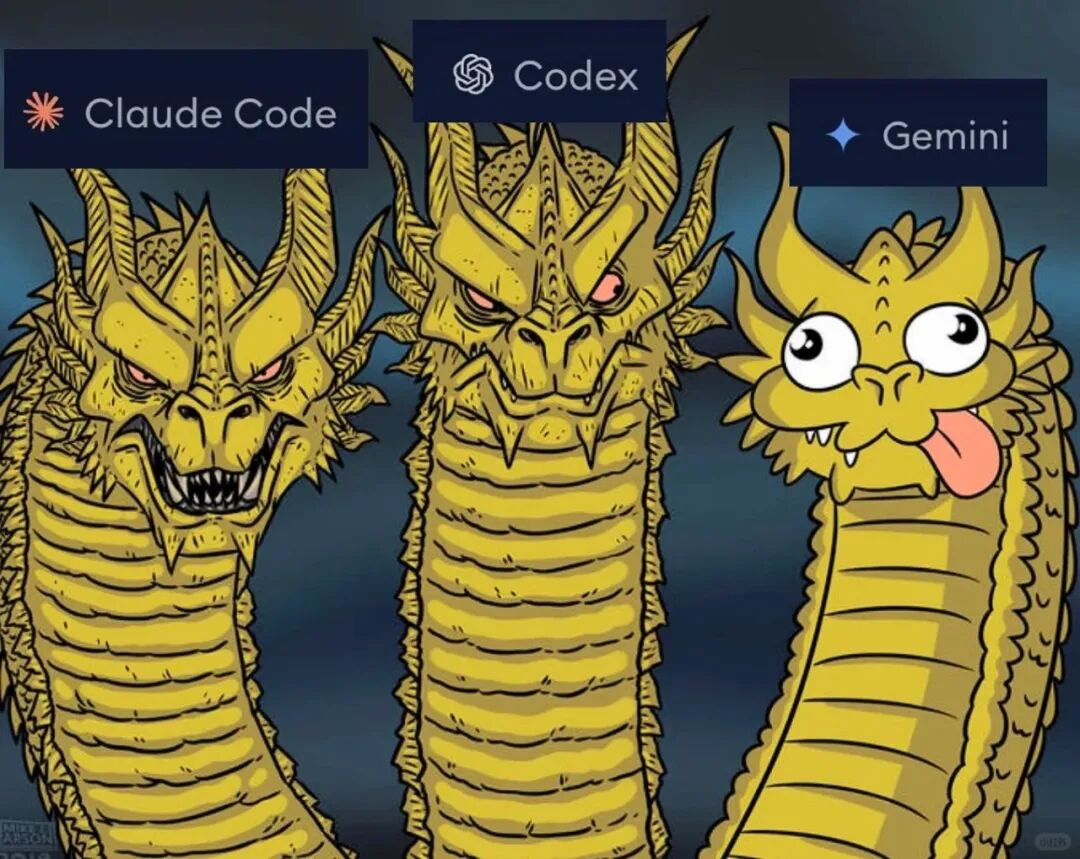
This is also why Sam Altman keeps making big news of atomic bomb explosions and shocking breakthroughs every few days; Dario, CEO of Anthropic, also keeps making mysterious and surprising announcements.
AI needs to constantly find new "Mount Everest" to prove that the next generation of models is indeed smarter than the previous one.
Mathematics is a field full of difficult problems.
Users can hardly feel intuitively when the reasoning ability increases by a few percent and the token consumption decreases by a few percent, but everyone can understand the achievement of cracking a difficult problem that has plagued mathematicians for decades.
If you don't believe it, go to the amateur science forums, 90%