We're done. Sam Altman revealed the mathematician's five-day mental journey reversal, Terence Tao: The era of heroes has stepped off the stage.
We are done. Our field is over. We have to ask graduate students to switch majors.
In an interview at Stanford Graduate School of Business, Sam Altman said that some mathematicians' first reaction after seeing AI's performance was exactly like this.
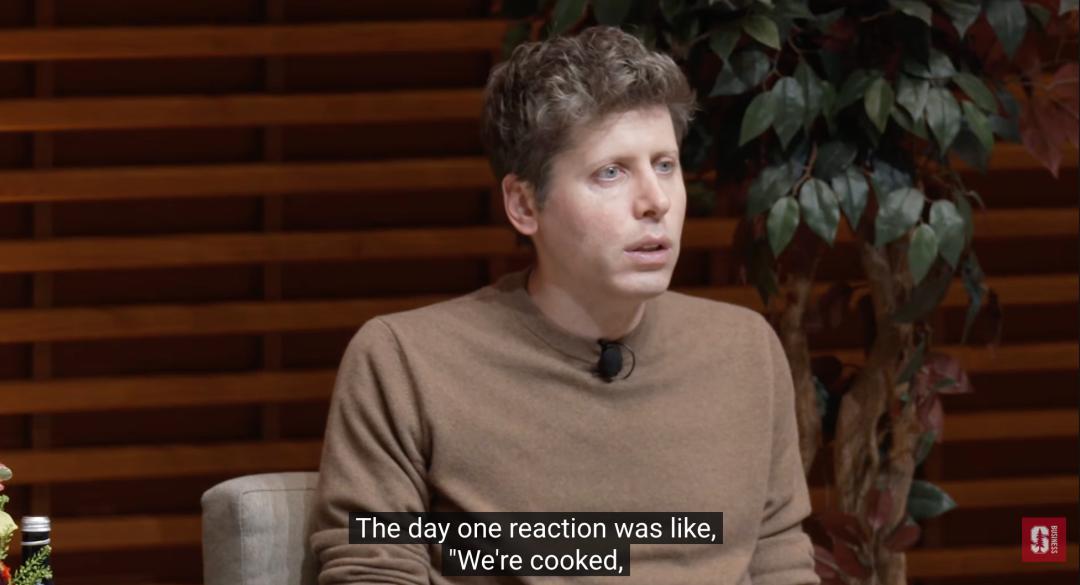
Altman recounted the reactions of some mathematicians after being impacted by AI.
On October 6, after announcing the breakthrough of the Navier-Stokes problem, OpenAI released more than 700 mathematical manuscripts in one go.
When AI starts to submit research results on a large scale, what should humans do next?
Some people can't believe it: "This is fake."
Others are full of anger, arguing that OpenAI should not have done this: if this is the price for gaining more mathematical knowledge, they would rather not have it.
But Altman found that among the feedback he heard, some people's thoughts changed roughly on the fifth day.
What happened in the process from worrying about the disappearance of the entire profession to rediscovering one's own value?
From "We Are Done", to Re-understanding Our Own Work
Altman reviewed the reactions of the mathematics community he observed in the past 10 days, saying that this process is "very interesting".
The initial reaction was disbelief: "This is fake."
On the first day, panic surged: "We are done, this field is over." They even began to persuade graduate students to change their majors.
By the third day, they were full of anger: "It's terrible for OpenAI to do this."
But around the fifth day, he began to hear other voices.
Some mathematicians re-realized that their work originally includes understanding knowledge, exchanging ideas, and explaining complex results in an easy-to-understand way.
Most people have never solved a Millennium Prize Problem, but they can still make important contributions.
After figuring this out, they began to believe:
My career as a mathematician will be different, but hopefully it will get better.
Of course, the "five-day" transformation cycle is only Altman's summary of the feedback from some mathematicians, which does not mean that the entire mathematics community has accepted the changes.
He also admitted that the model is advancing faster than expected.
In narrow fields such as mathematical reasoning, he believes that "superintelligence" has emerged.
But for people who are immersed in research every day, the feelings brought by this change are far more complex than the excitement and expectation of "superintelligence is coming" and "the singularity is arriving".
Terence Tao: The "Romantic Era" Is Fading Away
While Altman talked about new career possibilities, Terence Tao talked about what might be lost in this change.
A person spends years thinking hard and finally solves a difficult problem.
This kind of romance is being rewritten by AI.
In the Numberphile interview released on October 15, Terence Tao, the UCLA mathematics professor who obtained his doctorate at the age of 20, said that mathematics is moving from the era of individual heroic tackling of difficulties to the era of large-scale research.
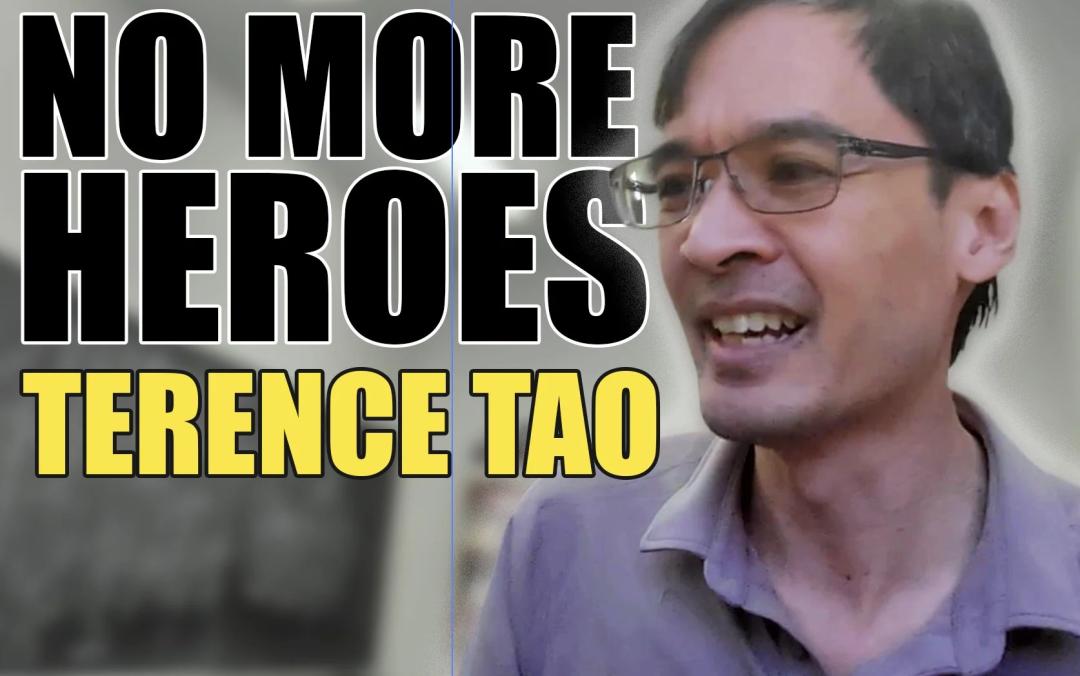
He mentioned the story of Andrew Wiles spending seven years conquering Fermat's Last Theorem.
When people are infatuated with a discipline, they will also be infatuated with the exploration process in it, and the sense of satisfaction of finally figuring it out after thinking hard.
Nowadays, AI starts to produce proofs in batches.
Researchers, in addition to finding answers by themselves, also need to spend time understanding the results delivered by machines.
In the "Math 2.0" speech, Terence Tao pointed out that the new insights and new methods obtained in the exploration process may be more important than the final answer.
Why couldn't the original path work? What limitations did the new method break through? What other problems can it be used to solve?
These gains often affect a whole subsequent field of research.
After a problem is solved, the exploration around it is not over yet.
If you only focus on "who hands in the answer first", you will easily ignore the brilliant ideas and valuable gains in the exploration process.
After Installing Automatic Doors, Do Doormen Lose Their Value?
In an interview at UCLA, Terence Tao told a metaphor about hotels.
A hotel wanted to cut costs and hired a management consultant.
The consultant thought that the doorman's job was just to open the door. So the hotel installed automatic doors and laid off all doormen.
But the consultant failed to see that doormen also help guests, call taxis, watch over the entrance, and make people feel at ease. These services also affect the guest experience.
This metaphor hits a common misunderstanding:
We are always used to using one "signature action" to summarize an entire profession.
Mathematicians solve problems, programmers write code, editors write articles.
Labels are convenient to paste, but they omit a lot of work behind them.
For mathematicians, beyond "solving problems", there are also tasks such as connecting different fields, cultivating the next generation, and teaching others how to think and solve problems.
The same is true for other professions.
After AI generates a draft, someone still needs to verify the facts, select key points, and judge what readers need to know; after AI writes a piece of code, someone still needs to confirm whether it solves the user's problem.
While output has become easier, judging what is worth doing and whether the result is useful still requires the intervention of subsequent human work.
After AI Hands in the Paper, Who Will Explain the Proof Clearly?
These follow-up tasks are exactly what Terence Tao expressed his dissatisfaction with in the interview.
In the Numberphile interview, he mentioned that one or two of OpenAI's results, at least in their current view, contain very clever new ideas.
But there are still many contents that are difficult to understand, have not been carefully checked, and there are cases where errors occur and results are withdrawn.
He said frankly that there will be good things and bad things in it, but we don't know what the proportion of each part is.
He also complained that at that time, no one from OpenAI helped them understand these materials. In his opinion, the other party seemed to think that the work was already done.
After the results are released, who will explain the key steps? Who will answer the questions of peers? After problems are found, who will follow up continuously?
When results pour in in batches, the subsequent understanding and verification cannot keep up in time, and mathematics is a little "indigested".
On October 15, the Simons Foundation announced that it will join hands with OpenAI and Anthropic to commit a total of 15 million US dollars in funds and resources to support mathematicians to test, understand and expand AI results.
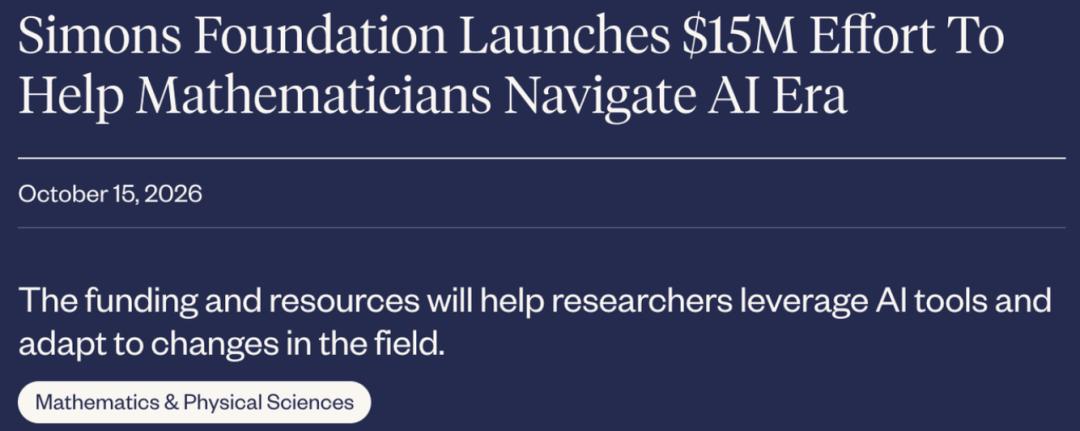
These supports can also be regarded as a response to the problem raised by Terence Tao: after AI labs release results, they still need to invest resources in subsequent verification and understanding.
Terence Tao also saw new research opportunities.
In the UCLA interview, he envisioned applying one method to tens of thousands of problems to systematically observe under what circumstances it works and where it fails.
In the past, it was very difficult to organize enough manpower to complete such exploration.
With AI, researchers may carry out large-scale research that was difficult to realize in the past.
The fascinating way of research is changing, and new possibilities are emerging.
The Smarter AI Is, the More Humans Need to Learn to Judge
Talking about what students should learn, Altman talked about his experience when he was a child.
The teacher asked him to learn writing, and he replied that he didn't want to be a writer, he wanted to be a mathematician.
The teacher told him that writing is also a tool for learning to think and organize ideas.
Even if you don't write for others to read when you grow up, this kind of training still has value.
Altman used this to emphasize that those skills that help people think are still worth learning.
This echoes Terence Tao's reminder to students: if you don't understand a discipline yet, you can't check whether AI's answers are correct.
Answers can be generated by AI, but judgment still needs to be practiced by yourself.
For students who are about to start their careers, Altman remains optimistic.
He believes that the time of the most drastic changes may also provide more opportunities for people who have ideas, motivation and master new skills.
His advice is not to only chase the directions that were popular five years ago, but to do new things.
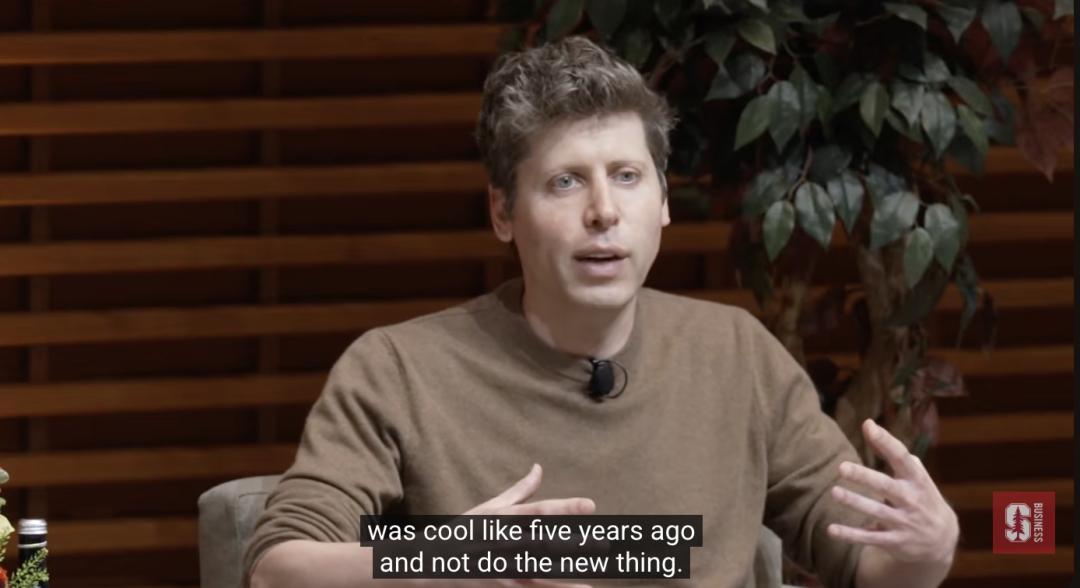
But he also admitted that a large number of work tasks and some positions will go through drastic adjustments.
From "We are done" to reorienting ourselves, the change of mindset may only take a few days.
However, figuring out how to do new work, how to evaluate contributions, and how to train new people will take much longer to explore.
The problems faced by mathematicians have now been placed in front of more people:
When AI hands in a seemingly perfect result, can you understand it, point out the problems, and decide what is worth doing next?
References:
https://www.youtube.com/watch?v=anAmTGcewX8
https://www.businessinsider.com/sam-altman-openai-mathematicians-math-disruption-navier-stokes-2026-10
https://www.businessinsider.com/math-ai-tools-openai-terence-tao-ucla-2026-10
https://www.scientificamerican.com/article/the-inside-story-behind-openais-million-dollar-math-proof/
https://www.youtube.com/watch?v=bAnwMdfcMVw&t=10s
This article is from the WeChat Official Account "AI Era" (ID: AI_era), written by Yuan Yu, and authorized for release by 36Kr.