A comment from Wang Xingxing, an AI devotee, points out that Unitree has seen a 54% increase, yet the real test lies ahead.
In recent days, Unitree has reversed its previous downward trend and risen consecutively. Its latest share price has rebounded by more than 54% in total from the intraday low of 404.3 yuan per share on October 15. Especially today, it directly hit the 20% daily limit up, closing at 624 yuan per share, and its market value once again exceeded 252.4 billion yuan.
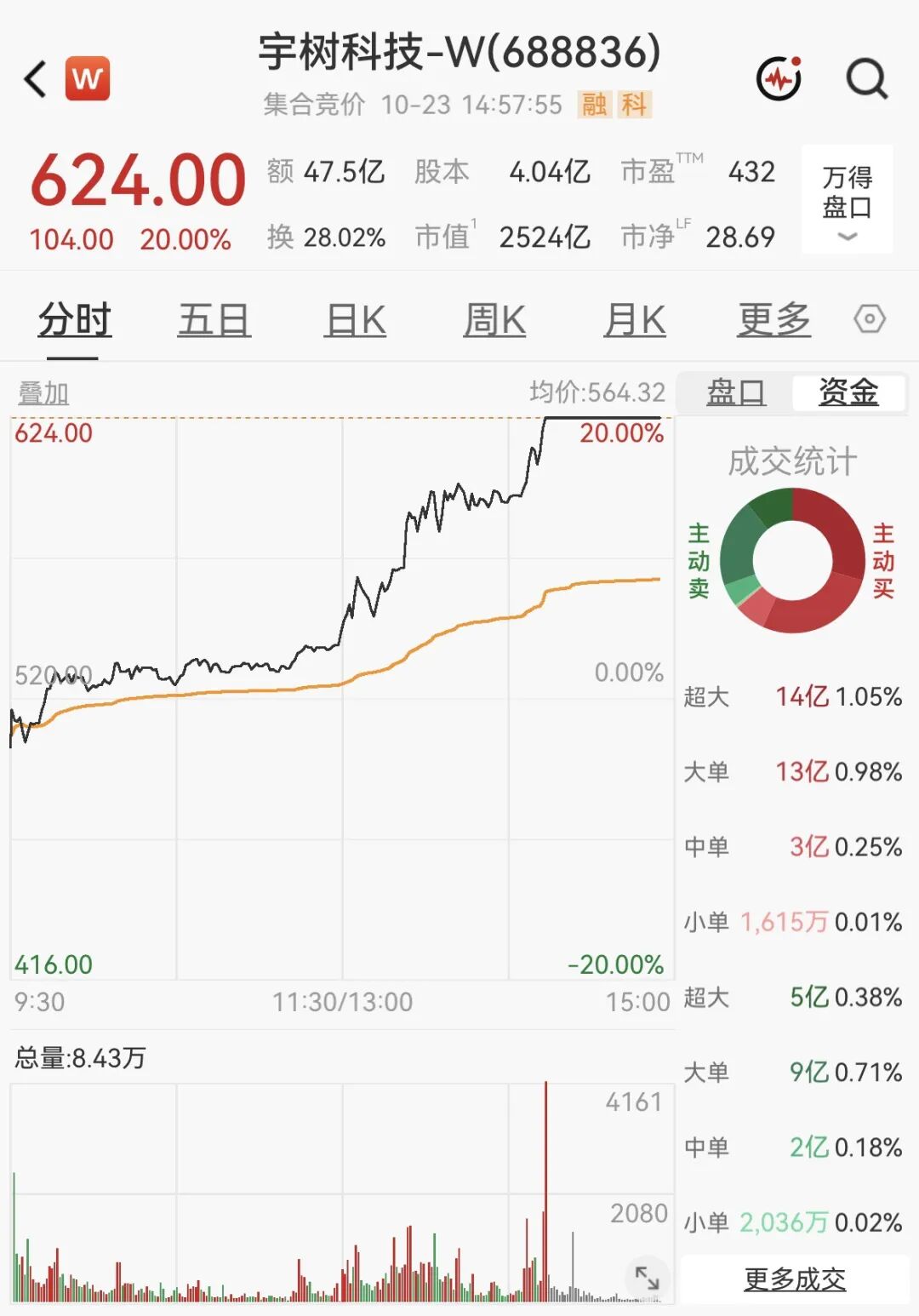
Figure | Source from Wind
Along with the sharp surge, Unitree just released its H2-X Kung Fu Legend robot positioned as a "bodyguard". In the demonstration video, it carried a car, performed flying kicks and elbow strikes, and made great progress in load capacity compared with its previous dancing form, which clearly shows that it is still trying to break through the limits of physical hardware.
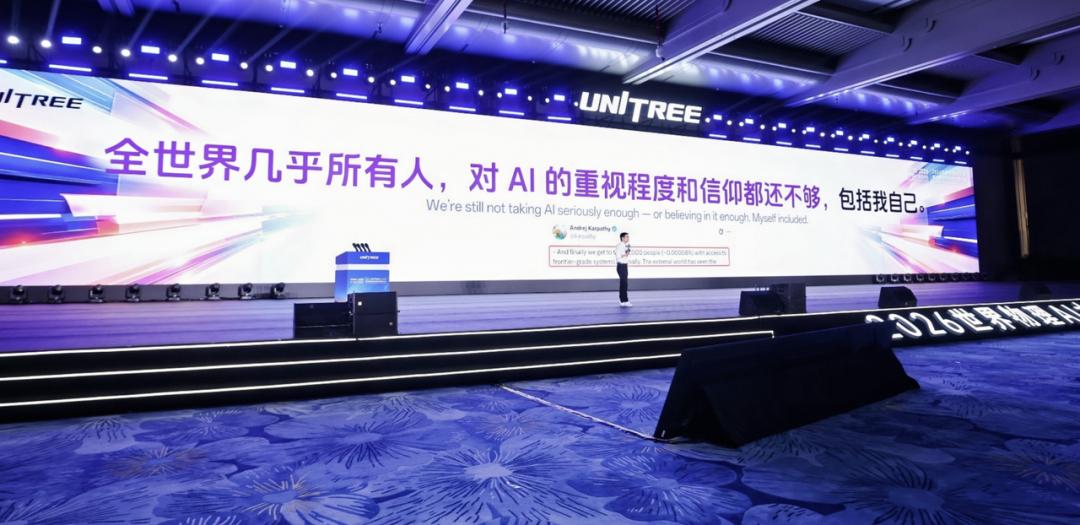
At the just-concluded 2026 World Physical AI Conference and Unitree Partner Ecosystem Conference, Wang Xingxing spent almost more than 90% of his speech talking extensively about AI.
He said, "The whole world, including myself, still does not have enough faith in AI"; "If colleagues pay more attention to AI, their value may increase tenfold or even dozens of times"; "There may be only a few thousand people who truly understand the potential of cutting-edge AI models"; "Physical AI has shown signs of being broken through, as fast as 1 to 2 years, as slow as 2 to 3 years..."
This is almost completely different from Wang Xingxing a few years ago. Since he started his business in 2016, Wang Xingxing has devoted more energy and thought to the research of hardware.
Judging from the demonstration at this conference, Unitree has been promoting the self-developed physical AI model and robot self-evolution system, but the most intuitive demonstrations on site such as painting and playing Go are mainly based on the test results of GPT-6 Astra.
The outside world may be more concerned about when Wang Xingxing, who has become a believer in AI, can finally launch Unitree's own AI capabilities. When the hardware capabilities of humanoid robots continue to improve, whether Unitree can turn self-developed AI from a technical route into a real product capability will become an important test in the next stage.
Wang Xingxing talks about AI everywhere, but where is Unitree's AI?
Unfortunately, although Wang Xingxing has repeatedly emphasized AI, there are not many solid self-developed AI achievements at the Unitree Ecosystem Conference.
In the past two days, Unitree held its first ecosystem conference in Hangzhou in the past ten years. The newly released Unitree H2-X is very eye-catching: it easily climbs over cars, its flying kicks and elbow strikes can smash dents on car doors, it lifts cars with bare hands, and jumps down from a 4-meter-high platform to land steadily. The official says its maximum battery life is 8 hours.
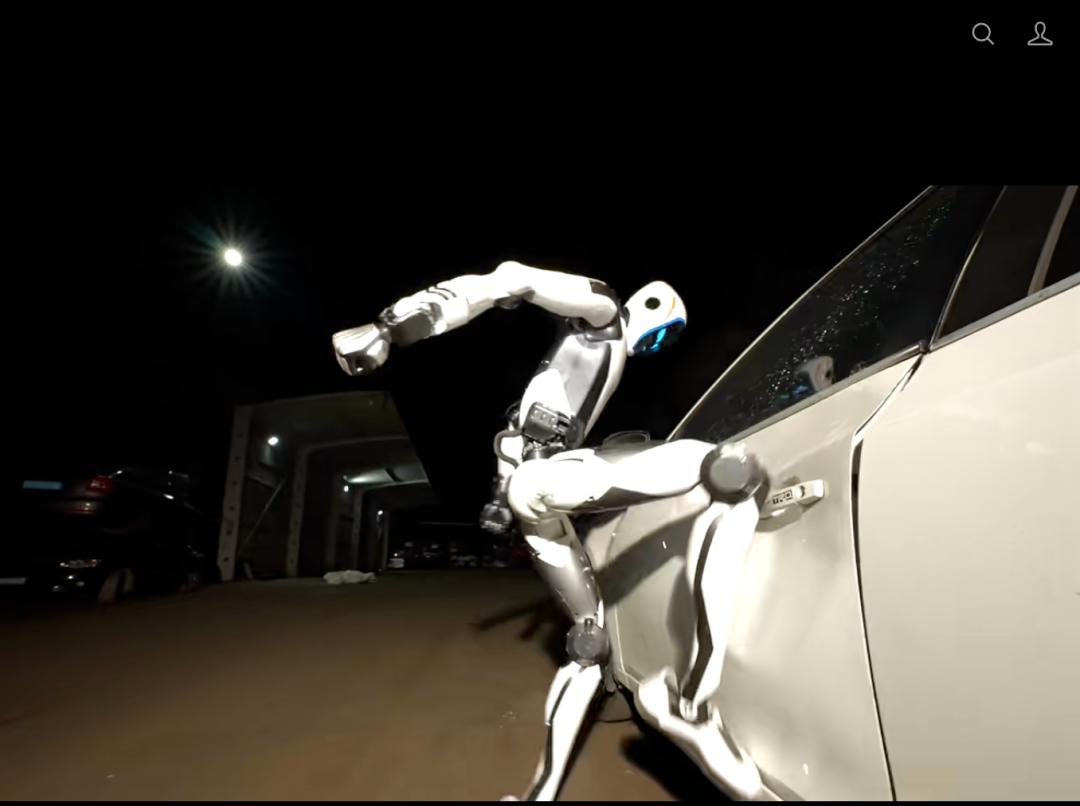
Figure | Source from Unitree official WeChat Channel
However, these actions still prove Unitree's capabilities in hardware, motion control and action choreography, rather than the AI that Wang Xingxing attaches great importance to.
The theme of the main forum of this conference is "World Physical AI Conference", and the title of Wang Xingxing's speech is "Believe, Believe in AI as Much as Possible". He almost devoted the whole speech to AI: the whole world does not have enough faith in AI, including himself; four or five years ago, he reminded his colleagues to pay attention to the stocks of leading AI companies. If they had believed at that time, their personal wealth might have increased tenfold or even dozens of times; there may be only a few thousand people who truly understand the potential of cutting-edge AI models; physical AI has shown signs of being broken through, as fast as 1 to 2 years, as slow as 2 to 3 years...
The more he emphasizes AI, the more the audience expects to see Unitree's AI achievements; but when it comes to the on-site practice, the truly presentable demonstrations do not come from Unitree's self-developed model.
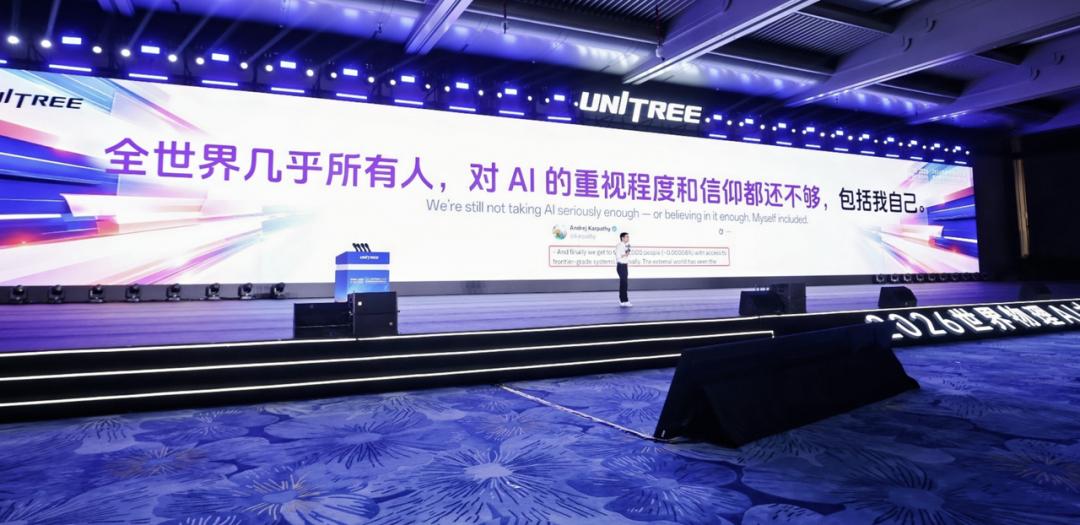
Figure | Wang Xingxing delivering a speech
First of all, Unitree does have self-developed AI products. In September, Unitree released UnifoLM-WLA-1.0, a general-purpose humanoid robot basic model. At this conference, Wang Xingxing further introduced the "Physical AI Robot Self-Evolution V1.0" which is under pre-research.
He also regards "Physical AI Robot Self-Evolution V1.0" as the most important pre-research direction this year: let AI independently search for papers, write codes, train in the simulation environment, then enter the real robot for testing, and form a continuous iterative closed loop through AI or manual scoring feedback.
But the pre-research framework is not equal to the model that has been fully operated, and the technical roadmap is not equal to the capabilities that have been implemented.
The most intuitive AI demonstration on site actually comes from GPT-6 Astra: the robot completes painting, washing brushes, changing pigments, playing Go, and indoor navigation under zero training conditions. Wang Xingxing himself also admitted that large models can already solve planning and navigation well, but they are still prone to errors when performing actual operations.
This shows that external large models can indeed drive robots to complete some tasks, but it also exposes that Unitree's self-developed model has not yet come to the forefront.
More importantly, UnifoLM-WLA-1.0 has been released for more than a month, but there is no on-site practical demonstration based on this model at this conference. What the audience sees is still the picture driven by GPT-6 Astra, while Unitree's own model still lacks solid real-world implementation.
To be precise, Unitree's AI is not non-existent, but it has not truly stepped onto the center of the stage yet.
It has built a complete framework - models, data, evaluation, and open source ecosystem are all being promoted, but there is still a gap before realizing the goal of "letting robots understand a sentence and then go to work". Wang Xingxing predicts that the "ChatGPT moment" of embodied intelligence will come as early as 2027, which means Unitree has reserved a window of more than one year to catch up.
The problem is that in this window, competitors will not stop and wait.
Hardware can be iterated continuously, but intelligence capability is the next critical barrier
Unitree's hardware advantage is real. H2-X can lift cars, perform flying kicks, jump down from a 4-meter-high platform, and has a battery life of 8 hours. Its motion control capability is in the first echelon of humanoid robots around the world.
But hardware has no barriers in China. The supply chains of motors, reducers, controllers, and lidar are already mature, and latecomers can catch up quickly through engineering iteration. If you happen to visit the 2026 World Robot Conference, many people's first impression is that humanoid robots that can sing and dance can be seen everywhere, which is by no means the unique skill of any single company.
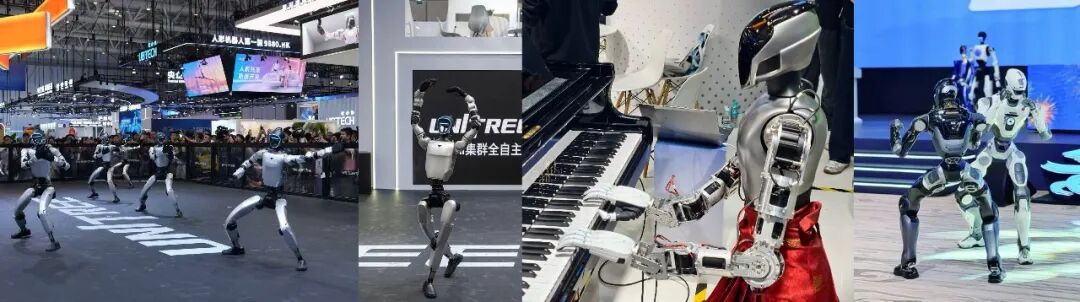
Figure | Source from the World Robot Conference, the scene is as crowded as a wet market
Therefore, it is far from enough for Unitree to maintain a certain degree of advancedness only by continuously improving hardware.
What really determines who can stay in the game is intelligence capability.
Wang Xingxing himself has made this threshold very clear. He has set a quantitative standard for the "ChatGPT moment" of embodied intelligence: completing about 80% of main tasks through natural language instructions in about 80% of unfamiliar scenarios. This standard is not low - it means that robots need to change from "demonstration products in specific scenarios" to "usable products in general environments".
The difficulty is that large models make robots better at "thinking", but doing housework is not the same as chatting.
Wang Xingxing admitted that current large models can already solve planning and navigation well, but they are still prone to errors when performing actual operations. The core bottleneck is the alignment between the input and output of the AI model and the real robot: sensor readings have deviations, joint responses have delays, and grasping force, friction, occlusion, and light changes will all bring errors.
Picking up a chess piece may not be difficult, but to assemble small parts in place, put fragile tableware safely into the dishwasher, the error of the last few millimeters may determine success or failure.
What is more troublesome is generalization. Current AI models can achieve a success rate close to 100% after full training in fixed scenarios; but as long as the position, shape of objects or the environment changes slightly, the success rate may drop significantly.
Family scenarios are exactly the most "uncooperative": the desktop is different every day, the elderly, children and pets change the space state at any time, and tasks are often vague - "tidy up the living room" sounds simple, but it includes recognition, planning, grasping, moving, obstacle avoidance, error correction and failure retry. Robots cannot only complete a wonderful demonstration once, they must succeed repeatedly in unfamiliar environments.
This is exactly where Unitree's self-developed model needs to prove its capabilities.
UnifoLM-WLA-1.0 released in September is a 6B parameter embodied multimodal large model, trained with about 2500 hours of real robot data, with a single model coordinating 64 tasks, leading open source models in multiple embodied reasoning evaluations.
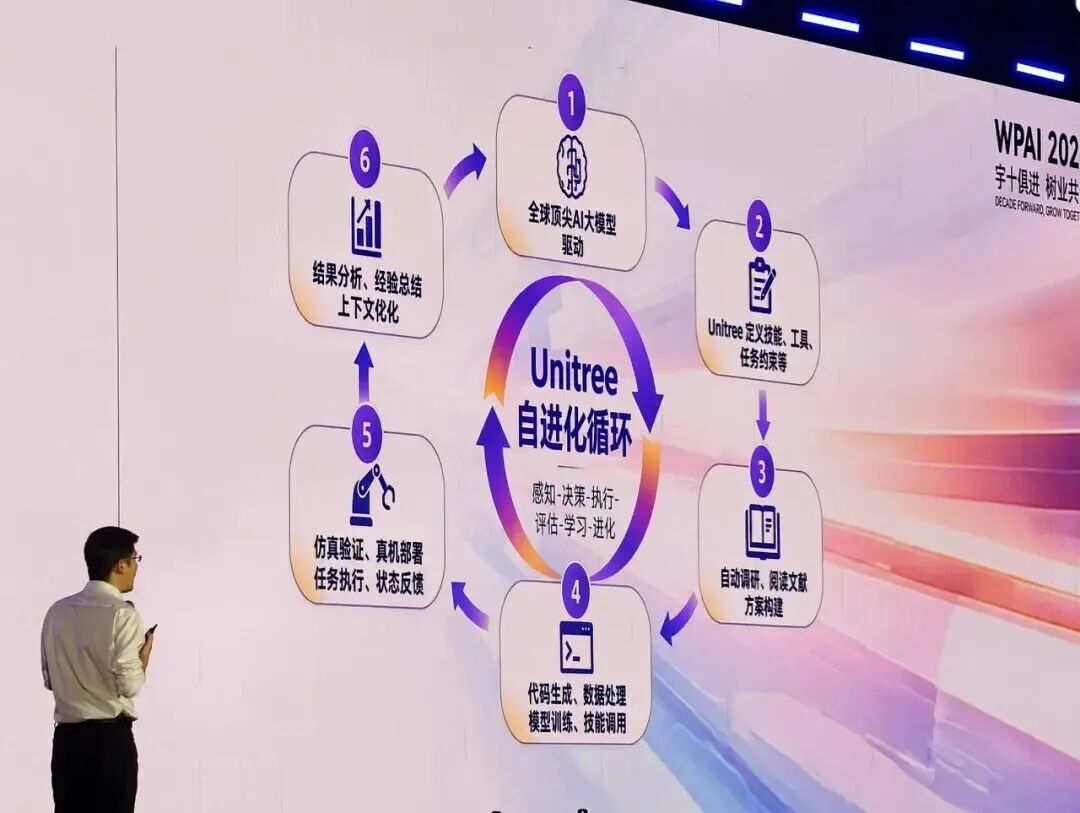
Figure | Wang Xingxing explaining the operating mechanism of Unitree's self-evolution system
But leading in evaluations does not mean being capable in actual scenarios. UnifoLM-WLA-1.0 has been released for more than a month, but there is no on-site practical demonstration based on this model at this conference. What the audience sees is still the picture driven by GPT-6 Astra.
This just shows that Unitree's self-developed model still lacks an "on-site proof". Releasing a model, proposing a technical route, and building a computing power cluster are two different things from proving the actual capability of the model. What is really worth paying attention to is whether the self-developed model can stably complete tasks on real robots, adapt to unfamiliar environments, and continuously improve according to the execution results.
The prospectus shows that Unitree's total R&D expenditure from 2023 to 2025 is about 265 million yuan. Compared with the R&D investment of AI large model companies, such funds are not in the same order of magnitude. Wang Xiaochuan once revealed that the single training cost of a trillion-parameter large model is between 30 million and 50 million yuan. Many practitioners in the embodied track also told Phoenix Tech with emotion that the investment in embodied brain is huge, with a daily consumption of millions of yuan.
Robots' capability to "perform fighting moves" has been realized, but there is still a long way to go before they can "live a normal life". For Unitree, the competition in the next stage is not only to make robots perform more amazing actions, but also to truly convert self-developed AI into the execution capability of robots.
At that time, when people evaluate a robot, they probably will no longer ask whether it can carry a car, but will ask: can it clean up the kitchen before I go out, and not scare the cat away?
This article is from WeChat official account "Phoenix Tech", author: Lu Chunfeng, published with authorization from 36Kr.