The most remarkable investment promotion of this year
Under the Lion Rock, crowds are surging.
Yesterday (October 22), the Office for Attracting Strategic Enterprises (OASES) of the Hong Kong Special Administrative Region held the 7th batch of key enterprise signing ceremony, with 18 enterprises officially settling in Hong Kong or expanding their local business presence.
"Half of the enterprises come from the Chinese mainland, and the other half from all over the world," said Paul Chan Mo-po, Financial Secretary of the Hong Kong Special Administrative Region at the signing ceremony. Well-known names including Zhiyuan, 5iVerse, Chery Automobile, Yum China and other familiar enterprises appear on the list.
So far, Hong Kong has attracted a total of 142 key enterprises, driving an investment of about 840 billion Hong Kong dollars and expected to create nearly 27,000 jobs. The investment attraction logic of Hong Kong has undergone a profound transformation from "attracting capital" to "attracting enterprises".
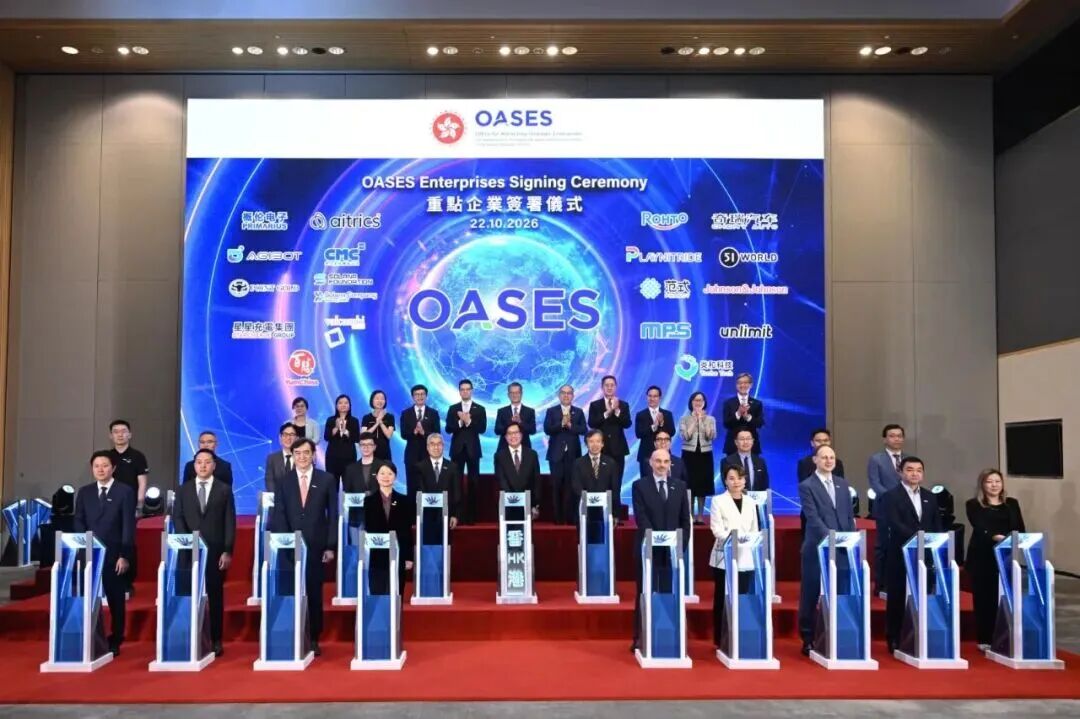
Hong Kong targets enterprises: 18 enterprises settle in the city
The full list is released —
Zhiyuan, 5iVerse, AITRICS, Chery Automobile, CMC Inc., Hunan Yanhe Technology, Core Systems (Hong Kong) Co., Ltd., Paradigm Intelligence, NDisplay Technology Corporation, Gold Point International Limited, Primarius Technologies, Rohto Pharmaceutical Co., Ltd., Star Charge Group, Unlimit, Yum China, Solana, Johnson & Johnson, Valcambi SA.
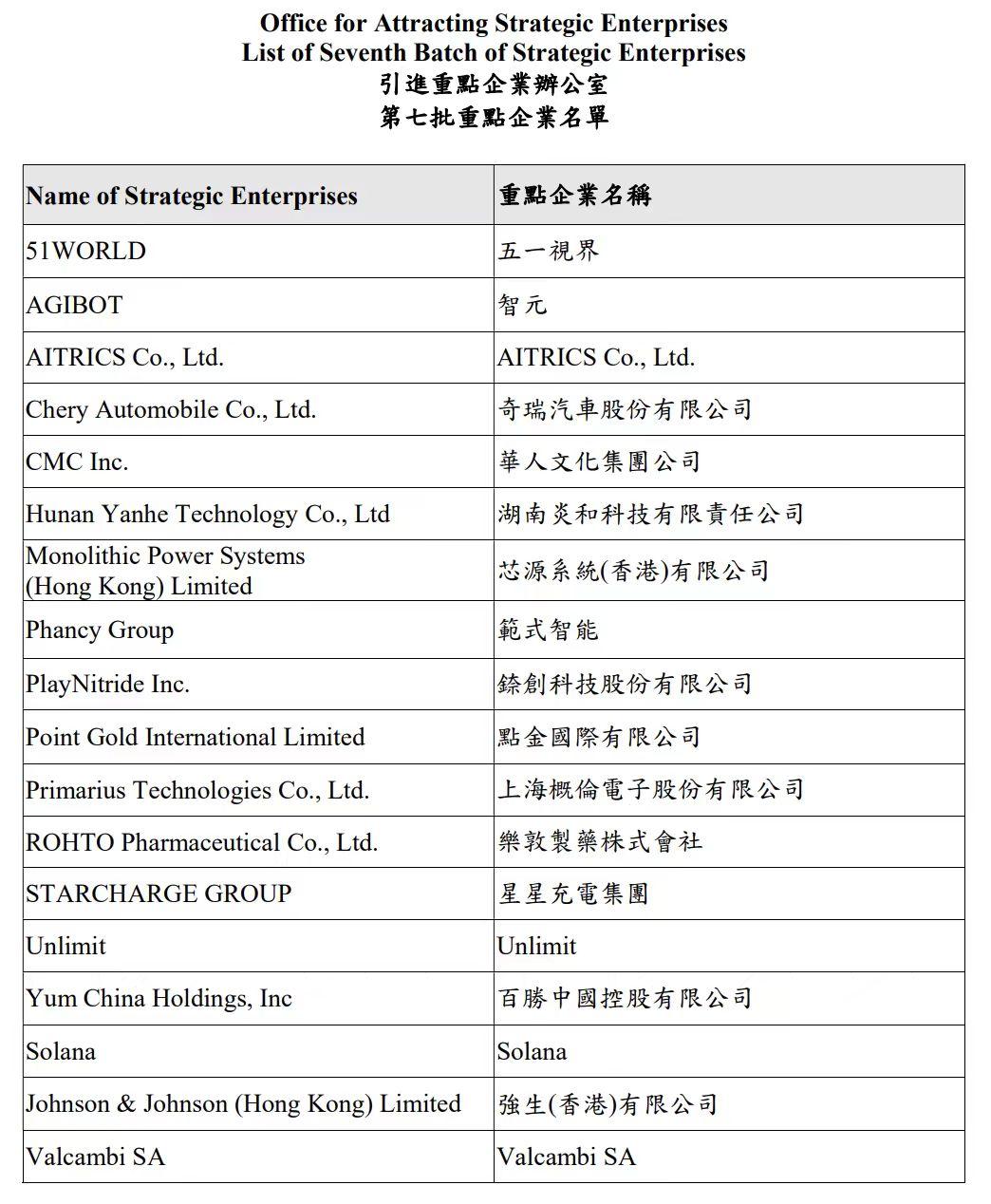
These 18 enterprises cover cutting-edge tracks including artificial intelligence and data science, fintech, advanced manufacturing, new energy, life health, and cultural and creative technology, among which the valuation or market capitalization of many enterprises has exceeded 100 billion Hong Kong dollars.
Why Hong Kong?
Peng Zhihui, co-founder of Zhiyuan, gave the answer at the signing ceremony. He said that the reason for choosing Hong Kong lies not only in its business environment, but also in its international scientific research talents and its ability to connect the industrial chain of the Guangdong-Hong Kong-Macao Greater Bay Area with the global market. "These unique advantages are highly aligned with Zhiyuan's development direction of promoting embodied intelligence technology innovation and large-scale commercial application."
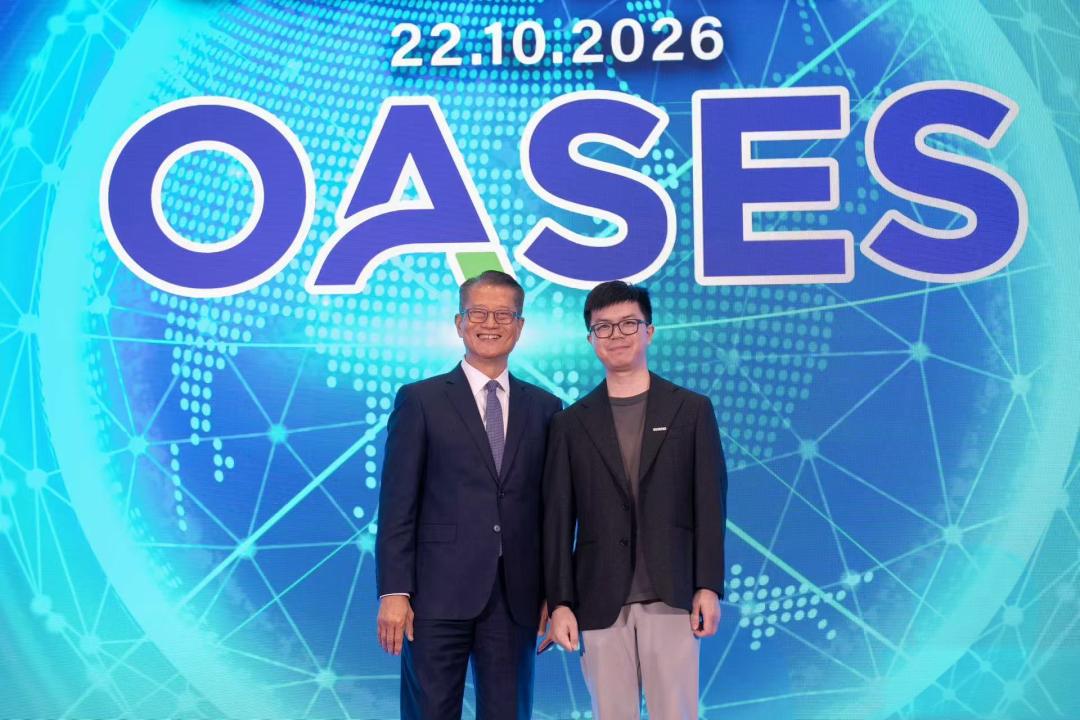
Not long ago, Zhiyuan officially opened its Hong Kong office located in Times Square, Causeway Bay, and positioned it as its "international R&D headquarters". According to the plan, Zhiyuan will invest tens of millions of yuan in Hong Kong, hold campus recruitment seminars at the Chinese University of Hong Kong, the Hong Kong University of Science and Technology, and the University of Hong Kong, and gradually expand its local Hong Kong team as R&D and business progress.
Paradigm Intelligence also values the local ecosystem. As an important participant in the enterprise-level AI field, Paradigm Intelligence has now officially been included in the OASES key enterprise list, and will work with local enterprises, partners and talent teams to promote the implementation and transformation of AI technology in specific business scenarios.
On the other side, 5iVerse completed its Hong Kong stock IPO in December last year, creating the "first physical AI stock", and has built a "dual-headquarters" layout between Qianhai, Shenzhen and Hong Kong.
"At present, more than 70% of our orders come from overseas," said Li Yi, founder of 5iVerse, when talking about the company's overseas deployment. For a hard technology company whose overseas business accounts for an absolute majority, the value of Hong Kong is self-evident.
In addition to emerging technology enterprises, the list also includes traditional manufacturing and overseas leading enterprises. Chery Automobile was listed on the Hong Kong Stock Exchange in September last year, making it the largest automotive IPO in Hong Kong that year; in April this year, it established the Chery Hong Kong Innovation Center in the Hong Kong Science Park. Star Charge Group entered the local Hong Kong charging market very early, and has now submitted its Hong Kong stock IPO application.
In addition, Primarius Technologies, a leading domestic EDA enterprise, has an office in the Hong Kong Science Park; overseas enterprises including Swiss precious metal refining giant Valcambi SA and South Korean medical AI company AITRICS also take Hong Kong as the bridgehead to enter the Asian market through this signing.
Unconsciously, a Hong Kong with deeper scientific and technological innovation thickness is emerging.
The era of Hong Kong's investment attraction
Let's go back four years.
In October 2022, John Lee Ka-chiu, Chief Executive of the Hong Kong Special Administrative Region, for the first time positioned "attracting enterprises" as a key strategy to enhance Hong Kong's competitiveness in the Policy Address, and the OASES was established under the leadership of Financial Secretary Paul Chan Mo-po, which is dedicated to introducing global high-potential and representative key innovative technology enterprises.
This move is of far-reaching significance when viewed in the historical context of Hong Kong.
In the past few decades, the core of Hong Kong's economic narrative has been finance, real estate and trade, with not very high "technology" content. The establishment of OASES means that Hong Kong has stepped out of its comfort zone and taken more initiative to pursue industrial diversification on the basis of its existing industrial foundation.
Prior to this, Hong Kong has successively introduced more than 100 technology enterprises including CATL, DJI, SmartMore, MGI Tech, Biren Technology, CloudWalk, iFLYTEK, Ant Group Digital Technologies, Xiaohongshu, Zhipu AI, WeRide, and MiniMax, almost gathering all the leading mainland players in the fields of computing power chips, large models, autonomous driving, new energy, biomedicine, low-altitude economy, and fintech.
With the two-way collaboration, the results of investment attraction are emerging. Public information shows that the performance of the first six batches of settled enterprises exceeded expectations: the total investment scale was 30% higher than the initial expectation, the number of new jobs exceeded the expectation by 34%, and these enterprises leased a total of more than 2.8 million square feet of commercial and industrial space.
Attracting enterprises is also a process of attracting talents at the same time.
The settlement of a leading enterprise is often followed by upstream and downstream partners, scientific research talents and supporting service providers, thus forming a positive cycle of "enterprises attracting enterprises, talents gathering talents".
Up to now, Hong Kong has attracted a total of 142 key enterprises, which are expected to bring about 84 billion Hong Kong dollars of investment and nearly 27,000 positions, including a large number of high-value-added R&D and management positions; the 18 newly signed enterprises alone are expected to bring more than 10 billion Hong Kong dollars of investment and create more than 1,600 high-end positions.
With the interweaving of talents and industries, a more mature scientific and technological innovation industrial ecosystem is taking shape quietly.
The flow of capital
A more profound scene is also happening: investors are coming to Hong Kong as well.
Hong Kong not only has the Hong Kong Investment Corporation with an initial management scale of 62 billion Hong Kong dollars and the "Innovation and Technology Industry Guide Fund" with a scale of 10 billion Hong Kong dollars, but also has a dense layout of Hong Kong innovation and technology venture capital funds. These capital pools attract mainland investment institutions to come to Hong Kong to obtain licenses, open offices and set up funds.
The Victoria Harbour Nexus Innovation and Technology Fund, which was officially unveiled in July this year, is a microcosm. It is the first fund established through cooperation and signing between the Hong Kong SAR Government and mainland institutions under the optimized scheme of the Innovation and Technology Venture Fund (ITVF). Shanghai State-owned Assets Investment Co., Ltd. acts as the cornerstone investor, CITIC Capital acts as the manager, Bocom International and Taiping Asset Management (Hong Kong) act as co-managers, Futeng Capital and BOC Investment serve as industry consultants, and E-Time International participates in the capital contribution together. The Innovation and Technology Venture Fund of the Hong Kong SAR Government participates as a limited partner. The total size of the fund is 600 million Hong Kong dollars.
Another equally landmark event is that Hong Kong funded 9 funds at one go in the first half of the year.
In April this year, the list of the first 9 fund managers selected in principle under the optimized scheme of the Hong Kong Innovation and Technology Venture Fund was announced — CC SIF Advisory Limited, Yunhao Asset Management Co., Ltd., CMBC International Asset Management Co., Ltd., Cowin Capital Hong Kong Asset Management Co., Ltd., Dalton Venture Hong Kong Limited, Gobi Admiralty Limited, Ss Capital Hong Kong Limited, Shuimu Huading (Hong Kong) Venture Capital Management Co., Ltd., Shuimu Asset Management Co., Ltd.
The two sides will jointly set up funds in accordance with the ratio of "3 yuan raised through market fundraising, 1 yuan matched by the government", to provide targeted support for the three major directions of artificial intelligence, life health technology, advanced manufacturing and new energy. The Hong Kong SAR Government's capital contribution to each fund ranges from 150 million to 250 million Hong Kong dollars.
With the flowing of capital, investors are flocking to Hong Kong: Chenyi Fund opened its Hong Kong office within the year and launched a new US dollar fund; the venture capital fund jointly established by CAS Star and the University of Hong Kong completed its first close; Huaying Capital listed Hong Kong as another core node after Shanghai and Beijing, and Ji Wei, founding managing partner, even said bluntly that "this is another re-startup of Huaying Capital".
"Recently, I always meet mainland investment peers on flights to Hong Kong," a Shanghai-based technology investor told us, saying that his business trips to Hong Kong have become significantly more frequent this year.
Once upon a time, there was a popular saying in Hong Kong's industrial community: "High Tech loses money, Low Tech makes money". The gist is that making high-tech products in Hong Kong will lose all your money, while engaging in industries with low technological content will make huge profits. Though it is a joke, it fully reflects the epitome of Hong Kong's past industries.
Times have changed. "Old Money fades out, New Money rises." As more and more cutting-edge technology companies are willing to set up their laboratories, overseas business and capital operation centers here, the industrial background of Hong Kong is being rewritten little by little.
This is an unprecedented industrial transformation.
This article is from the WeChat official account "Pedaily" (ID: pedaily2012), written by Zhou Jiali, authorized for release by 36Kr.