36Kr Exclusive | Metal 3D Printing Enterprise Has Completed Financing Worth Tens of Millions of Yuan, and Has Delivered Its Products to Leading Clients in the Commercial Aerospace Sector
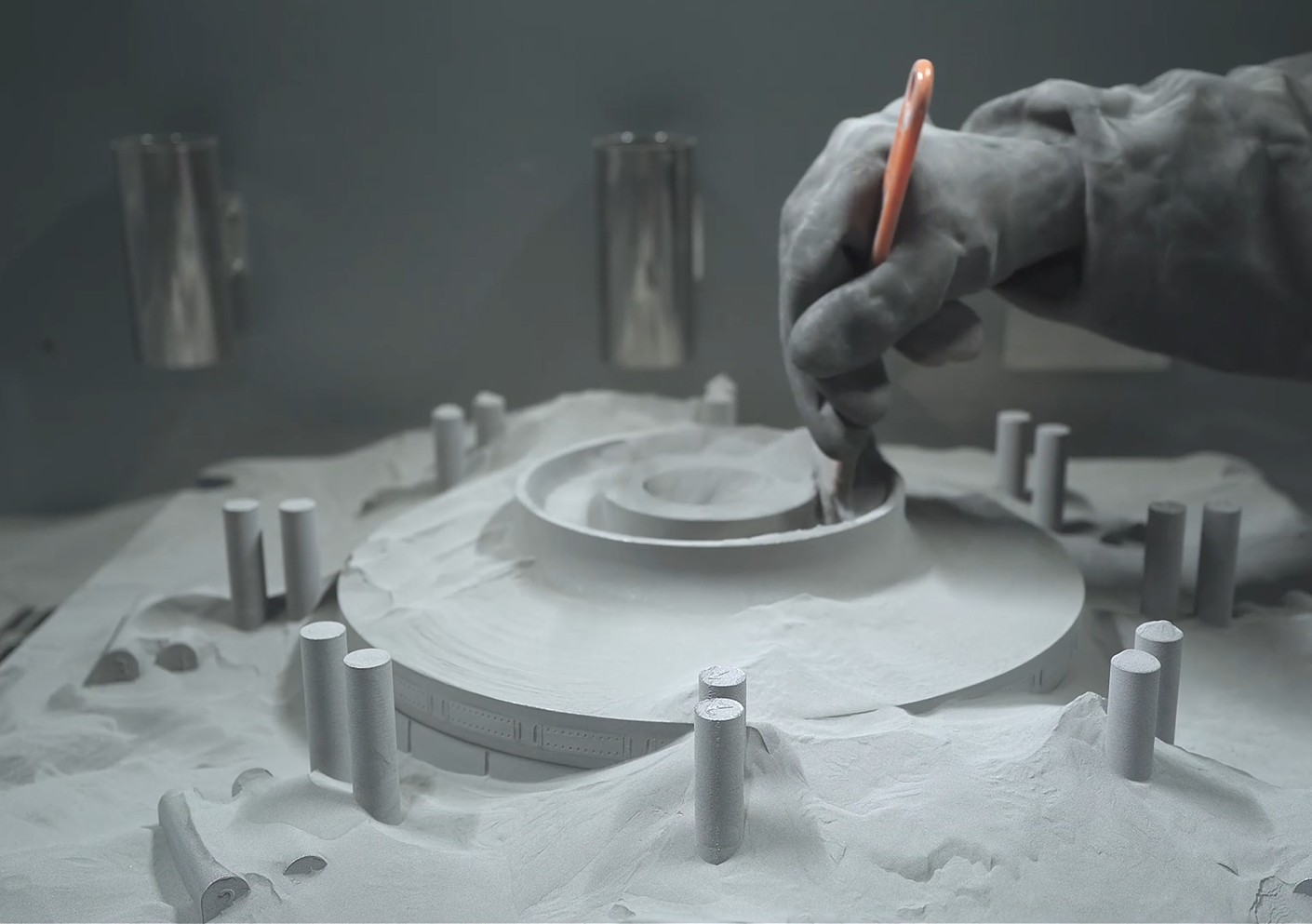
This article is about 2500 words, with an estimated reading time of 5 minutes
Author | QIAO Yujie
Editor | YUAN Silai
36Kr learned that Jiuhe Advanced Science and Technology (Beijing) Co., Ltd. (hereinafter referred to as "Jiuhe Company"), a supplier of additive manufacturing structural components and special materials, has announced the completion of a Pre-A+ round of financing of tens of millions of yuan. This round of financing was exclusively invested by Zhuzhou Beidou Spatio-temporal Industry Fund.
Founded in 2024, Jiuhe Company takes material science and technology as its core, and provides high-performance additive manufacturing (3D printing) structural components, special materials and related solutions for high-end manufacturing fields such as aerospace, nuclear fusion, low-altitude economy, and humanoid robots. Dr. XIA Tian, founder of Jiuhe Company, is a member of the Youth Expert Committee of China Additive Manufacturing Industry Alliance and a director of China Laser Manufacturing Technology and Industrial Innovation Alliance, who has long been engaged in material composition design, performance regulation, additive manufacturing industry research and investment work.
XIA Tian introduced to 36Kr that as the metal 3D printing industry gradually matures, industry demand is shifting from "being able to print" to "printing faster, better and at lower cost". Accordingly, industrial competition is also shifting from the early stage dominated by equipment and printing processes to the collaborative optimization of materials, processes and forming capabilities, and material technology is becoming a key decisive factor affecting the cost of additive manufacturing and product performance.
The full-process material processing for metal additive manufacturing includes four main links: alloy smelting, atomization powder making, 3D printing and heat treatment. The temperature, molten pool size and cooling rate of each link may affect the final performance.
XIA Tian said that 3D printing, from master alloy to powder making and then to printing, involves both slow solidification of large molten pools and rapid solidification of small molten pools, and these states appear alternately. If materials are designed only based on the rapid solidification of small molten pools during printing, problems may occur in the powder making and master alloy links; but the final structure does depend on the printing link, so the material composition design must take the whole process into account instead of optimizing a single process separately.
Focusing on this problem, Jiuhe Company combines material design with process forming control.
On the material side, the company can establish a correlation model between element distribution, phase structure, crack sensitivity and mechanical properties based on the characteristics of rapid solidification of tiny molten pools, and carry out multi-objective optimization of alloy composition with the help of AI-enhanced material calculation technology. Subsequently, the target composition is gradually verified and determined through small-batch experimental preparation and performance characterization.
In terms of microstructure and performance regulation, the company can predict the microstructure state of powder particles, laser molten pool and final components by combining the characteristics of the material itself and the grain and phase characteristics in additive manufacturing, and then make the internal microstructure of the material better match the final application requirements through powder microstructure design, solidification microstructure regulation, and optimization of hot isostatic pressing and heat treatment processes.
Aiming at the common cracking problem in metal 3D printing, the low-cost high-strength printable aluminum alloy developed by Jiuhe Company can balance strength and low cost without rare earth elements, achieve a yield strength of over 500MPa, and the material price is only more than 100 yuan per kilogram. Its technical idea is to design special in-situ self-generated nanoparticles in the aluminum alloy, and through process control, these nanoparticles can stably exist in molten aluminum for tens of minutes to about one hour. Based on this, the company coordinates the process time of smelting, powder making and other links to ensure that the material can improve the microstructure state and reduce the cracking risk through the dissolution and re-precipitation of nanoparticles during the printing process.
In addition to material design, Jiuhe Company also takes process forming control as another core competence. The company constructs a cross-scale simulation model between microstructure, molten pool structure and component performance to predict and optimize printing parameters, so as to reduce defects such as pores and cracks; at the same time, it uses stress control and anti-deformation technology to adjust the internal residual stress of components and its distribution, improve the final forming accuracy, and meet the requirements of high-end manufacturing for complex components through fine structure printing and integral manufacturing technology for complex structures.
In the field of commercial aerospace, these capabilities have been applied to many types of key structural components.
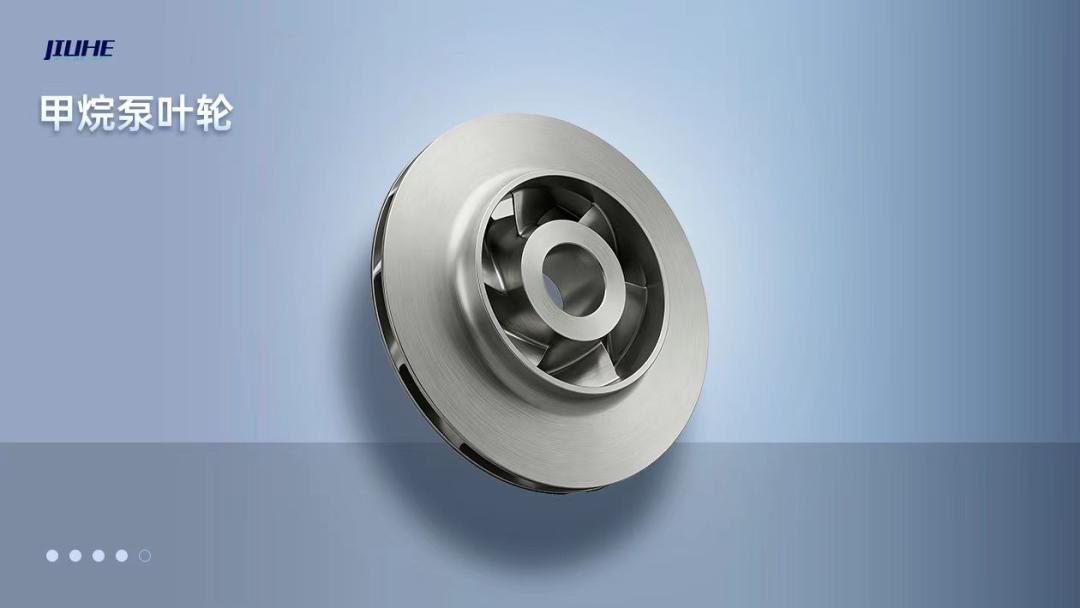
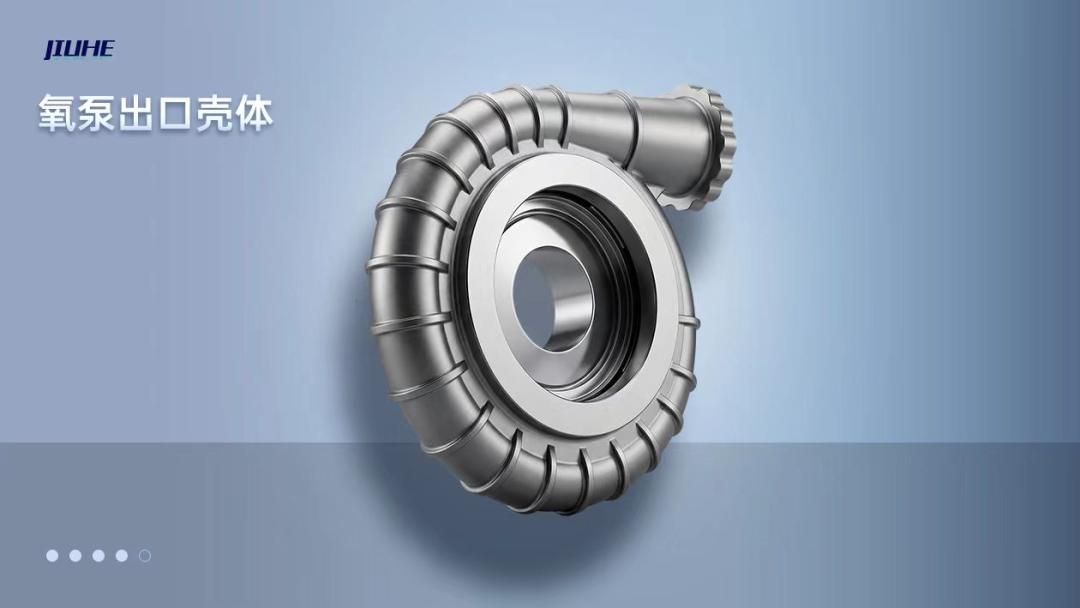
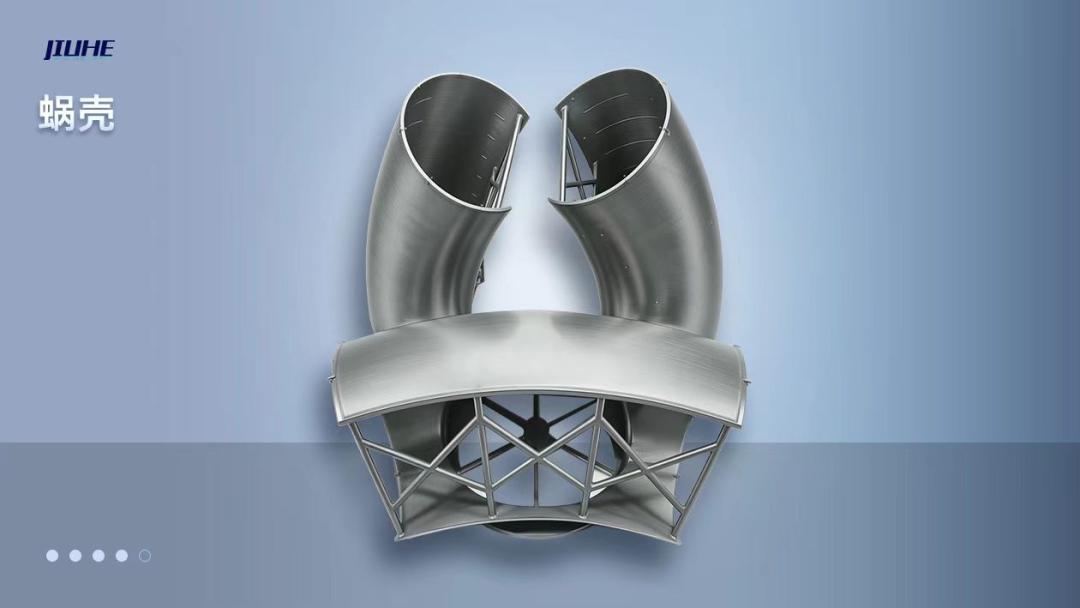
In terms of the turbine pump casing of liquid rocket engines, Jiuhe Company adopts integral forming technology, and controls the stress distribution and forming accuracy of components through a low-stress forming scheme. For the closed impeller of liquid rocket engines, the company realizes support-free printing, no support structure needs to be set inside the flow channel, and the support amount is 96% less than that of the conventional forming scheme. The company also stated that by regulating the material microstructure, the product eliminates unfavorable microstructure features such as acicular phase, and the elongation after fracture at low temperature (-196℃) is increased by about 50%, meeting the relevant index requirements.
(Source: the enterprise)
(Source: the enterprise)
(Source: the enterprise)
In addition, the company's Hall thruster pressure and flow regulator has been put into orbit operation. Aiming at the fine flow channels inside such parts, the company has developed a fine flow channel polishing technology, which can process flow channels as thin as 1mm and control the inner diameter size within ±0.1mm.
At present, Jiuhe Company has completed verification from leading customers in the commercial aerospace field, and has become the exclusive supplier of some key products for several leading commercial aerospace enterprises. In the future, the company plans to further expand into low-altitude economy, nuclear fusion, humanoid robots and other fields, and provide key structural components and material solutions for related scenarios.
The following is the Q&A with the founder:
36Kr: The company mentioned that it is developing an additive manufacturing AI agent. What specific role does it play in material design and product manufacturing?
XIA Tian: In the process of material R&D, we will accumulate a large amount of data, including the internal microstructure of materials, mechanical properties, as well as experimental and manufacturing data under different process conditions. These data can provide the basis for AI models. We hope that in the future, based on the accumulated material and process data, AI can realize printing parameter optimization close to the molten pool level, so as to achieve the purpose of improving performance and reducing cost. On the other hand, in the process of product manufacturing and delivery, we will also test the chemical composition, mechanical properties and deformation of each part. These test data can continuously revise the model, help us understand the relationship between material properties and processes more accurately, and realize rapid R&D of new alloy materials and determination of process parameters.
36Kr: The structural components delivered by the company in the commercial aerospace field have high performance indicators. Compared with other additive manufacturing enterprises, what is the core advantage of Jiuhe Advanced?
XIA Tian: I think there are three main aspects.
The first is the integral forming capability of complex structures. Compared with traditional casting, 3D printing has reduced a lot of welding requirements, but some parts with particularly complex structures still need to be printed separately and then welded. We hope to avoid welding as much as possible, so that the parts can be integrally formed, thus reducing the limitations brought by the connection links.
The second is the shape control capability of large-size thin-walled parts. Traditional machining mainly relies on equipment accuracy to ensure dimensions, but 3D printing involves material melting and re-solidification, and equipment accuracy is only one of the factors. How the material forms internal stress during solidification and how the stress is distributed will affect the final dimensional accuracy of the part.
Our ability to control the microstructure of materials helps us better control these variables. In the key dimensions of some large-size parts, we have achieved accuracy improvement through actual cases, and in some cases, the improvement can reach several times or even one to two orders of magnitude.
The third is the printing capability of complex parts that balances efficiency and accuracy. Some precision parts have high requirements for fine structure and surface quality. Although using finer powder and smaller printing spot can improve the accuracy, the printing efficiency will also decrease significantly. For fields such as commercial aerospace that need to balance cost and delivery efficiency, we can achieve relatively precise forming without significantly sacrificing printing efficiency, and truly deliver such parts to customers.
These three capabilities appear to be process advantages on the surface, but they are inseparable from material technology behind. Only by understanding the complex changes of materials in the process of melting, solidification and heat treatment, and being able to control the internal microstructure and stress distribution of materials, can we further control the final shape, size and performance of parts. For us, material design is not an independent process before printing, but the foundation running through the whole additive manufacturing process.