Wang Xingxing from Unitree: Physical AI will achieve breakthroughs in the next two to three years, and I am extremely afraid of wasting every single day.
Author | Qiu Xiaofen
Editor | Yuan Silai
On October 22, Unitree Robotics held the "2026 World Physical AI Conference & Unitree Partner Ecosystem Conference" in Hangzhou, which is also the first ecosystem partner conference hosted by Unitree in the ten years since its establishment.
At the conference, founder Wang Xingxing delivered a speech titled Believe, Trust AI as Much as Possible, sharing his judgments on the development of AI technology, Unitree's technical roadmap, and the future of the robotics industry.
"Almost people all over the world do not attach enough importance to and have insufficient faith in AI, including myself," Wang Xingxing said. In his view, even though AI has become the most concerned technical direction worldwide, people still lack sufficient understanding of its development speed and potential impact.
He cited an interesting case. As early as four or five years ago, he had recommended some AI-related stocks to his colleagues in the company. "If we had trusted AI more a few years ago, the personal wealth of some Unitree employees might have increased tenfold or even dozens of times."
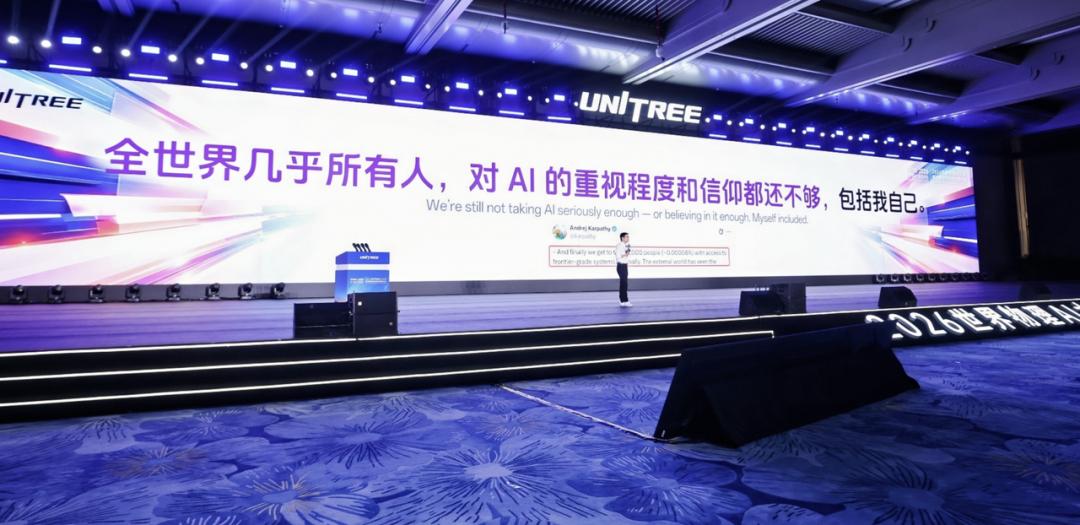
Wang Xingxing delivering the speech
However, why have ordinary people not felt much change despite the rapid development of AI technology? Wang Xingxing believes that it usually takes five to ten years for a technology to go from breakthrough to real popularization.
He took the Internet as an example: from the Internet bubble around 2000 to the gradual popularization of applications such as e-commerce around 2010, the whole process took nearly ten years. Therefore, it also takes time for the most advanced AI models to truly enter the lives of ordinary people.
But in his opinion, this does not prevent AI from bringing huge changes in the end. So he keeps thinking about an ultimate question every day: If AI will subvert everyone's life, what on earth are the most important opportunities among them?
As the founder of a robotics company, he believes that opportunities lie in physical AI. Wang Xingxing even put forward a rather radical judgment: with the rapid improvement of the capabilities of general large models, physical AI may usher in major breakthroughs in the next one to three years. "If everything goes well, it will take one to two years, otherwise it will take two to three years".
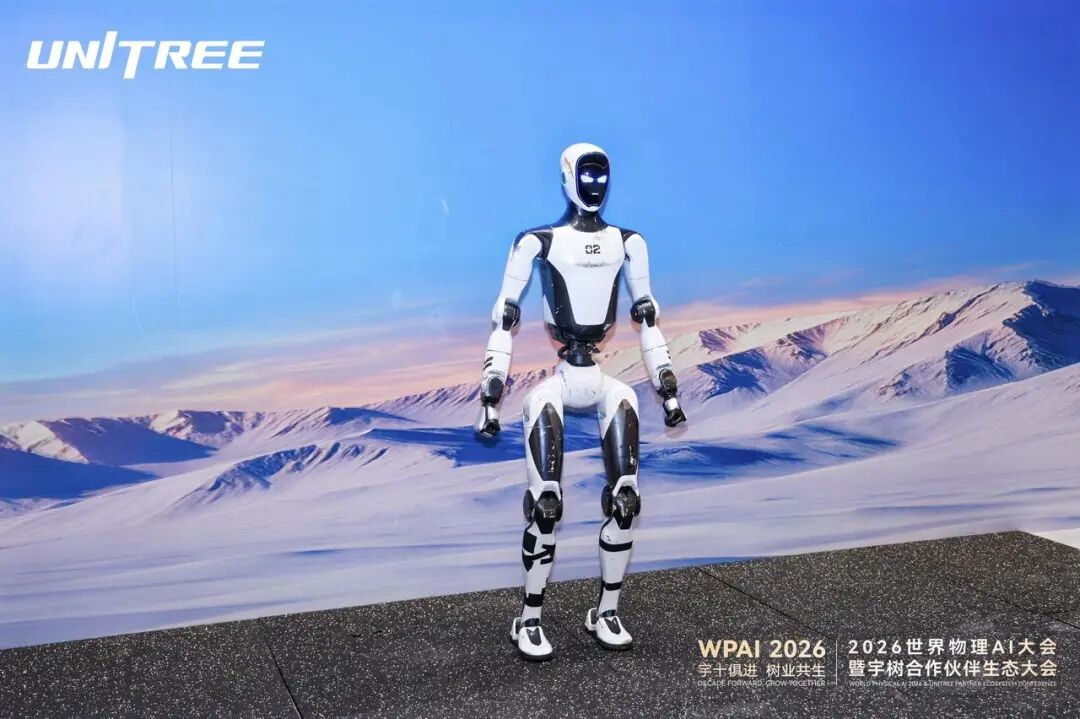
Unitree exhibited the newly released H2-X robot
GPT-6 Astra has a huge impact on embodied intelligence
Wang Xingxing believes that the recently released GPT-6 Astra has brought a huge impact to the industry. Inside Unitree, they also tried to use this model to conduct several robotics experiments.
One of the experiments was to let the robot paint. According to his introduction, Unitree did not write complex programs for this painting task in advance, and only used prompt words to make the robot complete the painting. Surprisingly, the robot also independently completed supporting painting work such as replacing pigments and cleaning brushes.
Another internal experiment of Unitree for GPT-6 Astra was playing Go.
They found that the robot can not only recognize the chessboard, but also place the pieces accurately at the corresponding positions. Wang Xingxing also repeatedly emphasized in his speech that these experiments were completed under the condition of "zero training".
In the past, robots often needed to be programmed for specific tasks or undergo special training. Now, GPT-6 Astra has proved that general large models already have the potential to directly control robots to complete some tasks.
However, Wang Xingxing also admitted that GPT-6 Astra is not almighty. In his view, large models have been able to solve the task planning and navigation problems of robots well, but they are still prone to errors when performing actual manual operations.
For example, it is relatively easy for a robot to grab an object, but it is much more difficult for it to assemble precision parts — this is because the robot not only needs to know how to do it, but also needs to adjust its movements in real time according to the position of the object, the force situation and other factors. In Wang Xingxing's view, current large models still have obvious deficiencies in perceiving changes in the real environment and correcting operation errors in time.
Nevertheless, Wang Xingxing still put forward a rather radical prediction. He believes that in the future, large models may "break through" physical AI.
Wang Xingxing judged that the core challenge for embodied intelligence to enter the ChatGPT moment next is whether the input and output of AI models can be aligned with real robots.
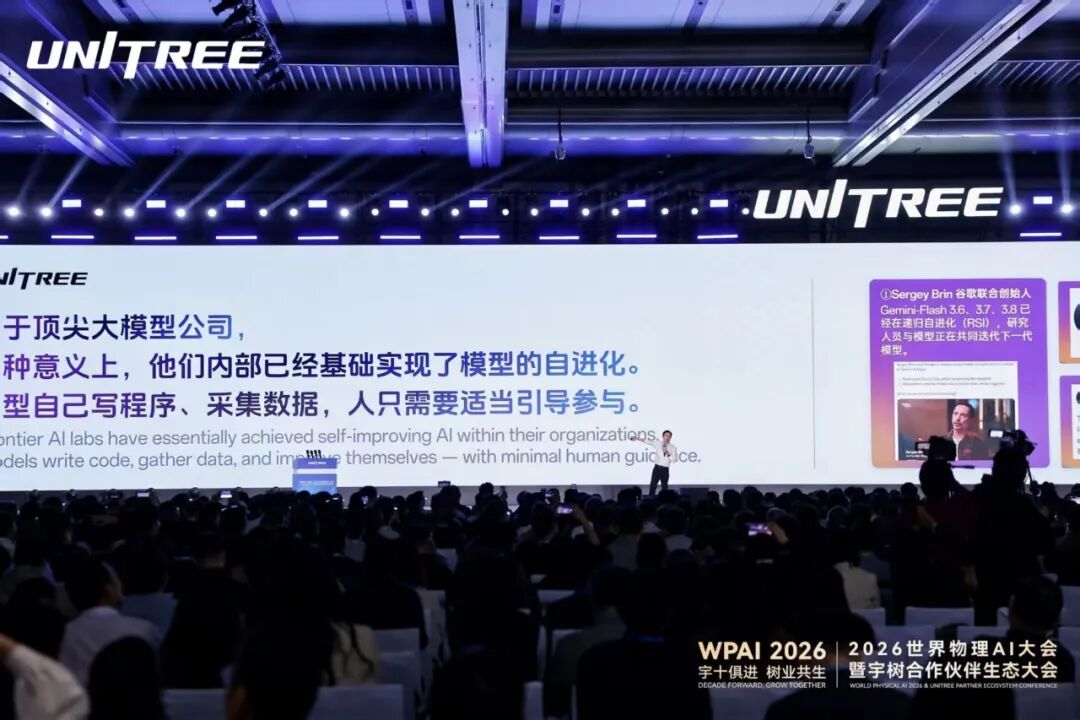
Wang Xingxing delivering the speech
He also announced his vision. He hopes that by the end of this year or next year, Unitree robots will be able to enter ordinary families, and people can use voice commands to make robots complete tasks such as tidying up rooms. The longer-term goal is that robots may be able to complete 80% of tasks smoothly through voice commands.
Self-developed AI self-evolution model
In terms of the "brain" of robots, Wang Xingxing said that in addition to continuing to promote cooperation with large model companies at home and abroad, Unitree is also synchronously promoting its own physical AI system. At present, Unitree is developing a model system called "Physical AI Robot Self-Evolution V1".
According to the introduction, this system allows AI agents to write code independently, test and train in a simulation environment, then verify in the real environment, and finally feed back the results to the independent evaluation system to form a closed loop of continuous iteration.
In the past, every time a robot mastered a new skill, R&D personnel often needed to spend a lot of time on data collection, training and optimization. Even if it succeeded in the laboratory, it might need to be readjusted after being migrated to a new environment.
Wang Xingxing hopes to use the AI model to transform this process into a more automated and scalable training system, reducing the dependence of robot skill development on manual programming and debugging.
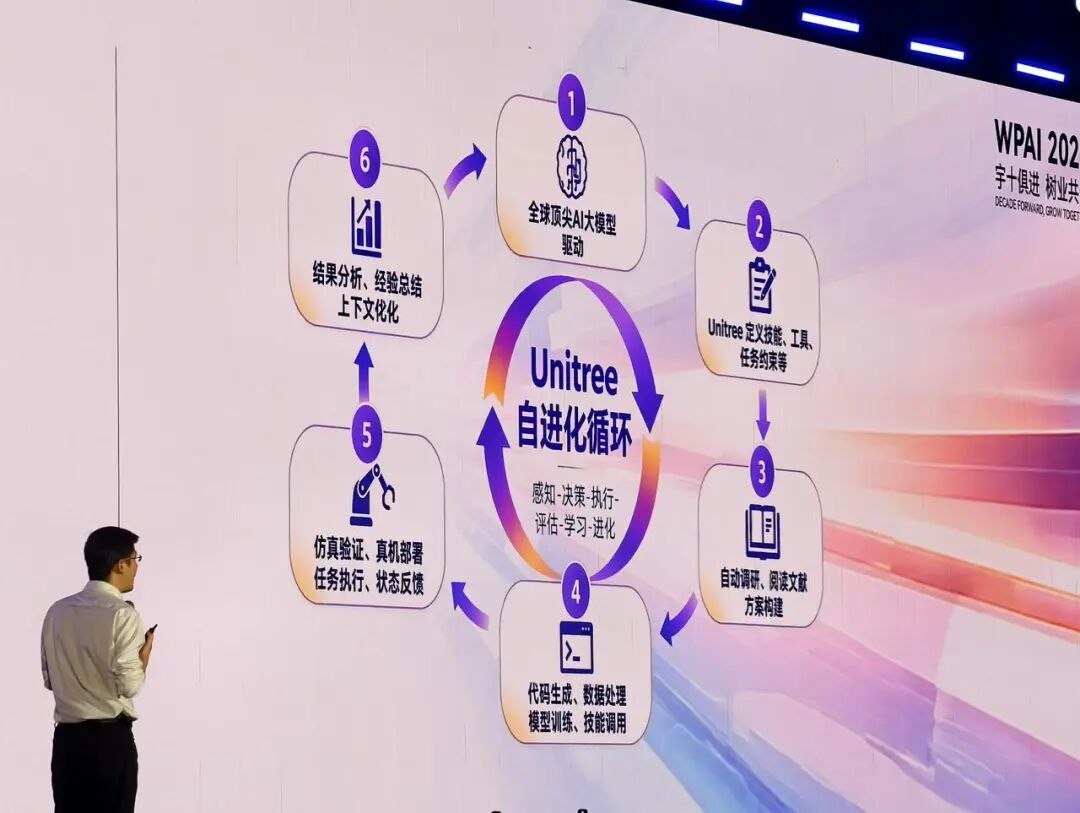
The operation mechanism of Unitree's self-evolution system
Wang Xingxing also explained why Unitree developed this system.
In his view, the stronger the basic model, the stronger the self-evolution ability of the robot. As more data is used for training, the scale effect of self-evolution will gradually emerge. When more robots are actually deployed, more real data will be generated, which will further promote model iteration.
Through this cycle, robots can continuously accumulate and expand their skills, and finally form a large-scale skill ecosystem.
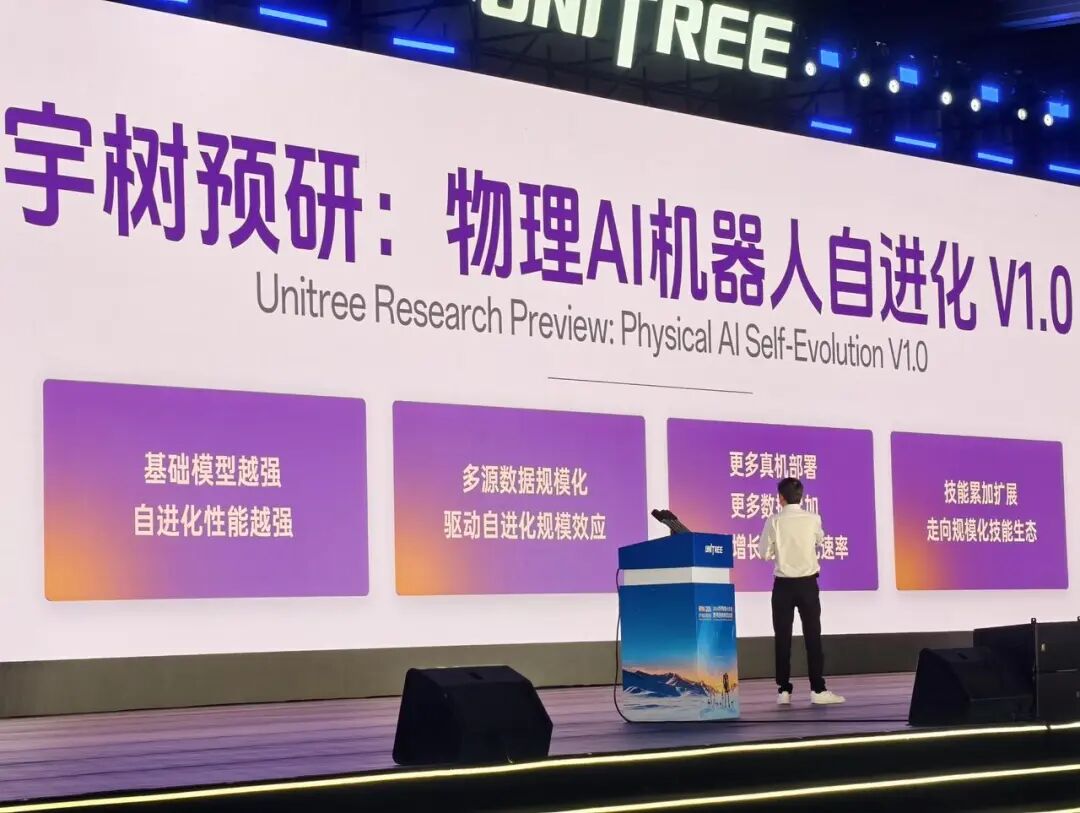
Wang Xingxing explaining why to develop the self-evolution system
However, at present, what Unitree has disclosed is mainly the technical idea. The actual training efficiency, skill transfer ability and success rate in the real environment of this system still need to be verified.
It can be seen that Unitree is increasing its investment on the "brain" side, and this self-evolution model is also closely following the current AI hotspots.
In the past, Unitree's advantages were mainly concentrated in the robot body, including joint modules, power systems and motion control algorithms. As the industry competition shifts from "making robots move" to "making robots complete practical tasks", pure hardware advantages are no longer sufficient to determine the long-term competitiveness of enterprises.
Unitree is clearly aware of this change.
Wang Xingxing revealed that since last year, Unitree has adopted pre-trained deep reinforcement learning technology, and independently developed a pre-trained full-body motion control model, which enables robots to train different actions in batches and greatly improves training efficiency.
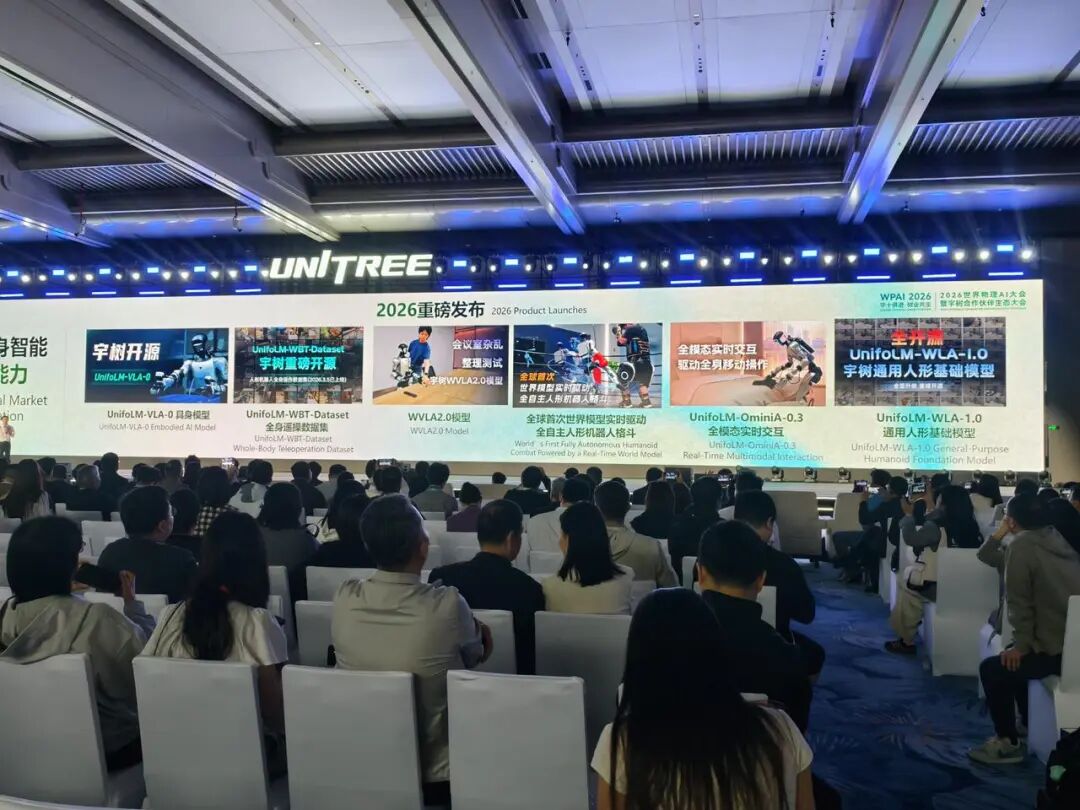
Unitree's progress in models and data since 2026
This is the best era, and I am extremely afraid of wasting every single day
Wang Xingxing is optimistic about the future of the industry, but he cannot avoid the cruelty of competition.
"This industry is very hot, the future market is very large, and the prospect is very broad, but the competition is also extremely fierce," he said.
This sense of urgency is also reflected in his personal state. He said frankly that he has many things he wants to do every day. In addition to robotics, there are many new technologies to learn and explore, but time is becoming increasingly insufficient.
"This is the best era, and I am extremely afraid of wasting every single day."
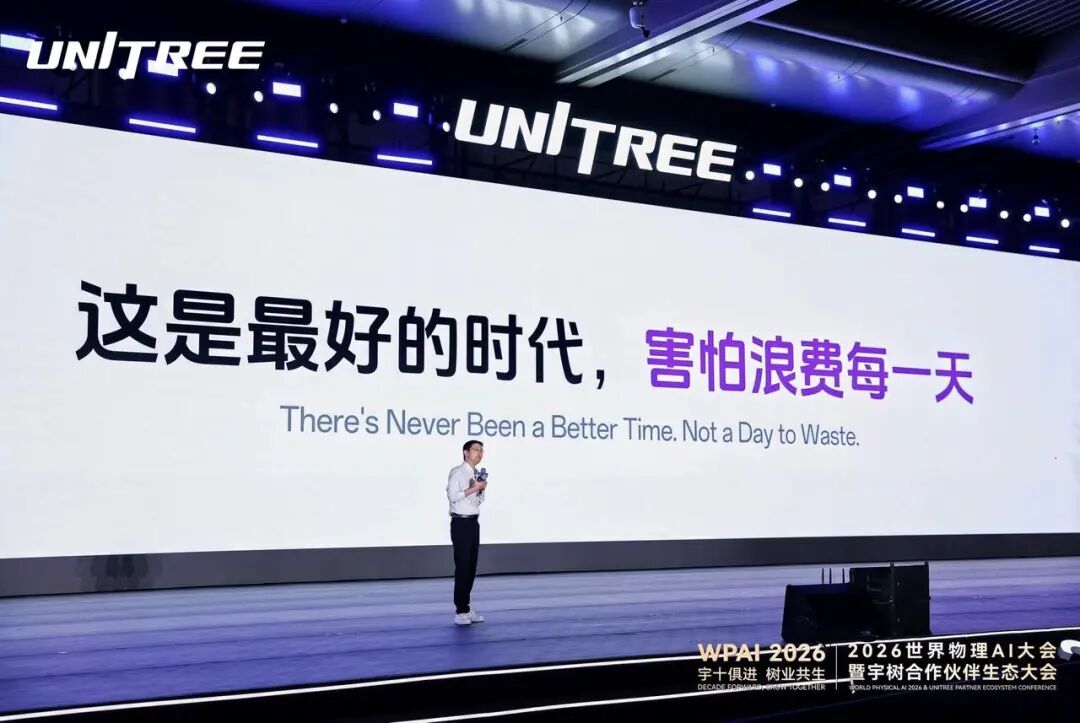
Wang Xingxing delivering the speech
In his view, the accumulation of human civilization over thousands of years has given this generation of humans the opportunity to truly realize super intelligence or AGI, and raise productivity to a new level through humanoid robots.
He even depicted a more distant social picture: when robots undertake a large amount of heavy labor and production, future living materials including houses may benefit more ordinary people through the social distribution system.
Under this picture, he believes that the four important directions that will determine the development of the robotics industry in the future are — large-scale robot manufacturing, R&D and implementation of physical AI models, super-large-scale computing power servers, and the manufacturing capacity of computing power and storage chips.
In terms of hardware manufacturing, he revealed that Unitree's G1 robot has been produced in a cumulative total of 10,000 to 20,000 units. But this production capacity is still far from enough. He believes that the future robotics industry needs to have an annual production capacity of 10 million units.
At the same time, the R&D and actual implementation of physical AI models will also become the key to industry competition. Wang Xingxing revealed that Unitree is currently maintaining cooperation with large model enterprises at home and abroad.
As the capabilities of models continue to improve, the demand for robot training and computing power will continue to grow. Super-large-scale server clusters, as well as the manufacturing capacity of computing power and storage chips, will become important foundations supporting the development of the industry.
Based on this judgment, Wang Xingxing believes that the five most core resources in the future world will be — data, computing power, chip production capacity, energy and minerals.
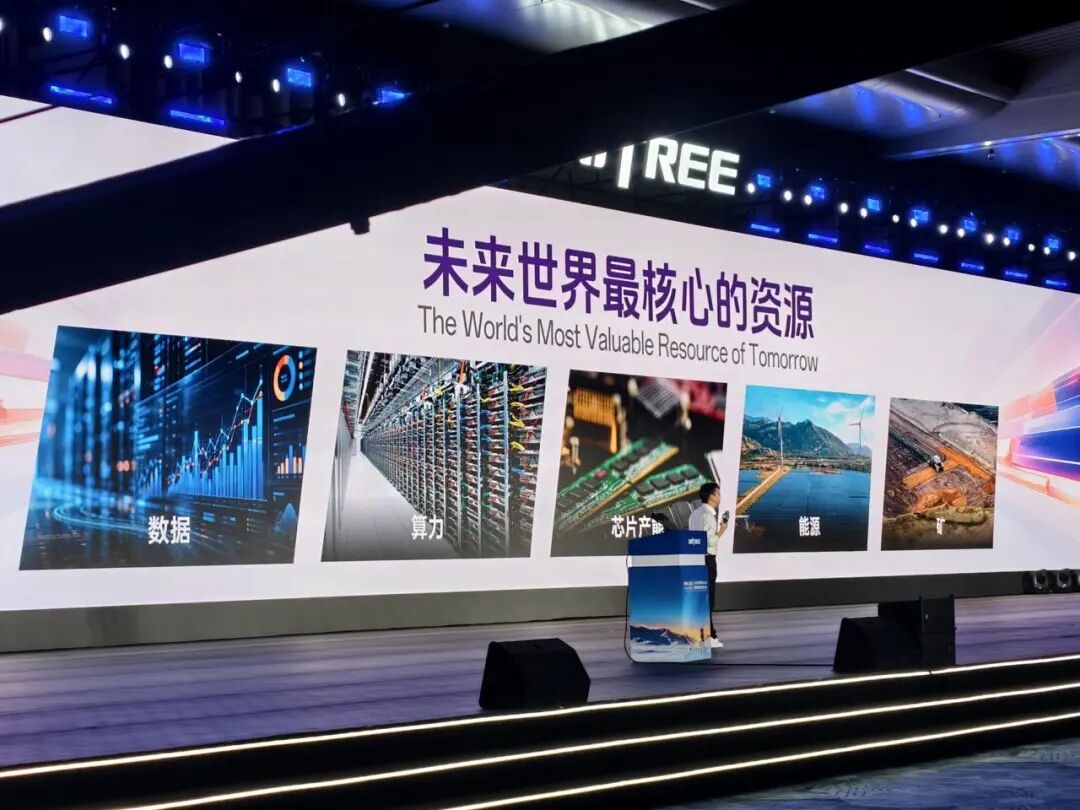
Wang Xingxing believes that there are five core resources in the future world
Unitree not only wants to put on performances, but also wants to build an ecosystem
In the past few years, Unitree has frequently attracted public attention with the sports capabilities of its robots such as dancing, fighting and running, but there has always been a question from the outside world: why do Unitree's robots always perform instead of doing practical work?
At this conference, Wang Xingxing also held a roundtable discussion with Yao Ming and responded to this question.
In his view, robots boxing and playing ball are similar to human physical exercise, the purpose of which is to improve sports ability, stability and movement accuracy, and lay a good foundation for performing practical tasks in the future.
"If you can't even walk well or run, how can you expect such a robot to do practical work?"
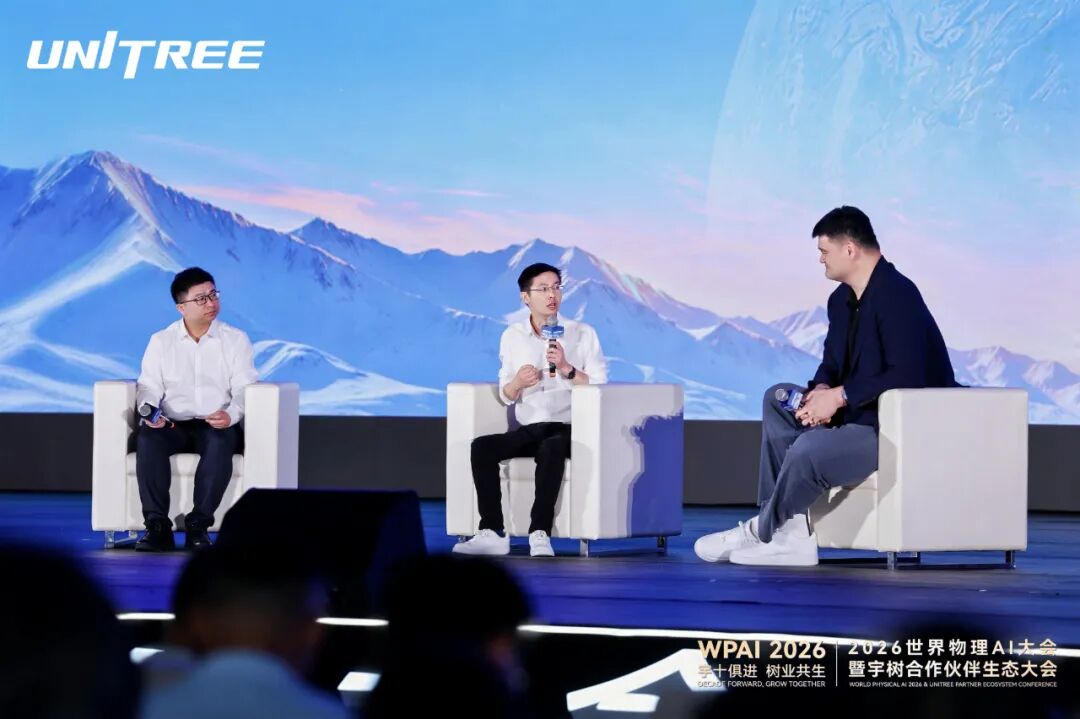
Yao Ming and Wang Xingxing having a discussion
Taking robot fighting as an example, he explained why Unitree is keen on such sports that seem to have nothing to do with practical applications.
On the one hand, fighting involves extreme situations such as collisions and falls, which can test the reliability of robots. On the other hand, fighting requires a large number of complex movements, which puts forward very high requirements for the motion control algorithm and stability of robots.
In addition to performances, Unitree is also trying to cooperate with more partners to promote robots to practical application scenarios. However, Unitree's strategy is not to do everything by itself, but to build an ecosystem.
At this ecosystem conference, Unitree officially launched the "Unitree Creation Program", recruiting entrepreneurs in the fields of robot body and core components, embodied intelligence algorithms, data and simulation platforms, industry applications and solutions for teams that have established companies or have clear entrepreneurial directions.
Wang Xingxing