It is not about AI replacing human beings, but humans creating together with AI.
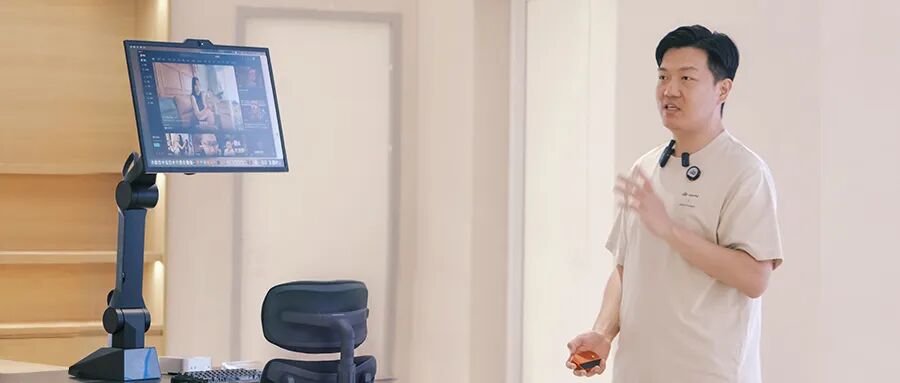
On October 18, Cell Wall hosted a new product launch event at the INNO100 Global Innovation Flagship Store located in Shenzhen Bay Cultural Plaza. Notably, the company turned the anxiety-prone question of "Will AI replace humans" into a demonstrable collaborative workflow: users put forward requirements, the Agent starts execution; before reaching key actions, the system pauses for humans to supplement, confirm or take over before proceeding, and the results are checked in the final step.
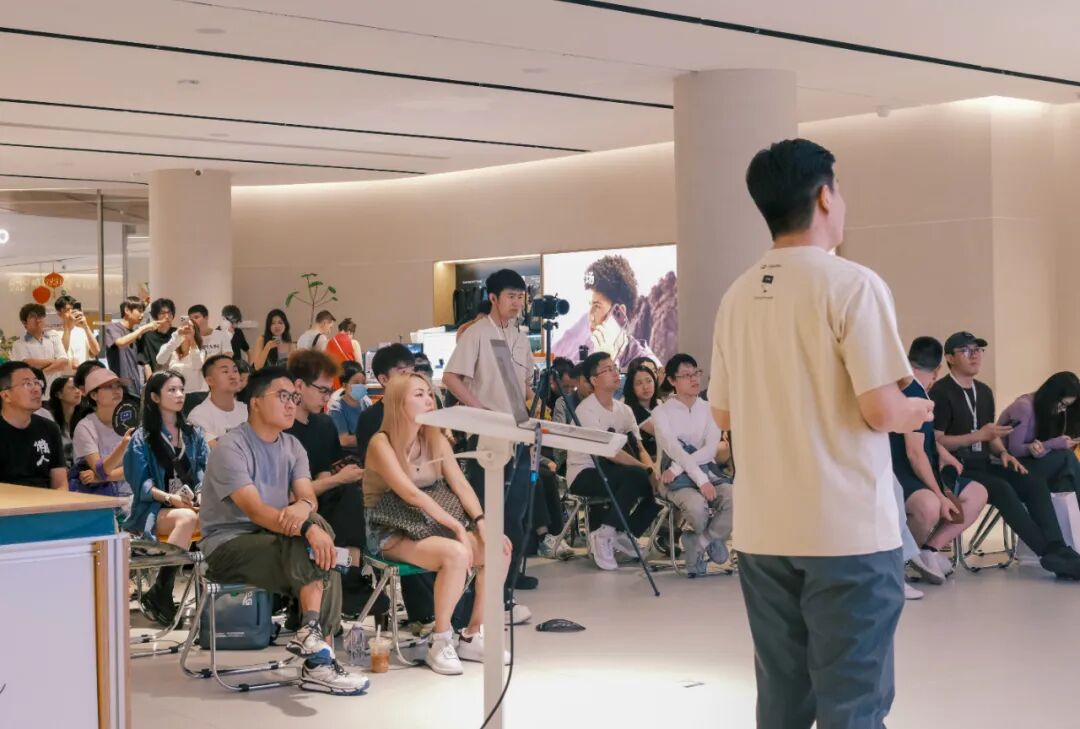
The answer given by Cell Wall is very straightforward: AI is not here to live instead of humans, but to endow humans with new capabilities. Humans still hold the steering wheel, and do not have to complete all tasks alone.
This is also the product roadmap that Cell Wall has built around the concept of "AI-augmented creators". At the launch site, Cell Wall unveiled two products: CyboPal ONE and WhisPrompt. The two products were introduced under the same collaborative context: the former is a desktop large-screen robot connected to the user's computer, while the latter is an AI work handheld device for use with computers. The two products target desktop and mobile office scenarios respectively, and share the same set of AI interaction system at the underlying layer. In Peng Tianfang's words, Cell Wall aims to enable people to turn their ideas into reality with the help of AI, while retaining full control over the direction and outcomes.
The judgments Peng Tianfang mentioned in the interview can be summarized into three layers: how to use AI to expand the boundary of human capabilities, why embodied intelligence starts with PCs and desktops, and how CyboPal ONE and WhisPrompt serve as two terminal entrances to the same set of AI interaction system. Connecting these three layers, you can understand how Cell Wall builds a complete human-machine collaboration system around the process where humans set goals, give feedback, make judgments, and take over at critical moments.
CyboPal ONE and WhisPrompt: Two Entrances to the Same Set of AI Interaction System
At the launch event, CyboPal ONE and WhisPrompt were introduced in the same collaborative workflow. The two products are not isolated individual hardware items, but share the same set of AI interaction system, connecting users, computers, Agents and devices, so that people can express ideas, modify requirements, switch tasks, confirm key actions and view results.
In other words, the focus of the launch event demonstration is "how humans can complete a task with AI through this system".
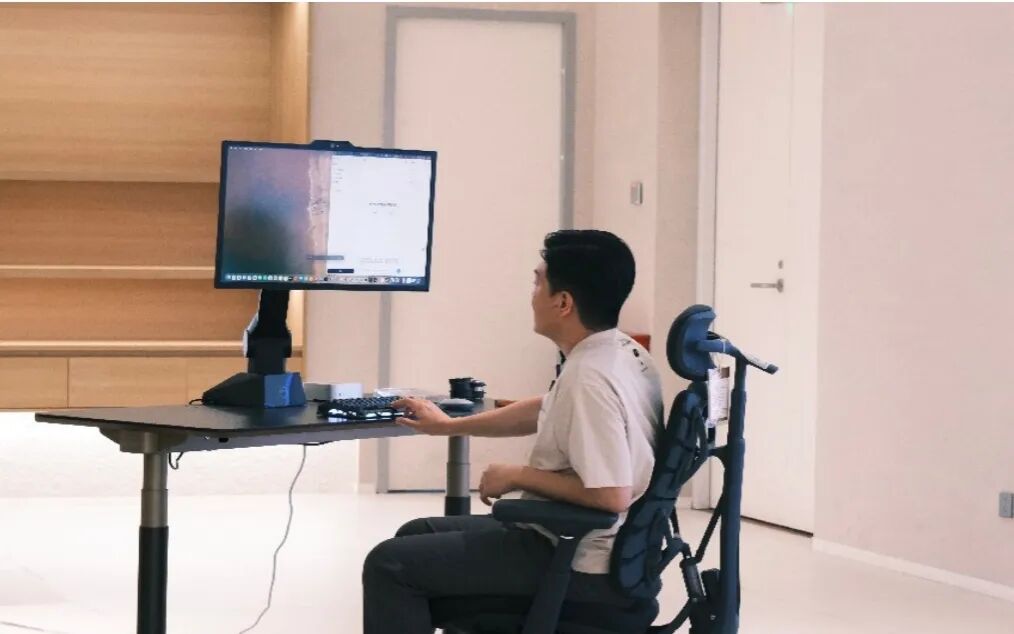
Let's start with CyboPal ONE. It is a desktop large-screen robot connected to the user's computer, combining large display, perception and physical motion, allowing AI to naturally appear next to the computer in the form of embodied intelligence. Peng Tianfang regards this type of product as a bolder attempt: it targets people who work long hours on the desktop and use Agents intensively, especially geeks and deep developers. It turns the computer into a perceptible, interactive and movable embodied collaboration entrance. Users still process tasks, call software and view results on the computer, and what CyboPal ONE does is to make the deployment, execution and feedback of Agents more naturally integrated into this scene. According to Peng Tianfang, CyboPal ONE is equipped with functions such as voice input, voice modification and user memory, and has realized deeper integration in this AI interaction system.
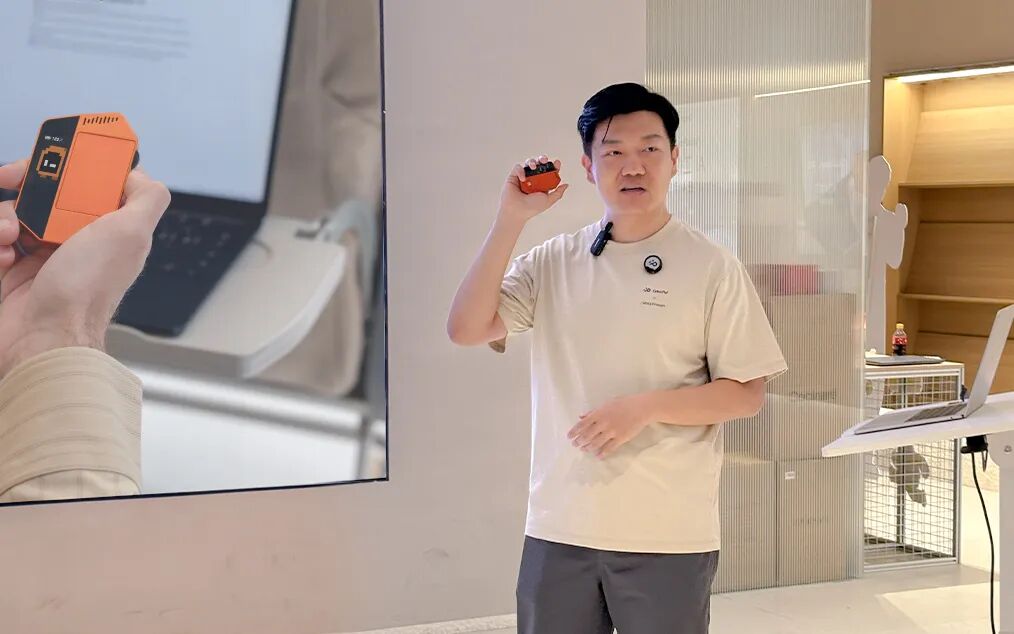
Next is WhisPrompt. It is an AI work handheld device for use with computers, which puts voice, buttons and knobs within easy reach, targeting mobile office scenarios. Users can more easily express ideas, adjust requirements, assign tasks to Agents for execution and view results. Peng Tianfang described it very specifically: the handheld device first improves the intention expression and control experience, so that users do not have to fully rely on the keyboard and mouse to deliver ideas to the computer faster. The team's philosophy is that after users get familiar with the product gradually, they can work with one hand, and even in the future, the computer only needs to stay there, and people can complete interactions by speaking to it and making simple swipes. The product is designed with hardware elements such as touchpad, buttons and knobs, which moves high-frequency operations such as "modifying requirements", "switching tasks" and "confirming actions" out of the screen and puts them within easy reach.
The shared AI interaction system of the two products connects users, computers, Agents and devices, enabling AI to understand tasks, execute operations and return results; when key actions are involved, humans will confirm or take over. The launch site linked the specific experience with five actions: "speaking, modifying, switching, approving and checking". Speaking means expressing ideas; modifying means adjusting requirements; switching means changing tasks; approving means confirming key actions; checking means viewing results. These five seemingly simple actions correspond to the most easily broken links in the collaboration between humans and Agents.
It should be noted that the traditional operating system still manages computing resources, and Cell Wall's AI interaction system is an upper layer that organizes human-Agent collaboration on top of it. It enables stable collaboration among software, computers and physical hardware, allowing AI to step out of the dialog box on the screen and become a perceptible and cooperative embodied intelligence collaborator around humans.
Putting CyboPal ONE and WhisPrompt together, you can understand why Cell Wall says they are "two entrances to the same set of new capabilities": they serve the same goal - to let people turn ideas into reality with AI, while retaining control over the direction and results. As for why this entrance first lands on PCs and desktops, we need to go back to Peng Tianfang's judgment on the relationship between humans and Agents.
Why Start from PCs, and How the AI Interaction System Organizes Human-Agent Collaboration
In the conversation with 36Kr, Peng Tianfang first talked about the boundary between humans and AI. In his view, if the relationship between humans and AI only stays at the slogan level, it will easily become a vague statement of "AI augments humans"; if we only talk about "AI replaces humans", the discussion will be led to unnecessary anxiety.
What Cell Wall wants to clarify is the boundary between the two: humans retain the right to set direction, make judgments, confirm and take over, while AI is responsible for deployment, execution and trial. When humans start to set goals, give feedback and make judgments to Agents, the role of humans will shift from "completing every step personally" to "setting direction, viewing results, and taking over at critical moments".
From an industrial perspective, this is actually a response to the most common fork in the road for embodied intelligence and AI hardware startups: if you only make software, it is lightweight but easy to have no barriers; if you only make hardware, it lands fast but is easy to be left unused after the novelty fades. Cell Wall chooses to base its judgment on "humans still hold the steering wheel", which at least gives the product logic a testable starting point - the core is to see whether people are more willing and more comfortable to assign ideas to Agents for deployment, so that users dare to try, dare to modify, and dare to adjust the direction at any time.
In fact, this judgment is related to Peng Tianfang's personal experience. He describes himself as "very lazy": he would rather lie down than sit, and hopes to get greater returns with less energy, so he naturally thinks: can people finish their work half-lying while looking at the screen? His academic background is in the design and manufacturing of microsystems, which gives him the judgment on which new technologies can be mass-produced in recent years at a reasonable cost.
Therefore, the starting point for Cell Wall to design the form of embodied intelligent products is to make the process of "users putting forward demands and the screen feeding back information" happen in a more comfortable way.
The methodology he gave to the product team is "add some surprises and unexpected experiences on the basis of familiarity": the form should not be too weird for users to dare not use, nor can it just put a new shell on old things. The desktop large-screen robot is designed to give new life to desktops or displays; the work handheld device is to find a familiar yet unexpected position among mice, walkie-talkies and mobile phones.
This methodology sounds simple, but it is not common in today's AI hardware industry. Common practices in the industry are: either make the "new form" a spectacle in the demo video, or add voice functions to old peripherals and call them AI hardware; Cell Wall tries to find a balance between "familiarity" and "unexpectedness". The opportunity here is that once users feel comfortable using the product, the form innovation will have the possibility of daily use.
For this reason, Peng Tianfang believes that the company must have software, hardware and algorithm capabilities. Pure hardware products lack soul and conversation ability, and cannot understand users' personal habits and historical background, so the novelty will pass quickly; while pure software that only interacts with users through cold screens, mice and keyboards does not provide a truly new experience, and most likely has no competitive barriers.
He made an analogy: raising a quadruped robot dog is very cute at first, but if the interaction is not precipitated into its habits, the novelty will disappear quickly; while a real dog will understand you better and better as you get along. He wants to illustrate that the role of software and models is to make interaction precipitate into the understanding of users.
This is also why Cell Wall chooses to build both the AI interaction system and the embodied physical terminals at the same time. From the perspective of industrial division of labor, with this choice, Cell Wall hopes to take root between the "model layer" and the "hardware layer", and truly establish the AI interaction system layer. This position is not easy: it has to face the rapid iteration of model capabilities upward, and face the situation that hardware forms are easy to be imitated downward; but if context and user habits can really be precipitated in the interaction system, it may become a more sticky entrance than a single App or a single piece of hardware.
The choice to start from PCs and desktops stems from Cell Wall's "non-consensus judgment". The industry generally believes that AI will bring new terminals, but different paths determine whether startups can succeed.
Peng Tianfang observed that the interaction methods that users are really accustomed to are changing significantly at present, and the fields that need new-form hardware are mainly concentrated in productivity scenarios: people who write codes, write articles, do research and create content have extremely strong perception of the pain points and pleasant experience brought by AI, and they really need a new type of interactive terminal to improve efficiency. In contrast, in scenarios such as short videos, social networking and shopping on mobile phones, users do not have strong expectations for "efficiency improvement", the traditional sliding operation is already comfortable enough, and the demand for new-form hardware is not so strong.
PCs and desktops are the core scenes where creators process tasks, call software and view results, and are also the main positions for high-frequency continuous collaboration between humans and Agents. Cell Wall chooses to cut in from PCs, in order to first stabilize the main link of human-computer collaboration, and then use WhisPrompt to supplement the mobile office entrance that "puts requirements within easy reach". This path judgment is noteworthy: it starts directly from "which group of people has the most painful and most frequent work segments". For early-stage companies, it is more realistic to first prove that the AI interaction system is feasible in a high-frequency productivity scenario than to expand to scenarios such as mobile phones, glasses and home appliances at the same time; but this also means that Cell Wall must first accept the test of PC scenarios, to see whether users are willing to have an extra entrance next to their computers.
Peng Tianfang roughly divided the industrial chain into four layers: cloud large model, end-side model, interaction or operating system layer, and hardware carrier. He believes that the first two layers have basically settled down, and Cell Wall is in the third and fourth layers closer to users - the interaction layer and the hardware carrier layer.
In his view, traditional operating systems have completed their historical mission of coordinating software and hardware resources and allowing users to control computers through mechanical clicks for a very long period of time; the next-generation operating system needs to solve deeper problems in the relationship between humans and devices: to enable devices such as computers, TVs, mobile phones, refrigerators, air conditioners and glasses to naturally identify who the user is, and understand the true meaning of users' past behavior habits and vague instructions.
In other words, Cell Wall focuses on the connecting "AI interaction system": when users put forward demands, it automatically understands and translates them into executable requirements; users' language habits, preferences and personal context are precipitated in the interaction layer. "Context is the key for Agents to understand users, and the interaction layer is closest to where context is generated and changed, so it has the opportunity to become a more natural connection between humans and Agents," Peng Tianfang said.
The name Cell Wall is also related to this. Peng Tianfang explained that the name is chosen to hope that silicon-based life can coexist with carbon-based life; in the future, there may be not only other human partners around humans, but also many silicon-based partners, and interaction is the key to unlock this possibility. This expression is visionary, but the product problem it points to is not mysterious: how to make machines truly understand humans.
Stabilize the Desktop Collaboration Link First, Then Make Embodied Intelligence Accessible to Thousands of Households
From the perspective of business logic, Cell Wall's choice is not complicated, but the order is critical. Many AI hardware startups tend to tell a grand ecological story first and then look for users; Cell Wall does the opposite: it first locks in a group of people who most need to "turn ideas into reality with AI", then covers their high-frequency scenarios with two entrances, and finally talks about openness and ecology. Whether this order is feasible depends on whether it can first prove one thing: some people are willing to pay continuously for this brand new human-computer collaboration experience.
Peng Tianfang has a very specific judgment on the target group: developers, researchers, content creators and independent workers who often use AI Agents and hope to turn ideas into reality are high-frequency users. Compared with opening more chat windows, what they really need is a set of AI interaction system that can link intention expression, process control and result confirmation together.
Peng Tianfang also mentioned a consumption logic: AI-augmented creators spend a long time in front of computers and desktops, and they are willing to pay for comfort, efficiency and smoothness of their time; just like some people are willing to spend thousands of yuan on keyboards and hundreds of yuan on mice, because every tap and grip feels more comfortable. The consumption preference of this group is productivity tools that can truly improve daily experience.
From an industrial perspective, this is equivalent to taking "AI-augmented creators" as a niche market that is taking shape but has not been fully served by traditional peripheral manufacturers: the demand is real, the reasons for payment are specific, and the product form also has the opportunity to stand out from the alternative relationship of mice and keyboards.
After the crowd is determined, the entrance combination has commercial significance. CyboPal ONE cuts in from the desktop scenario, WhisPrompt cuts in from the mobile office scenario, and the two share the same set of AI interaction system. The desktop entrance covers high-frequency actions of "collaborating next to the computer", and the mobile entrance covers the scenario of "putting requirements within easy reach". For users, the two products are extensions of the same interaction system in different scenarios; for Cell Wall, sharing the interaction system means that the collaboration among software, computers, Agents and devices is the core capability, and hardware is the physical terminal of this collaboration link. Peng Tianfang also admitted that the two products target different scenarios: the handheld device is easier to be accepted by ordinary users, while the desktop large-screen robot is a bolder attempt of embodied intelligence in desktop scenarios, which will first attract geeks and deep developers, and then gradually bring the experience to a wider audience. This product combination of "one stable, one pioneering" is more in line with the resource rhythm of early-stage companies than betting on only one form: the handheld device is responsible for lowering the understanding threshold and expanding the user base, and the desktop large-screen robot is responsible for verifying bolder interaction assumptions.
Looking further at the industrial level, Cell Wall positions