Hilton, why did it flee the New York Stock Exchange?
01
This week, Hilton, the top player by market capitalization in the global hospitality industry, has decided to relocate its listing venue.
On October 20, Hilton announced that it plans to move the listing of its common stock from the New York Stock Exchange to the Nasdaq Global Select Market.
This relocation will retain its original stock ticker HLT, no new shares will be issued and no additional fundraising will be conducted. Shareholders do not need to take any action to smoothly complete the transition of their holdings.
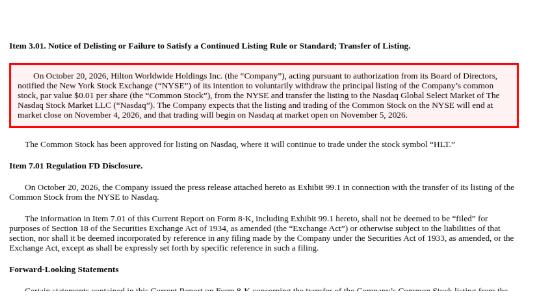
Looking back at Hilton's history, the New York Stock Exchange has occupied a very important position.
In 1946, Hilton became the first hotel enterprise to be listed on the NYSE. At that time, Nasdaq had not yet been founded, and Hilton was far from building the global hotel network it has today.
Hilton's capital journey has not been all smooth sailing. In 2007, Blackstone took Hilton private, and it was not until December 2013 that it escorted Hilton back to the NYSE to ring the bell in a high-profile manner.
That year's IPO, which raised as much as 2.35 billion U.S. dollars, set the highest record in the history of the global hospitality industry and became a classic case widely talked about on Wall Street.
After a cycle of 13 years, the hotel giant with a market capitalization exceeding 60 billion U.S. dollars chose to pack up and leave the century-old bourse that has accompanied it for a long time.
Hilton's resolute departure is not an isolated incident on Wall Street.
As early as 2013, its long-time rival Marriott International made exactly the same choice, abandoning the NYSE where it had been listed for a long time and moving to Nasdaq.
When Hilton officially completes the transfer on November 5, the world's two largest hotel empires by market capitalization will meet historically on Nasdaq.
Looking at the current list of the U.S. stock travel sector, Nasdaq has long quietly hollowed out the industry foundation of the NYSE.
Overseas online travel giants Booking and Expedia have been listed there for years, and Airbnb, the representative of shared accommodation, also chose Nasdaq as its base when it went public in 2020.

In the travel sector of the NYSE today, only a few traditional hotel groups such as Hyatt and Wyndham are still sticking to their positions alone.
Established giants are voting with their feet, while the chill in the incremental market is even more biting.
Just 4 days before Hilton's official announcement of the transfer, Klook, a travel experience unicorn from Hong Kong, China, officially applied to the U.S. Securities and Exchange Commission on October 16 to withdraw its NYSE listing plan.
Counting from the high-profile submission of its prospectus in November 2025, Klook has waited nearly 340 days in front of the NYSE, and its original plan to raise 300 million to 500 million U.S. dollars has finally come to nothing.
In fact, looking back at the Chinese enterprises on the other side of the ocean, leading players gathered on Nasdaq many years ago.
Ctrip and Huazhu took root there long ago. Atour Group, which successfully went public on the U.S. stock market in November 2022, also chose Nasdaq as its listing location. The three enterprises together account for the majority of the overseas capital market share of China's hospitality and travel sector.
In contrast, GreenTree Hospitality, the only Chinese hotel representative remaining on the NYSE, is in a rather awkward situation. Its current stock price has long been hovering between 1 U.S. dollar and 2 U.S. dollars, and its total market capitalization has shrunk to around 100 million U.S. dollars.
From the successive departures of multinational hotel giants, to the emergency brake of Asian travel unicorns at the listing gate, to the divergence of performance among Chinese concept stocks, the capital vane of Wall Street has changed significantly.
The NYSE, which has a 234-year history, seems to be losing its appeal to global travel enterprises.
02
Why did Hilton suddenly say goodbye to the NYSE on the 80th anniversary of its listing?
The explanation given in the official announcement focuses on technology investment and innovation positioning, and emphasizes that this move will help improve capital efficiency.
To outsiders, it seems somewhat out of place for a traditional hotel group that makes money from franchise fees and property management fees to join the crowd of tech stock companies on Nasdaq.
Looking through the financial statements of Hilton and Marriott, the valuation logic of Wall Street for international hotel management giants has been completely restructured as early as 10 years ago.
After divesting heavy assets, the brick-and-mortar property rights of more than 8,000 Hilton stores around the world mostly belong to local owners, and the group headquarters has completely got rid of the traditional label of a real estate rent collector.

Hilton Executive Lounge in Tashkent / Photo by Travel Industry
The core asset supporting Hilton's market capitalization of more than 60 billion U.S. dollars is actually the digital network of Hilton Honors, which consists of more than 200 million registered members.
The closed-loop experience of completing room booking through mobile phones and opening the door with a digital room card makes analysts from Goldman Sachs and Morgan Stanley more willing to regard it as a franchise software platform with huge private domain traffic.
Moving to Nasdaq is essentially Hilton's move to stand in the same valuation coordinate system as Airbnb and Booking to tell its growth story.
After all, in the eyes of the capital market, the price-earnings ratio of traditional commercial real estate and hotel operations is usually only around 15 times, while platform-based enterprises empowered by digitalization can easily enjoy a valuation premium of more than 30 times.
Apart from getting rid of the traditional industry label, Hilton's management also has a more shrewd plan for liquidity.
In 2026, when the artificial intelligence wave sweeps across Wall Street, the seven tech giants including NVIDIA and Microsoft have absorbed the vast majority of active funds in the entire market, and traditional consumer stocks face a liquidity discount even if their performance is excellent, with no investors showing interest.
Although Hilton, which stays on the NYSE, has long been included in the S&P 500 Index, it will never be eligible for the constituent stock list of the Nasdaq 100 Index.
According to the official rules of Nasdaq, only leading non-financial enterprises listed on the exchange are eligible to enter the candidate pool for the Nasdaq 100 Index.
As early as after its transfer in 2013, Marriott International reaped the benefits and successfully became a constituent stock of the Nasdaq 100 Index.
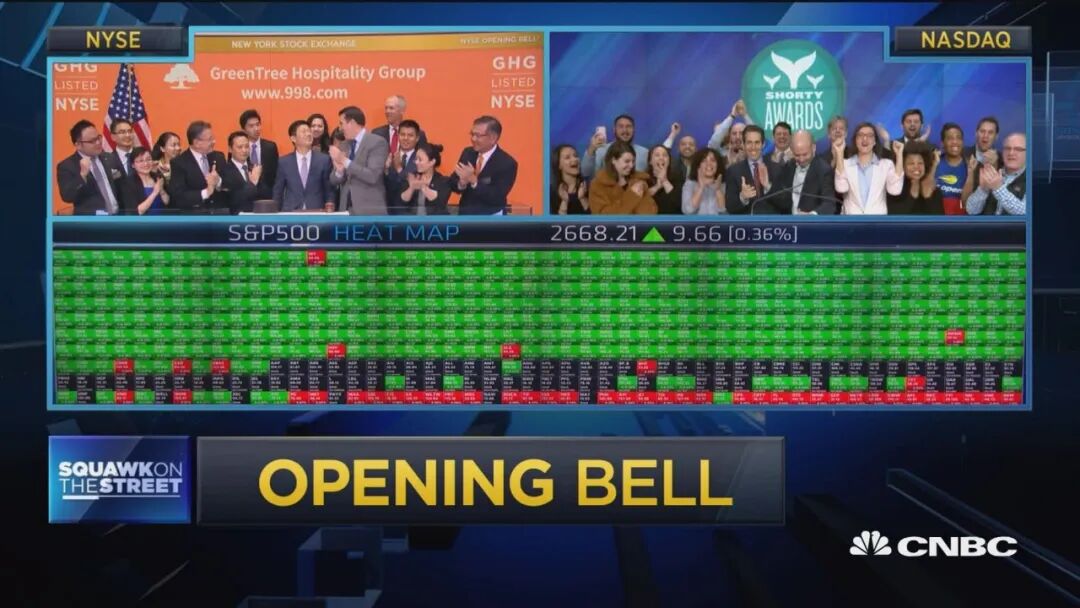
GreenTree Inn NYSE bell-ringing live broadcast in 2018
At present, the scale of various passive funds tracking the Nasdaq 100 Index around the world has exceeded hundreds of billions of U.S. dollars, and Invesco QQQ alone has an asset management scale of more than 300 billion U.S. dollars.
It can be said that as long as Hilton successfully enters the Nasdaq 100 Index after its listing on November 5, tech index funds around the world will have to passively buy Hilton's stock according to its weight.
When active fund managers on Wall Street are all frantically chasing artificial intelligence chips, Hilton, through the clever move of changing its trading venue, has forced its stock into the buying basket of tech ETFs.
Thus, Hilton's transfer is by no means a spur-of-the-moment brand public relations move. When the rules of the game on Wall Street have completely tilted towards algorithms and tech narratives, the century-old hotel giant must learn to find its bargaining chips at the new table.
03
Multinational hotel giants are making shrewd moves at the Wall Street table, and the value judgment of global travel enterprises on the capital market is also undergoing profound changes.
For decades, going to the NYSE hall to ring the bell was often regarded as the highest honor for an enterprise, representing the recognition of status as a mainstream blue-chip noble.
Nowadays, the calculations of major boards of directors have become extremely pragmatic. The illusory historical aura has been cast aside, and enterprises will not hesitate to go wherever they can get sufficient stock liquidity and tech premium.
The sudden change in capital trends on the other side of the ocean has also poured cold water on Chinese travel enterprises that are eager to raise funds overseas.
Klook's emergency brake in front of the NYSE has torn apart the real side of the U.S. stock market's indifference to pan-consumer and travel themes.
Even if the company's total booking volume for the whole year of 2026 is expected to exceed 80 million transactions, it still cannot get a decent issuance valuation in the chip and computing power-dominated Wall Street.
Under the dual pressure of the normalization of China-U.S. games and the extreme concentration of U.S. stock funds, Chinese domestic travel enterprises' obsession with listing in the U.S. is fading rapidly.
Small and medium-sized cultural tourism companies not only have to bear millions of dollars in annual compliance and cross-border audit costs across the ocean, but also are likely to face the dilemma of zombie stocks with an average daily turnover of less than 100,000 U.S. dollars after listing.
Even Ctrip and Huazhu, which established a firm foothold on Nasdaq in the early years, have successively returned to the Hong Kong Stock Exchange to complete secondary listings in the past few years, hedging potential risks in a single overseas market through a dual-home layout.

Turning our attention back to the domestic market, the Hong Kong Stock Exchange and A-share market at home are no longer safe havens that provide blind capital infusion.
In mid-October, Yangzhou Slender West Lake Cultural Tourism just submitted its prospectus to the Hong Kong Stock Exchange and launched its sprint for listing, but the capital market's scrutiny of traditional scenic spots and performance projects has long become strict.
Impression Dahongpao, which was successfully listed on the Hong Kong Stock Exchange at the end of 2025, received a frenzied subscription of more than 3300 times during its public offering stage, but plunged 35% on the first day of listing, and its cumulative decline has exceeded 65% so far.
Whether it is the multinational giants that went to Nasdaq to find support from tech index funds, or the local scenic spots that suffered from the break of issue price in the Hong Kong stock market, all confirm that the global hospitality and travel capital bubble has completely receded.
The secondary market has long passed the wild era when investors would generously invest just by seeing famous mountains, rivers and the scale of hotel groups. Today, investors only value the real revenue per available room and cycle-resistant free cash flow.
In 1946, when the old Conrad Hilton stepped into the NYSE hall in high spirits, he relied on real brick-and-mortar buildings and land expansion.
Eighty years later, when Hilton is scheduled to start its first day of trading on the electronic big screen of Nasdaq on November 5, the long march of the global tourism industry yielding to algorithms and real space efficiency has just kicked off.
This article is from the WeChat official account "Travel Industry", Author: theodore Xishao, authorized for release by 36Kr.