Wang Xingxing's remarks today revealed that the humanoid intelligence sector is poised to go through two tough years.
On October 22, 2026, the 2026 World Physical AI Conference & Unitree Partner Ecosystem Conference welcomed more than 3,000 guests, which is the largest event held by Unitree in the two months since its listing.
In his keynote speech titled Believe, Trust AI as Much as Possible at the event, several of his remarks revealed the current hard-to-break bottlenecks in the embodied robot industry:
"With the release of GPT-6, physical AI has shown initial signs of breakthrough, which will most likely come in the next 1-2 years or 2-3 years."
"The core challenge for embodied intelligence to cross the ChatGPT moment lies in the alignment between the input and output of AI models and real robots. Large models can perform planning and navigation, but they cannot solve the problems after physical contact."
"The implementation in commercial services will be faster than in household and industrial scenarios."
"Almost everyone around the world does not attach enough importance to and have enough faith in AI, including myself."
Looking at these four sentences separately, he is talking about the core bottlenecks of the embodied industry.
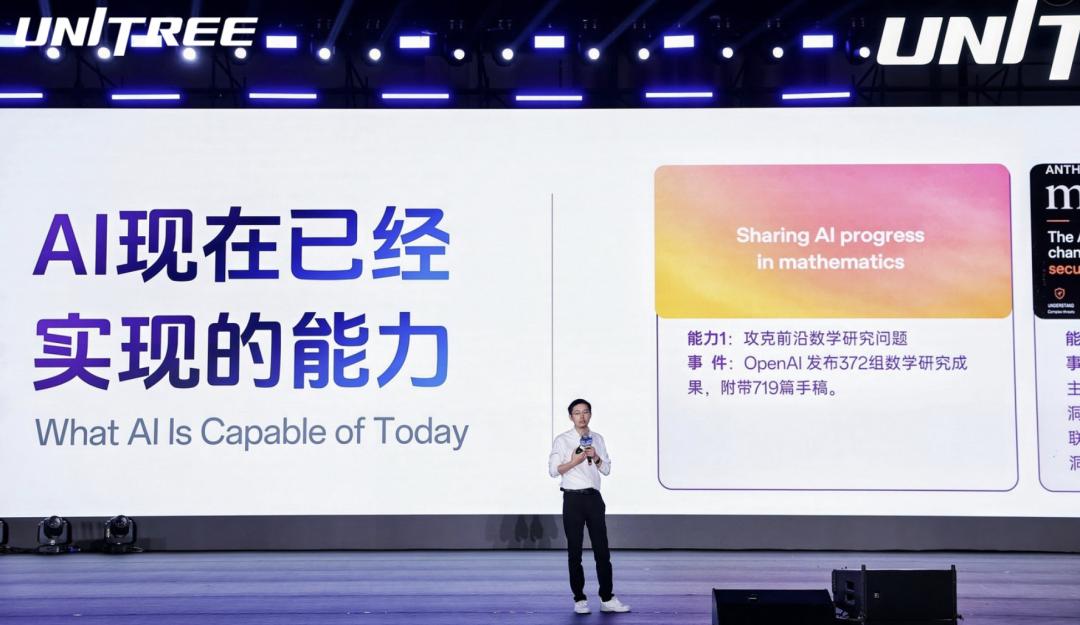
2026 Unitree Partner Ecosystem Conference
The first layer is about timeline: Physical AI has shown signs of breakthrough, but it will still take 1 to 3 years.
The second layer is about capability: The bottleneck lies in alignment. The model handles "thinking" but cannot manage "physical contact", so highly anticipated scenarios such as household and industrial applications are pushed back accordingly.
The third layer is about boundary: Currently, only scenarios with high fault tolerance such as commercial services are accessible, which is a clear self-awareness.
The last layer is the most thought-provoking: The person who said this is the top performer and the most well-funded player in this industry, and he even counts himself into the group of people with "insufficient faith in AI".
Putting it all together: The ChatGPT moment for embodied intelligence has not arrived yet, and large-scale commercial implementation will take several more years.
When other people say this, it is a prediction; when Wang Xingxing says it, it is a testimony.
Unitree is the company with the world's largest shipment of humanoid robots, with a market share of about 32.4% in 2025. Its G1 model alone has rolled off the production line for a total of 10,000 to 20,000 units, making it one of the very few profitable players in the entire industry.
Wang Huadong, Managing Partner of Matrix Partners China, is an early investor of Unitree and the sole lead investor of its Series B1 round in 2021. He confirmed the weight of this status in the In-depth Interview video podcast: In March 2024, he walked into a robot lab in Silicon Valley, where there were 8 Unitree robots, and products of other brands were basically broken, only Unitree's products were usable.
In his words, DJI is one of the few Chinese companies that have achieved absolute global leadership in a certain field, and Unitree is another.
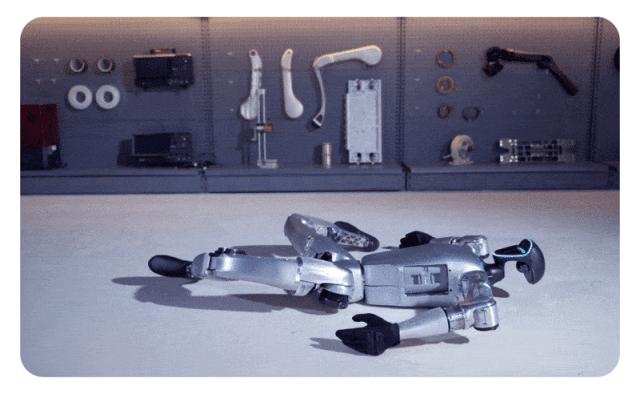
G1 Humanoid Robot
When the head company confirms in person that "commercialization will take several more years", this is the starting point of the tough days for the entire industry in the next two years.
01
The timeline keeps being moved forward, but the bottleneck remains unchanged
In the past year, Wang Xingxing's public statements have changed several times.
In August 2025, at the World Robot Conference, he said the ChatGPT moment for embodied intelligence would come "in 1-2 years or 2-3 years if everything goes well";
On August 20, 2026, the second day after listing, he said "as fast as 2 to 3 years, as slow as 5 to 10 years"; at the Industry Expo on October 12, he made his most radical statement: "as fast as within 1 or 2 years", and GPT-7 next year may directly achieve breakthrough; today, he returned to the statement of "seeing signs of breakthrough in 1-2 years or 2-3 years".
Every time a new generation of large model is released, he moves the timeline forward one step. But a set of keywords has never changed: alignment, generalization, error, retraining.
In August, he put it most bluntly: When sufficient data collection is completed in a fixed scenario, the success rate is close to 100%; once the environment changes slightly, the success rate plummets. When a robot tries to grab an object, it looks like it has grasped it, but there is always a gap of several centimeters to several millimeters in the end, which cannot be corrected. The factory pilot has been carried out for two years, but the efficiency is still lower than that of human workers, and retraining is required for every new task.
The forward movement of the timeline is driven by large models; the unchanged bottleneck is determined by the physical world.
According to the statement of the head company itself, the day when robots are truly applied in scenarios such as housework, nursing and factories is still several years away.
02
"Insufficient faith" refers to insufficient investment in the brain
Funding is the lifeblood of this industry.
According to Wang Huadong: "In the history of Chinese investment, there has never been an industry like the embodied intelligence industry, where so many companies have raised so much money at such high valuations."
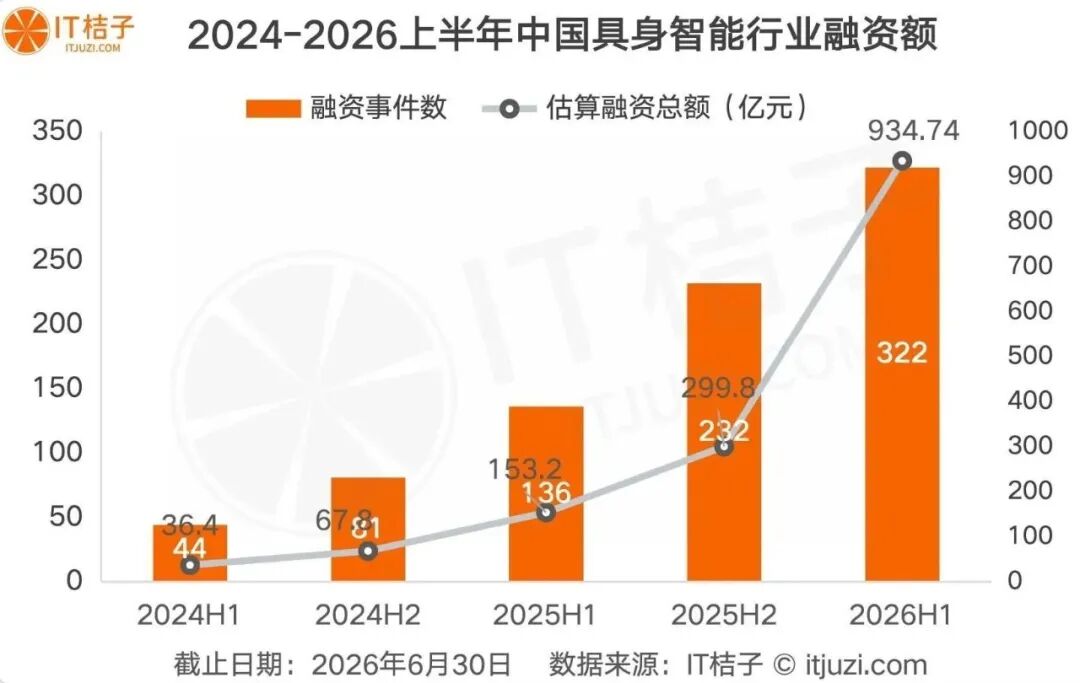
According to statistics from IT Juzi, the domestic embodied intelligence track raised about 935 billion yuan in the first half of 2026, exceeding the total amount of 2025 in just half a year.
According to the monthly statistics of the Humanoid Robot Scenario Application Alliance, global financing reached a record high of 315 billion yuan in June alone, and returned to over 300 billion yuan in August. XPeng Robotics raised more than 900 million US dollars in one round, setting a new record for a single round of private equity financing in China's embodied intelligence sector.
However, the direction of this huge amount of investment does not match the bottleneck identified by Wang Xingxing.
The bulk of the financing flows to ontology hardware: complete machines, joints, dexterous hands, and sensors.
And as he said, almost everyone around the world does not attach enough importance to and have enough faith in AI, including himself.
In his context, this sentence is not a modest remark, but a strategic proposition: the focus of the industry in the past two years has been entirely on hardware, and the real decisive factor lies in the embodied brain, while the industry's investment in AI is far from enough.
At the Industry Expo on October 12, he also reflected: "The biggest mistake I have made in the past ten years is that I did not trust AI enough."
A founder who has achieved global No.1 position relying on hardware publicly stated that the strategic focus should shift to the AI brain.
Following this judgment, we will get a colder conclusion: If the bottleneck really lies in AI, then hundreds of companies valued based on the logic of "hardware mass production" in the past two years will all need to be re-evaluated.
The meaning of "commercial value will be realized a few years later" has also changed: it does not mean that you can just wait it out, but that the money may need to be spent in a different way.
03
What H2-X proves is: There is no core improvement in capability
Let's look at the product side again.
The day before the conference, Unitree released the H2-X "Kung Fu Legend Guardian": it can kick a car door dented, lift a car with bare hands, complete a 4-meter backflip and land safely, with a nominal maximum battery life of about 8 hours. Its scenario positioning includes protecting the owner, participating in car accident rescue, security and emergency rescue.
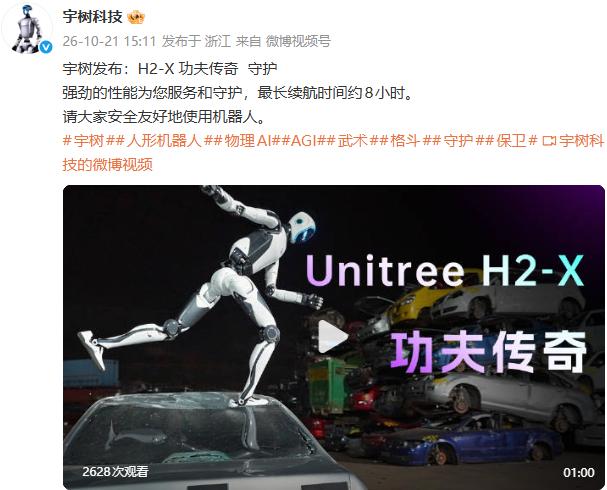
Screenshot from Weibo
Looking back a year ago, Unitree appeared on the Spring Festival Gala relying on martial arts and yangko dance performances.
The movements are more powerful, the packaging is updated, but the essence remains the same: it is still scenarios with high fault tolerance, simple tasks, no need for fine operation, and no autonomous operation capability.
The part of fine operation, that is, the part stuck by alignment, has not been touched by this generation of products at all.
Here we need to break down what Wang Xingxing means by "commercial services".
This category includes the current batch of scenarios: exhibition hall performances, shopping mall tours, stage martial arts, plus the newly released security scenarios.
They have common features: closed scenarios, fixed tasks, no need for generalization, performing the same set of actions for different audiences, and walking the same route in different shopping malls.
This kind of scenario can generate revenue, but cannot generate large revenue: there is no room for large-scale replication, it cannot handle thousands of new items, and the ceiling is within easy reach.
The so-called priority implementation of commercial services means to continue selling the same batch of products with low generalization capabilities in different scenarios.
Take the highly anticipated direction of housework as a comparison.
Folding clothes, tidying desktops, and handling thousands of items of different shapes are precisely the parts that have been repeatedly proven to be the most difficult by test data.
Xu Huazhe, founder of Pebble Robotics, disclosed tests at the Bund Conference: The robot control task success rate of GPT-6 Astra reaches 95%, while the previous generation model only has a 40% success rate; but it still cannot complete tasks such as poking objects with chopsticks, folding boxes, and folding clothes.
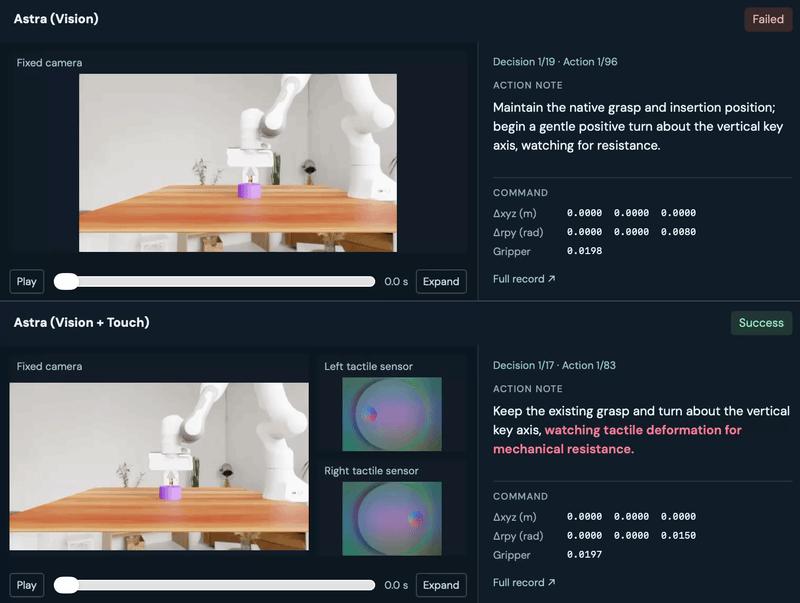
Astra's operation comparison in the key extraction task
The response of head companies is very honest: Without capability breakthroughs, we will continue to make products for scenarios that are within our current reach.
The shipment structure shows that this is not a choice of a single company.
According to IDC data, global shipments of humanoid robots in the first half of 2026 are close to 25,000 units, of which scientific research and education, performance exhibition, and government data collection centers account for 69%. The main buyers of robots are still people who research robots, people who display robots, and people who collect data for robots.
When the head companies are in this situation, the product structure of the entire industry is basically finalized: In the next two or three years, revenue will depend on the opportunities from scenarios that can achieve "fuzzy correctness", and general applications that can generate real commercial value will have to wait for model breakthroughs.
04
This is a sign that the industry is about to enter a cold winter
Putting the capital side and the above reality together, the contradiction is obvious at a glance.
The primary market has poured in the largest amount of money in history based on the valuation logic of "commercialization is coming soon".
However, the timeline for commercialization has been pushed back by several years by the head founders.
In the next few years, hundreds of companies will continue to burn money, where will the money come from?
The two signals of the cold winter in the embodied industry have already gathered: Capital is becoming volatile, and scenarios are absent.
On the financing side, the financing hit a record high of 315 billion yuan in June, plummeted 62% month-on-month in July, rebounded to 300 billion yuan in August, and there were only two large financing deals exceeding 1 billion yuan in September — capital has shifted from casting a wide net to only supporting head companies and core component suppliers.
On the demand side, large-scale commercial scenarios have not been realized so far, and nearly 70% of shipments in the first half of the year flowed to scientific research, performance and data collection.
Investment fluctuations and scenario absence will reinforce each other: without new capital, companies that cannot survive the bottleneck will die first; without large-scale scenarios, the surviving companies cannot grow bigger.
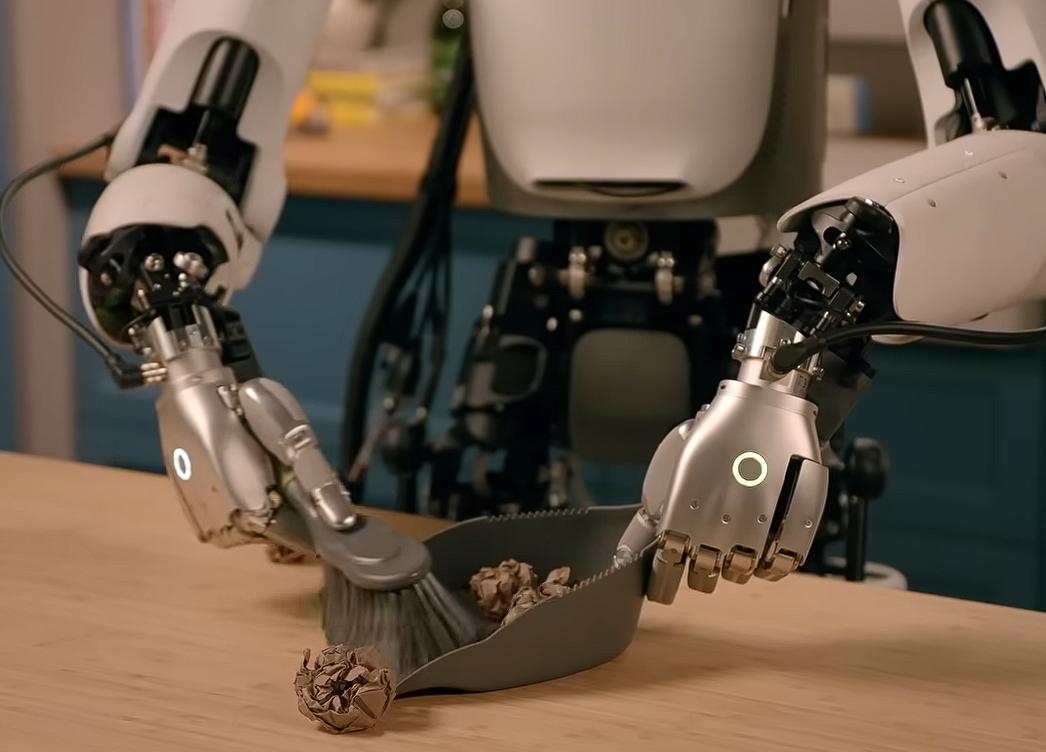
This is the mechanism of the cold winter. It does not mean that the industry is dying, but only companies that survive the bottleneck are qualified to live until the day of breakthrough.
This outcome is not a deduction, but a fact that has already happened.
On October 19, Yinghe Robotics held its first creditors' meeting at the Shenzhen Intermediate People's Court: it was incubated by He Jianfeng, son of He Xiangjian, and once attracted strategic investment from ByteDance and Meituan. With a peak valuation of 500 million US dollars, it now goes into bankruptcy liquidation, its equipment is auctioned by the court, and no one bids even after multiple price cuts.
Deep Blue Robotics owes more than 23 million yuan in salaries, 102 employees collectively filed a claim for rights protection, and it has also entered bankruptcy liquidation. The earlier fallen CloudMinds, once an industry unicorn with a valuation of more than 20 billion yuan, began to default on salaries in early 2024, laid off more than 70% of its staff, and hundreds of former employees still have not received their unpaid salaries.
The same is true in Silicon Valley: K-Scale Labs disbanded its team and fully refunded investors, leaving only 400,000 US dollars in its account...
These companies did not die because of poor technology, but because their capital chain broke and no viable scenarios came.
The exit side has already given the answer.
Unitree was listed on August 19,