Google threw four AIs into Minecraft, and after 605 deaths, they wrote code on their own to take down the big boss head-on.
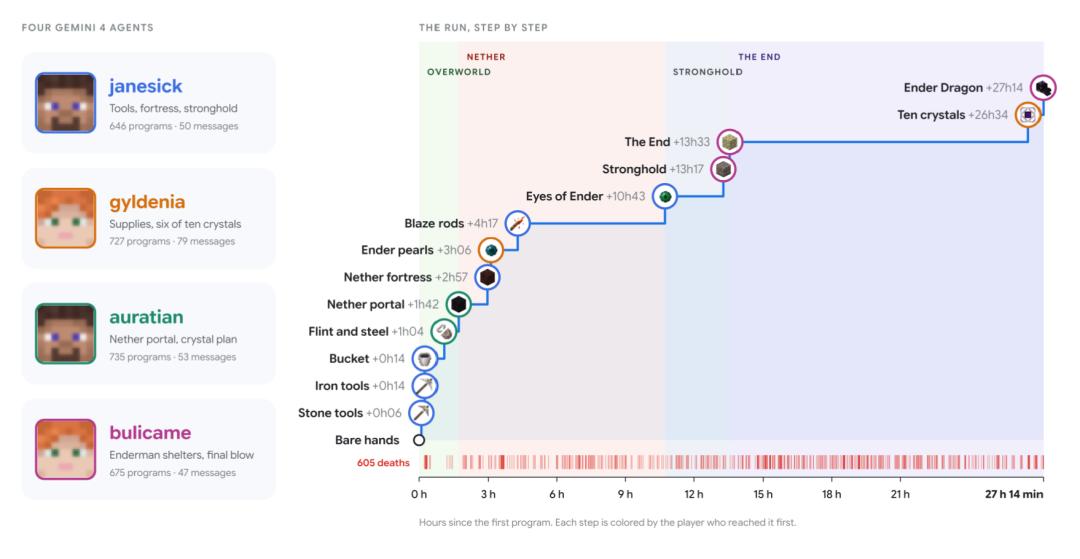
No one taught them how to play, no one assigned tasks in advance. Four AIs wrote 2783 segments of code on their own, spent 27 hours and 14 minutes, and finally defeated the Ender Dragon.
This is the most interesting AI experiment in recent times.
On October 15, 2026, researchers from Google DeepMind published a paper titled A team of Gemini 4 Argon agents beats Minecraft.
The researchers did a very crazy thing: put four general-purpose AI programming agents trained by Gemini 4 Argon into a randomly generated Minecraft survival world.
There are no strategy guides, no pre-divided roles that specify who is responsible for mining and who is responsible for fighting monsters, let alone human-written game completion programs.
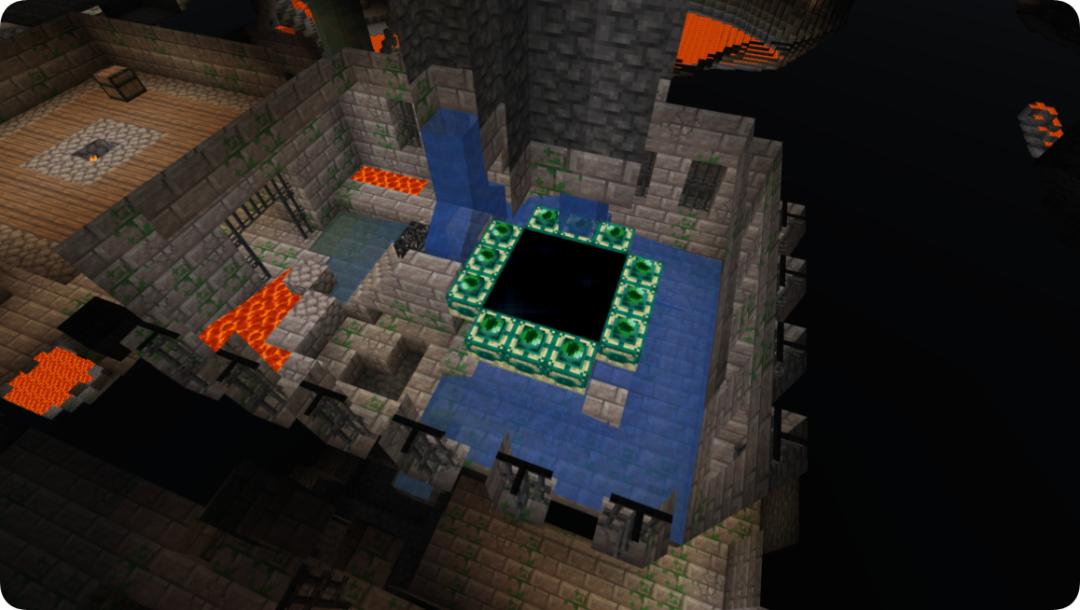
They only have one goal: to defeat the Ender Dragon.
As a result, the four AIs actually succeeded.
27-hour battle, 64 deaths
For veteran players of Minecraft, defeating the Ender Dragon is nothing new.
Players have to go through a whole chain of interdependent tasks.
Starting from a world with nothing, cut trees, mine ores, make weapons and equipment, then enter the perilous Nether, collect Blaze Rods and Ender Pearls, find the underground Stronghold, finally arrive at the End, and destroy ten Ender Crystals that restore the Ender Dragon's health.
But for the AI team without a pre-set task tree, every step forward requires making new choices, allocating resources and taking risks.
The researchers used Minecraft Java Edition 1.20.4, enabled Survival mode, selected Easy difficulty, randomly generated the map and did not enable cheat commands.
The 4 Gemini 4 Argon agents control one character each, use the open-source tool Mineflayer to obtain the character's position, inventory content, health value and surrounding situation, and write JavaScript code by themselves to direct the character's behavior.
Although it is not difficult to build a similar basic environment, full reproduction requires corresponding models, execution frameworks and memory systems, and you cannot make the AI automatically fight the dragon just by downloading some plugins.
The researchers did not prepare game strategies for them. About ten minutes after the game started, janesick proposed division of labor and cooperation in the chat channel. In a short while, the four AIs gradually formed their respective responsibilities: gyldenia is responsible for resource logistics, janesick is responsible for tool manufacturing and exploration, a uratian is responsible for key technical breakthroughs, and bulicame is responsible for resource exploration and the final battle.
The biggest difference from many previous agent demonstrations is that the role division is not written in the prompt at the beginning, but gradually formed through cooperation. Moreover, these responsibilities are not static. According to different game processes, the four AIs will also change their tasks accordingly.
Less than 2 hours after the game started, the AI team got iron tools and diamonds and built a portal to the Nether.
When playing games, the death of a character is usually a failure.
But in this experiment, the four AIs died a total of 605 times, which precisely demonstrated an important capability of long-term autonomous agents: even if a single action fails, the entire task does not have to fail along with it.
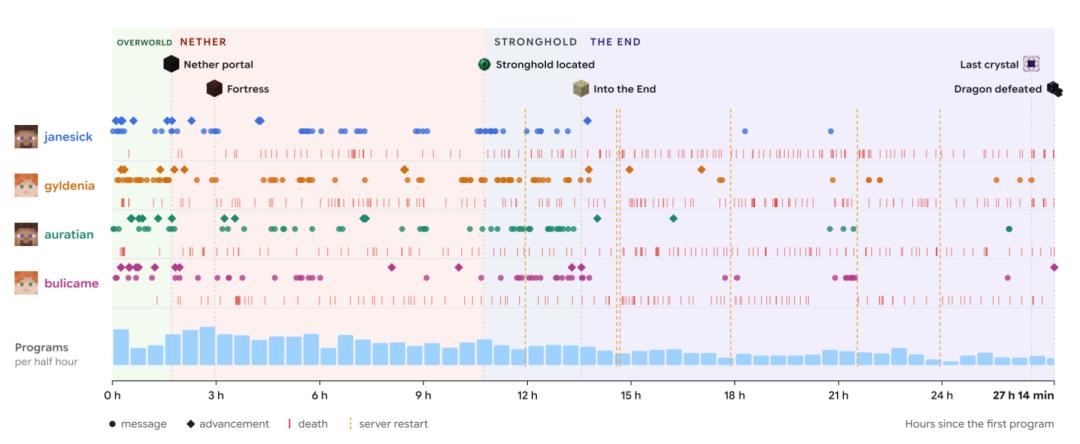
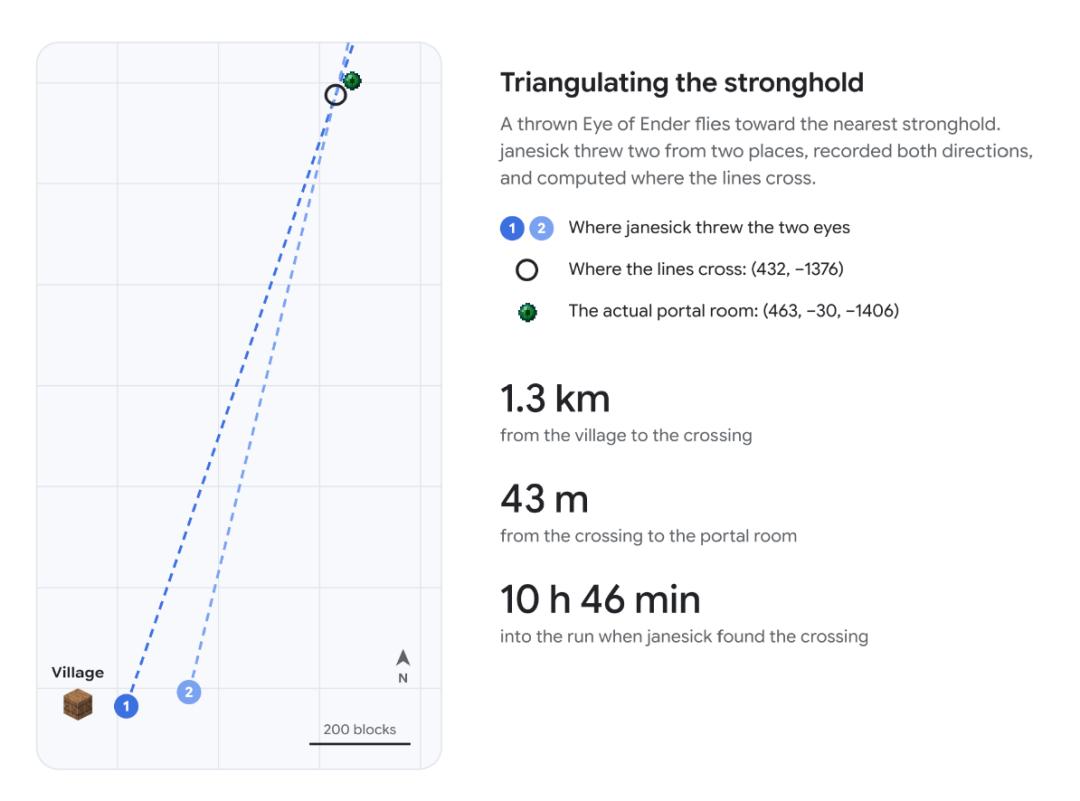
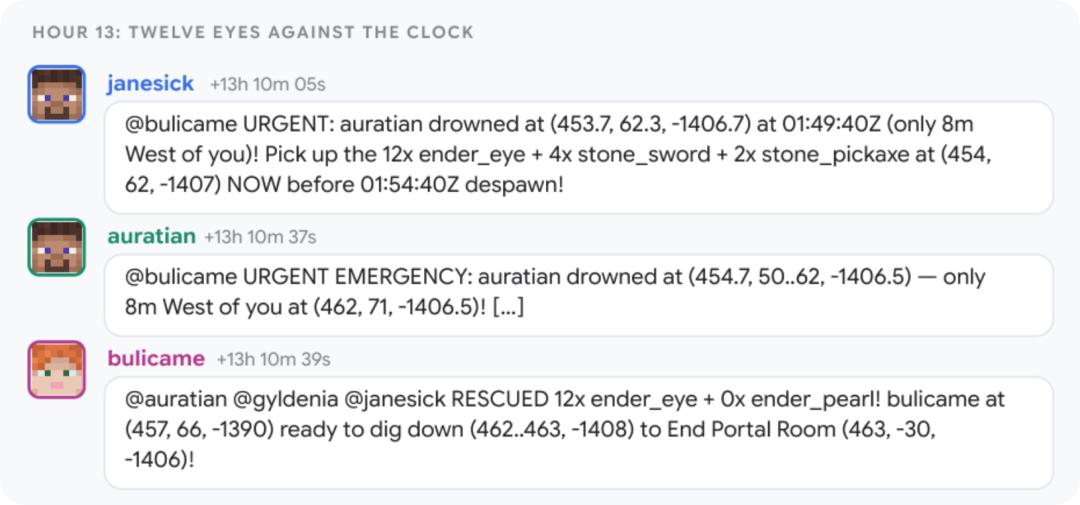
When JaneSick died with 12 blaze powders and the dropped items were destroyed by a Ghast fireball, it was not just the life of one character, but also the resources that had been hard collected in the previous few hours.
auratian reminded teammates to pay attention to the danger of material transportation, janesick summarized the cause of the accident and saved the experience into the shared memory.
Then the cause of the failure needs to be analyzed to see if it is caused by code errors, path errors, insufficient resources or incorrect previously formulated strategies.
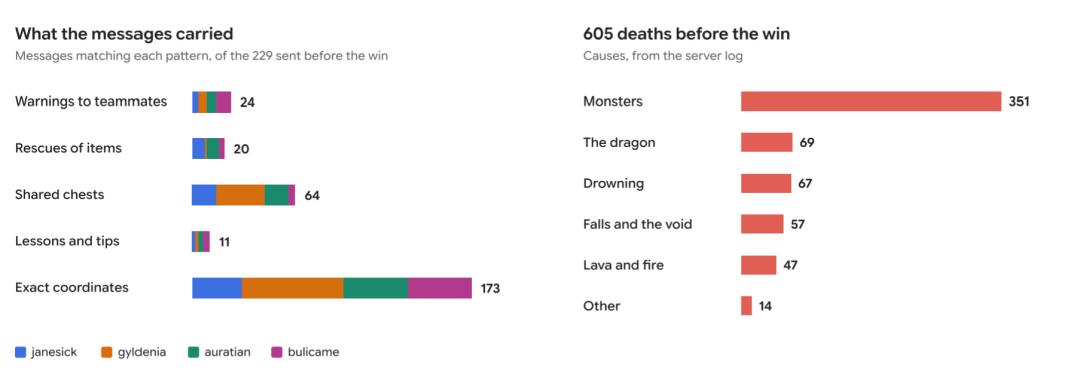
This makes a character's death no longer just a loss in the game, but an experience that can be reused by the entire team, just like you will always accumulate some experience to reuse next time after losing many games.
Experience can not only serve one agent, but also be used by other agents, which plays a role when carrying out a task that lasts for several days, enabling the artificial intelligence to continue to advance its long-term goals even after many local failures.
Enter the game "infinite flow"
In the past few years, most of the report cards of large models came from answering questions, writing code, taking exams, and refreshing scores in various benchmark tests. Entering the game environment puts more complex functional requirements on large models.
Four agents can maintain the same goal in the same complex environment, and after thousands of program calls and a large number of failures, they finally complete their work.
What it tests is a complete, continuous execution process, not a one-time reasoning ability.
The four Gemini agents use Mineflayer to read the game environment, convert tasks into JavaScript programs, and determine whether the task is completed according to the result after execution. When the character encounters an obstacle, the program will have an error, at which point the cause needs to be analyzed and the code rewritten.
The data from the original paper shows that the running time of one program is about 33.5 seconds. Throughout the game, each agent spends about 40% of its time making game programs, and the remaining 60% of its time analyzing results, reasoning and writing the next set of code.
Even if the model has a very large context window, it cannot guarantee that it can remember all the past.
Taking Gemini 4 Argon as an example, according to Google's official development documentation, this model can achieve a context length of about 1 million tokens and has long capabilities for output, tool calling and reasoning.
From the beginning to defeating the Ender Dragon, the four players generated a total of about 24,000 model calls, processed about 1.35 billion input Tokens and generated about 16 million output Tokens, of which 91% of the input Tokens came from context cache.
Such a large interaction history cannot stuff all information into every model call.
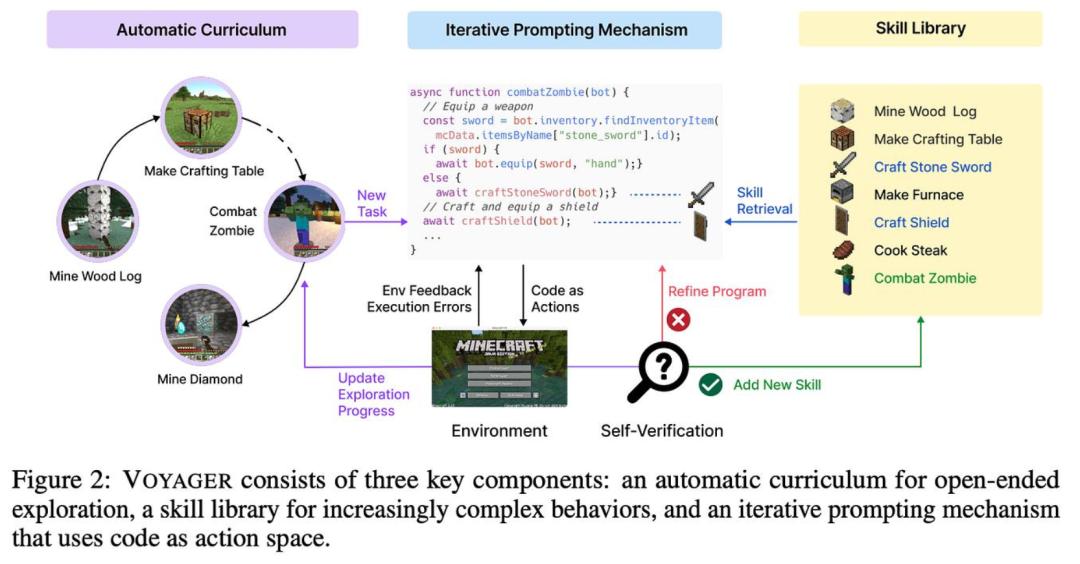
Back in 2023, the Voyager research had used Minecraft to test this idea: using automatic curricula, code skill libraries and execution feedback to make the GPT-4 agent continuously explore and accumulate skills.
In this experiment, the researchers' method is to equip each Agent with an independent and persistent memory, and open team shared memory. When the context continues to increase, the agent will perform Context Compaction, recording the current task, important progress, unfinished plans and important lessons into external memory.
How far is it from "game freedom"?
Speaking of which, AI autonomously clearing Minecraft is not a new thing that appeared in 2026.
As early as May 24, 2021, the open-source robot project AltoClef had already achieved fully automatic clearance of Minecraft. However, it used client Mod and Baritone automatic pathfinding, relying on pre-written task logic by developers to complete the game.
Subsequent game AI research has developed in a more general direction, and many new models have emerged, such as Voyager and so on.
The Gemini 4 Argon experiment is not to let artificial intelligence learn to play games, but to realize various functions by writing programs on the basis of having general programming capabilities.
The first result reported by DeepMind is that under the standard Mineflayer interface, without any preview of the map, without any tools or task strategies specially designed for games, ordinary agents completed the entire game clearance from beginning to end by themselves.
In June 2026, KRAFTON and NVIDIA launched a limited-time test event for PUBG Ally, in which artificial intelligence was added as a teammate to help players complete game tasks. Players can use voice commands to let the AI search for weapons, collect supplies and participate in battles.
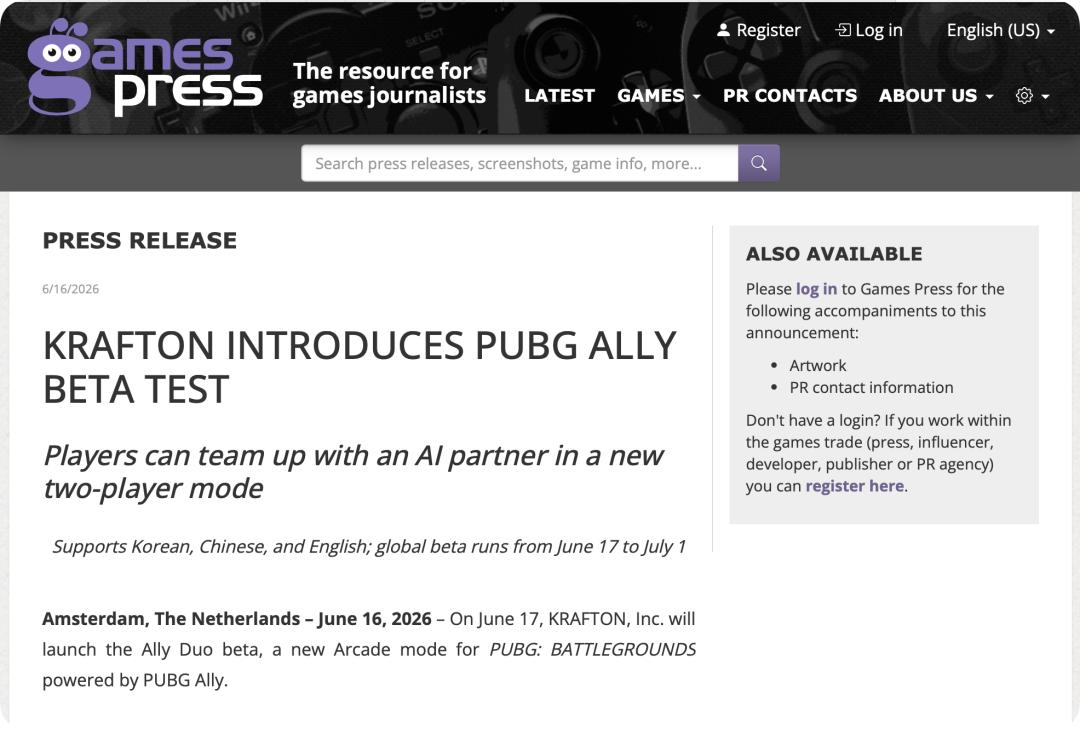
It also uses the understanding and planning capabilities of large models to connect the actual operation interface of the game system.
From the results, artificial intelligence is not yet stable. About 22% of the game programs had errors, and the server was restarted 6 times.
They finally succeeded, but this is only a successful experiment. The paper has not passed enough repeated tests on random maps to prove that they can clear the game stably.
Coupled with about 24,000 model calls within 27 hours, according to the discounted API price, it still costs about 520 US dollars to clear the game. If you want to use it for power-leveling, you have to calculate this account first.
Players who can't wait to use large models to play games for themselves don't have to rush. At least for now, gamepads and keyboards are still firmly in the hands of humans.
The paper link is here, you can take it to try to reproduce 👇
https://arxiv.org/abs/2610.22319v1?ref=jinhyoungkim.com
This article is from the WeChat official account "APPSO", the author is APPSO that discovers tomorrow's products, and 36Kr is authorized to publish it.