NVIDIA storms into the market, sparking a fierce rivalry among the four leading CPU powerhouses.
In 2026, the server CPU market is once again engulfed in fierce competition.
On October 19, Modal, a US AI cloud service provider, announced plans to introduce NVIDIA's new-generation Vera CPU to run AI Agent related workloads. Previously, the company's CPU infrastructure had long relied on x86 processors from Intel and AMD. Now, NVIDIA is leveraging Vera to break into the market that has long been dominated by traditional CPU giants.
But NVIDIA is far from the only new entrant. Back in March this year, Arm, whose core business had long centered on IP licensing, launched its first self-designed data center processor AGI CPU, officially stepping from behind the scenes to the forefront of the industry.
For a time, the server CPU market, once mainly dominated by Intel and AMD, has welcomed two powerful new competitors: NVIDIA and Arm. Facing the computing power tsunami brought by AI Agents, what exactly is the new round of division and game in the CPU market fighting for?
The Rise of Agents Transforms the Role of CPUs
Over the past decades, the development of server CPUs has long revolved around higher general-purpose computing performance. However, with the rise of Agentic AI, this long-established design logic is undergoing fundamental changes.
In traditional GPU-accelerated servers, CPUs are mainly responsible for data preparation, task scheduling, I/O processing and coordination with accelerators, with the core mission of ensuring the efficient operation of GPUs. In Agent execution environments, however, CPUs also need to undertake a large number of tasks such as sandbox operation, code execution, tool invocation and data processing. Especially when tens of thousands of Agents run concurrently, the importance of single-threaded performance, memory bandwidth, task throughput and resource isolation capabilities has become increasingly prominent.
Different AI workloads are putting forward completely different requirements for CPUs.
In June this year, Satadal Bhattacharjee, Head of Global Cloud and AI Infrastructure Chips at Arm, pointed out in his article From Host Node to Heterogeneous Rack: Rethinking the AI CPU that as AI infrastructure evolves toward specialized computing, CPUs are undertaking an increasing number of differentiated tasks. Agentic AI is driving data centers to shift from accelerator-centric architectures to heterogeneous rack designs oriented to complete AI workflows. This means that in the future, CPUs will not only provide general computing power, but also need to be specially optimized for different computing stages.
Arm further divides CPUs in AI computing into three roles: host CPUs serving the model prefill stage, host CPUs serving the decode stage, and Agent execution CPUs responsible for tasks such as code execution and tool invocation between model calls.
This division sends an important signal: the value of CPUs is shifting from simply competing for general-purpose computing performance to competing for actual efficiency under specific workloads.
For server CPU manufacturers, this not only means that the direction of product design needs to be adjusted, but may also give rise to more segmented market demands. The competition that used to center on general performance is gradually evolving into a new pattern that attaches equal importance to general performance and workload optimization.
Four Major Players Unveil Their Unique Killer Features
Facing the new round of computing demands brought by Agentic AI, NVIDIA, Arm, AMD and Intel have all unveiled their respective strategies. Although the four manufacturers are targeting the same market, their technical routes and strategic considerations are quite different.
NVIDIA — Extending from GPUs to CPUs to Seize Control of AI Systems
Let's start with NVIDIA. NVIDIA's confidence first comes from its huge ecosystem built in the field of AI accelerated computing.
As GPUs occupy a core position in the AI training and inference market, NVIDIA has gradually realized that what affects the efficiency of AI systems is no longer only the GPU itself, but also the CPU, memory, interconnection and the entire software operating environment.
Vera is a direct continuation of this line of thinking. As the new-generation CPU following Grace, Vera adopts NVIDIA's self-designed Olympus core, integrates 88 cores and 176 threads, and delivers a maximum memory bandwidth of 1.2TB/s through the LPDDR5X memory system.
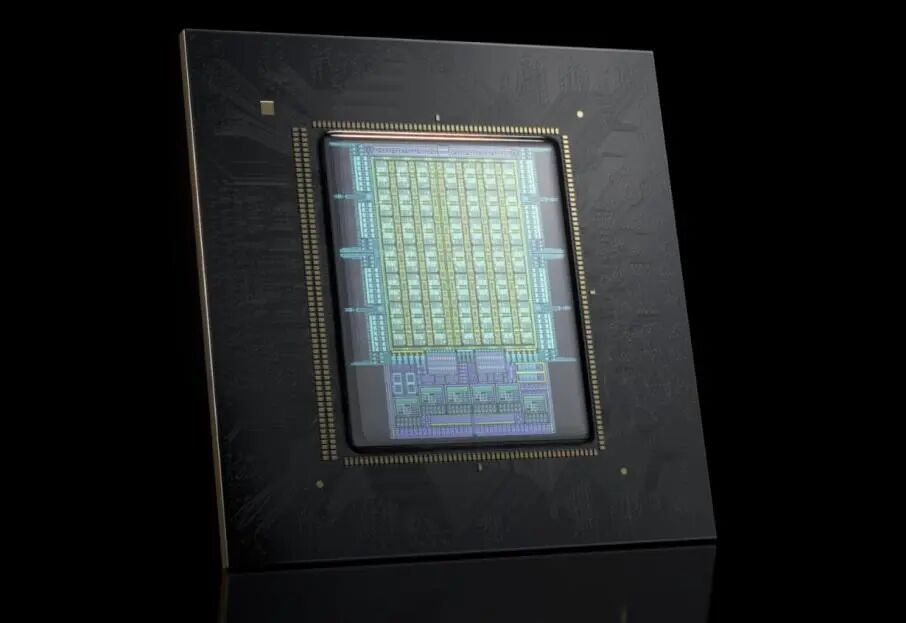
NVIDIA Vera CPU (Source: NVIDIA)
It can be seen that its design focus is not to blindly increase the number of cores, but to improve single-threaded performance while reducing resource contention and improving memory access efficiency in high-concurrency environments. This highly aligns with the characteristics of Agent workloads: a large number of tasks run in parallel, but each individual task requires fast response speed. More importantly, Vera can not only work closely with NVIDIA GPUs through NVLink-C2C, but also be deployed independently in CPU servers.
According to the technical report released by Modal on October 19, Vera does not outperform competitors in all single-task tests, and its leading edge is not very obvious. The figure below shows the reasonably expected single-task latency of Agent running tasks (selected from Terminal-Bench) in the sandbox. This experiment runs serially on an unloaded machine, so the result shows pure single-thread/single-task latency.
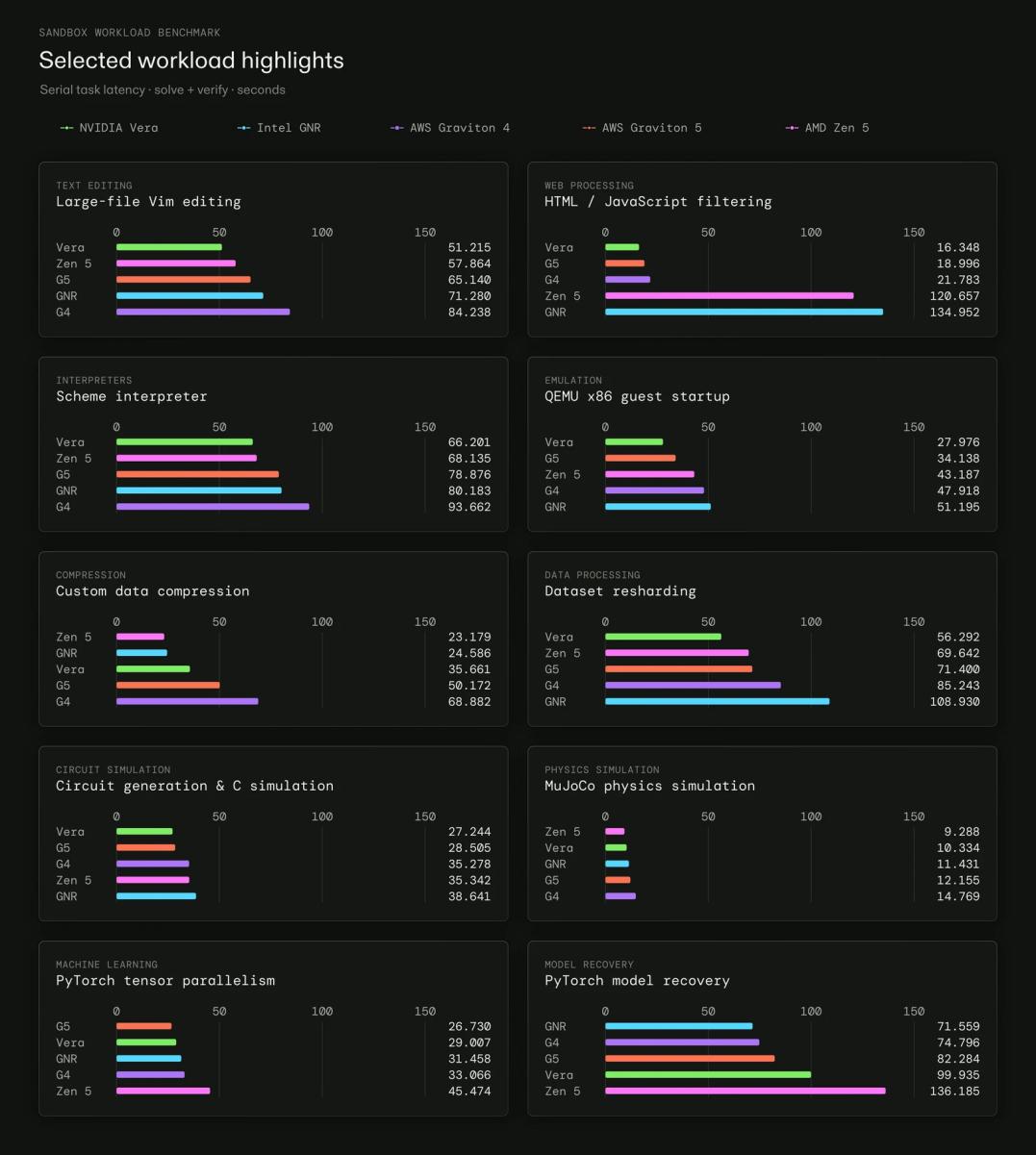
Single-task latency comparison under no load (Source: Modal)
However, as the number of concurrent tasks continues to increase, its throughput advantage begins to expand. Under specific test conditions, compared with Intel's Granite Rapids platform, Vera can achieve up to about twice the task throughput. Its key advantage lies in memory bandwidth and resource contention control under high load. That is exactly why Modal has become a firm supporter of Vera.
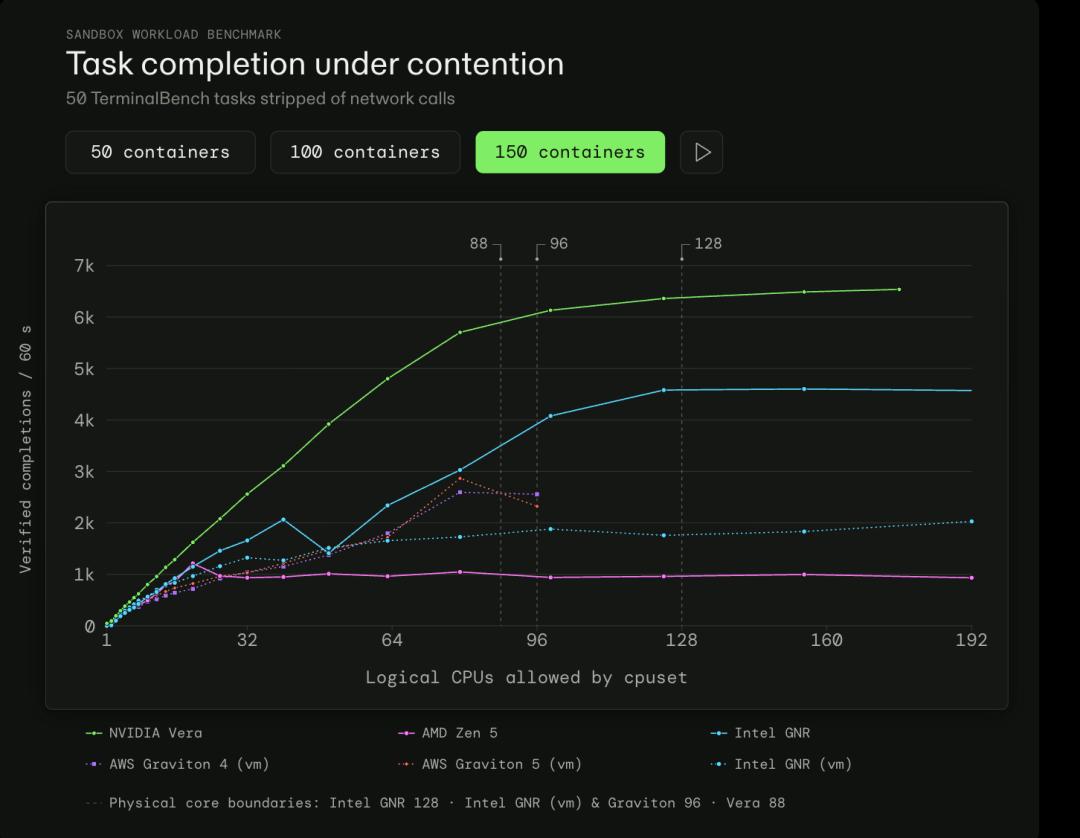
Task throughput comparison of various CPU platforms in high resource contention scenarios with different (50/100/150) concurrent containers (Modal benchmark test)
This is not the first time NVIDIA has launched a CPU, but it is an important breakthrough in the commercialization of its independent CPUs. Vera is not only paired with Rubin GPUs, but can also be deployed in independent CPU servers. Modal, which has long adopted the x86 architecture, is now starting to adapt its infrastructure for the Arm architecture, which means NVIDIA has the opportunity to enter the computing resource pool originally supplied by Intel and AMD. According to a Reuters report on October 19, NVIDIA's sales forecast for the Vera chip proposed to investors for the current fiscal year has reached at least 20 billion US dollars.
Arm — Moving from IP licensing to self-developed chips to reshape its role in the industrial chain
Now let's look at Arm. After years of "tough business" of IP licensing, Arm has long wanted to enter the processor market.
Sure enough, back in March this year, Arm launched the data center-oriented AGI CPU co-developed with Meta. This processor based on the Neoverse V3 architecture integrates up to 136 CPU cores, has a thermal design power of 300W, is manufactured on TSMC's 3nm process, and is mainly oriented to Agentic AI infrastructure.
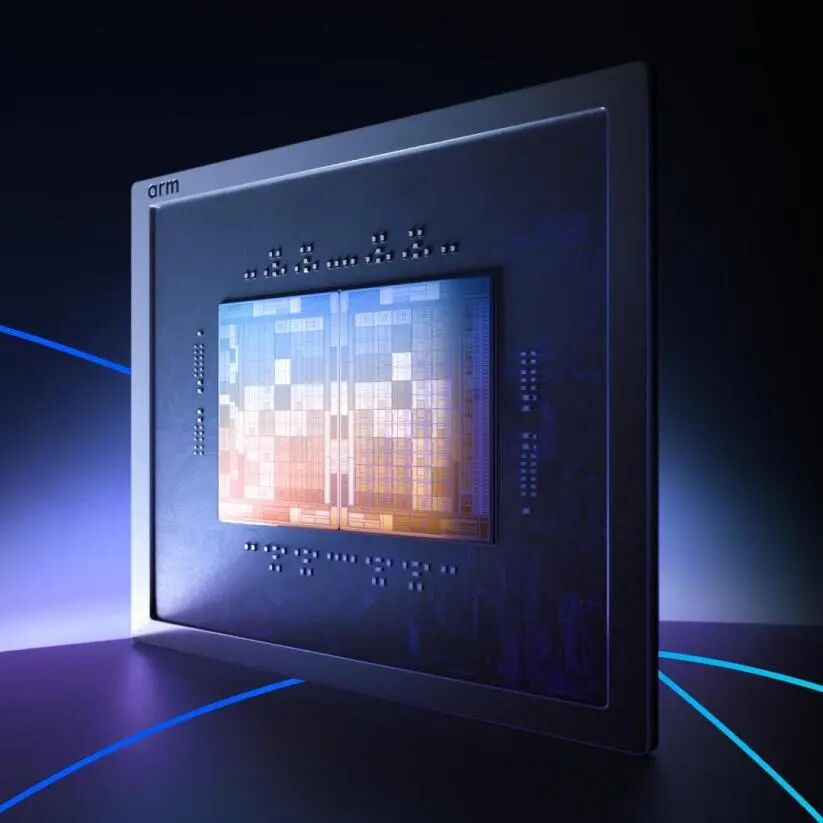
Arm AGI CPU (Source: Arm)
Arm does not focus all its attention on the performance of a single CPU, but emphasizes rack-level computing density and energy efficiency. According to the data released by Arm, under specific test and configuration conditions, the AGI CPU can achieve more than twice the rack-level performance of the x86 platform, though this result still needs to be viewed in combination with specific workloads and test conditions. This design direction reflects Arm's judgment on the data center market: when the number of Agents continues to grow, how many tasks can be run within a limited power budget may be more important than the peak performance of a single CPU.
Arm also co-developed the AGI CPU with Meta and has received support from many cloud computing and equipment manufacturers.
It is worth noting that as Arm enters the chip market in person, its relationship with customers has also begun to change. Products such as NVIDIA Vera, AWS Graviton, and Google Axion are all built on the Arm architecture ecosystem. Now Arm is not only a technology supplier for these companies, but also has become a direct competitor in the server CPU market. How to develop its own chip business while maintaining an open licensing ecosystem will become a new issue that Arm must address.
AMD — Continuing to leverage the advantages of multi-core, Chiplet and x86 ecosystem
Facing these two new entrants, AMD has no intention of giving up the advantages it has accumulated in the x86 market.
In May this year, AMD announced that its 6th-generation EPYC processor codenamed Venice has started mass production ramp-up on TSMC's 2nm process. This product adopts the Zen 6 architecture, with up to 256 cores and 512 threads per single CPU, and supports 16-channel DDR5 memory and PCIe 6.0. Multi-core design, Chiplet architecture and continuously improved memory and I/O capabilities remain important chips for AMD to compete in the server market.
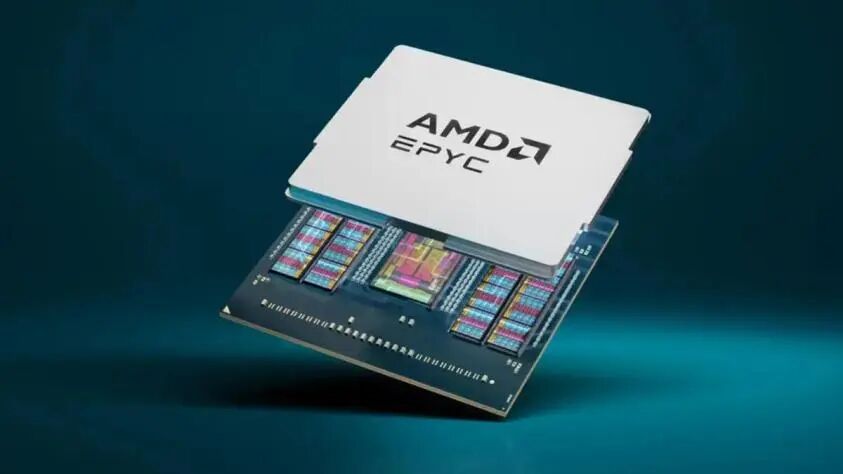
However, AMD's latest moves show that it is also aware of the changes in Agent computing requirements. On October 12, AMD released the Helion Agentic AI rack solution, proposing two different infrastructure forms: one is a pure CPU rack that supports up to 32,768 CPU cores, which is specifically responsible for Agent execution tasks and connected to an external model inference system; the other integrates EPYC CPUs, Instinct GPUs and general computing nodes in the same rack.
It can be seen that AMD has begun to regard Agent execution and model inference as two types of workloads that can be independently configured with computing resources. For large-scale cloud service providers, a large number of Agents can be run through high-density CPU clusters; for enterprise customers, CPUs and GPUs can be deployed in a unified platform according to demand.
According to AMD's plan, Helion-related configurations will be available starting from November this year, and are currently in the ecological partner development stage.
Intel — Defending its core market with new architectures and mature ecosystems
Among the four manufacturers, Intel faces the most complex competitive pressure. On the one hand, AMD continues to expand its share in the x86 server market; on the other hand, the Arm camp is penetrating into data centers relying on energy efficiency advantages, and now NVIDIA Vera has also joined the competition.
According to data from Mercury Research, in the second quarter of 2026, in its broad-caliber x86 server CPU statistical scope, Intel's shipment share was 65.5%, and AMD's was 34.5%; if only comparing EPYC and Xeon processors in the core server market, AMD's shipment share has reached 46.4%.
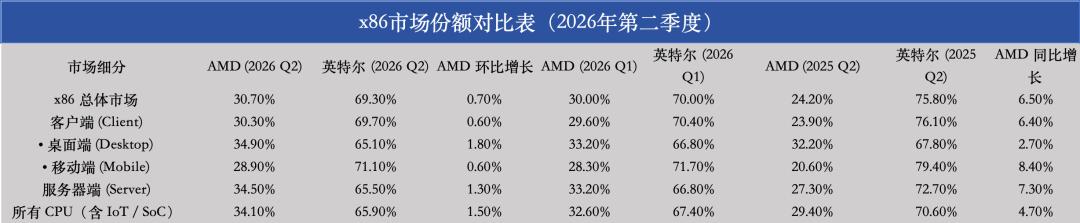
Data source: tom'shardware
Facing the new round of competition, Intel is fighting back through two product lines.
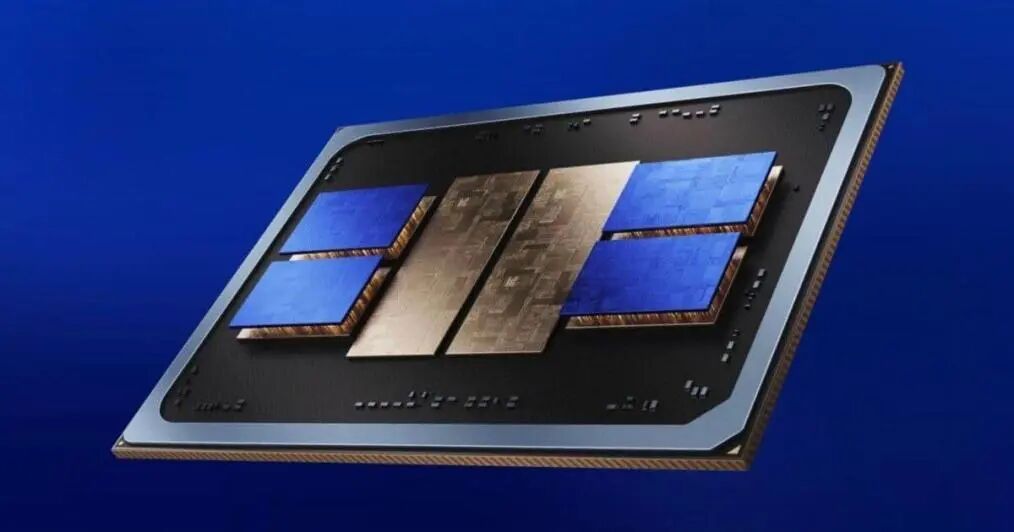
The already launched Xeon 6+ (Clearwater Forest) adopts Intel 18A process, integrates up to 288 efficient cores, emphasizes high-density computing, throughput and energy efficiency, and is suitable for cloud-native and large-scale parallel tasks.
At the same time, the next-generation Diamond Rapids focuses more on high-performance general-purpose computing. At this year's Hot Chips conference, Intel revealed more technical details of Diamond Rapids, including up to 256 performance cores, 1.28GB last-level cache, 16-channel memory, PCIe 6.0, CXL 3.0 and other capabilities, and further enhanced architectural technologies such as AMX matrix acceleration and APX.
Intel also combines Diamond Rapids with the Crescent Island GPU for AI inference, trying to build a complete platform covering Agent task orchestration, model inference and general computing.
Compared with NVIDIA, Intel's biggest advantage lies in its long-accumulated x86 software ecosystem, enterprise customer relationships and mature server platforms. A large number of databases, enterprise applications, virtualization platforms and development tools have been optimized for x86 for many years, and these will not be quickly replaced just because new architectures emerge.
But for Intel, relying only on ecological advantages is obviously not enough. As competitors continue to make breakthroughs in energy efficiency, memory bandwidth and system architecture, how to make the new generation of Xeon truly meet Agent computing requirements will directly affect its future market position.
What they are fighting for goes far beyond a single chip
When we step back from the specific microarchitecture and parameter comparison to examine this "four-way CPU hegemony" jointly launched by NVIDIA, Arm, AMD and Intel, we will find that this transformation has long gone beyond the traditional market share encroachment between semiconductor manufacturers. The core essence of this four-player competition is an in-depth battle for commercial control and industrial chain reconstruction, which mainly involves three layers of interests.
The first layer: competing for the new CPU budget of AI data centers.
The rise of Agentic AI is creating new growth opportunities for CPUs. In May 2026, Adrian O'Connell, an analyst at Gartner, released a report titled Agentic Will Drive CPU Demand and Bring Opportunities for New Entrants, pointing out that the boom of generative AI has driven GPU demand, while the growth of Agentic AI has re-highlighted the importance of CPUs. However, Gartner also reminded that the Agent-driven CPU market growth will not reach the level of the previous GPU explosion brought by generative AI, and the final beneficiaries may not necessarily be traditional CPU manufacturers.
IDC also clearly raised its demand forecast for non-accelerated servers in its updated global server market forecast in October this year, one of the reasons being that Agentic AI and inference workloads have begun to increase demand for standard rack x86 servers.
The second layer: competing for the entry of the Agent execution platform.
In the AI era, it is no longer an era where a single processor fights alone, but an era that pursues the maximum benefit of the entire system. That is why the competition of the four manufacturers has begun to extend from chips to the entire platform. Whether it is cutting into the GPU field from the CPU side