The battle over Personal Agent is spreading to the hardware sector.
AI glasses, earphones and recording devices are becoming the entry points for Personal Agent to enter the real world.
On October 13, Qwen launched AI glasses and AI ear-clamp earphones, aiming to enable the same Personal Agent to understand users and continue tasks across different devices. At the same time, hardware manufacturers are also trying to convert real-world communications into context that can be called by Agents through earphones and recording devices.
Mobile phones already have built-in recording, perception and AI processing capabilities, so why do users still need to purchase a separate set of dedicated hardware?
One of the features of independent hardware is fast startup. In efficiency-focused scenarios, the process of unlocking the phone, opening the app and pressing the recording button is relatively lengthy, and even lighting up the phone to check the recording status during a meeting will distract your attention. In contrast, pressing the button on the recording device and seeing the indicator light turn on is a much simpler and more straightforward operation, bringing a more relaxed experience to users.
Hardware sales reflect users' willingness to purchase, while user stickiness needs to be judged based on subscription conversion, continuous usage and renewal rates.
Although model inference and task execution capabilities can be provided by external platforms, hardware manufacturers can also participate in context management.
Qwen integrates models, apps and hardware, Shokz provides services with the help of external AI capabilities, viaim, a brand under Future Intelligence, tries to schedule other Agents through its own Personal Agent, and Bee under Amazon accesses existing assistants and shopping services. Different enterprises are exploring their own positioning in this track.
Hardware acts as the sensory organ for Personal Agent to absorb context in the real world, and competition among various manufacturers is unfolding around the long-term management, task scheduling and service charging of this type of information.
I
By the Ear, Before the Eyes, The Same Agent
One Personal Agent has strung together a whole hardware launch event.
On October 13, Qwen, under Alibaba, launched its AI glasses N1, N1 Pro and AI ear-clamp earphones, with all three products available for spot sale on the same day. After applying national subsidies and limited-time discounts, the starting price of the glasses for consumers is 2218 yuan, and the starting first-sale price of the earphones is 1099 yuan.
Song Gang, Vice President of Qwen Business Unit of Alibaba Group, stated at the launch event:
"Qwen's goal is to become the Personal Agent for everyone. We believe that AI wearables are the extension of Qwen in the physical world and an important part of Personal Agent. No matter where you initiate a demand, it is always the same Qwen behind it, understanding the same user and continuing the same goal."
Prior to this launch event, Alibaba has already laid out AI applications, internal group services and hardware terminals around Qwen.
Glasses, earphones and recording devices are respectively oriented to scenarios such as visual perception, portable voice interaction and office records. The "Skill Square" on the Qwen Open Platform has begun to introduce third-party services, so that users' voice commands can call for more functions.
In August, Shokz launched the OpenFit 2 AI earphones; in September, Meta announced at the Connect conference that it would introduce its personal agent Muse to the AI glasses product line, with the launch expected in a few months.
The story of AI-native products was first told by Humane AI Pin and Rabbit R1 two years ago, but the product experience did not reach the expected level, and the freshness shown in the promotional videos was not realized. Most of the new round of AI hardware no longer focuses on replacing mobile phones, and earphones, glasses and recording devices are set to take on more perception and interaction tasks.
It may not be the most reasonable choice for a single piece of hardware to cover all users' life scenarios.
Hardware such as earphones, glasses and recording devices have limited size and need to be worn close to the body or carried around. It is difficult for them to compete with smartphones in terms of functional integration and hardware configuration.
The key is to find their respective ecological niches, collaborate with each other, cover different usage scenarios and user demands respectively, and ultimately serve the complete Agent workflow.
For multiple pieces of hardware connected to the same Agent, performance and parameters are still important, as they are part of the long-term user experience. Under this premise, the hardware also needs to continuously obtain scenario information that is useful for the Agent.
II
Clear Audio is Only the Prerequisite
To enable the Agent to use real-world conversations to complete subsequent tasks, it first needs to obtain clear and complete recordings. If the recording obtained at the very beginning is incomplete, it will be very difficult for the subsequent model to accurately restore the missing content.
The context required during Agent processing is not limited to text content. Historical recordings, transcripts, documents, related people, project backgrounds and unfinished tasks can all be the context needed to complete the next task.
Yan Gengzhen, China Regional Director of acoustic technology company Soundskrit, explained to All-Weather Tech that different forms of AI hardware have different requirements for microphones and sound processing algorithms.
Glasses first need to extract the voice of the wearer themselves and remove surrounding noise in noisy environments; if used for face-to-face translation, they also need to clearly hear the speech of the communication counterpart. Recording devices, on the other hand, place more emphasis on long-distance sound pickup, complex meeting room environments, and the ability to distinguish different speakers.
When All-Weather Tech asked which type of company the new acoustic demands mainly come from, Yan Gengzhen replied:
"Both types exist. Some traditional audio hardware manufacturers are considering adding new application forms that combine acoustics and AI, such as reducing the size of the microphone array while lowering the bit error rate of text transcription in noisy environments;
Some companies with an AI background are considering redefining application scenarios around the implementation of large models, adopting new acoustic technologies and applications."
The position where the sound pickup device is placed will also affect the context.
Earphones worn close to the ear are closer to the wearer themselves, making it easier to prioritize and clearly record the user's own voice in noisy public scenarios. However, when having a meeting in the office, people usually place the recording device on the desktop to ensure that everyone's voice can be recorded.
Some products attempt to enable both the earphones and the charging case to record. According to Ma Xiao, founder of Future Intelligence, viaim Rise, the AI agent earphone released at IFA Berlin in September, integrates multiple modes such as previous online recording, face-to-face recording, and audio-video recording into one single recording button.
The button on the charging case can also start recording even when the mobile app is closed, and the recording function does not fully depend on whether the earphones are worn or the mobile app is running.
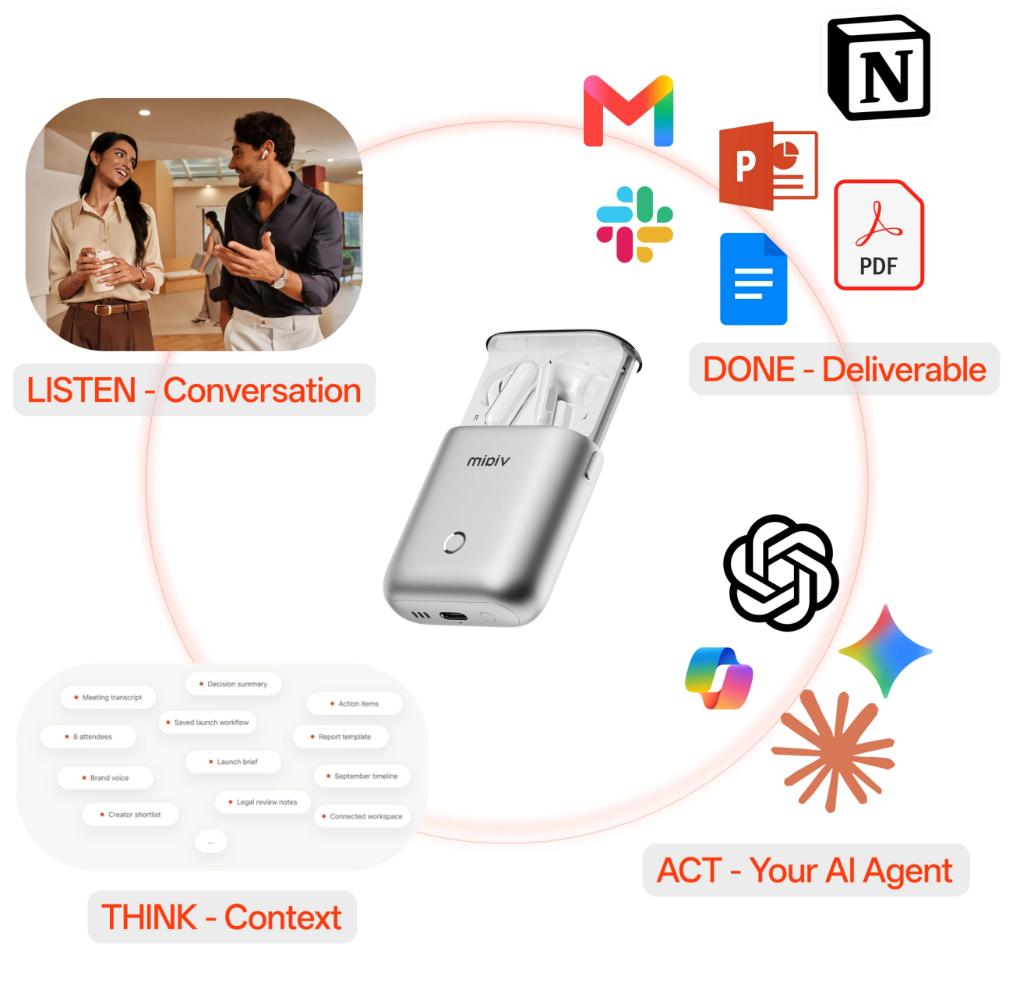
"We put a lot of effort into this case. There might have been a lot of objections at the beginning, but we still pushed it forward bravely, because the Agent hardware must have something new in it."
Ma Xiao does not believe that this round of Personal Agent boom has brought about essential changes in hardware technology. In his view, what has changed is people's perspective on hardware.
Agent connects devices with context, making a single recording the starting point for subsequent tasks. Ma Xiao believes that when the Agent can drive meeting matters to form a closed loop, the usage scenarios and commercial value of the hardware will also change accordingly.
After the sound is collected, corresponding signal processing and model analysis are required before it can become information that can be called by the Agent. As for the specific division of labor between the end side and the cloud side, different products have different designs.
The Qwen office recording card QwenNote A2 has a built-in 4G IoT card, which can transmit sound to the cloud without relying on a mobile phone for real-time transcription and minutes processing. The original audio will be deleted after the transcription is completed, and only the text and meeting minutes will be retained.
viaim focuses on organizing multiple recordings, documents and historical discussions into the same project for the Agent to call in subsequent tasks. The device side is mainly responsible for tasks such as sound pickup, noise reduction and transmission. When the network signal is poor, the recording will be cached locally first, and uploaded after the connection is restored.
Currently, the original audio is uploaded to the cloud for processing, and transcription and subsequent Agent analysis are mainly completed in the cloud. Users can export the original audio and transcribed text.
III
From Listening to Remembering
Recording, transcription, context management and subsequent Agent services can be provided by different companies.
Take Shokz OpenFit 2 AI earphones as an example. Shokz controls the hardware and user interaction entrances, the recording transcription and minutes generation are handed over to Qwen, and Guangfan provides support for the relatively independent "AI Lab" function.
Shokz responded to All-Weather Tech that after the user presses the recording button, the audio is first stored in the built-in chip of the earphones, and each of the left and right earphones supports 4 hours of recording; after the recording is finished and the mobile phone is connected, the audio is automatically uploaded to the Shokz App, and then the Shokz server calls the Qwen large model for transcription and minutes generation.
At the Yunqi Conference in September, Shokz joined hands with Guangfan Technology to launch the "AI Lab" on OpenFit 2 AI.
According to Shokz's response, Guangfan provides technical support for functions such as intelligent conversation, schedule to-dos, casual notes and message assistant in the AI Lab of the Shokz App. The recording minutes service and the AI Lab service are independent of each other, and their data do not cross.
Shokz also stated that its information security management system has passed the Level 3 Cybersecurity Protection and SOC 2 Type 1 certifications, and has adopted encryption measures for the entire process from recording, transcription to file archiving.
Qwen follows an integrated path, launching glasses, earphones and recording devices, while operating apps, model capabilities and third-party skill ecosystems, bringing multiple entrances into the same service system. If the same Qwen can understand users, call historical context and connect to Alibaba's services, Alibaba will have the opportunity to cover the whole process from the entrance all the way to task execution and service consumption.
The commercial value of this path lies in the closed loop, while the challenge is that users may not be willing to hand over all their daily tasks to the same ecosystem.
Plaud allows users to choose different models. Users can initiate tasks through external AI tools such as ChatGPT and Claude, and call the meeting records saved by Plaud through connection methods such as MCP.
Integrating multiple external AI tools gives users more freedom, and the next step to consider is user retention. In a replaceable ecological niche, manufacturers need to provide differentiated value.
viaim hopes to undertake part of the context management and task allocation through its own Agent. "We have built an Agent that can dispatch other Agents." Ma Xiao, founder of Future Intelligence, explained to All-Weather Tech.
Ma Xiao introduced two cooperation modes between viaim and Tencent WorkBuddy. The first mode is scheduled by the host side: the self-owned Personal Agent analyzes the information accumulated by users, identifies demands, and the tasks are handed over to WorkBuddy for execution. The second mode is to open CLI: users initiate tasks in WorkBuddy, and call the recording records through viaim CLI.
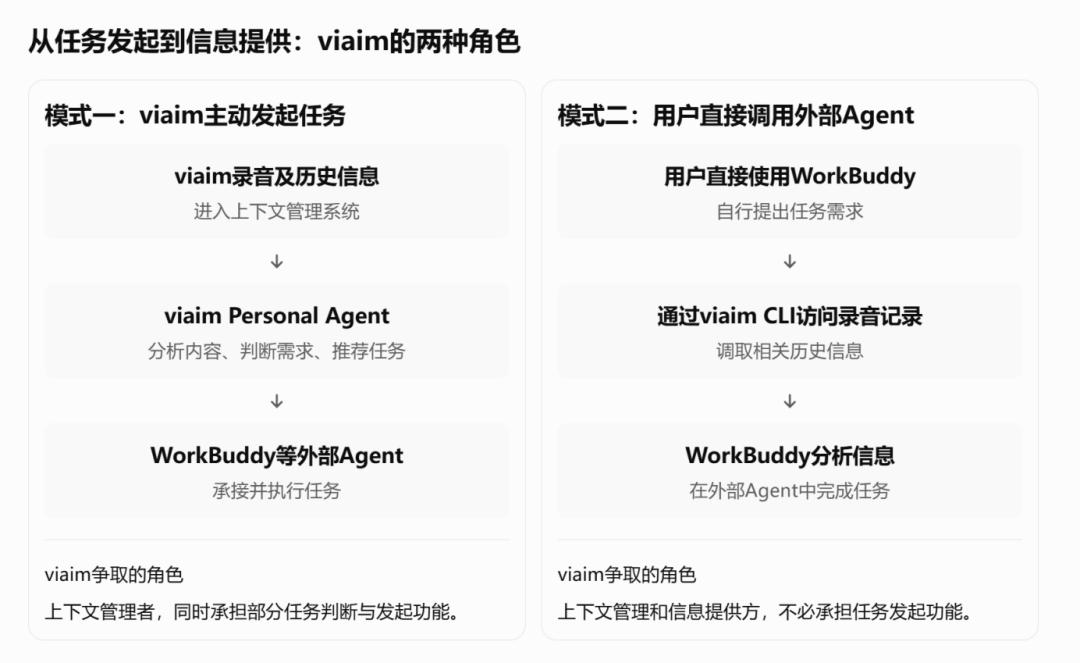
The two modes can use the same set of recordings, the difference lies in where the task is initiated.
Local time on October 15, Bee under Amazon released the Bee Frontier bracelet and the magnetic card accessory Bee Eclipse.
These two pieces of hardware can extract information from users' conversations and connected apps, generate summaries and to-dos. The paid subscription service Bee Pro supports integration with third-party apps as well as Alexa+ and Amazon.com.
Judging from the announced functions, Amazon is trying to connect the real-scene information collected by hardware with AI assistants and e-commerce services.
While all making hardware, manufacturers have chosen different positions in the value chain. Some focus on operating hardware and user entrances, some hope to master context and task allocation, and some platform companies try to connect real-world information to their own services. As for the frequency of users actually calling this information and their willingness to pay, the currently publicly disclosed data is not yet sufficient to fully explain this.
IV
What Are Sold Separately Under the Subscription Model
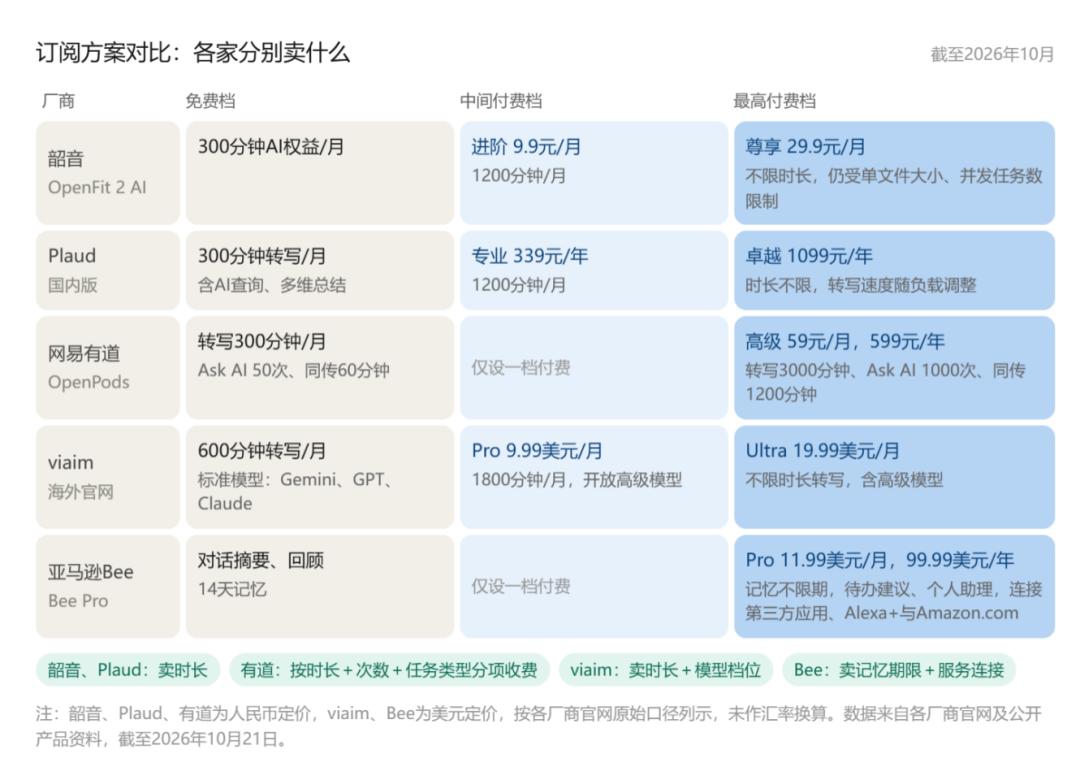
Context processing is a long chain, and different enterprises cover different links on this chain. In a specific task, the fees charged by each party are not for the same layer of service. Selling hardware is only the first step. In the long-term usage process, software services and subscription systems are important sources of revenue.

At present, many manufacturers have launched subscription services, but in terms of specific charging standards, all parties are trying to design paid rights and interests separately for information processing volume, context management and subsequent task services.
In the past six months, Alibaba, iFlytek, Stepfun, Tencent Hunyuan, Xiaomi and other companies have successively released or upgraded their speech recognition models.
When Qwen released the Qwen-Audio-3.1 series in September, the price of the entire line of speech models was reduced, among which the price of speech recognition was reduced by 95%. General devices such as mobile phones can call speech recognition capabilities through software, so the subscription value of independent hardware needs to be reflected in context management and Agent services.
For users who often hold meetings and conduct interviews, if they have to check the remaining duration every time before deciding whether to record, the quota itself may become a usage threshold. However, if after the user scale expands, the revenue brought by each user cannot cover the corresponding cost, the gross profit margin of the subscription business may still face pressure.
Ma Xiao, founder of Future Intelligence, believes that there are two bottlenecks for the current AI initiative: one is the accuracy of judging user demands, which requires continuous accumulation of user information; the other is the task completion rate, which involves task execution and feedback.
As users continue to use hardware and Agent services, the number of recordings increases, but the available context does not necessarily increase proportionally. Context management also needs to organize multiple communications into project backgrounds, character relationships and historical decisions, so that the Agent can continuously call them in subsequent tasks to optimize execution efficiency and delivery results.
For example, after the meeting ends, the Agent needs to accurately identify the person in charge and the deadline, and synchronize the to-dos to the user's office system.
In this way, when the user discusses the same project again, they can easily retrieve the previous task results and to-do items. If the Agent needs to send a message to an external person, it should also request user confirmation at necessary links.
In the past, hardware product sales were usually one-time transactions, and iteration and update often meant replacing the device with a new one.
Personal Agent tells a long-term story, hardware begins to emphasize "always on", and context is becoming a resource. But the resource itself will not directly precipitate into a competitive