The iPhone Duo also enables AVS fast charging, but there is a rather unusual detail.
After the launch of iPhone Duo, its foldable form and crease design have drawn widespread attention. We intend to start with another issue that affects daily usage experience: under the spatial constraints of the foldable body, what fast charging solution has Apple equipped it with? What changes will this bring to the daily charging experience?
We immediately used the Sugar Factory IonFlow (AI PD Analysis Platform) to conduct a comprehensive charging test on the iPhone Duo. The test covers the full range of AVS chargers and charging stations from Hard Candy, including 45W and 60W single-port chargers, 68W three-port chargers, AI Power Hub Mirror five-port charging station, as well as Apple's own 40W dynamic power adapter.
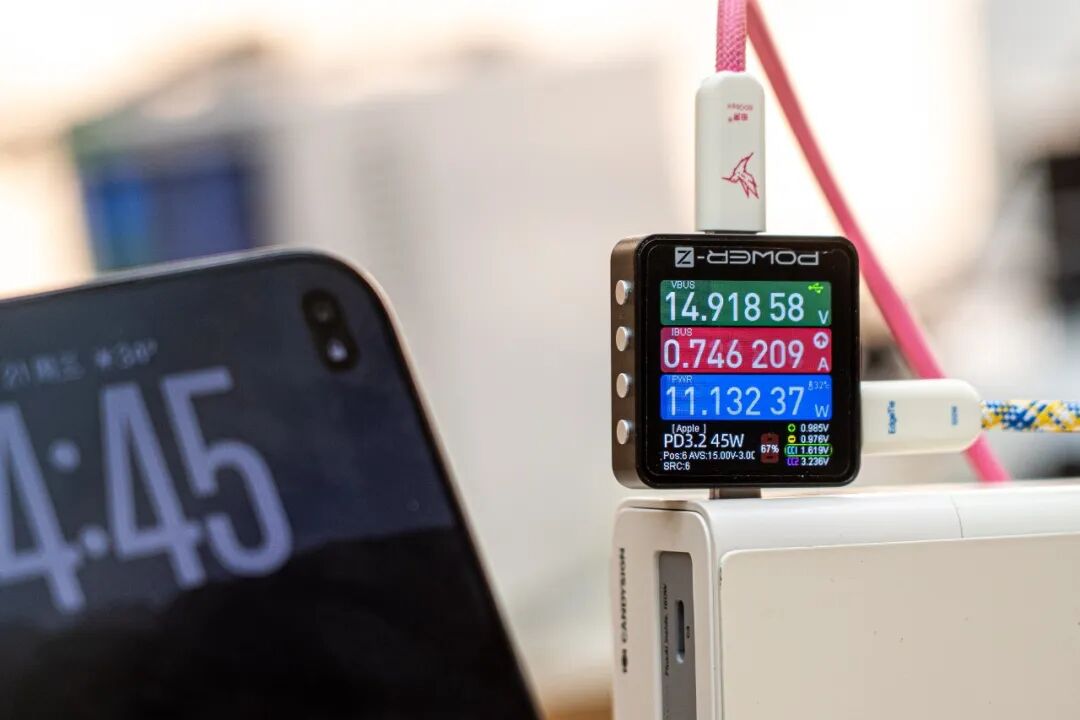
During the test, we discovered a detail that Apple has never explicitly stated: the iPhone Duo supports SPR AVS.
This is an unexpected conclusion.
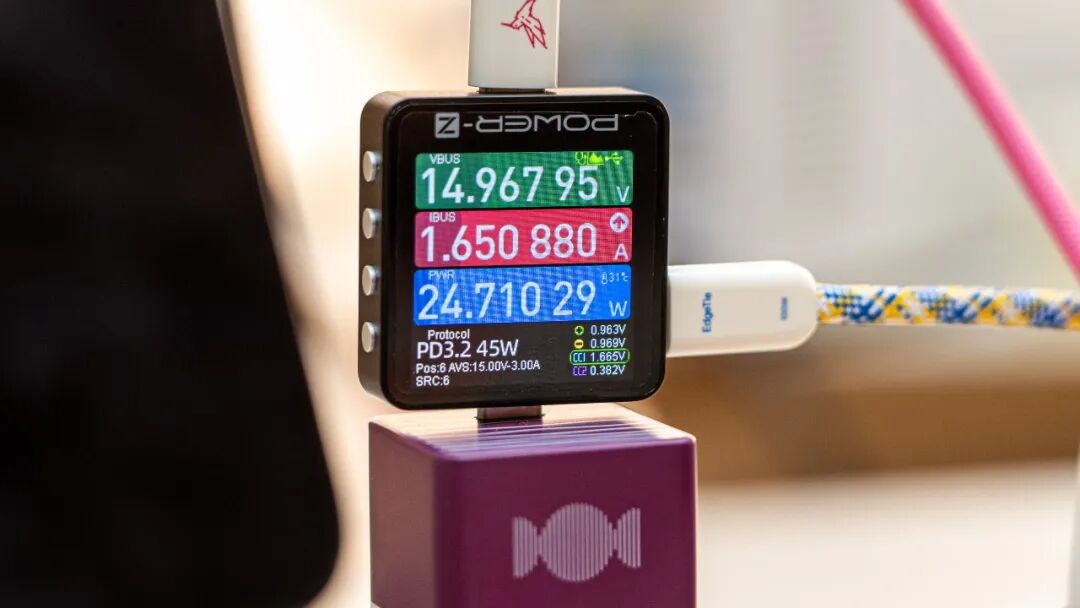
Because Apple did not mention this point in the launch event or product detail page, the results recorded by the protocol analyzer are highly consistent: on all SPR AVS-compatible chargers tested in this round, the iPhone Duo negotiates to enable this protocol during the handshake phase and continues to use it throughout the main fast charging stage.
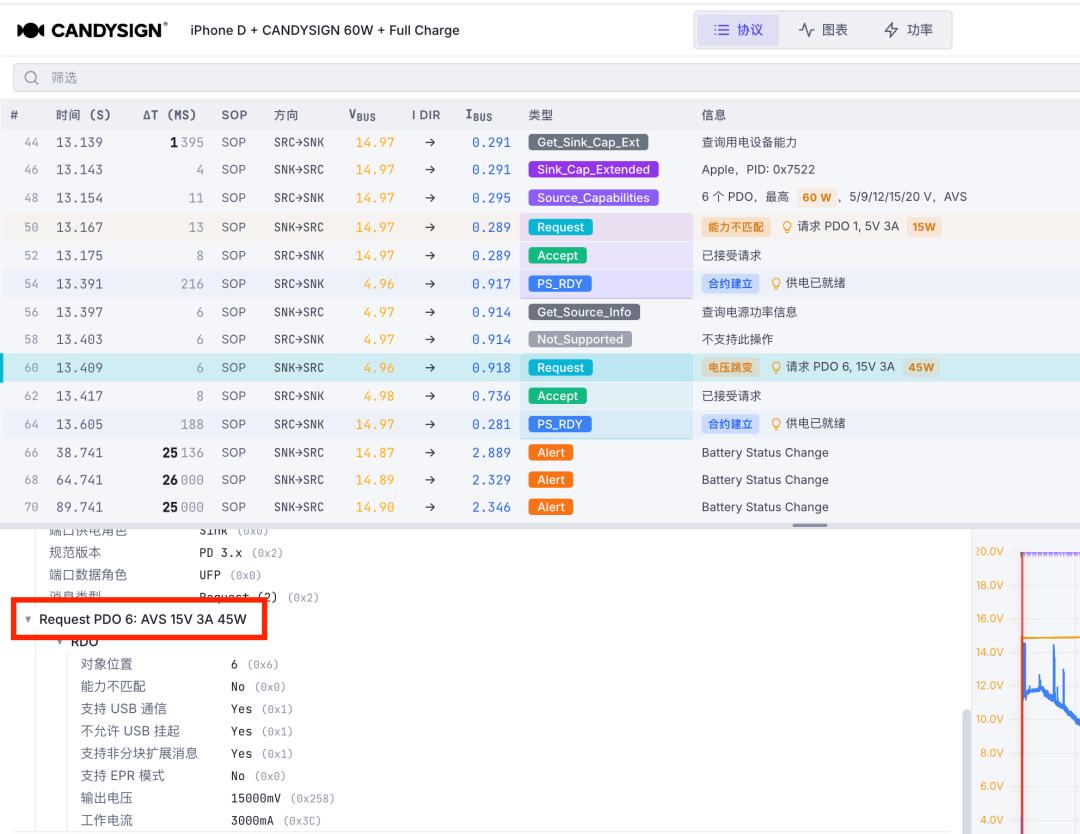
After the charger enables AVS capability, it requests the AVS gear
SPR AVS is the abbreviation of Standard Power Range Adjustable Voltage Source. How does it affect charging performance, and what should users pay attention to when choosing a charger? In the following sections, we will explain this change by combining protocol records and actual test data, and explore its significance for users and the charging industry in the evolution history of USB-C fast charging.
Why did Apple fully embrace SPR AVS,
What changes will it bring?
Traditional USB PD fast charging follows a "fixed gear" negotiation mechanism. The charger reports a set of voltages — commonly 5V, 9V, 15V, 20V — and the iPhone picks the one closest to its own needs, which in practice are 5V, 9V and 15V, while the 20V gear is rarely used. After selecting the gear, the remaining voltage difference is converted by the internal circuit of the device. This is like a staircase with several large steps: the ideal voltage falls between two steps, the phone cannot hover in the air, and has to compromise to match the charger.
Android devices have long moved away from this mechanism. PPS has been popular for many years, allowing voltage adjustment in 20mV steps. The only product line that has always stuck to fixed gears is iPhone.
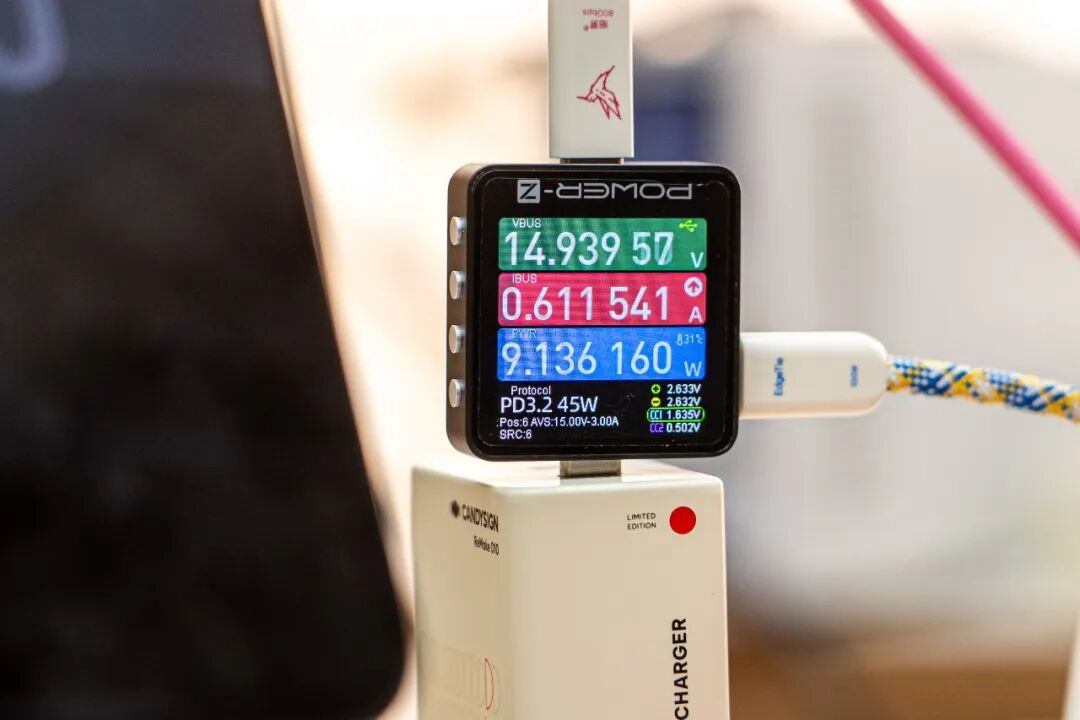
SPR AVS introduced in USB PD 3.2 also provides the possibility for iPhone to move from "steps" to "ramps". To understand it, we can start from two aspects: voltage regulation and current control.
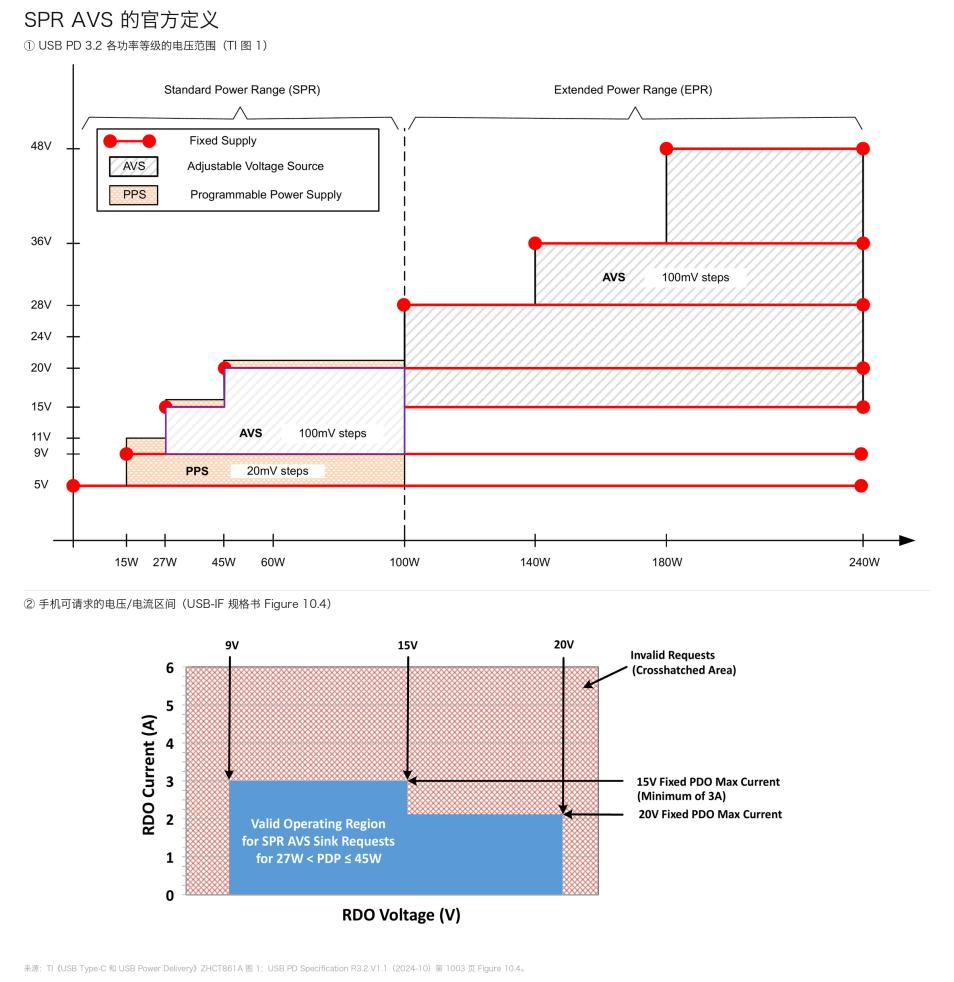
First, the voltage can be continuously fine-tuned, no longer limited to several fixed gears. The charger adjusts the output voltage in 100mV (0.1V) steps, and the adjustable range covers 9–15V according to the power supply capability, or further extends to 20V. As a result, the phone can choose a voltage that better suits its own needs within the supported range.
Second, the current control method is different, and the PPS-style programmable current limiting is no longer adopted. PPS allows the phone to set the current upper limit, but this upper limit may not match the actual capability of the charger and the voltage drop of the cable, which easily limits the power output when the voltage is low. SPR AVS removes this layer of programmable current limit (Current Limit Mode), and the charger announces the maximum available current in two ranges of 9–15V and 15–20V. The phone controls power intake within the negotiated allowed range, without having to estimate the power ceiling by itself.
With the same 15V output,
what is the value of SPR AVS?
First look at the actual test result: adjustable voltage is enabled, but 15V is selected throughout the whole process.
The full charging curve recorded by the IonFlow analysis platform is quite stable: starting from 0%, the battery level reaches 42%–45% in 20 minutes, about 60% in 30 minutes, and 86% in 60 minutes; at around the 75th minute (about 94%–95%), the phone exits the SPR AVS with a lower limit of 9V, switches back to the 5V fixed gear to complete the final charging stage, and the whole process takes about 85 minutes.
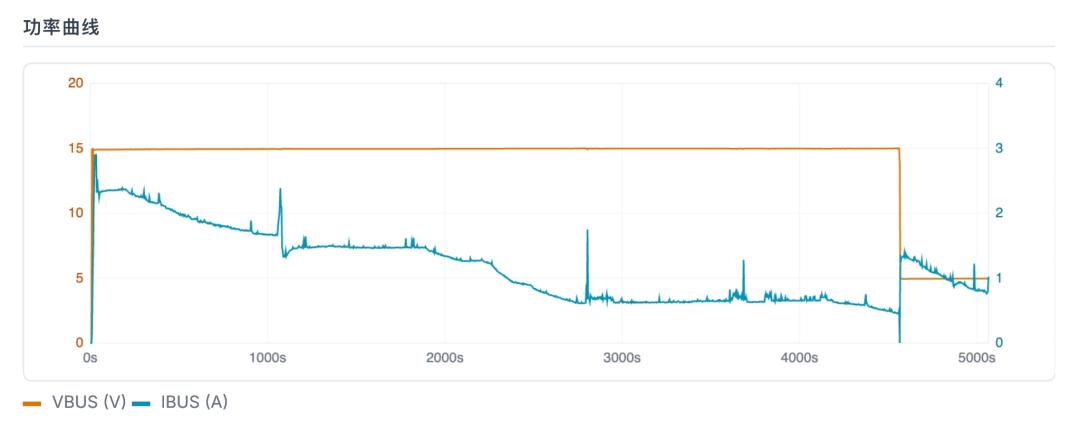
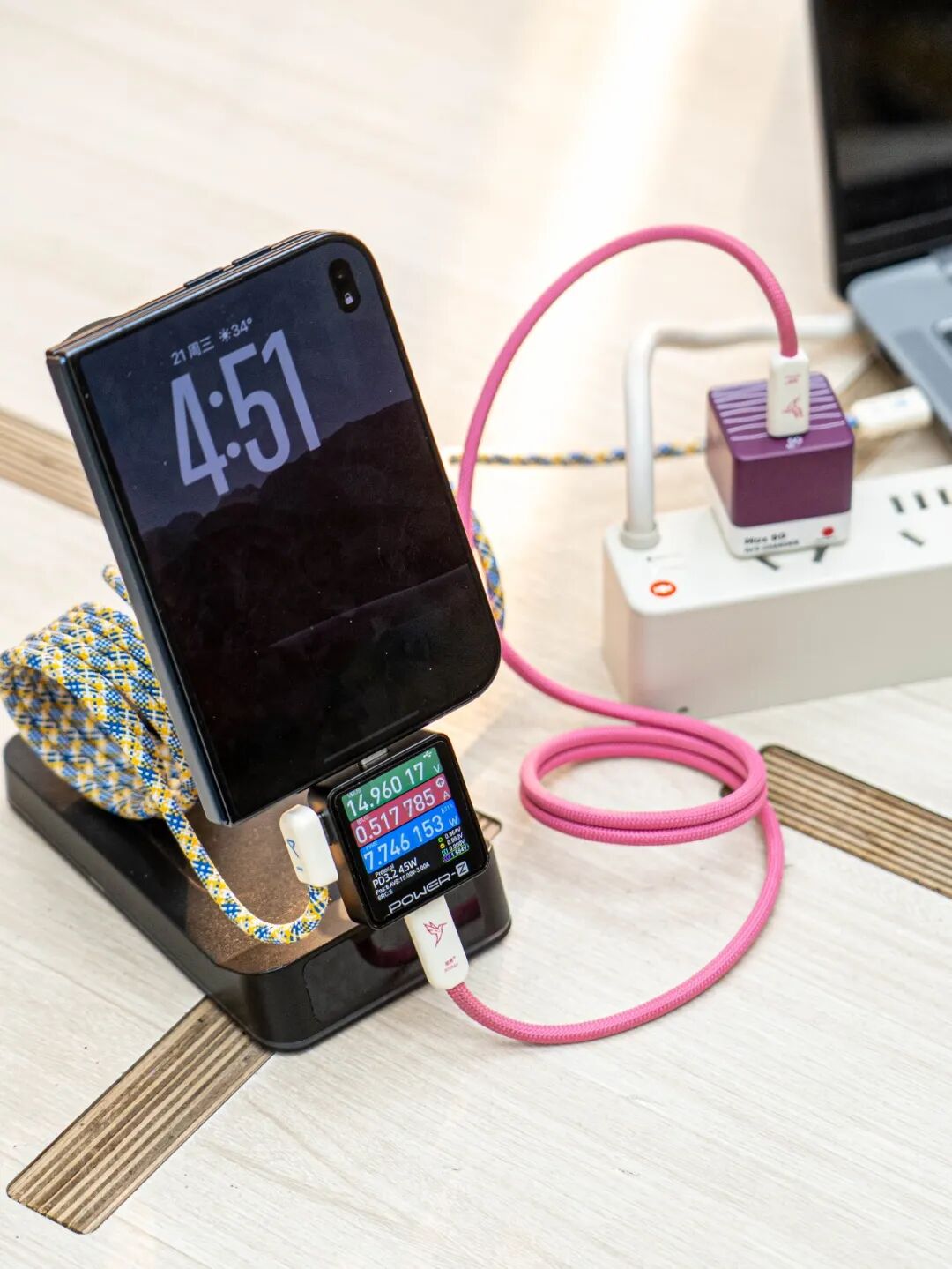
What is worth noting in the data packet is the voltage: throughout the entire SPR AVS interval, the iPhone Duo always requests 15V without any adjustment. The maximum current is about 3A, corresponding to a peak input power of about 45W.
The choice of 15V is not unfamiliar — the previous generation of iPhone also used this voltage under the fixed gear mechanism, which means that what has changed for the iPhone Duo this generation is the negotiation method, not the working voltage.
The maximum power drawn by the phone is about 45W, why does the official website require a 60W charger?
There are two figures that need to be considered separately.
First, the power intake performance of the phone in this test: 15V, maximum current of about 3A, corresponding to about 45W.
The AVS chargers tested in this round cover Hard Candy 45W, Little Demon 60W, 68W Hard Candy C3, and AI Power Hub Mirror; among them, the 68W C3 and Power Hub both have a 20V gear with higher power supply capability, and the cables also meet the 60W specification of 20V⎓3A. But the Duo still chooses 15V. This shows that 45W is the choice of the phone itself, not the ceiling limited by the charger or cable — a Hard Candy 45W SPR AVS charging head is indeed sufficient for it to run at full power.
Second, the accessory conditions given on Apple's official website: "A USB-C charging cable and USB PD power adapter that supports 60 watts (or higher power) is required". The maximum power that the adapter can provide and the actual power drawn by the phone are two different things, and the two do not contradict each other.
60W refers to the peak capability of the adapter, not the continuous power drawn by the phone. Apple's own recommended 40W dynamic power adapter is rated at 40W with a peak of 60W, and using it to charge the Duo also gets 50% charge in 20 minutes. The fact that a 40W-rated charger can be recommended itself shows that the continuous power demand of the Duo is at the 45W level.
The 60W cable corresponds to the 20V⎓3A cable. When the Duo draws 3A at 15V, this is exactly the cable it needs.
However, "sufficient" and "excellent performance" are two different things.
15V⎓3A is the rated full load of a 45W charger, and the main fast charging stage needs to run continuously at this power for 20 to 30 minutes. Small-sized GaN chargers will heat up quickly and derate early when running at full load for a long time, with smaller margins for efficiency and service life; a 60W charger running at 45W is only 75% load, with a much more generous temperature margin. This is presumably the most practical reason why Apple writes "60W" into the requirements — it provides a power margin, not a strict threshold.
As for the gap between the 42%–45% we measured in 20 minutes and the official "up to 50%": Apple's data comes from the trial-production models in July, and is marked as "up to". The actual result is affected by ambient temperature, initial body temperature, screen status and the definition of "0%". Our record is continuous charging in a laboratory environment, without cooling or screen-off treatment, and the lower result is within the normal range.
Even with the same 15V selection, the value of AVS lies in retaining a finer adjustment space. At this point, experienced readers may ask: since traditional PD already has a fixed 15V gear, and the actual measured speed is the same, what is the point of using SPR AVS?
What we pursue is not the speed today, but the protocol itself. The current result is the same, but the underlying architecture has been updated by a generation — the master-slave relationship between the phone and the charger has changed, and the "dynamic voltage regulation" capability has been fully retained.
First, the right to decide the voltage has been transferred.
On traditional chargers, 15V is one of the few fixed options of the charger; under SPR AVS, it is the working point actively selected by the iPhone Duo from a whole continuous voltage range. More importantly, even if the current strategy keeps the voltage constant at 15V, the channel itself remains open — the phone can re-request voltage in 0.1V units at any time, it just does not do so in this generation. This capability is not a decoration: if future firmware wants to optimize the charging strategy, the interface is already ready.
Second, the fast charging base of Apple's entire product line has been unified.
This generation of iPhone 18 Pro/Max has obvious differences in internal power design. The iPhone 18 Pro and iPhone 18 Pro Max have larger bodies, more abundant battery and heat dissipation conditions, and can push the power above 45W through working points outside the fixed 18V gear; while the iPhone Duo is limited by the foldable form, its heat dissipation space is shared by the hinge and dual-battery structure, so the charging strategy is more conservative, and 15V is selected in this actual test — consistent with the previous generation of iPhone.
In the fixed gear era, such differences can only be compromised and digested on the phone side. After switching to SPR AVS, Apple uses the same set of protocols to unify its entire product line — any iPhone plugged into the same SPR AVS charger can request the most suitable voltage according to its own needs.
From "prepared but unused" to gradual rollout
If we extend the timeline to two years, Apple's intention and the implementation path of SPR AVS will become clearer.
The dynamic power adapter launched with new phones last year already supported SPR AVS on the charger side. However, according to third-party actual tests from ChargerLAB and other platforms, the iPhone 17 series released last year did not enable this function at launch, and still used fixed gears after being plugged in; there is no consistent public information about whether it will be turned on through system updates later, and Apple has not made any statement. At that time, SPR AVS was only a foreshadowing laid unilaterally by the charger.
This year, the phone side is truly connected. Not only the iPhone 18 Pro and iPhone 18 Pro Max that pursue high power, but also special form factor models like the Duo are equipped with SPR AVS, and they can complete the handshake without a 60W-level power supply — a 45W SPR AVS charger can also make it run under this protocol.
This is not just a change from Apple. According to the new USB-IF PD 3.2 certification requirements, power adapters with a rated power exceeding 27W need to take SPR AVS as a standard capability; the upstream Linux kernel and some Android manufacturers are also promoting SPR AVS negotiation support.
Of course, protocol support, system enabling, and product implementation are three different things, and the standard requirements do not mean that every charger on sale has kept up. However, the fast charging ecosystem that has been split by private protocols for many years is converging to this open standard. The support for the accessory industry is self-evident: when phones start to actually call SPR AVS, it changes from an item on the charger parameter list to a compatibility condition that users have reason to pay attention to when purchasing.
Apple rarely rushes to be the first to release gimmicks in the field of charging. But as long as it popularizes a certain open protocol, it is often the beginning of the popularization wave of the entire accessory industry. This test of the Duo proves that the application value of SPR AVS does not only exist in models that pursue higher peak power.
How to choose a charger for the iPhone Duo?
If you already have old chargers, you can make a comprehensive consideration.
If you already have a reliable traditional PD charger that supports 15V⎓3A output, you can continue to use it if it is only prepared for the iPhone Duo. Under the test conditions of this round, the charging curve and speed of SPR AVS and fixed gears are basically the same, and there is no obvious slowdown due to the lack of SPR AVS. However, if you use both the iPhone Duo and the iPhone 18 series, it is recommended to upgrade to SPR AVS to ensure that both phones get the best charging performance.
If you are buying a new charger, you can take SPR AVS into consideration.
If you are buying a main charging head or upgrading your desktop equipment, USB PD 3.2 SPR AVS is worth investing in for the future. Protocol upgrade does not necessarily bring speed upgrade immediately, but it provides greater space for future charging strategies. In the next few years,