Over 3 months, with 5 "outsiders", a budget of 200,000 US dollars and the support of Claude, Citrini, the "internet-famous research institute", has developed the "anti-scorpion toxin protein".
A 5-person team, with $200,000 budget and 3 months of time, an investment research institution has used AI to accomplish a feat that was previously exclusive to professional pharmaceutical companies: designing a brand-new protein that can bind to scorpion toxins from scratch. 211 candidate molecules were sent to the laboratory, 17 passed the binding test, covering 4 types of high-risk scorpion toxins. This is the real result delivered by Claude after coordinating more than 300 Agents and consuming over 10,000 hours of H100 computing power. The threshold of AI pharmaceutical R&D is being redefined: the entrance to scientific discovery is opening up to non-professionals.
An overlooked industry, a group of non-professionals, a 35-page prompt, 10,000 hours of H100 computing power, a lab bill, 211 protein designs, 17 positive results.
The story started from an investment question, and ended with a new protein in the test tube.
The "internet-famous research institute" Citrini Research initially wanted to figure out an investment question: How far has AI drug development actually come?
In the past few years, the life sciences and healthcare sectors have experienced a noticeable cooling down. The post-pandemic dividend has faded, the financing environment has tightened, secondary market valuations have declined, and the primary market has become more cautious in making investments. In contrast, AI infrastructure, semiconductors, and the computing power chain have become far more popular narratives. The biomedicine track, which was once chased by capital, has begun to look somewhat deserted.
But this is exactly where Citrini sees opportunities: If an industry that has been neglected by the market is truly transformed by AI tools, the growth expectations for it may be significantly underestimated.
The problem is that no one can give them a unified answer. When asking scientists, some say AI has never produced a truly important new drug, while others believe AI will reshape the drug R&D system within a few years. For an investment research institution, such divergent judgments can hardly be translated into investment conclusions.
Therefore, they decided to get personally involved in the practice.
The team only has 5 members, 3 of whom barely have any life science background, and the other 2 have a little relevant experience, far from being veterans in drug R&D. With a budget of $200,000 and a timeline of 3 months, they set a seemingly risky goal for themselves: using Claude to design a new protein that can be actually synthesized and tested.
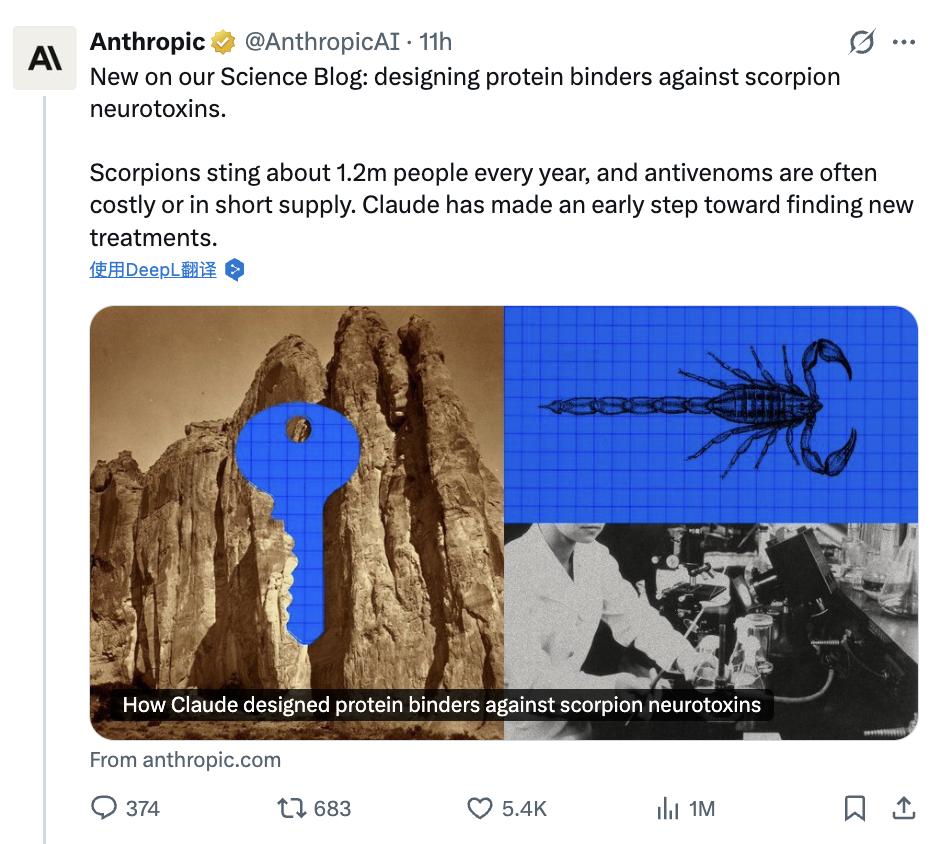
If the laboratory results can prove that it effectively binds to the target, even if it is only the first step, it is enough to demonstrate one thing: the threshold of AI for Science is falling, and non-professionals are beginning to have access to the previously highly specialized scientific discovery process.
Why does an investment team set its sights on scorpion toxins?
Citrini did not directly choose scorpion toxins at the very beginning. They first listed several screening criteria: the experimental verification should be fast, the cost should be controllable; the problem itself should rely on molecular design capabilities; ideally, it should have practical public health value, while lacking long-term investment.
Candidate directions included rare childhood diseases, Clostridioides difficile infection, "vaccines" that block potent fentanyl analogs, and anti-tick solutions to reduce Lyme disease risk. The direction left in the end was antivenom.
There have been AI protein design cases in the snake venom field before. Citrini wanted to find a newer, less noticed target, so they turned their attention to scorpion toxins.
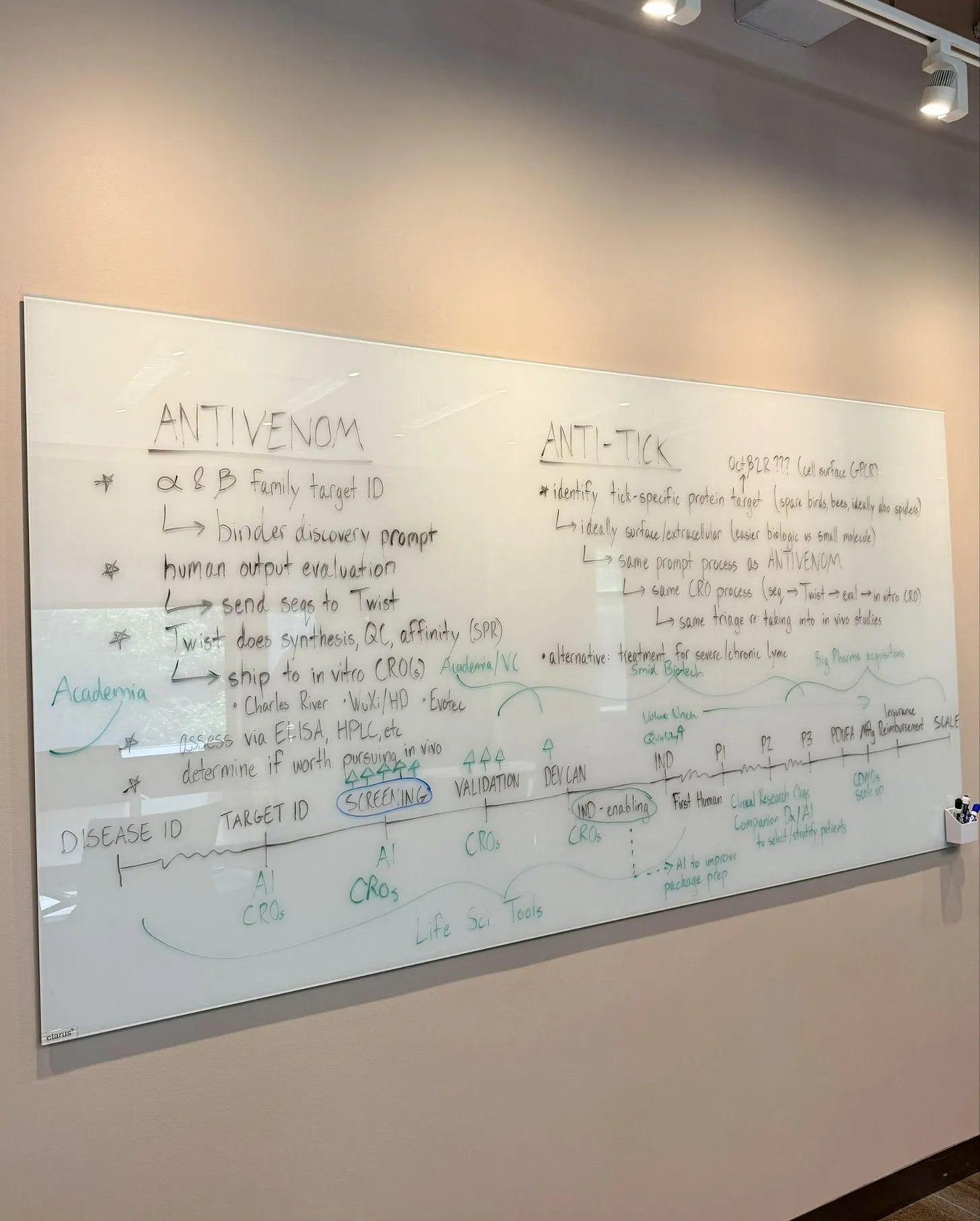
Scorpion stings are not a niche problem. About 1.2 million people are stung by scorpions every year around the world, thousands of people die, and children are at particularly high risk. In many high-incidence areas, medical resources are limited, antivenom is expensive, and its supply is unstable.
The existing production method of anti-scorpion antivenom is quite traditional: collect scorpion venom, inject a controlled dose into horses, wait for the horses to produce antibodies, then extract and purify the antibodies from the plasma. The process is time-consuming, expensive, and dependent on animals.
Citrini wanted to try a new path: directly design a small protein that can grasp the neurotoxin in scorpion venom like a "molecular clip". This type of small protein is called minibinder, which is smaller in size than antibodies, and theoretically can be produced through synthetic biology methods. For a team with limited budget and time, protein design is closer to the current capability boundary of AI.
They finally selected 5 scorpion venom neurotoxins, covering representative toxins from regions including Mexico, Brazil, North Africa and the Middle East. The initial goal was very simple: first design proteins that can bind to a single toxin. As long as the in vitro experiment can prove that it "can grasp the target", it will already be an important signal.
Subsequently, the team added a more difficult question: can a single molecule be designed to bind 5 toxins at the same time?
Claude reminded them that the success probability is very low. Although the 5 toxins all belong to scorpion venom neurotoxins, their surface structures, key sites, charge distribution and spatial conformations are different. Trying to match multiple targets with one small protein is equivalent to letting one key open five locks with different structures.
The team still decided to give it a try.
This step is very symbolic. AI can allow non-professionals to enter the protein design process, but the difficulty of life sciences will not disappear automatically just because the prompt gets longer.
35 pages of prompts, more than 300 Agents, 10,000 hours of H100
Before actually starting, the Citrini and Anthropic teams spent a lot of time designing prompts. The final prompt was about 35 pages long, which clearly stated the target toxins, design constraints, evaluation tools, screening rules, candidate allocation and all information required for the laboratory.
This is no longer like ordinary chat, but more like a research proposal handed over to a "virtual dry lab team".
After that, Claude began to take over most of the computational design processes: looking up literature, adjusting tools, doing structure prediction, managing computing resources, and screening candidate solutions. It also wrote emails to scientists at Twist Bioscience under human supervision, asking whether certain fusion proteins and bispecific configurations can be manufactured. After receiving the reply, Claude wrote the manufacturer's manufacturing constraints back into the design process and continued to move forward.
This point is critical. Real scientific research never only exists in papers and models, but also has to go through real links such as suppliers, manufacturing restrictions, experiment scheduling, and sample preparation. Only when Claude can connect all these pieces of information can the project form a complete workflow.
According to Citrini's disclosure, the entire design activity used slightly more than 10,000 hours of H100 GPU. The computing power cost was $49,997, and Claude even spent $3 less than the budget. The subsequent experimental costs including DNA synthesis, protein expression and purification, binding test and developability evaluation were close to $150,000. The $200,000 budget was almost fully spent.
During the 64-hour design phase, Claude generated more than 310,000 protein designs, and screened out 180 of them. After four follow-up rounds, humans and Claude supplemented a batch of candidates, and finally 211 solutions were sent to the laboratory for synthesis and testing.
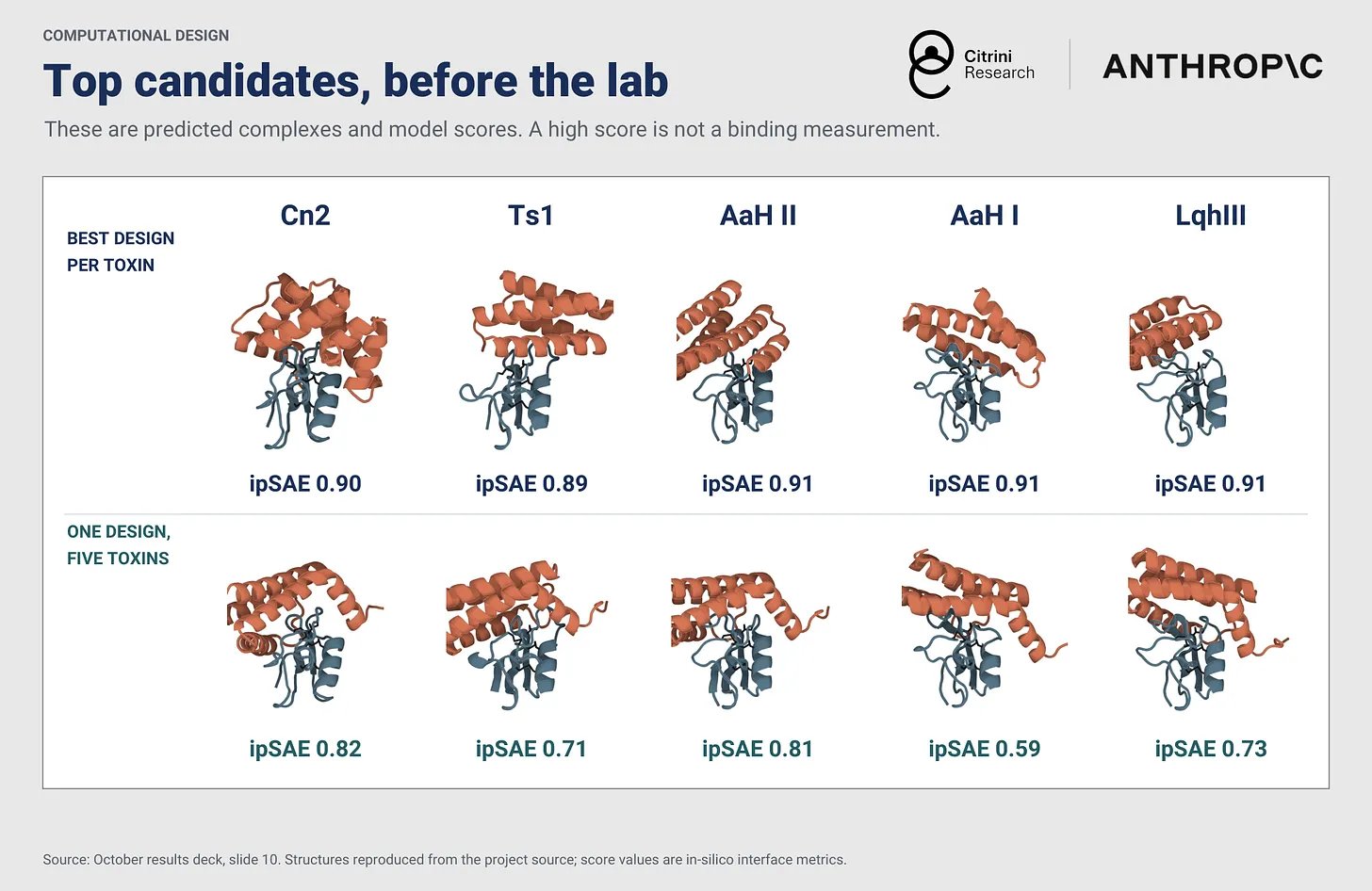
The Citrini team later recalled that when they first saw the protein structure diagram on the screen, they felt very surreal. A few days ago, they were still doing investment research; a few days later, a batch of unprecedented protein structures appeared on the screen, along with sorting, rationales, manufacturing suggestions and experimental submission materials.
This is exactly the most intuitive change brought by AI for Science. Professional capabilities are beginning to be disassembled into a tool chain: large models are responsible for understanding goals, scheduling processes, integrating literature, and generating designs; outsourced laboratories are responsible for verification; humans are responsible for setting questions, supervising risks, and judging directions.
211 proteins sent to the laboratory, 17 positive results, covering 4 of the 5 toxins
No matter how beautiful the structure diagram in the computer is, it cannot be regarded as a scientific result. Citrini sent the candidate solutions to Adaptyv Bio and Twist Bioscience for DNA synthesis, protein expression and purification, and binding tests. The experimental results show that:
Among the 211 tested designs, 17 met the preset binding criteria, covering 4 of the 5 toxins.
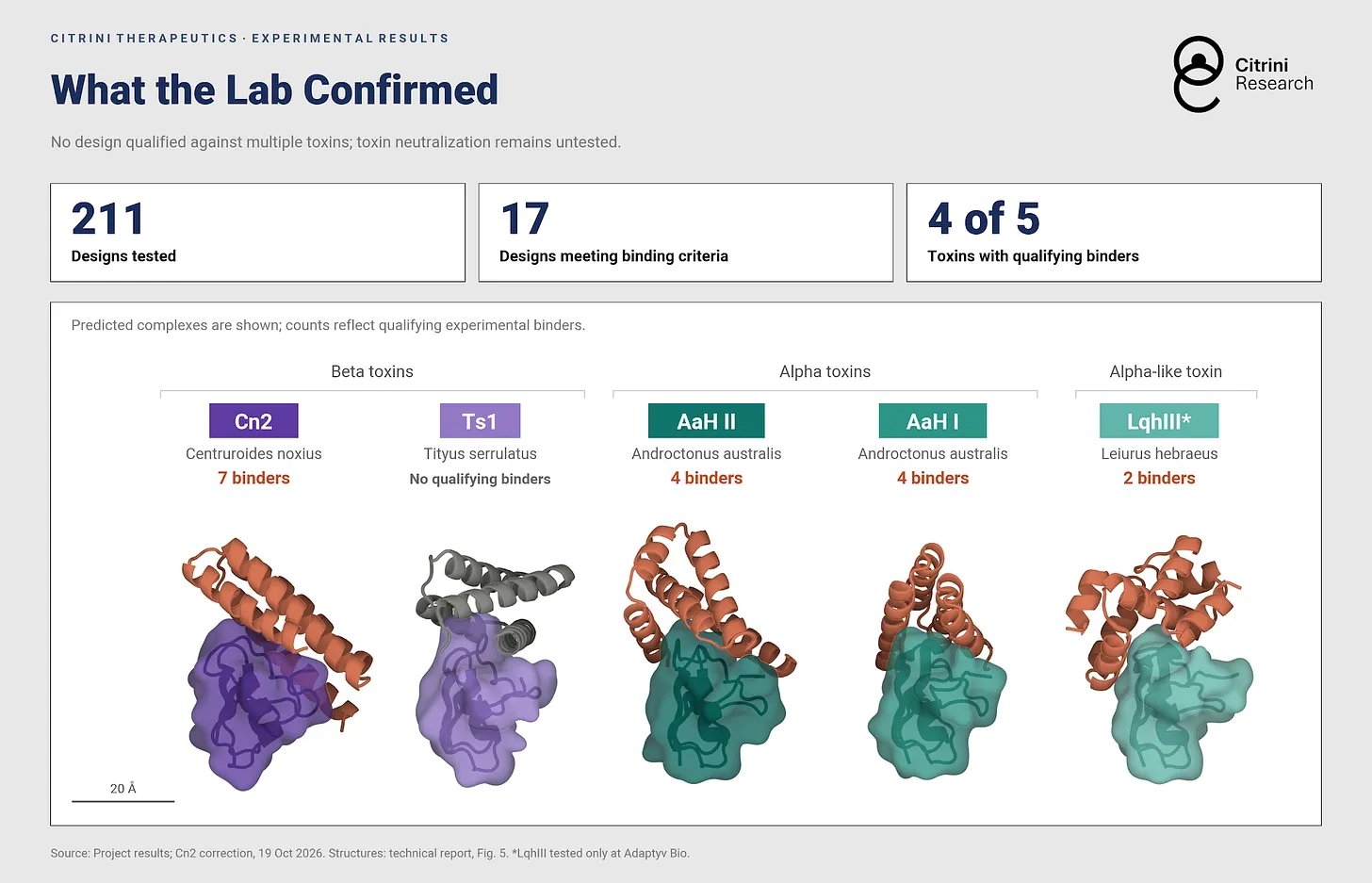
Among them, the candidates targeting the Mexican scorpion toxin Cn2 performed the most prominently. The two designs Cn2-B1 and Cn2-B2 bind very strongly to the target toxin, with affinity reaching the low nanomolar level. In layman's terms, this means they "grasp the toxin very tightly". In the early stage of drug discovery, this level of affinity is enough to make researchers take it seriously.
The team also conducted competitive binding experiments. It is known that there is an antibody fragment LR that can neutralize the Cn2 toxin. Experiments show that when LR occupies the toxin first, the binding between the Claude-designed protein and the toxin is significantly affected. This suggests that Cn2-B1 and Cn2-B2 may grasp the same or adjacent site as LR.
This is very important. The real purpose of the anti-scorpion toxin protein is not just to stick to the toxin at any position, but ideally to block the key area where the toxin acts on the sodium channels of nerve cells. The competition experiment at least gives a positive clue: The protein designed by Claude may grasp a functionally meaningful site.
At the same time, the most difficult goal of "covering all five toxins" failed. No design was proven to bind multiple toxins at the same time. Claude's initial risk warning came true.
This result makes the case even more credible. AI has not magically crossed all biophysical constraints. It delivered experimentally positive candidates for a single target, but hit a wall on the universal molecule that targets multiple toxins. Both success and failure are clearly reflected in the experimental data.
It has not become a drug yet, but it has crossed an important threshold
At present, these proteins only prove that they "can bind to toxins". They have not yet proven that they can neutralize toxins, nor have they proven that they can protect cells, animals or the human body.
The next step requires functional experiments. For example, first confirm that the toxin does disrupt cellular ion channels, then use methods such as patch-clamp to test whether these proteins can prevent or reverse the effect of the toxin. Only after that can it possibly enter animal protection experiments to evaluate dosage, onset speed, in vivo residence time, safety, immune response and manufacturing stability.
In other words, there is still a long way to go before a truly usable anti-scorpion toxin treatment is available.
But the value of this experiment has already emerged: a group of people with almost no drug R&D background, with the help of AI tools, experimental outsourcing and expert safety frameworks, can start from an investment question and reach the stage of "new protein partially verified by experiments".
Citrini has not become a biotechnology company in the traditional sense. It remains an investment research institution. But with $200,000 and 3 months, it has touched a new boundary: The entrance to scientific discovery is being reopened.
AI pharmaceutical R&D has entered the next stage
Put Citrini's story in the broader context of the AI pharmaceutical industry. In the past few years, AI pharmaceutical R&D has gone through a round of high expectations. The market once expected AI to directly shorten the new drug R&D cycle, significantly reduce costs, and quickly launch blockbuster drugs. The reality is more complicated. There are many bottlenecks in drug R&D: target selection, molecular design, druggability, toxicity, clinical enrollment, manufacturing scale-up, regulatory approval, any of these links may stop the project.
Therefore, the next progress of AI pharmaceutical R&D will most likely not be reflected in a certain model "generating new drugs in one step", but more likely reflected in the continuous compression of multiple links in the R&D chain.
What Anthropic demonstrated is the capability of large models to coordinate the protein design process; Radical Numerics has advanced AI-designed phages to the compassionate use scenario for patients with drug-resistant bacterial infections; OpenAI, through Rosalind and Orchestra Bio, has extended AI to scientific research project management, experimental dependency tracking and R&D process coordination.
When these three types of capabilities are combined, they exactly correspond to the three key directions of AI pharmaceutical R&D: designing molecules, verifying biological functions, and managing complex R&D systems.
The inspiration brought by the Citrini case to the industry is particularly direct: the future participants in AI pharmaceutical R&D may be more diverse. Pharmaceutical companies, CROs, and top laboratories are still important, but more and more people with specific problems, specific resources and specific judgments can also enter the scientific workflow. They may not complete the whole process independently, but they can put forward neglected demands, organize tools and experimental resources, and quickly form verifiable results.
This will change the supply mode of early-stage R&D. In the past, it was difficult for a rare disease or marginal public health problem to attract investment from large pharmaceutical companies. Now, if AI can reduce the cost of early exploration, small teams will have the opportunity to produce experimental signals first, and then attract foundations, governments, pharmaceutical companies or industrial capital to take over the follow-up work.
This article is from "WallstreetCN", written by Zhao Ying, and authorized for release by 36Kr.