Harvard's landmark study: AI can predict the mortality risk of cancer patients merely through facial photos
Just today, this news has topped all major trending search lists.

The Dana-Farber Cancer Institute at Massachusetts General Hospital affiliated with Harvard published a breakthrough study in *The Lancet Digital Health*.
They have trained the world's first original AI model — FAHR-Face.
With only one ordinary facial photo input, this AI can not only reveal your "real biological age", but even directly predict the survival probability of cancer patients!
More than half of the patients in the highest-risk group passed away within 90 days after their photos were taken.
This is literally like science fiction coming true. What underlying technology is hidden behind this AI that "judges life and death by looking at faces"?
Link: https://www.thelancet.com/journals/landig/article/PIIS2589-7500(26)00079-8/fulltext
Feeding 40 million facial images to AI,
It develops "superhuman insight"
In daily life, we often praise someone for "looking much younger than their actual age", or feel that someone "has aged rapidly recently". In fact, in medical schools, doctors have also received similar training.
Raymond Mak, a radiation oncologist and corresponding author of the study, admitted: "The training we received in medical school teaches us to walk into the ward, glance at the patient, and mentally assess how healthy, frail or seriously ill they are."
This kind of "visual diagnosis" by doctors often determines whether the patient will receive high-intensity surgery, radiotherapy and chemotherapy, or conservative treatment afterwards.
However, the problem is that the judgments of human doctors are highly subjective, and are often not accurate enough when predicting the life expectancy of terminally ill patients.
To break this subjectivity, the Harvard team came up with a powerful solution.
They built a foundational AI model named FAHR-Face.
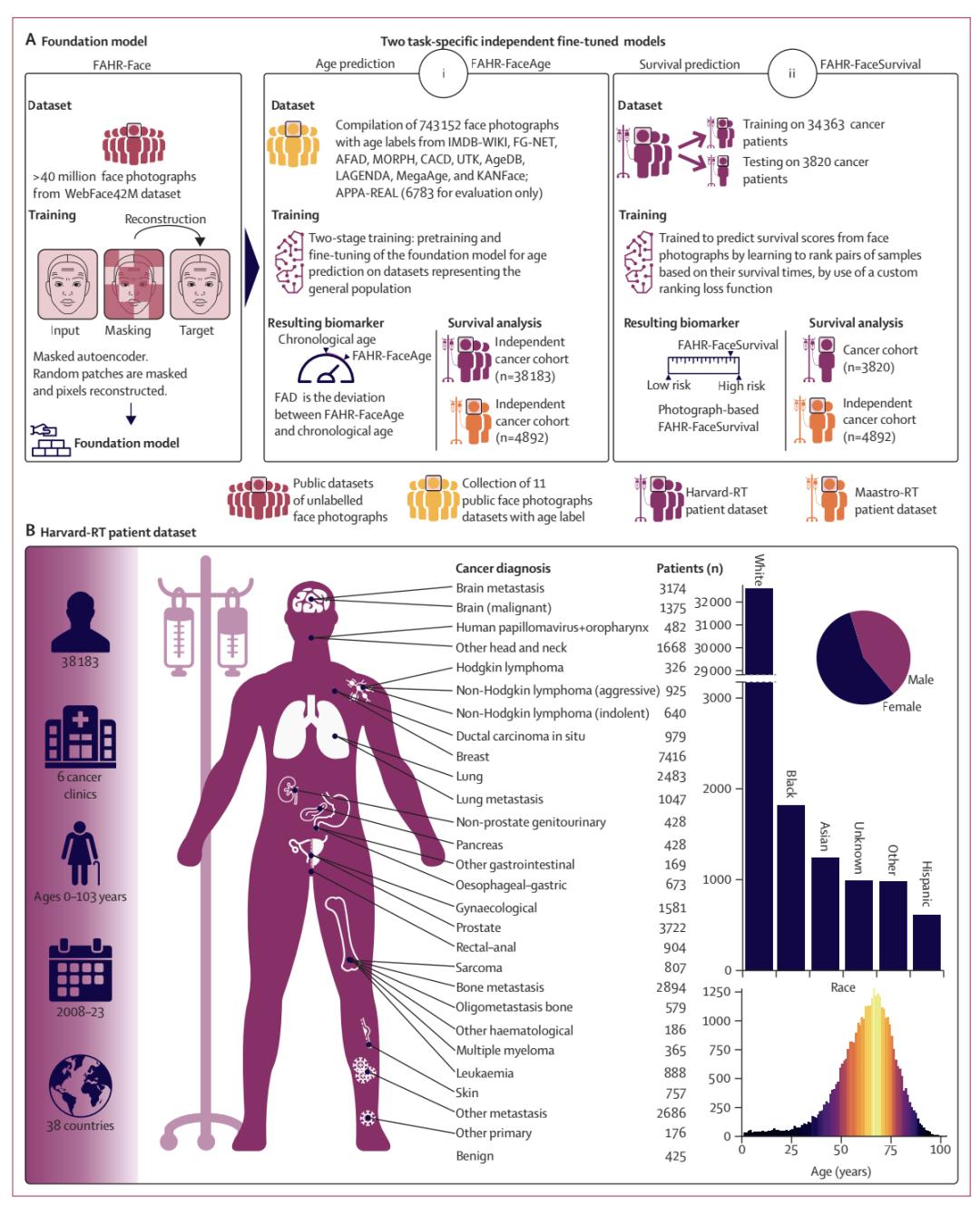
The research team used the large public WebFace42M dataset, and without any specific prompts, simply fed this AI more than 40 million unlabeled facial photos of various types, covering the full human life cycle from 0 to 116 years old.
During this process, the AI was allowed to "figure out" the mysteries of human faces on its own.

After absorbing the data from these 40 million facial images, the research team fine-tuned two complementary "killer-level" tools based on this powerful foundational model.
FAHR-FaceAge: Specially designed to accurately estimate a person's "biological age" (the real aging degree of your body, not the number on your ID card).
FAHR-FaceSurvival: This world-first model was specially trained with 34,363 photos of cancer patients. It can directly predict the survival risk of cancer patients through a single facial photo.
How does AI "predict life and death"?
You may ask, is it reliable to predict how long a cancer patient can live with just one photo?
The data gives a staggering answer.
First of all, more than half of the high-risk group died within 90 days.
In the test subset of 3,820 cancer patients, the AI gave a survival risk score to every person.
The results show that among the 122 extremely high-risk patients with scores in the highest range (0.9-1.0), 64 of them (as high as 52.5%) unfortunately passed away within only 90 days after taking the photos!
In contrast, among the 975 patients with the lowest scores (0.0-0.1), the 90-day mortality rate was only 2.1%.
In the overall data, the mortality rate of the highest risk quartile group was more than 3 times that of the lowest risk group (adjusted hazard ratio HR 3.23).
Even when the timeline is extended to 5 years and 10 years, the AI's predictions remain terrifyingly accurate.
In terms of 5-year survival rate, the patients rated as "lowest risk" (the top 25%) by FAHR-FaceSurvival have a 5-year survival rate as high as 78.1%; while those unfortunately classified into the "highest risk" group (the bottom 25%) have their 5-year survival rate plummet sharply to only 17.7%!
The second staggering finding is that if you look "older in the face", it may really be life-threatening.
The FAHR-FaceAge model has achieved extremely high accuracy in age estimation, with a mean absolute error (MAE) of only 5.1 years.
More interestingly, the study found that this estimated "facial age" has a weak correlation with the patient's "actual ID age" (R=0.16), which means that what the AI measures is not just the passage of time, but the real degree of health depletion.
The "age difference" it calculates (FAD, that is, the AI-estimated age minus your actual age) has become a real "life and death mark" —
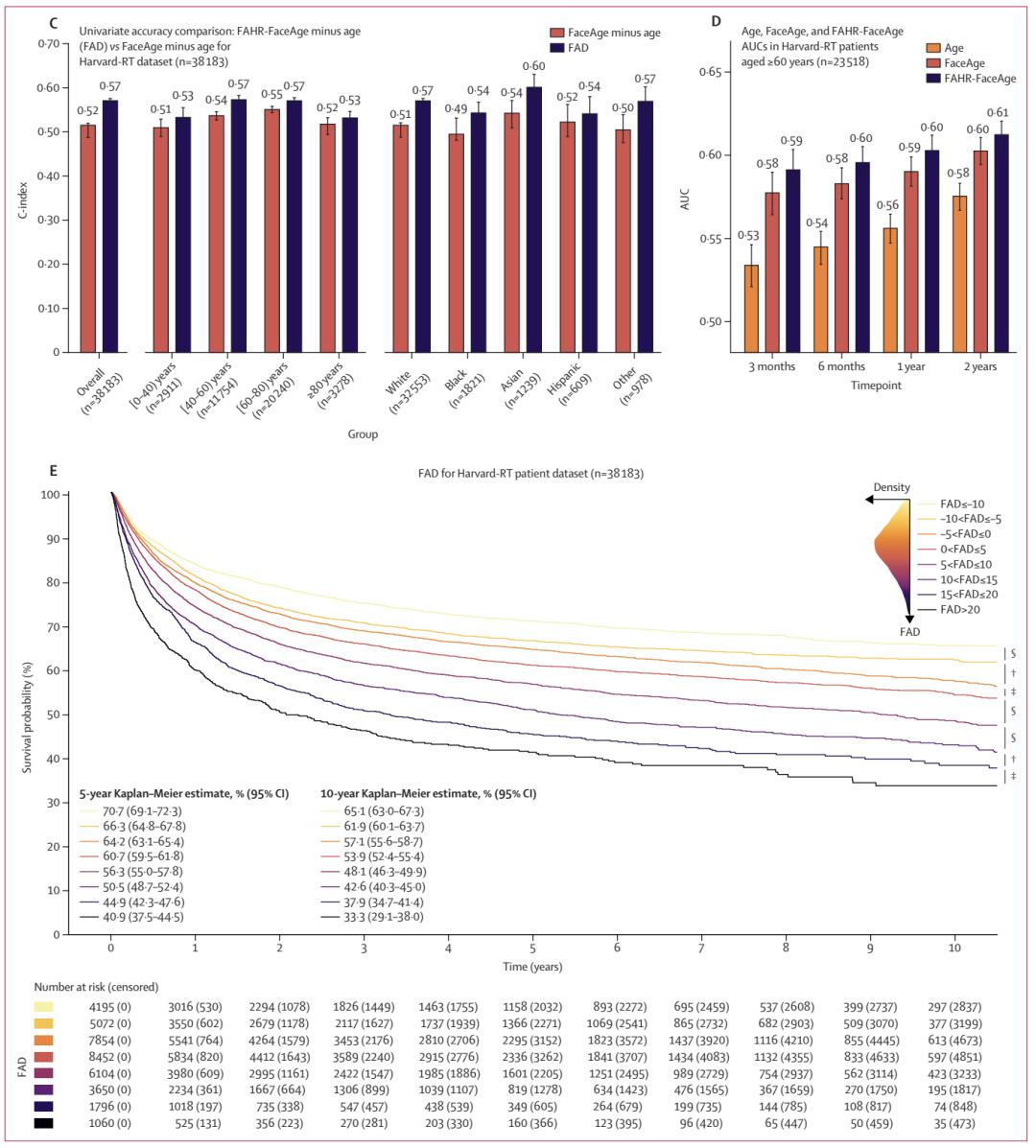
If you look more than 5 years older than your actual age (FAD≥5), your death risk will increase significantly by 21%!
On the contrary, if you look more than 5 years younger than your actual age (FAD≤-5), your death risk will be reduced by 17%.
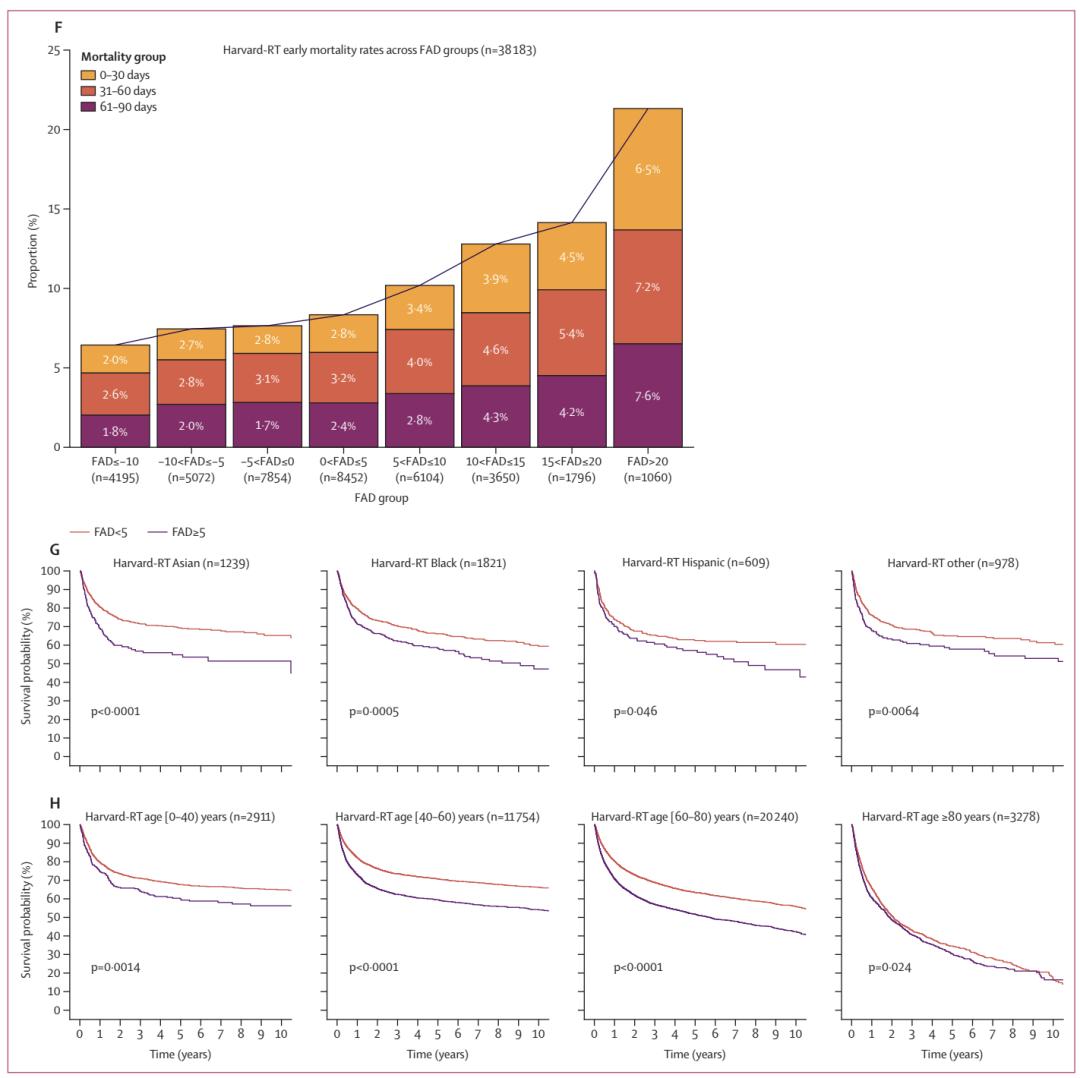
Moreover, if you look extremely old, more than 20 years older than your actual age (FAD>20), your early mortality risk within 90 days is as high as 21.3%.
Looking at the 10-year timeline, the 10-year survival rate of this group of "extremely old-looking" patients is only 33.3%; while the 10-year survival rate of patients who look "very young" (more than 10 years younger than their actual age) is as high as 65.1%.
In other words, AI can not only identify those extremely high-risk populations, but also accurately outline the survival trajectories of different populations 3 months, half a year, 1 year, 2 years, and even 10 years later.
In the eyes of AI, your face is like a pre-deciphered "life progress bar".
In addition, the segmented data also shows a harsh fact: in the correlation between "facial aging and mortality", the hazard ratio (HR) of female patients is higher than that of male patients; and compared with Black and Latino patients, once White and Asian patients "look older", their survival risk stratification is more drastic.
A coincidence spanning two thousand years: AI sees the "death gaze" of the ancient Greek medical sage
The most creepy part of this study is that the researchers figured out exactly where on your face the AI is "looking".
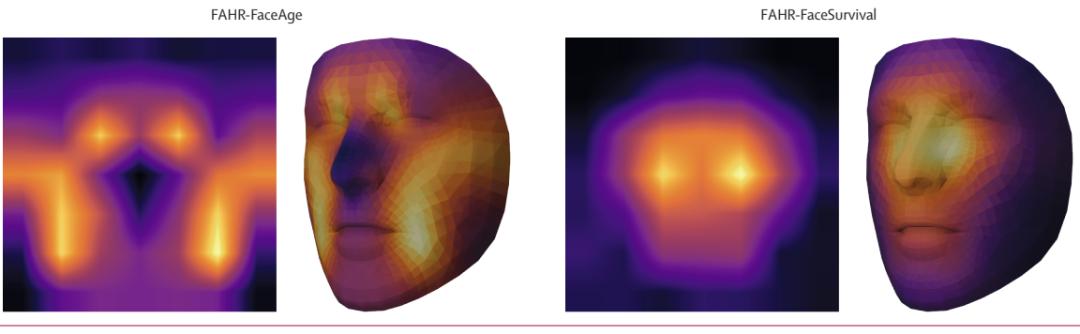
The research team used a technology called "attention mapping" to track which pixels on the face the AI focuses its sight on when making decisions.
The results show that although these two AI tools come from the same origin, they have "extremely low overlap in feature space", and they look for two completely different dimensions of health signals on the face (the correlation coefficient is only 0.22).
When guessing age (FAHR-FaceAge): the AI mainly focuses on your nasolabial folds, the forehead above the eye sockets, and the temple area. This makes perfect sense, after all, wrinkles and collagen loss are obvious signs of aging.
And as age increases (especially after the age of 40), the AI will shift more and more of its attention to the temples and forehead.
When measuring life and death (FAHR-FaceSurvival): the AI's sight is eerily focused on the area directly under the eyes (eye sockets) and the bridge of the nose!
Why the eye sockets and the bridge of the nose?
Dr. Raymond Mak was shocked to find that this coincided exactly with the observation of Hippocrates, the "Father of Medicine" in ancient Greece more than two thousand years ago!
As early as before the Common Era, Hippocrates described a terminal physical sign called "Hippocratic face". He pointed out that sunken eye sockets, sunken temples, and sharpened nose are physical failure signs that appear in the early stage before a person's death.
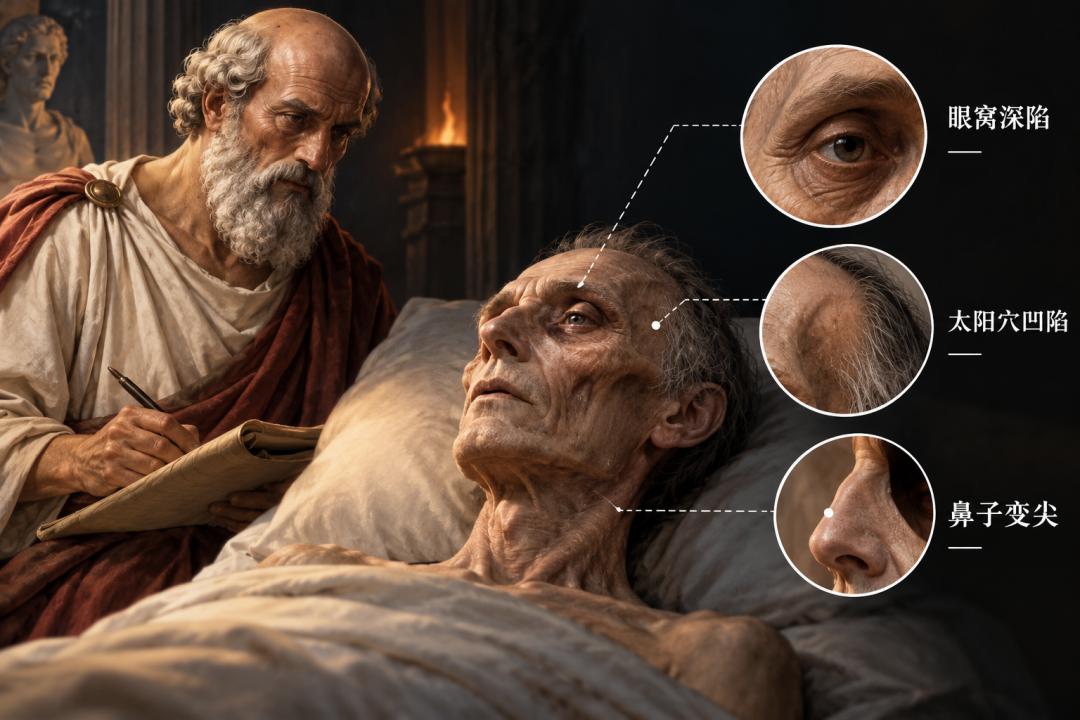
Today, two thousand years later, AI, without any prompts, with pure data, locks its sight on exactly the same position as the ancient Greek medical sage!
This coincidence is awe-inspiring.
Don't try to trick AI: beauty filters, makeup, and plastic surgery are all useless!
Since AI evaluates lifespan by looking at faces, many people will definitely think: "If I put on makeup, turn on the beauty filter, or get a facelift, can I trick the AI into thinking that I can live a few more years?"
The answer is — you can't trick it!
In order to test the stability of the AI, the researchers collected various photos of the same person taken in a short period of time for "robustness" testing, including:
Bare face vs heavy makeup
Neutral expression vs various exaggerated expressions
Different lighting and camera angles
Even photos before and after plastic surgery!
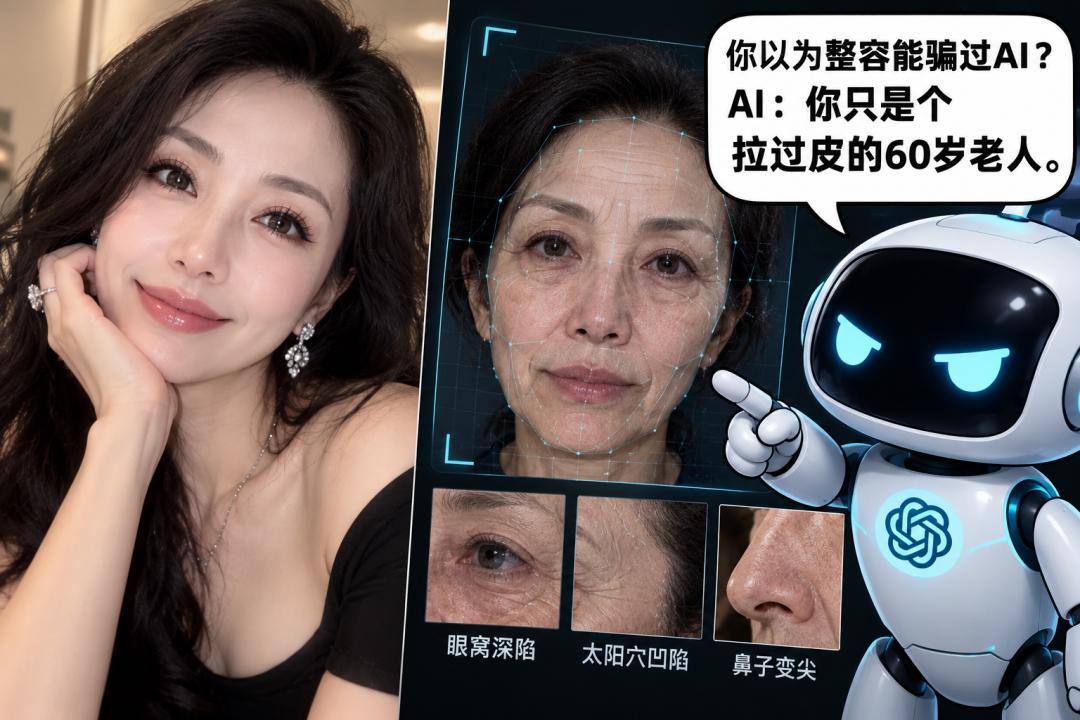
The test results show that: No matter superb makeup techniques, changing lighting and angles, smiling or frowning, the estimation results of FAHR-FaceAge are exactly the same.
What's more, even if you get brow lift, double eyelid surgery, facial facelift or fine adjustment of facial bones, the AI can still see through these "high-tech tricks" and instantly see your real biological aging degree, and the evaluation results have no statistically significant changes at all!
There is only one exception — rhinoplasty.
The study found that only people who have had nose plastic surgery will be slightly interfered with when evaluated by the AI, resulting in an average estimated age 1.11 years older after the surgery (p<0.0001). But this does not affect the accuracy of the model in the vast majority of cases.
In addition, your lifestyle is all written on your face.
Studies have confirmed that smoking, alcohol abuse and drug abuse are linked to a significant increase in biological age (aging). Among them, smoking has the most fatal impact, and even presents a strict "dose-dependent" relationship.
Not only are "current smokers" older than "former smokers", and "former smokers" older than "never smokers"; but in terms of lifetime exposure, "moderate to heavy smokers" are also significantly more old-looking than "light smokers"!
No matter if you have a smoking-related cancer or not, smoking will erode your face indiscriminately.
The era of AI fortune-telling is coming?
"As far as we know, this is the first report to prove that an AI model can directly predict cancer survival rate through a simple photo," said Hugo Aerts, co-senior author and director of the Artificial Intelligence in Medicine Program at Mass General Brigham.
If it were you, would you dare to let the AI take a photo of you and tell you how long you have left to live?
Professor Matthew Liao, director of the Center for Bioethics at New York University, pointed out that this technology also has some ethical risks.
What if the AI makes a mistake? Misjudging a patient in need of urgent treatment as "very healthy" may delay the best treatment window.
Will this AI be used as a reason to refuse to provide drugs to patients?
Once this technology becomes popular, will insurance companies refuse to underwrite or raise premiums based on AI results?
Will recruitment companies use it to filter out job seekers who are "not healthy enough"?
The research team has drawn a very clear boundary for these concerns.