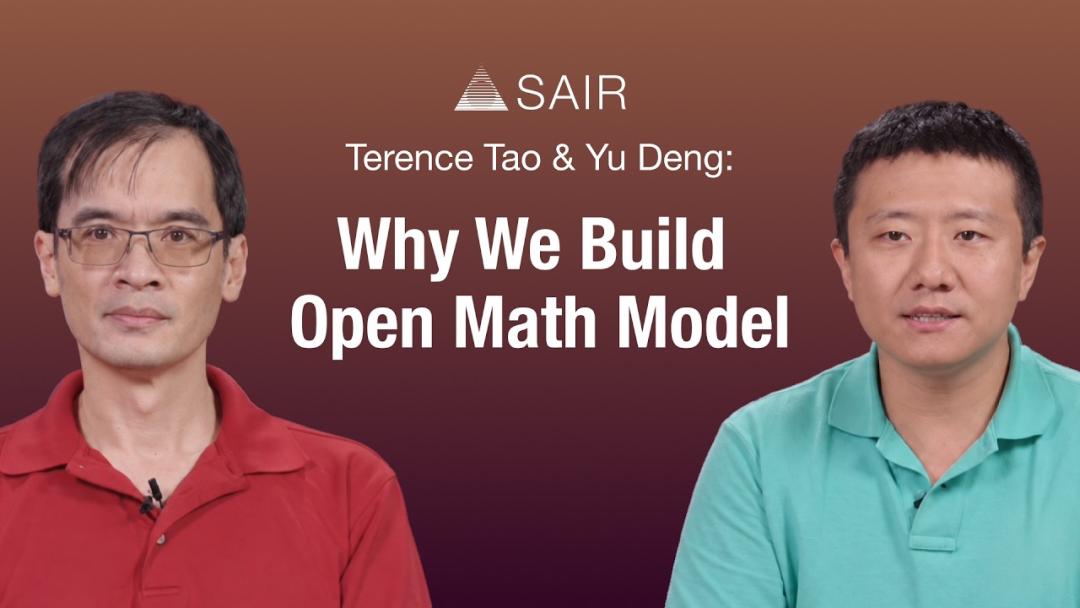
Terence Tao and Yu Deng's latest dialogue calls for "slow scientific research" in the field of mathematics.
Terence Tao and Yu Deng are starting to embrace "slow science" too (doge).
"Preserve the benefits brought by the slow-paced approach to doing science and mathematics, including deepening understanding, building a strong community, and enabling humanity to continuously master the comprehension of a discipline."
Just recently, in response to the controversy sparked by commercial AI's mass release of mathematical proofs, the two Fields Medal winners sat down together and gave their responses in an interview released by SAIR.
Their core view is: AI being able to generate a mathematical proof does not mean that humans truly understand the problem.
In the past, solving a difficult mathematical problem usually meant that researchers could explain the proof, raise new questions, and pass on the knowledge to others.
But now, when AI starts to churn out proofs in batches, "getting the solution" and "fully grasping the logic behind it" may become two completely different things.
Compared with how many new problems AI has solved, the two of them care more about whether these proofs can be understood, whether the derivation process can be verified, and whether mathematicians can continue to explore on this basis.
During the interview, the two further discussed how mathematicians and AI should divide the work: which tedious derivations can be handed over to AI, and which abilities including questioning, planning and judgment still need to be cultivated by researchers themselves.
This is also one of the motivations for the two to participate in the Open Math Model open mathematical model initiative: to let the mathematical community participate in tool development, so that AI can truly serve mathematical research.
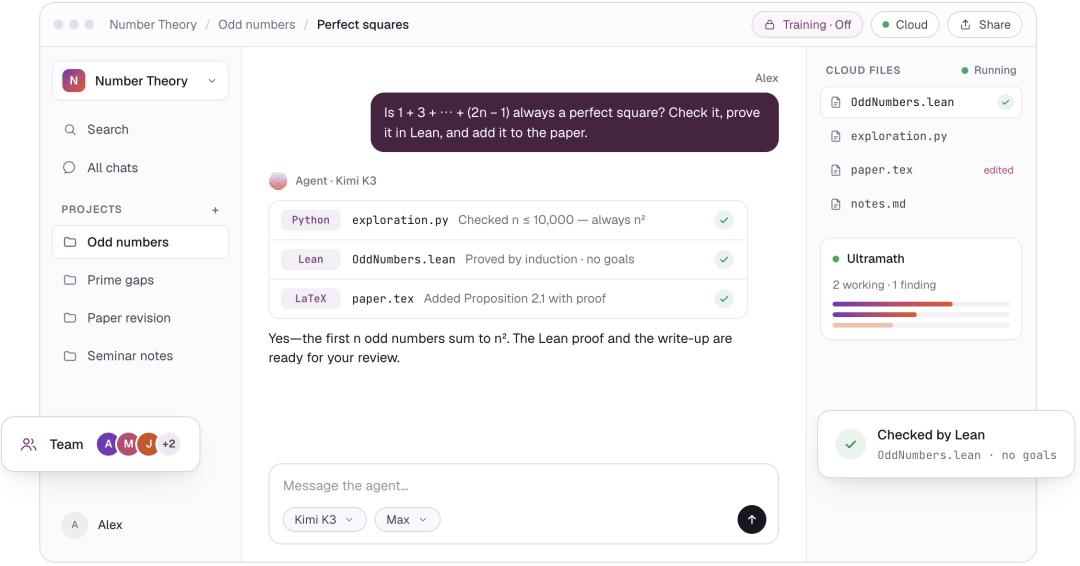
According to the progress at the time of the interview, the team's new model is still under preparation, and the first to be launched is Open Math OS — a working platform that integrates existing open models, research tools and collaboration functions.
The core views of the interview are as follows:
AI can bring new ideas and take on tedious derivations. Yu Deng affirmed the creativity in AI-generated proofs; when humans already have a proof roadmap, AI can also help complete time-consuming details, freeing researchers to focus on more fundamental issues.
Solving a problem and understanding the proof are two distinct boundaries. After the machine generates a proof, humans still need to understand the key ideas in it, explain why it holds, and what new problems it can lead to.
The origin and contribution of ideas should be traceable. AI is also built on the long-term accumulated human literature. Citing existing achievements and explaining the source of key ideas is part of the research process.
Open tools should allow the mathematical community to participate in deciding the development direction. The two hope that researchers can participate in tool construction, and make explanation, collaboration and knowledge accumulation clear goals.
A good tool should empower its users. Putting forward valuable questions, designing the overall proof route, and developing new ideas are still abilities that researchers need to cultivate. While getting answers, users should also deepen their own understanding.
The following is the full sorted interview transcript.
AI can accelerate research, and the value of "slow science" should also be preserved
Host: Hello everyone, welcome back to the SAIR Podcast. Recently, a leading commercial AI company released more than 700 mathematical proofs at one go, and the entire internet was abuzz. Many people say that it seems AI is about to replace mathematicians now. But if you really talk to people in the mathematical community, I think you will find that what everyone cares about is not so much that machines are taking away jobs, but more about academic integrity, who should be credited for the results, and the very soul of mathematics itself.
Today we have Yu Deng and Terence Tao with us. Please introduce yourselves to the audience first.
Yu Deng: Hello everyone, I am Yu Deng, currently a professor of mathematics at the University of Chicago, focusing on fields such as partial differential equations (PDE) and probability theory.
Terence Tao: I am Terence Tao, a professor of mathematics at the University of California, Los Angeles (UCLA), focusing on analysis, number theory and combinatorial mathematics. But recently, I have also been involved in AI-related work, paying attention to the future of the entire mathematical field.
Host: Thank you both. Before moving on to other questions, I would like to learn about your attitudes towards AI. The general impression now is that many people are against AI, but I would like to hear your more nuanced views: how do you think AI can be used in mathematical research? What uses has it already had?
Yu Deng: I think using AI is a good thing and the direction of the future. AI can greatly expand the boundaries of mathematics and research, but we just need to use it correctly. I also mentioned this in my lecture this morning. This is mainly at the level of academic norms, and it is also more of an ethical issue.
Of course, from a technical point of view, these proofs we have seen recently are really remarkable, with very beautiful new ideas in them. Leaving aside the company's practices and other similar issues, and only looking at the proofs, I think we are in a very good situation now: AI learns from humans, learns human ideas, and creates its own new ideas. And these new ideas, we can indeed understand, and can further develop our own new ideas on this basis. This is a kind of co-evolution between humans and AI, which is what I hope to see.
Terence Tao: It seems that everyone now wants to divide people into two camps, supporting this and opposing that, but technology has never been that simple. You can ask a person, do you support cars or oppose cars? Support the Internet or oppose the Internet? But things are never that simple. Every technology has advantages and disadvantages. You can try to only look at the advantages, or only look at the disadvantages, but the actual situation is always more complicated. AI is definitely the same.
AI gives us more capabilities. Many tasks that were very difficult in the past can now be completed automatically. But it is also replacing some much slower but very valuable ways of doing things. Ideally, we want to get the benefits of both. Cars can have more advantages than walking in travel, but you don't want to replace all the original walking scenarios with driving. Sometimes you really want to walk, maybe to enjoy walking, or for safety, environmental protection or other reasons.
So, we have to find the right balance. On the one hand, preserve the benefits brought by the slow-paced approach to doing science and mathematics, including deepening understanding, building a strong community, and enabling humanity to continuously master the comprehension of a discipline; on the other hand, we also use these powerful methods that can make things much faster. But sometimes, speed is not the only thing we want to optimize.
Yu Deng: Right. Actually I thought of a usage scenario that would work very well. For example, you have a problem, you already have a roadmap to solve it, and you know exactly what steps to take, but you find that the actual implementation is too complicated, and it will take a lot of time to derive all these details. But you already have the idea, and know how to make this path work.
At this time, handing over these tasks to AI, I think this is a very good example: let AI help you save time and energy, so that you can focus on more fundamental problems.
Solving a problem and understanding the proof are two distinct boundaries
Host: That makes a lot of sense, especially what you said, that the attitude should be dynamic, not a simple total support or total opposition, which is very important. This also brings us back to what happened recently. These proofs are indeed amazing, but after release, the company withdrew several preprints due to basic symbol errors; people also noticed that there is a big gap between the text proofs and the Lean code.
A large technology company throwing these immature proofs in front of the public at such a speed will indeed cause the problem of polluting academic literature. How can we prevent others from following suit, while avoiding everyone spending time acting as free debuggers for such achievements?
Terence Tao: I think we need to change the incentive mechanism and value system. The reason why these technology companies want to make a big splash to announce that they have solved these problems is partly because our mathematical community itself has always attached great importance to solving these problems.
In the past, when a person solved such a problem, it usually meant that he had a deep understanding of the problem, could explain it clearly, could raise new questions on the basis of existing work, and could train students. These things are linked together. We will award someone for solving a problem, but in fact, what we reward is this whole set of broader activities. Problem solving is just the easiest indicator to measure.
But now, these AI technology companies are almost solving these problems as a side effect. For them, mathematical problems are a useful benchmark when training more general models. As a result, these solved problems become a kind of by-product, you can even call it "toxic waste", and then they have to find a way to deal with it, or we have to deal with it.
So I think we really should make it clearer: we don't need to solve problems just for the sake of solving them, what we want is broader understanding and insight. Ideally, the companies that produce these proofs should also cooperate with us to help everyone understand these proofs. Maybe before the work starts, some mathematicians should be involved, instead of cleaning up the mess afterwards. Some practices worth following can be formed in this regard.
But realistically speaking, I think people will continue to do this. At some point, we can only say: if you only solve the problem without producing those other valuable things, then these achievements will not become part of our mathematical literature.
We will look at them later. Among the results released by this technology company this time, there are about ten problems that I care about, and one day I will read them, but this is really not my current priority. The current way they explain these results hasn't really excited me yet. We will look at them eventually, but this process will be much slower. If they can cooperate with us, the progress could have been much faster.
Yu Deng: Right, I have always agreed with the idea of deepening understanding. Basically, my understanding is: why do we do mathematics? Different people may have different answers. For me, the answer is to understand the world. The world here includes both the real world and the abstract mathematical world.
So, what exactly does understanding mean? In fact, there are two boundaries here. The first is the boundary formed by all problems that already have proofs. The second is the boundary formed by the problems with existing proofs whose proofs we are able to understand.
In the past, the second boundary was not a problem at all. Because if there was a proof, it meant that someone had proved it, and someone could understand it. But now, if only AI knows the proof, this second boundary comes into being.
So I think our value orientation has actually been consistent in different eras, it's just that the situation has changed. On the surface, the value orientation seems to have changed now, but in my opinion, when we do mathematics, we have always followed the same values.
Make the origin and contribution of ideas traceable
Host: This also involves the issue of contribution attribution and fairness. Seeing that open letter signed by Fields Medal winners, I would like to ask: when commercial companies demonstrate their computing power in this way, whose credit are they taking for themselves?
Terence Tao: In a sense, they are extracting the work results of others, using data from other research and papers. How can we trace these sources?
For hundreds of years, the academic community has been following the principle of open science, treating scientific literature as common wealth. We publish papers, and of course, reading journals often requires payment, and there are indeed some issues worth discussing in this regard. But leaving these aside, scientific literature should be open to all, and people should also use the research literature of others. Of course, proper citation is needed, so that we can trace the source of ideas. This is how science moves forward.
Now, we have a technology that can absorb all the literature accumulated by scientists and mathematicians for thousands of years, and then convert these literature into answers in some opaque way. AI can give answers, sometimes it will tell you that it used a specific result in a certain paper; sometimes it cannot trace all the way back to the source, or show where these ideas come from.
So we are starting to break this chain of ideological inheritance, the real "chain of thought". It's a pity, because part of what we learn when solving a problem is what influences it has received, and which key ideas already exist in the literature in incomplete forms. Maybe this is only temporary, and maybe future AI will be better at tracing its own sources. But current technologies are doing very poorly in this regard.
I think technology companies have an incentive to downplay this point, because they want to make people feel as if these AIs have solved the problem out of thin air without any existing results. But just like human scientists, they are also built on the foundation of thousands of years of human efforts. Sometimes they note the contribution attribution, sometimes they don't. This aspect needs to be done better.
Yu Deng: There is also a more specific example: someone directly uses other people's ideas that others have previously input into ChatGPT, and then uses them to generate proofs.
I think the ultimate goal is to create something that can truly trace the source of ideas. Now, if you can see AI's chain of thought, you can at least roughly know how it got these things and what materials it consulted. But if not even this is provided, it would be too absurd.
Of course, if we want to create something that does not depend on these big companies, then this is one of the goals we are striving to achieve.
Why build the Open Math Model
Host: Generally speaking, there has been a disconnect between the industry and the scientific community in some links, especially the different ways the two sides deal with problems. This also reminds us that we should form a consensus on what we can do next.
Terry, as the chairman of the SAIR Foundation, you and we recently jointly launched the Open Math Model initiative. What was your original vision when you took the lead in promoting this? Why do you think open source models can truly help mathematicians in ways that closed source models cannot?
Terence Tao: When we founded SAIR, one of my visions was to provide the mathematical community with tools developed by the community itself that conform to its values and goals.
Large technology companies do give us useful tools. I often use proprietary models, and many of my colleagues do too. Sometimes these tools are quite consistent with our work goals. For example, their current literature retrieval capabilities are indeed very strong and practical. We become better at retrieving literature, and this will not destroy our understanding of the research field.
But as we have seen, sometimes they generate proofs without bringing understanding, and the citations are incomplete, thus cutting off the connections between literature. So we have always wanted to develop tools independently of large technology companies, with the full participation of the community.
We discussed many solutions, and then came up with the idea that open source models for mathematics, plus a set of easy-to-use supporting frameworks, would be very valuable. In this way, users do not need to deploy the models by themselves, nor do they need to buy GPUs by themselves. We originally had a long-term plan to launch it step by step.
But in the past few months, as these major events have occurred one after another, many mathematicians have suddenly developed a strong interest in AI usage methods outside the large cutting-edge technology companies. So we accelerated the release of Open Math OS. We don't have our own new model yet, and we initially use existing open source models, but at least we already have an operating system built around the models. We hope that it can be put into use now, integrating models with various tools and supporting collaboration.
We are organizing many teams to pool ideas, data, training resources and computing power, and many partners are participating. I hope that in a few months, we can make our own model on the basis of existing open source models. I am very much looking forward to seeing how this community develops and what we will launch in the next few months.
Host: Yu Deng, what prompted you to join this project with Terry? What aspects of it inspired you, even made you intuitively feel that