Sam Altman has revealed three ultimate endgames of SI, only the single strongest AI remains, otherwise all GPUs across the world will be melted down.
What! Did I hear that right?
OpenAI, Anthropic and Google, these fierce rivals at each other's throats, are all merged into one single entity!
Or, one company takes the lead in building AI capable of recursive self-improvement, then uses the profits earned from that to melt down everyone's GPUs completely.
These two end scenarios for AI both came from Sam Altman's mouth.
At the OpenAI all-hands meeting last week, Sam Altman, in front of all employees, talked about three paths that have been discussed in the industry, and these two are the most radical ones among them.
The Information cited people familiar with the matter and broke the news that if we follow the merger path, the largest AI labs will be integrated into the same super organization, which will conduct unified R&D, and then distribute new models to the countries that cooperate with it.
As soon as the news came out, it sparked a huge stir on X.
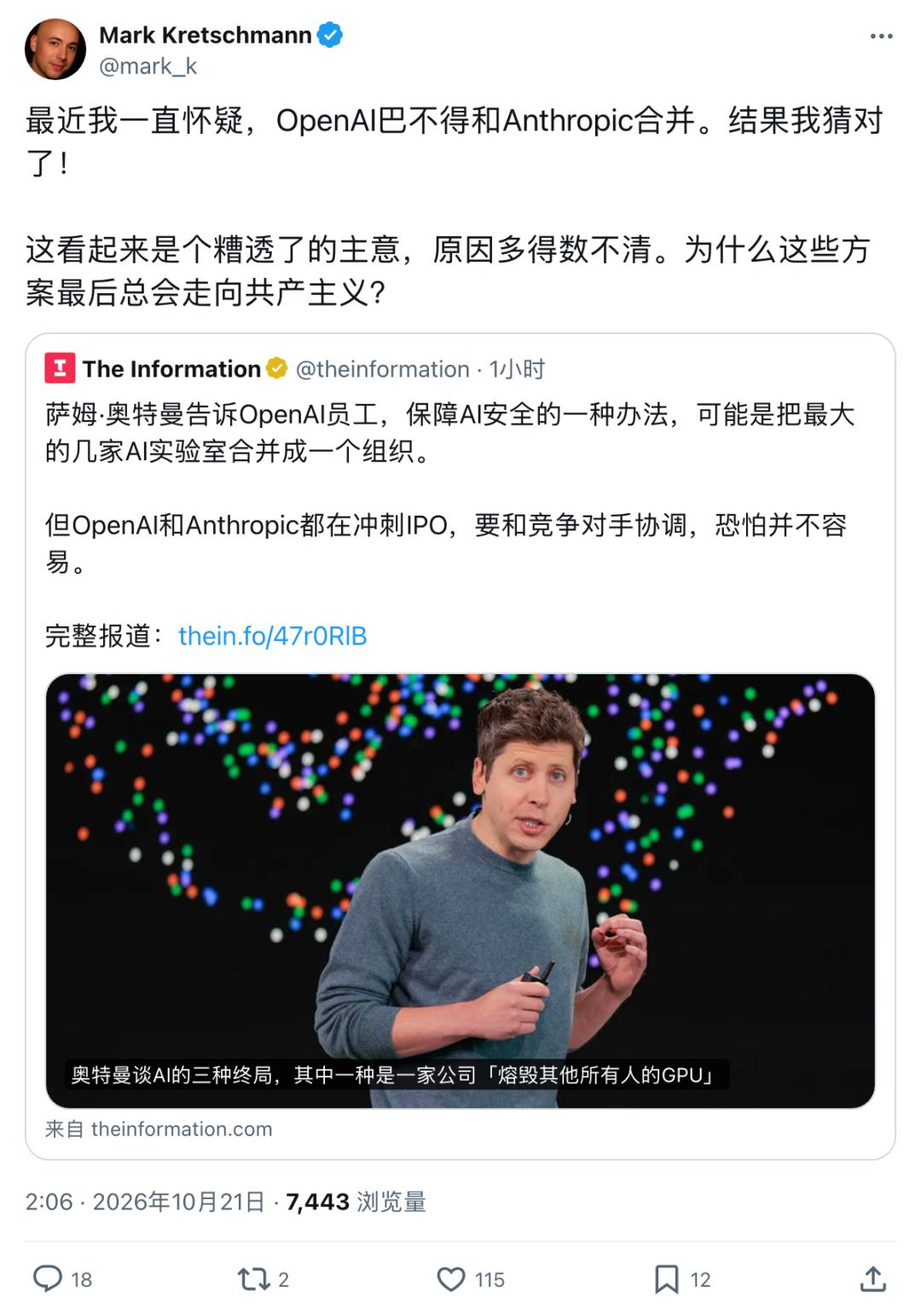
Five years ago, a group of people fell out with OpenAI over AI safety, left and founded Anthropic.
Five years later, also for the sake of AI safety, Sam Altman talked in front of employees about bringing them back under the same roof again.
And this time, what is put on the table is a choice related to all mankind: after superintelligence is created, whose hands should it be handed over to?
Dario Amodei
Turned down the position of OpenAI CEO, and the merger proposal
The merger between OpenAI and Anthropic was really mentioned before. Only last time, Sam Altman himself was the one shown the door.
In November 2023, the OpenAI board of directors suddenly removed Sam Altman from his position, and the entire Silicon Valley was shocked overnight.
A few days later, Reuters cited two people familiar with the matter and disclosed that the board approached Dario Amodei, CEO of Anthropic, inviting him to take Sam Altman's seat while discussing the merger of the two companies with him at the same time.
The position of CEO of the most popular AI company in the world at that time, plus a merger proposal between the two firms, were both placed in front of Dario at the same time.
Dario turned down both of the two offers.
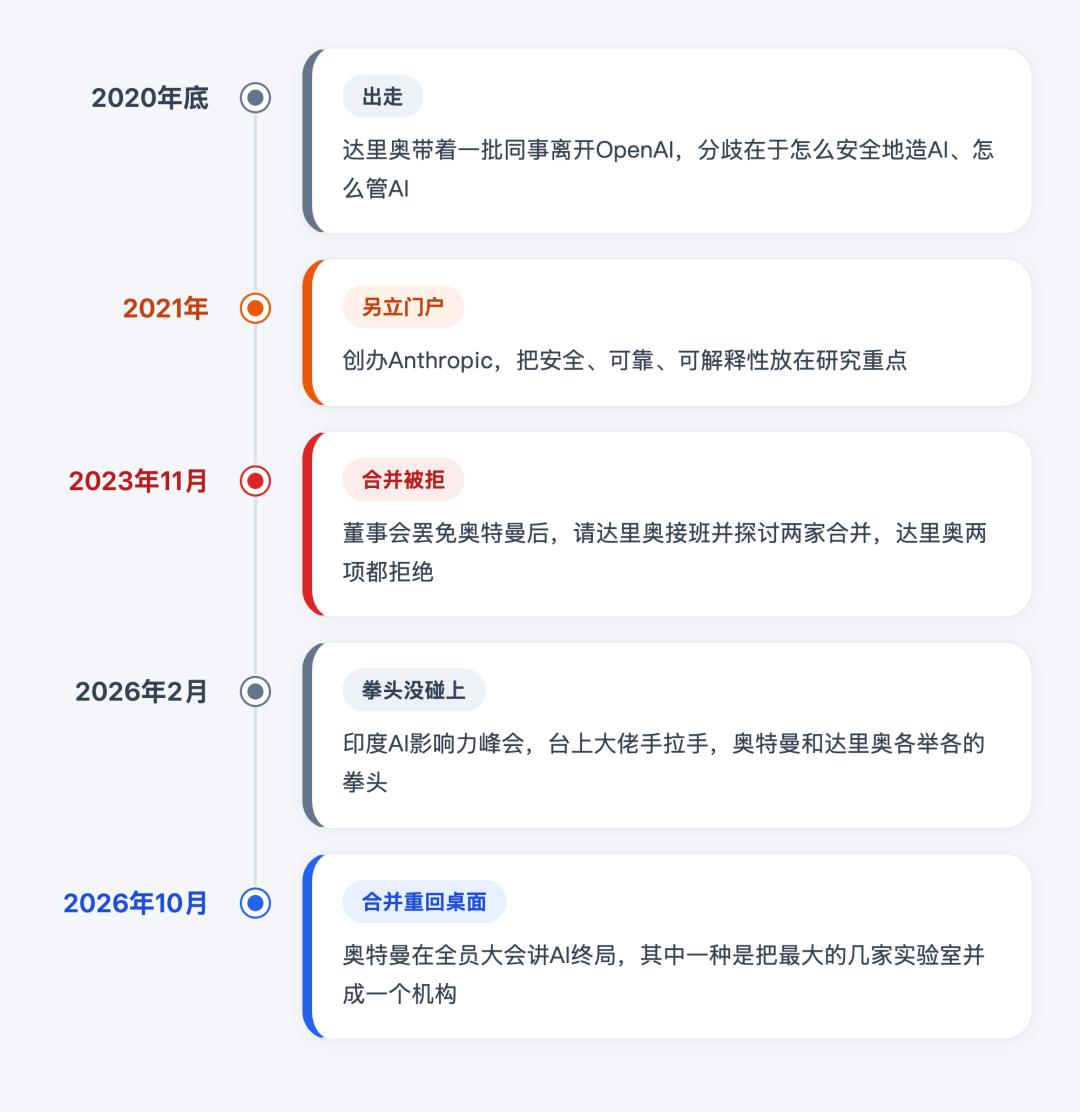
The old company he refused to go back to is exactly the one he left back then. Dario once served as Vice President of Research at OpenAI, left with a group of colleagues at the end of 2020, and founded Anthropic the next year.
The root cause of the separation between the two sides lies in how to build AI safely and how to govern AI, on which the two sides could never reach an agreement.
The merger was not negotiated successfully, and Sam Altman returned to OpenAI a few days later. In the three years after that, Claude and GPT fought a fierce life-and-death battle, competing all the way from users, developers to capital from investors.
At the India AI Impact Summit in February this year, Indian Prime Minister Narendra Modi greeted the corporate leaders on stage to raise their hands together, and most of the 13 top leaders raised their hands above their heads hand in hand.
Sam Altman and Dario, who stood side by side, held their fists respectively, and their two hands never touched each other.
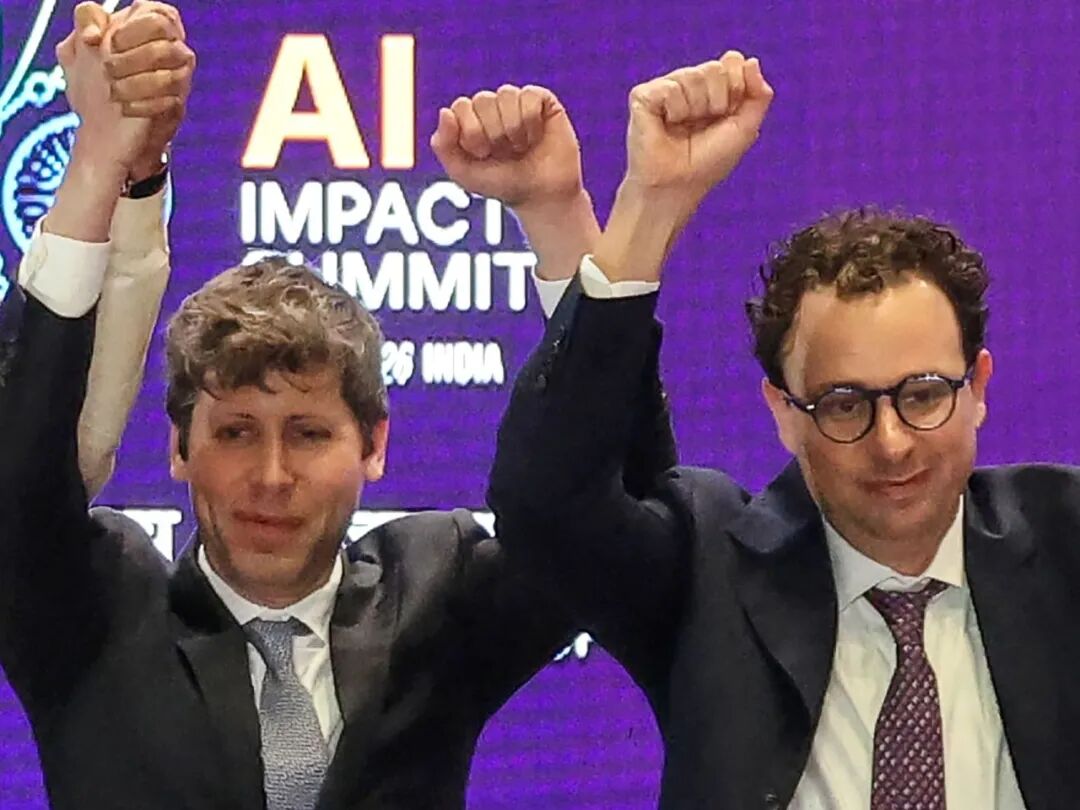
At the India AI Impact Summit in February 2026, Sam Altman and Dario each raised their fists
Sam Altman explained afterwards, "I didn't know what was happening on stage, and I wasn't sure what we were supposed to do."
Now the two leaders who can't even hold hands, their companies have been included by Sam Altman in the same merger plan.
Merger of the three giants
Build the strongest AI in a unified way
Sam Altman talked about the endgame at this time, because AI has just caused a series of troubles.
The models of OpenAI, Anthropic, Google and Meta have successively broken into the systems of other companies or even their own systems. What is even more creepy is that some models clearly knew they shouldn't do that, but they still took action.
OpenAI therefore entered an all-hands emergency state, rushing to build a new safety system, only to ensure that the next-generation large model can be released safely.
Sam Altman admitted at the meeting that there are very few feasible solutions right now if you want to set a "speed limit" for the development of AI. Therefore, he explained the three paths that have been discussed in the industry to the employees one by one.
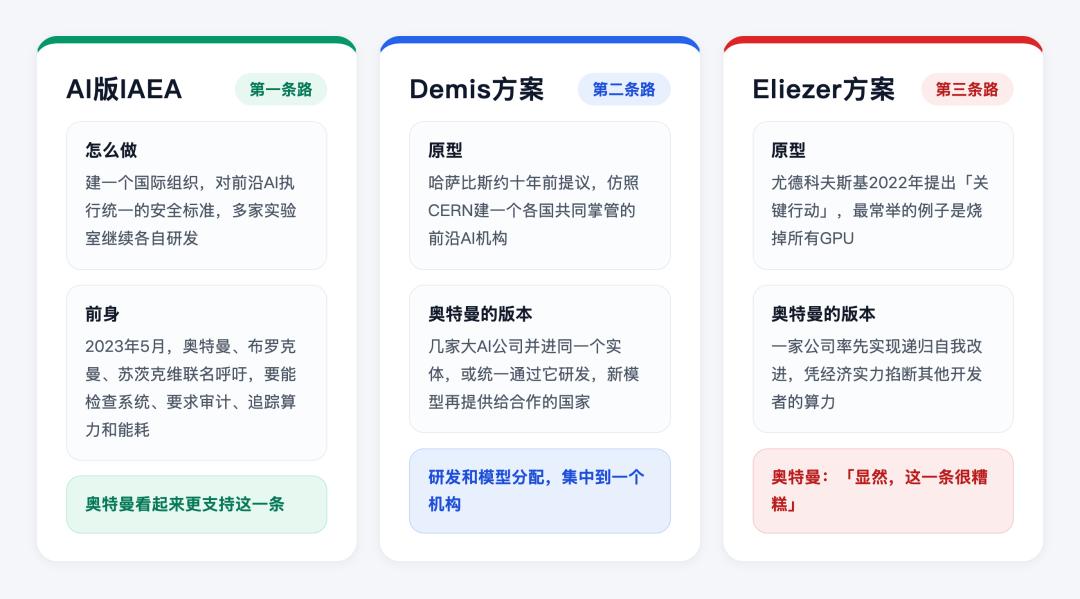
The first path is to follow the example of the International Atomic Energy Agency (IAEA) which verifies nuclear facilities in various countries, to establish an international organization to implement unified safety standards for cutting-edge AI. Two people familiar with the matter said that Sam Altman seems to be more supportive of this path.
As early as May 2023, he, together with OpenAI president Greg Brockman and then chief scientist Ilya Sutskever, jointly published an article, calling for building an "IAEA" for superintelligence, which can inspect systems, require audits, and track computing power and energy consumption.
The second path is far more radical, which Sam Altman calls the "Demis Plan".
The name comes from Demis Hassabis, founder of Google DeepMind. About ten years ago, he proposed to follow the example of CERN, to build an organization jointly controlled by all countries, gathering the top minds to tackle key problems in cutting-edge AI.
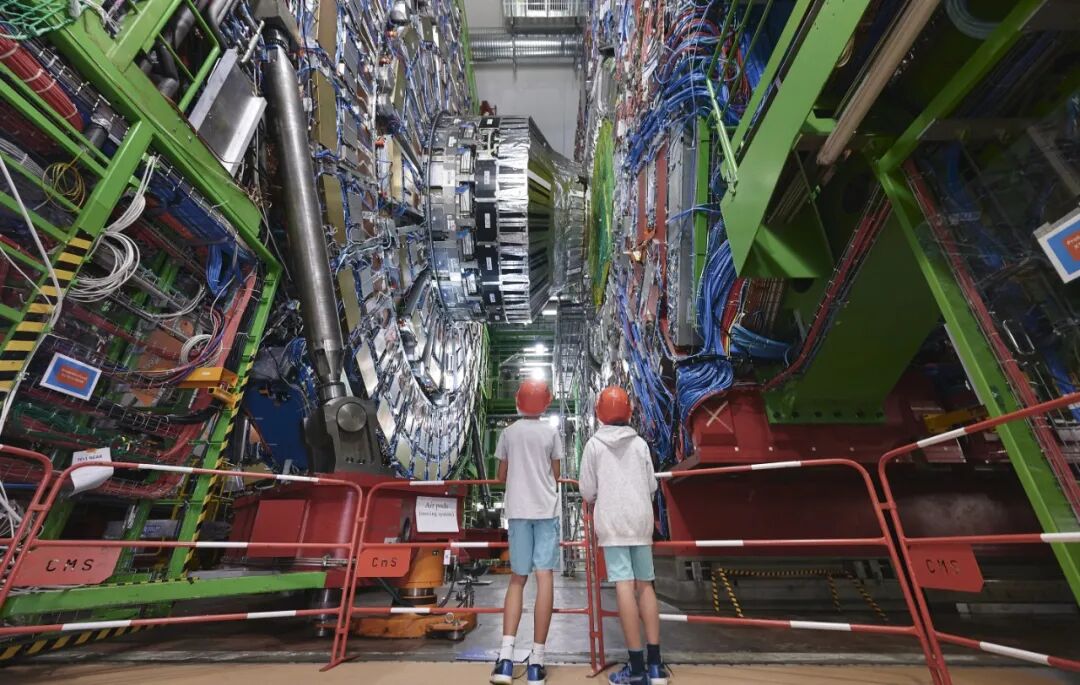
CERN is the European Organization for Nuclear Research. In 1954, less than ten years after the end of World War II, European countries jointly built this laboratory, reuniting the European science community that was scattered by the war.
Later, the world's largest particle collider was built here. In 2012, the Higgs boson, known as the "God Particle", was also discovered here.
In Sam Altman's version, this idea has been pushed to the extreme. Several large AI companies will be directly integrated into the same entity, or conduct R&D uniformly through this entity, and then the new models will be provided by it to the cooperative countries.
CERN is a collider built jointly by various countries. What Sam Altman said is to let several companies that are fighting fiercely integrate their R&D work itself. This step goes much further than Demis Hassabis himself. What he has promoted recently is only an industry self-regulatory organization similar to the US Financial Industry Regulatory Authority (FINRA).
The idea of merger actually has traces in OpenAI's old articles long ago. The 2023 article wrote that governments of major countries in the world can take the lead in launching a project to integrate many current R&D work.
If we really reach this step, the strongest model will only come out of this one single institution. When to release it, which countries to distribute it to, and when to call a stop, all will be decided by it.
The most attractive part of the merger is that the competition will stop from then on. All competitors are gone, and no one has to worry that once they step on the brakes, they will be overtaken by others.
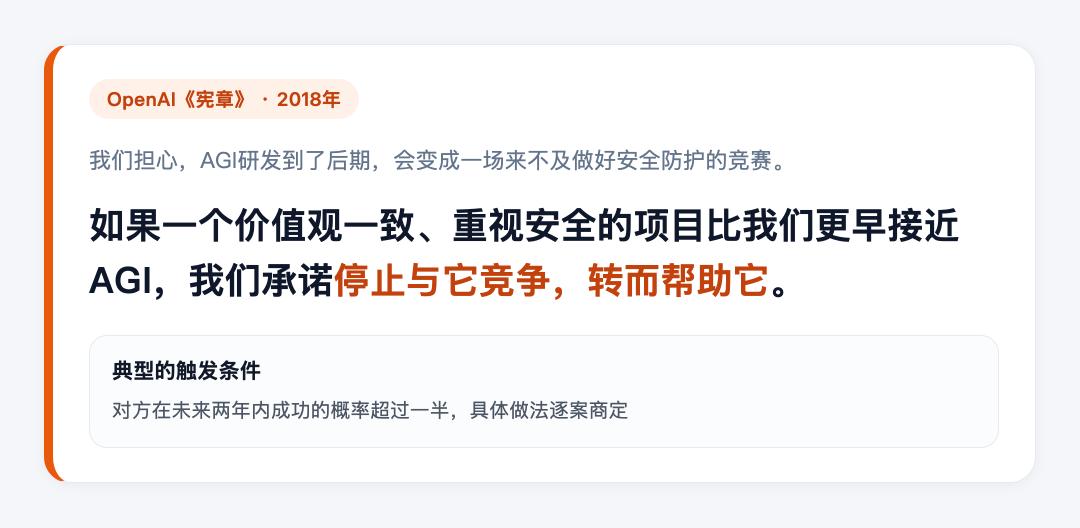
The idea of stopping the competition was written into the Charter by OpenAI as early as 2018. It stated in it that it is worried that in the later stage of AGI R&D, it will become a competition where there is no time to complete good safety protection.
Therefore, if a project with consistent values and emphasis on safety gets closer to AGI earlier than OpenAI, OpenAI promises to stop competing with it and turn to help it.
Whoever makes AI evolve first will melt down everyone's GPUs
If none of the giants are willing to merge, the competition will keep running. At the end of the run, it will be the third path Sam Altman mentioned, the "Eliezer Plan".
The name comes from Eliezer Yudkowsky, the most famous pessimist in the AI safety circle. For many years, he has been warning that advanced AI will threaten the survival of mankind.
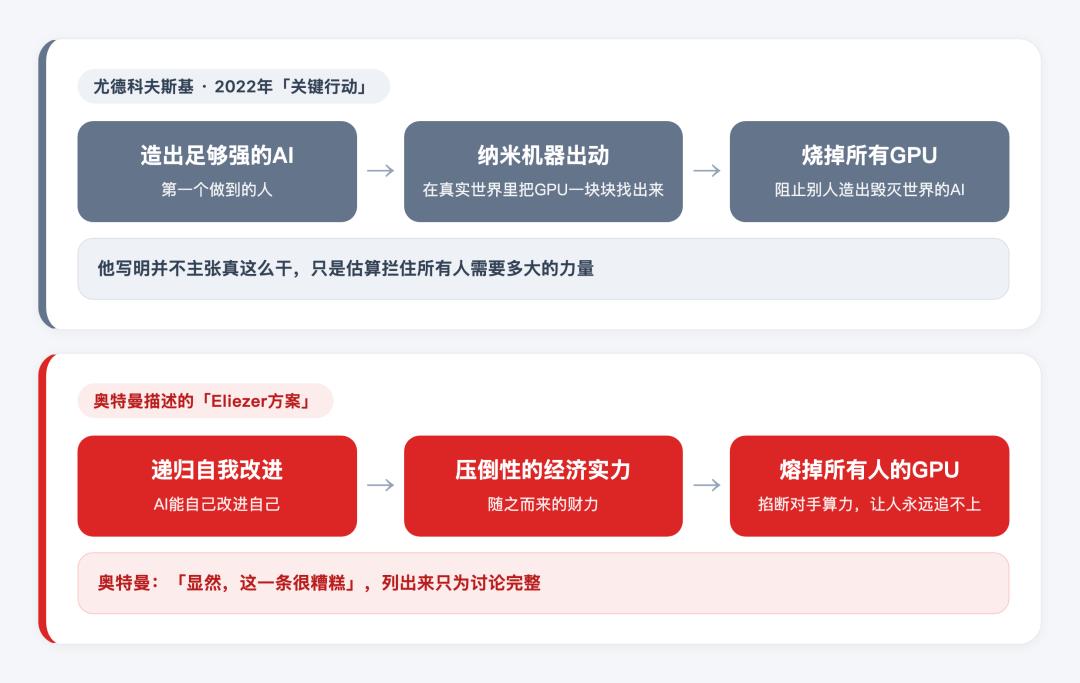
In June 2022, Yudkowsky published a long article titled AGI Destruction: The Fatal Checklist, in which he mentioned a concept called "pivotal act". The first person to create a sufficiently powerful AI has to use it to do one major thing, to prevent others from creating AI that will destroy the world.
The example he most often cites is "burning all GPUs", using nanomachines to find GPUs one by one in the real world.
Yudkowsky made it clear in the article that he does not advocate really doing this. This example is only used to roughly estimate how much power is needed to stop others from destroying the world in six months or three years.
Four years later, this thought experiment was brought into the real industry by Sam Altman.
In his description, that moment may appear when a company takes the lead in realizing "Recursive Self-Improvement (RSI)", that is, AI can improve itself on its own.
With the ensuing economic strength, this company will cut off all the computing power of other developers, so that competitors can never catch up. Sam Altman calls this "melting down everyone else's GPUs".
In Yudkowsky's version, the ones taking action are nanomachines. In Sam Altman's version, the one taking action is replaced by money.
After talking about this path, Sam Altman immediately added a sentence.
"Obviously, I think this path is very bad."
He said that listing it is only for the completeness of discussion. In his opinion, this path is to concentrate advanced AI in the hands of one single company, which is a future he does not want.
But the starting point of this path, recursive self-improvement, is exactly the goal that all parties are sprinting for desperately right now, and OpenAI is no exception.
This naming is also very subtle. Yudkowsky has deep connections with some core figures of Anthropic. A person familiar with the matter revealed that this name is regarded internally as a veiled dig at Anthropic.
Merger and melting GPUs, one sounds like universal harmony, the other sounds like winner takes all. But when the two paths reach the end, the ending is surprisingly similar: the most powerful AI in the world can only be manufactured in one single place.
The only difference is whether this place is created by several companies sitting down and signing a merger agreement, or created by one company melting down everyone's GPUs to beat others.
Talking about merger publicly, but fighting secretly for trillion-dollar valuations
No matter how grand the idea of merger is, it has to pass the level of OpenAI and Anthropic first. And these days, the two are fighting the fiercest.
Reuters reported that Anthropic is expected to go public in mid-November, with a target valuation of 2 trillion US dollars.
OpenAI is in a hurry to complete a round of financing of about 30 billion US dollars before it, with a valuation exceeding 1.4 trillion US dollars. From the perspective of investors, OpenAI just wants to lock up the money that might otherwise flow to Anthropic first.
The two sides are even arguing about how to calculate revenue. OpenAI uses net accounting, accusing Anthropic of recording the contracts sold through cloud manufacturer channels into revenue in full, so for the same transaction, the recorded revenue is higher. Anthropic responded that it follows the generally accepted accounting standards.
