The first city in central and western China to hit the 1-trillion-yuan mark in foreign trade is coming.
The landscape of China's trillion-yuan foreign trade city pattern is about to be rewritten.
In 2025, the total import and export volume of Shenzhen, Shanghai, Beijing, Suzhou, Dongguan, Ningbo, Guangzhou and Jinhua all exceeded the 1-trillion-yuan mark, forming the "top tier" of China's foreign trade cities. All eight cities are without exception located in eastern China — but this pattern is being broken.
The latest data released by the General Administration of Customs shows that the total import and export volume of China's goods trade in the first three quarters reached 39.94 trillion yuan, up 18.8% year on year. Apart from the eight trillion-yuan foreign trade cities, the total import and export volume of Wuxi, Xiamen, Hangzhou, Xi'an, Chongqing and Qingdao has all exceeded 720 billion yuan, officially sprinting towards the trillion-yuan threshold.
Among them, the total import and export volume of Xi'an in the first three quarters reached 764.413 billion yuan, up 115.5% year on year. Its national ranking jumped sharply from 19th in the same period last year to 12th, surpassing Chongqing in one fell swoop to become the largest foreign trade city in the central and western regions. If the growth momentum continues, there is almost no suspense that it will exceed 1 trillion yuan for the whole year.
This also means that the trillion-yuan foreign trade club, which has long been "exclusively occupied" by eastern cities, is expected to welcome its first member from the central and western regions. Behind this, industries such as integrated circuits and automobiles are accelerating their integration into the global division of labor, which is rearranging the foreign trade rankings of Chinese cities.
01
Trillion-yuan Scale Expansion
In the first three quarters of this year, China's foreign trade showed an upward curve.
Data from the General Administration of Customs shows that China's import and export volume increased by 15.3% year on year in the first quarter, 18.3% in the second quarter, and the growth rate further rose to 22.3% in the third quarter, hitting the fastest growth rate in the past five years in the first three quarters.
This is largely supported by the trillion-yuan foreign trade cities. In the first three quarters, the total import and export volume of 8 trillion-yuan foreign trade cities including Shenzhen, Shanghai, Suzhou, Beijing, Dongguan, Ningbo, Guangzhou and Jinhua reached 18.81 trillion yuan in total, and their proportion in the national total rose from 45.0% in the same period last year to 47.1%, playing an increasingly important role.
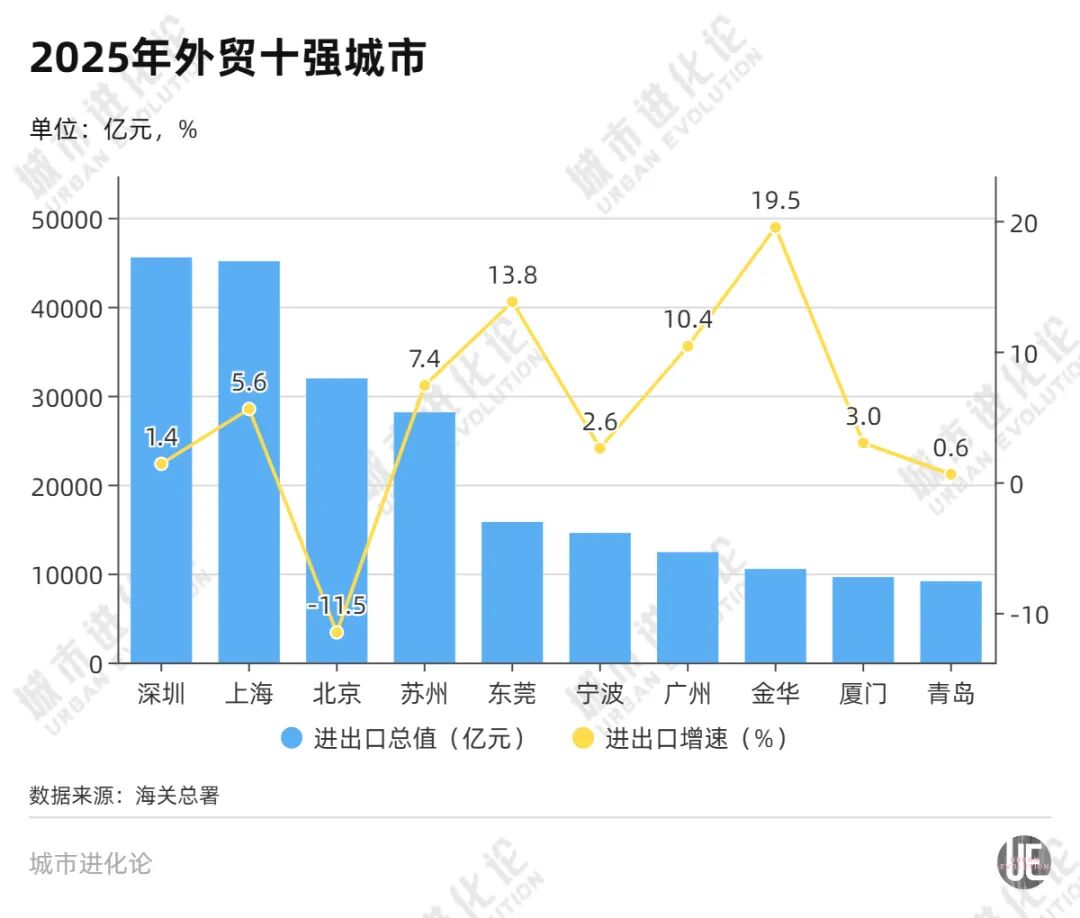
Among them, Suzhou (51.9%) and Shenzhen (38.8%) led the growth rate of import and export among all trillion-yuan foreign trade cities.
The import and export volume of Shenzhen in the first three quarters has reached 4.65 trillion yuan, exceeding the full-year scale of last year, and it is only one step away from becoming the first "5-trillion-yuan foreign trade city".
The import and export volume of Suzhou in the first three quarters exceeded 3 trillion yuan for the first time, reaching 3.07 trillion yuan, surpassing Beijing to be promoted to the "third largest foreign trade city in China".
Customs data shows that in the first three quarters, the export of Suzhou's equipment manufacturing industry reached 1.5 trillion yuan, up 53.4%, accounting for 83.5% of the total export value, driving export growth by 41.3 percentage points. Among them, the export of the computer, communications and electronic equipment manufacturing industry, which is highly related to AI, increased by 88%, becoming the core driving force for the leapfrog growth of Suzhou's foreign trade.
If we broaden our horizons, the trillion-yuan foreign trade city club is expected to witness a large-scale expansion this year.
In the first three quarters, the total import and export volume of Wuxi, Xiamen, Hangzhou, Xi'an, Chongqing and Qingdao was 805.188 billion yuan, 790.398 billion yuan, 779.009 billion yuan, 764.413 billion yuan, 749.796 billion yuan and 724.072 billion yuan respectively, all of which have the strength to sprint to the trillion-yuan club by the end of the year.
Bai Ming, an economist, analyzed to City Evolution that the incremental opportunities in the international market this round are highly concentrated in the AI-driven industrial chain — no matter the 8 existing trillion-yuan foreign trade cities, or the candidate cities such as Wuxi, Hangzhou and Xi'an that are sprinting towards the trillion-yuan level, their industrial structures are highly related to artificial intelligence.
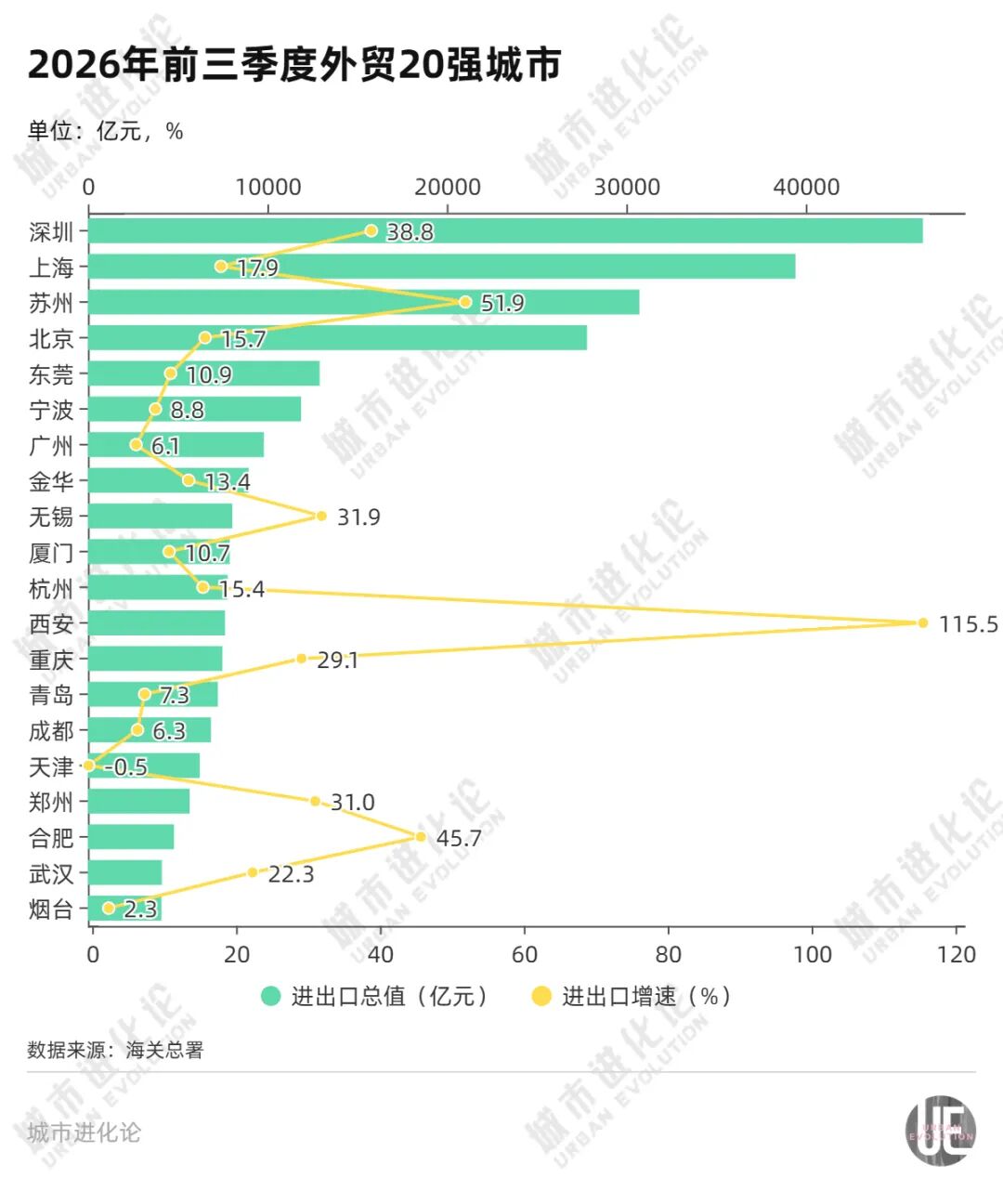
Take Wuxi as an example. With a growth rate of 31.9% in the first three quarters, it overtook 5 cities in a row, becoming the top "seed player" sprinting to the trillion-yuan foreign trade club.
From the perspective of foreign trade structure, Wuxi's export of electromechanical products reached 474.57 billion yuan, up 52.3% year on year, accounting for 79.8% of the total export value. Among them, the export of computing power hardware such as electronic components and computer spare parts reached 147.28 billion yuan and 107.56 billion yuan respectively, up 47.2% and 499.1% year on year, and the total contribution rate of the two to export growth reached 78.5%.
Xi'an has an even stronger growth momentum. In the first three quarters, the import and export growth rate of Xi'an reached 115.5%, leading all sub-provincial cities, and its foreign trade ranking rose to 12th in the country. It is expected to become the first trillion-yuan foreign trade city in the central and western regions at the end of the year.
02
Xi'an and Chongqing's Speed Race
In 2025, the total import and export volume of Xi'an's foreign trade was only 498.789 billion yuan, which had not yet broken the 500-billion-yuan threshold; in the same period, the total import and export volume of Chongqing was 800.678 billion yuan, and the two cities could hardly be called "rivals".
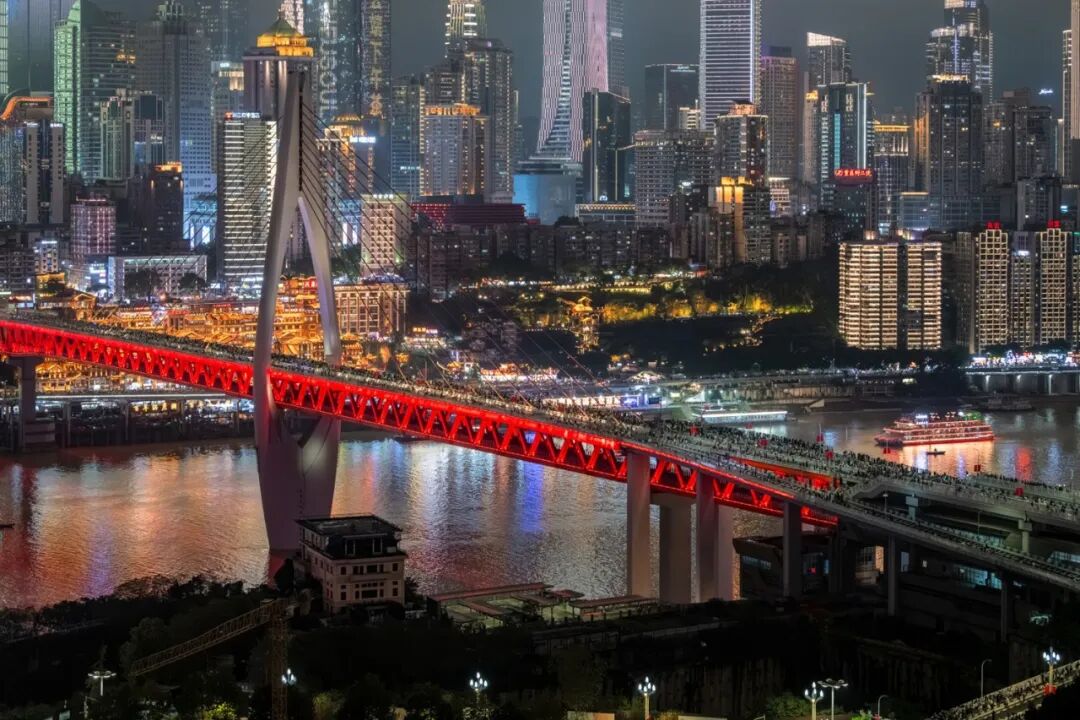
Image source: 699pic_702175628
However, entering 2026, Xi'an has started the "accelerated catching-up" mode:
The foreign trade growth rate of Chongqing in the first quarter, the first half of the year and the first three quarters was 34.3%, 31.9% and 29.1% respectively; in the same period, the growth rate of Xi'an was significantly faster, reaching 74.2%, 96.2% and 115.5% respectively.
As the world's largest notebook computer production base, notebook computer exports once accounted for "half of the country" of Chongqing's total foreign trade volume. Benefiting from the dividend of rising memory chip prices, the export value of Chongqing's notebook computers has rebounded sharply; at the same time, the export of automobiles and their spare parts has supported the "second growth pole", supporting Chongqing's foreign trade to continue the high growth trend.
In the first three quarters, the total import and export volume of Chongqing reached 749.8 billion yuan — of which more than 260 billion yuan was added only in the third quarter, standing at the door of the trillion-yuan mark.
In contrast, Xi'an added more than 310 billion yuan in a single quarter, pushing the total import and export volume of the first three quarters to more than 760 billion yuan, surpassing Chongqing to become the top foreign trade city in the central and western regions. Judging from the growth trend, Xi'an will most likely take the lead over Chongqing this year and be the first to break into the trillion-yuan foreign trade club.
In Bai Ming's view, Xi'an has superimposed dual advantages: it has a large number of computing power-related industries such as integrated circuits and automatic data processing equipment, and at the same time relies on the westward opening advantage of China-Europe Railway Express to empower the development of other industries such as automobiles. Xi'an has a strong scientific and technological foundation, which also attracts many foreign-funded enterprises to gather, so the scale of processing trade is relatively large.
Similar to the notebook computer industry that Chongqing relies heavily on, Xi'an attaches great importance to the semiconductor industry.
According to the data released by local media, the current scale of Xi'an's semiconductor industry has exceeded 140 billion yuan, ranking sixth in the country, making it the city with the largest semiconductor industry scale in the central and western regions.
Xi'an has two major production bases of Samsung and Micron, which are Samsung's largest overseas flash memory base in the world and Micron's only large-scale packaging and testing base in the world respectively. This also makes integrated circuits continuously top the list of Xi'an's largest export products.
In the first half of this year, the total import and export volume of Micron reached 230.79 billion yuan, up 224.1% year on year, accounting for more than 50% of Xi'an's total import and export volume. Behind this, foreign-funded enterprises contribute more than 70% of Xi'an's foreign trade, and the proportion of processing trade is also more than 70%.
Compared with general trade, processing trade is "two ends outside", that is, "raw materials are imported from outside, and products are sold outside", which usually has low added value. This is also an important reason why Xi'an's "hot foreign trade but cold economy" has attracted public attention since the beginning of this year.
In fact, Xi'an is also working hard to promote the adjustment of foreign trade structure.
The outline of Xi'an's "15th Five-Year Plan" specifically proposes to "cultivate new growth poles of foreign trade", upgrade goods trade, continuously expand the foreign trade scale of advantageous industries such as semiconductors, new energy vehicles and photovoltaics, increase the export of high value-added products, and vigorously cultivate new growth points such as energy storage batteries, second-hand cars, photonic chips, artificial intelligence, green power equipment and aerospace products.
03
Regional Logic
Behind Xi'an and Chongqing, many cities in the central and western regions have also delivered impressive foreign trade performance.
In the first three quarters, the total import and export volume of Zhengzhou, Hefei and Wuhan was 567.33 billion yuan, 480.015 billion yuan and 412.416 billion yuan respectively, up 31.0%, 45.7% and 22.3% year on year.
The research report of CITIC Securities believes that in the first three quarters of this year, with the expansion of overseas AI industry capital expenditure, the export of related commodities has become the growth engine of China's overall export. The cumulative export of integrated circuits, automatic data processing equipment and their spare parts increased by 107.8% and 54.5% year on year respectively; the cumulative export of automobiles (including chassis), auto spare parts and ships in the first 9 months increased by 54.3%, 10% and 29.5% year on year respectively.
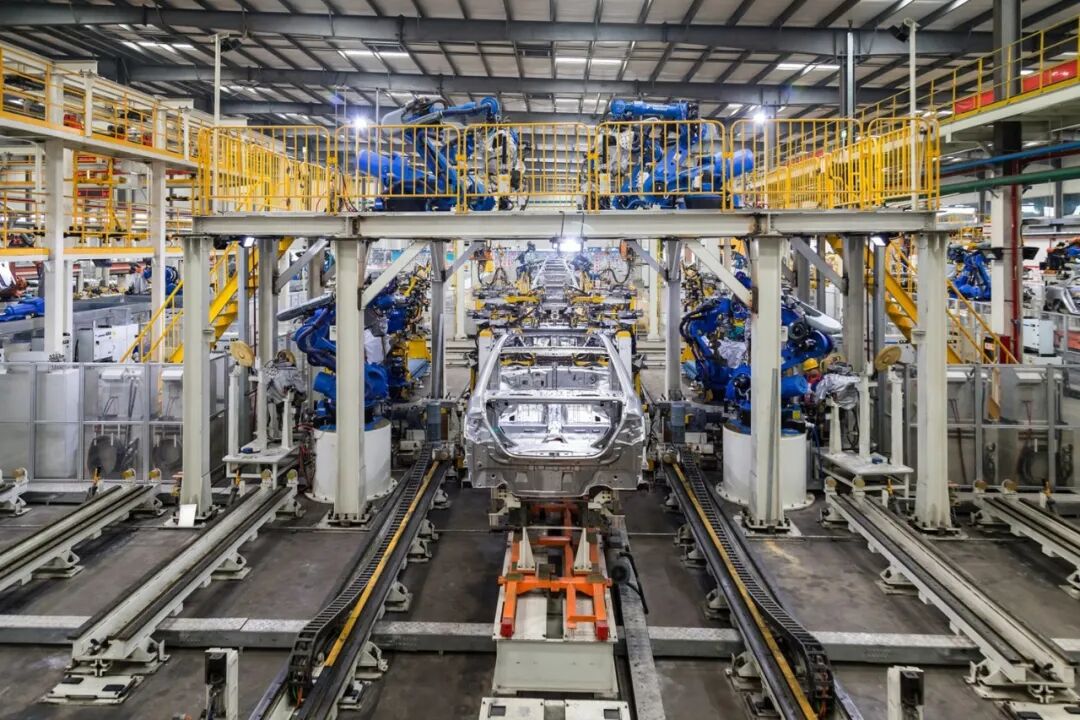
Image source: 699pic_501627453
It is not difficult to find that the above central and western cities with rapid foreign trade growth are all important towns of the electronic information and new energy vehicle industries, and their industrial structures are closely related to the AI industrial chain and the "three new major export products".
And "processing trade" that links the domestic and international markets plays an important role in it.
At the beginning of this year, Zhong Yanming from the Statistics Department of Guangzhou Customs pointed out in the article "Processing Trade Moves Westward and Rises: Central and Western Regions Become an Important Engine for Foreign Trade Growth" that different from the trend that the proportion of national processing trade import and export in the total import and export volume is gradually declining, the proportion of processing trade in the central and western regions has been rising steadily, from 13.9% in 2001 to the peak of 37.7% in 2018; although it has declined in recent years, it still reached 25.4% in 2024, and further rebounded to 26.6% in the first 11 months of 2025.
Zhong Yanming also pointed out that the structure of processing trade in the central and western regions is moving towards the middle and high end. Instead of simply copying the eastern model, it pays attention to the overall transfer of the industrial chain and cluster cultivation, and builds a number of characteristic industrial clusters with national and even global influence based on its own resource endowments and industrial foundation.
The Ministry of Commerce recently stated that during the "15th Five-Year Plan" period and for some time to come, processing trade will continue to play an important role in responding to the reconstruction of the global industrial and supply chain, promoting industrial quality upgrading, cultivating new foreign trade momentum, promoting coordinated regional development, and improving employment and people's livelihood.
At the same time, another path is unfolding: the accelerated rise of independent brand manufacturing represented by new energy vehicles in Chongqing and other cities has driven the proportion of general trade to rise. Over the past five years, Chongqing has increased the proportion of general trade by 11.2 percentage points, reaching 42.1% by 2025.
Both paths are evolving in the direction of clustering and high added value. For cities in the central and western regions, the real test lies in whether they can continuously capture industrial trends and complete structural adjustment.
This article is from the WeChat official account "City Evolution", author: DAN Zhongkui, published with authorization from 36Kr.