44 trillion US dollars, Anthropic is boasting again
"By 2030, the US GDP could reach $44 trillion."
On October 17, Jack Clark, co-founder of Anthropic, the developer of Claude, put forward such a vision during the annual meetings of the IMF (International Monetary Fund) and the World Bank held in Bangkok.
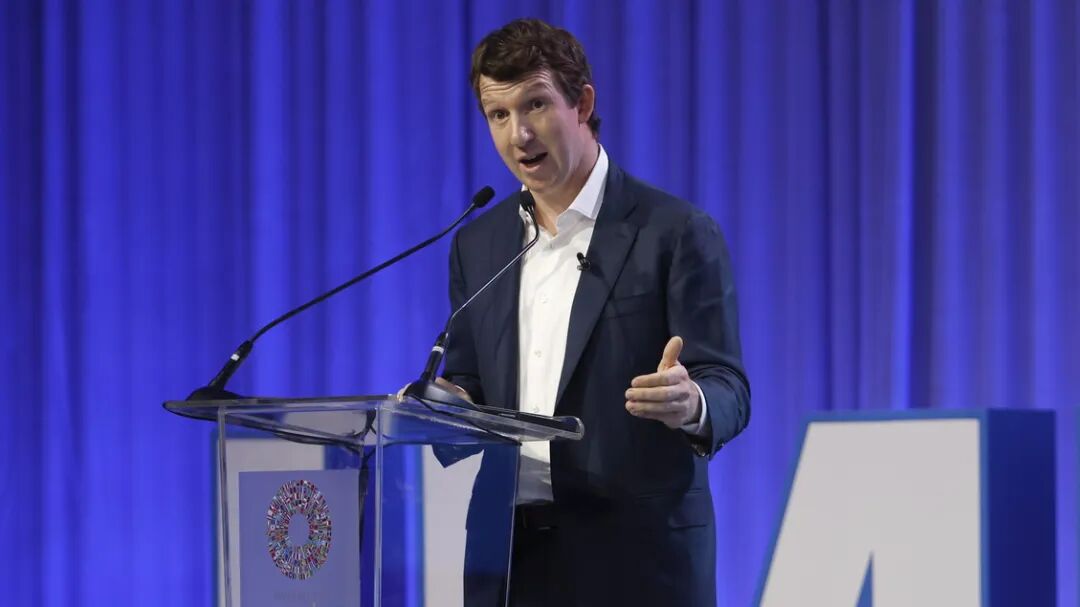
On October 17, 2026, Jack Clark delivered a speech in Bangkok. Photo: EPA / Rungroj Yongrit.
The premise Clark put forward is that AI can independently complete a wide range of tasks and quickly integrate into economic activities. He also claimed that humanity has entered the early stage of the singularity, and AI will drive the accelerated progress of science and technology at a speed too fast for humans to keep up.
How absurd is the $44 trillion prediction exactly?
01
$44 Trillion, More Than Twice the Size of China's Economy
According to Clark's speech, if AI can independently complete a wide range of tasks and be rapidly applied, the US GDP could reach $44 trillion by 2030.
He knows that this number sounds absurd. But immediately after that, he explained that it is the result pointed to by continuous technological progress.
It should be noted that the full-year US GDP in 2025 is about $30.86 trillion. Calculated at 2025 prices uniformly for the $44.4 trillion GDP, the United States has to actually produce about 44% more goods and services.
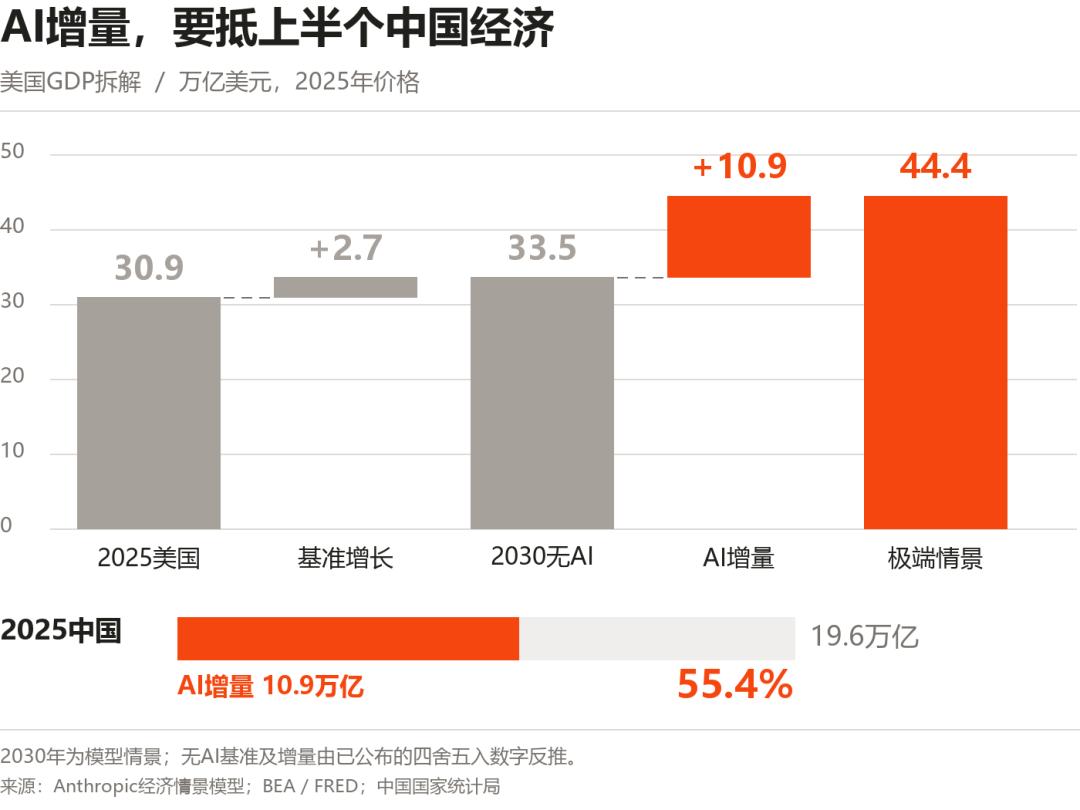
Model scenario, in 2025 prices; the non-AI baseline and increments are derived from the rounded values of 44.4 and 32.4%, all approximate figures.
Converted over five years, the US real GDP needs to grow by an average of about 7.5% per year. From 2006 to 2025, the average annual growth rate of US real GDP was about 2.1%, with the best performance in 2021, the post-pandemic rebound year, at 6.3%.
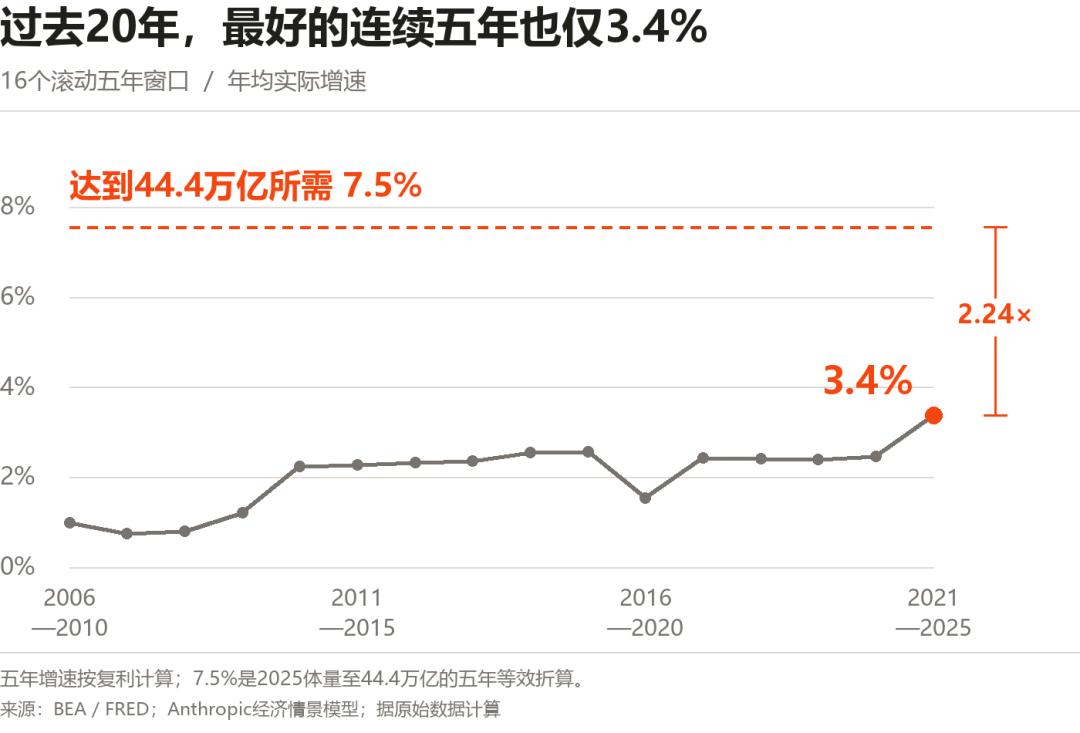
Calculated based on compound annual real growth rate from 2006 to 2025; 7.5% is converted over five years from the 2025 base size to $44.4 trillion, not the year-by-year path of the model.
Take China as a reference. Converted according to the GDP published by the National Bureau of Statistics of China and the annual average exchange rate, China's total economic volume in 2025 is about $19.6 trillion. $44.4 trillion is equivalent to 2.26 times China's 2025 economy.
The $44.4 trillion figure comes from the economics working paper "Economic Scenarios for Transformative AI" released by Anthropic Research Institute in September, co-authored by economists Anton Korinek, Charles Jones and others. The paper uses a set of models to link the impact of AI on labor tasks with changes in capital investment, wages and employment, to estimate what the US economy will look like.
This set of models yields three results: with moderate AI development, the US GDP will be about $34.1 trillion in 2030; with faster development, it will reach $36.3 trillion; only in the most aggressive scenario will it reach $44.4 trillion. Anthropic itself named this last scenario the "Extreme Scenario".
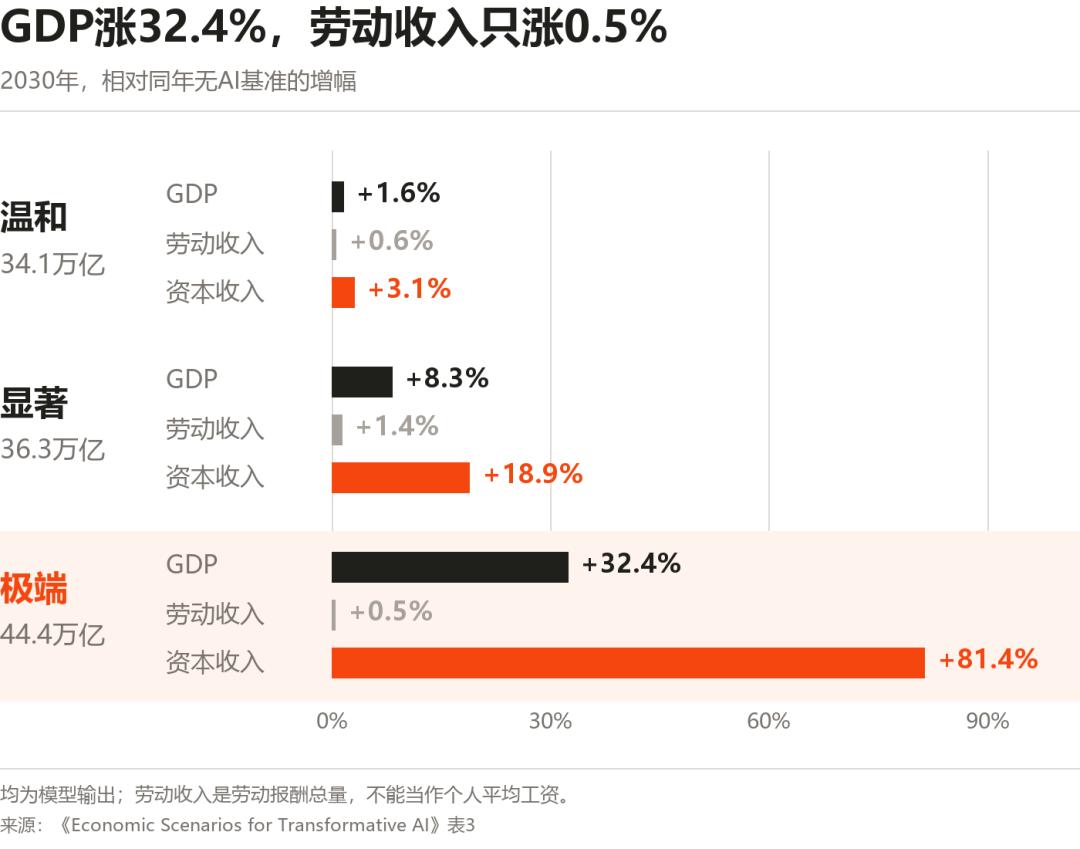
Changes of various indicators in 2030 relative to the non-AI baseline of the same year, all model outputs. Labor income refers to the total labor compensation, not the average individual wage.
How extreme is this scenario exactly?
The authors' setting is: divide all labor tasks in the whole economy into 100 parts according to the model weight, AI has the ability to handle 50 of them, and enterprises use AI in 60% of these 50 tasks, that is 30 parts. The productivity of these 30 tasks reaches about 2.2 times of the original level, and 90% of them are completed directly by AI.
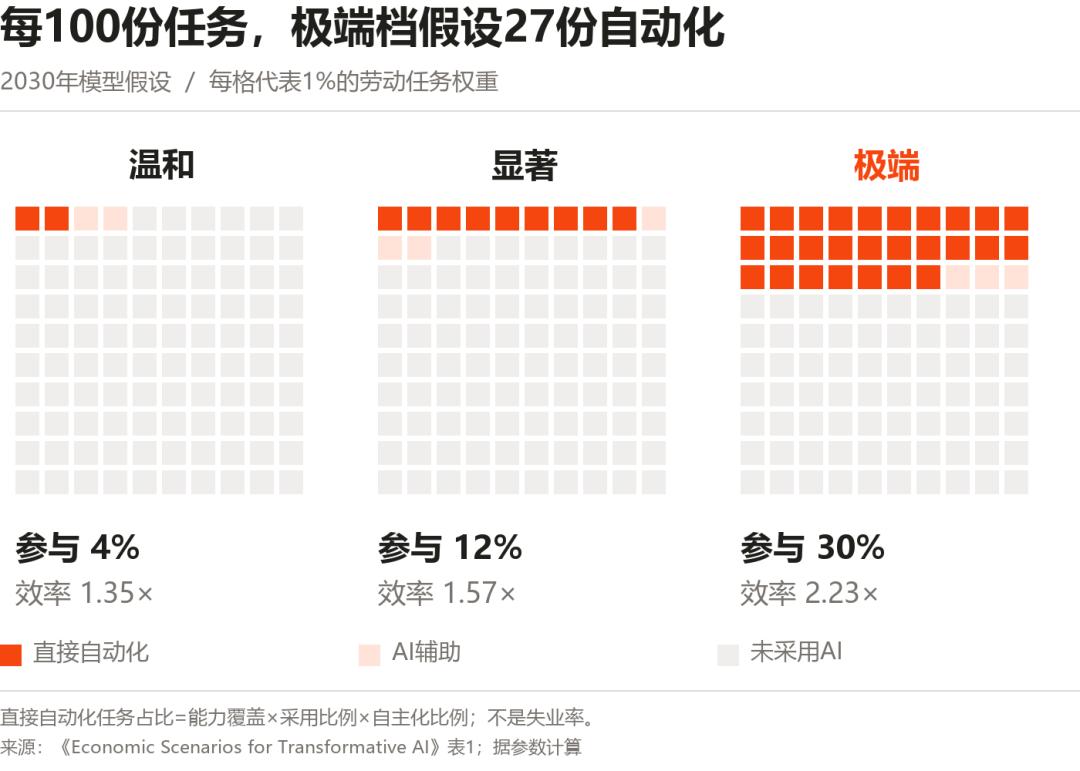
2030 model assumptions, by labor task weight; automation as a share of all tasks = capability coverage × adoption rate × automation rate, not unemployment rate.
As a comparison, according to the paper's estimate in mid-2026, the labor tasks actually participated by AI account for about 1.4% of all labor tasks in the United States.
In other words, in the three and a half years from mid-2026 to early 2030, this proportion needs to rise from 1.4% to 30%, reaching more than 20 times of the original level, to meet the setting of the "Extreme Scenario".
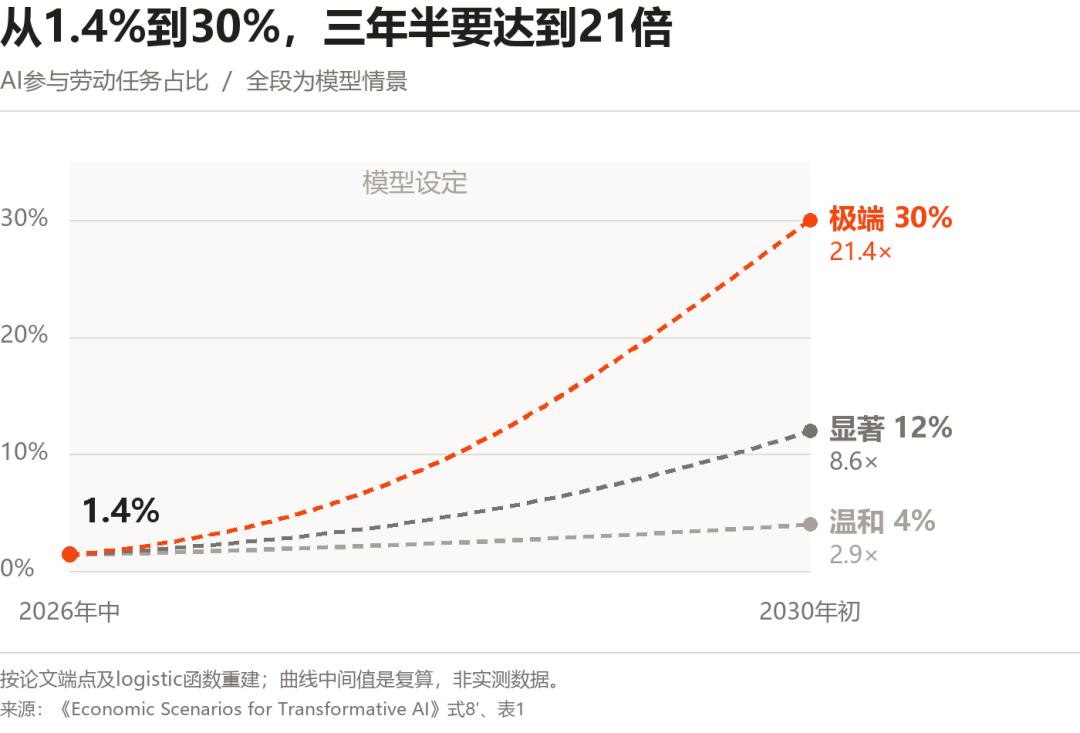
The setting trajectory reconstructed based on Equation 8' and Table 1 of the paper; the median value is recalculated, not observed or independently predicted.
The $44 trillion growth expectation is built on this popularization speed. It is not difficult to understand how much of this number is from "fantasy".
02
What Exactly Is the Singularity
To explain why the US economy can suddenly accelerate, Clark also put forward a bolder judgment: humanity has entered the early stage of the "singularity".
The so-called technological singularity refers to a vision: when the intelligence of AI surpasses that of humans, it can participate in the R&D of stronger AI, and the stronger AI will further accelerate R&D. With such rounds of acceleration, the progress of science and technology will be so fast that humans can hardly keep up, and past development experience will no longer be applicable.
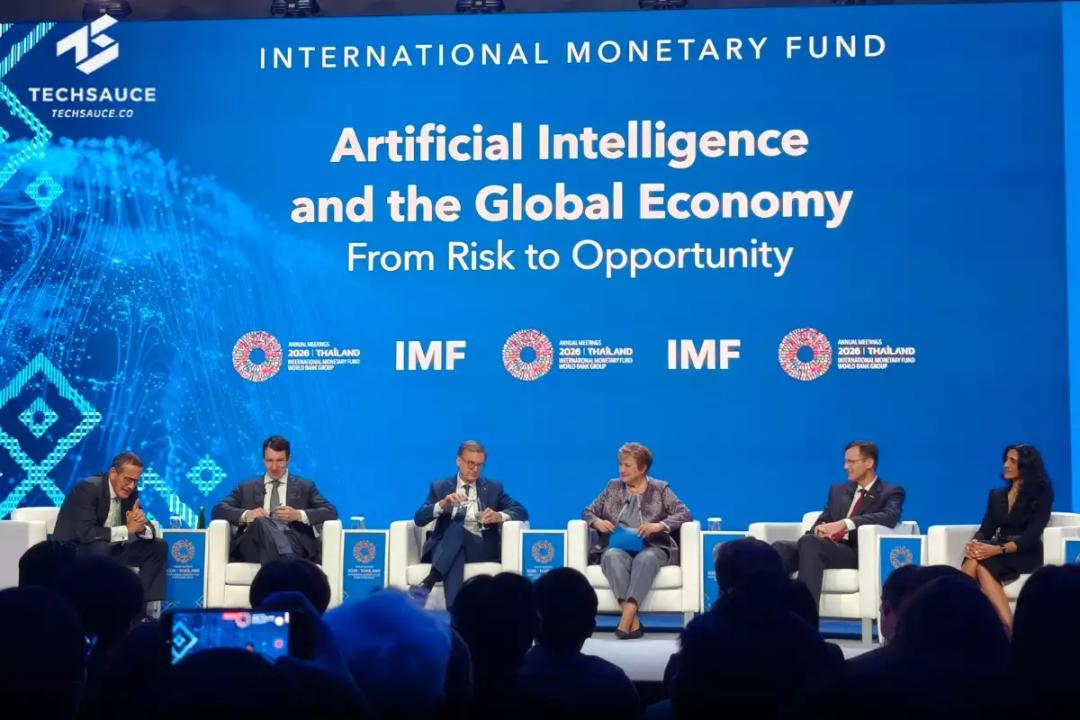
According to Clark, the next to speed up will be the entire scientific research. He envisages that human scientists can lead hundreds of AI assistants to conduct research together, so that new drugs, new materials and new industries will emerge faster.
Why does he think this era has already begun?
The reasons Clark put forward include that the code output of Anthropic researchers is nearly ten times that of the past, and the rapidly improving performance of AI in mathematics and physics tests. Based on this, he judged that AI has shown scientific research creativity, and this capability will also be used to develop AI itself, promoting the next round of progress.
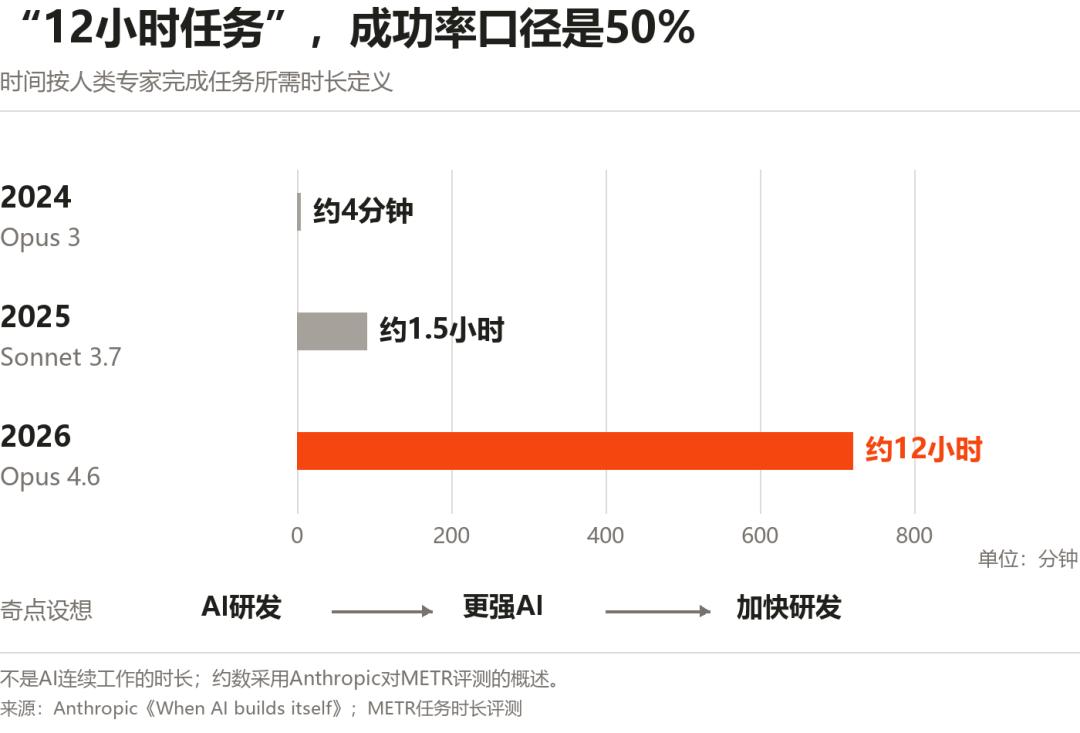
Anthropic's overview of METR results; the test task difficulty corresponding to 50% reliability, not the actual continuous working duration of AI.
In September this year, scholars from the Massachusetts Institute of Technology, the University of Pennsylvania and Boston University updated a study analyzing data from more than 500,000 developers on GitHub, the code collaboration platform. For interactive programming assistants, the study estimated that the increase in code additions and deletions is about 958%.
This number sounds impressive, but the number of officially released software versions only increased by about 20%, which is not at the same order of magnitude as 958%.
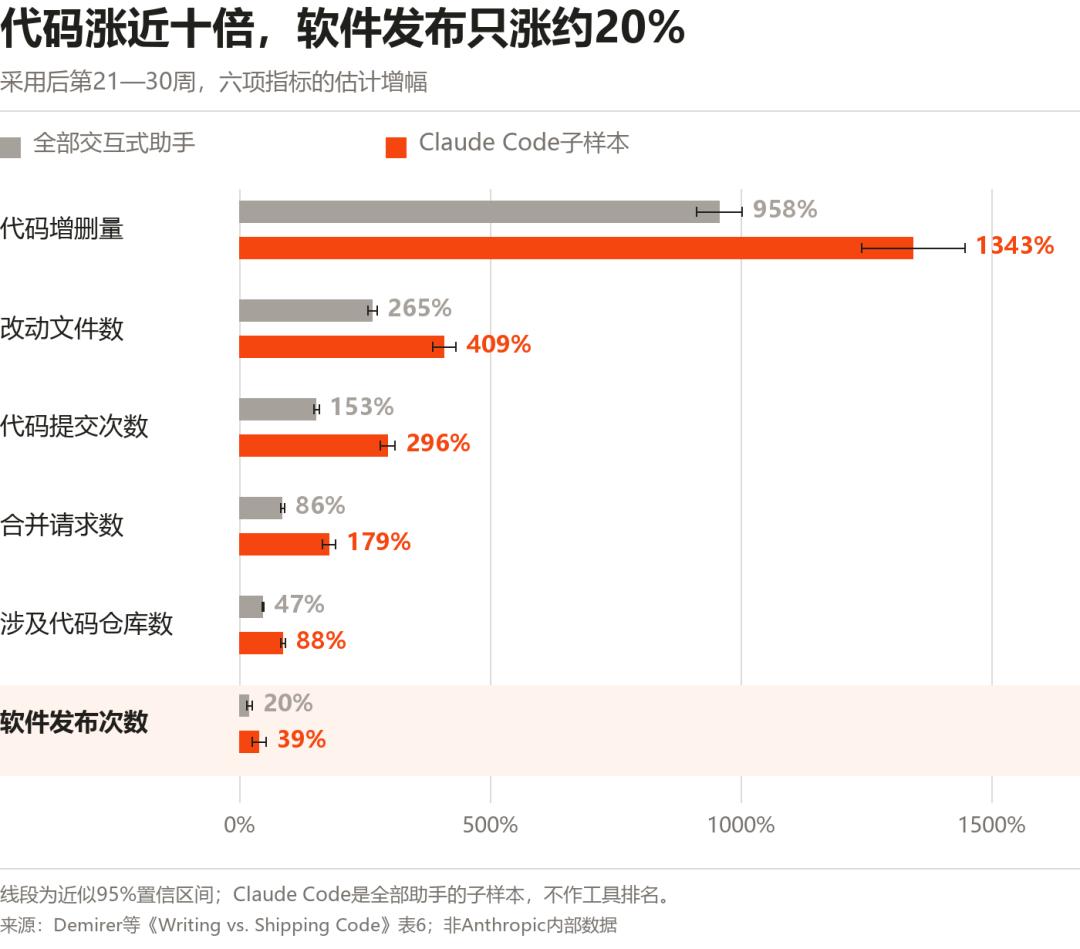
Matched event study; the estimated increase in the 21st to 30th week after adoption. The two groups have inclusion relations, so the pros and cons of tools cannot be ranked based on this; not Anthropic internal team data.
The study further found that developers will try more projects, and rewrite and discard more code. Subsequent review, integration and release did not skyrocket along with the previous code volume.
Anthropic's own research also shows that the amount of code merged by engineers every day has reached 8 times that of 2024. The company also admits that this number almost certainly overestimates the real productivity improvement.

Cat Wu introduced programming products at the Code with Claude conference (archived photo). Photo: Anthropic, published via TechCrunch.
The physics test that Clark specially emphasized also cannot support such a big conclusion.
This evaluation is called TheoPhysEval. The paper states that physicists have sorted out 50 unpublished research-level calculation problems, the best-performing AI answered 49 of them correctly, with an accuracy rate of 98%, and even helped find errors in the experts' answers.
The paper introduces that a common way to set questions is to take solved research problems, change parameters, let AI consult materials, understand the original methods, and then complete new calculations. The question bank does not include major open problems, nor does it require proposing new physical theories.
This paper that gives a 98% score even states at the beginning: As of the publication of the paper, autonomous AI has not yet made significant breakthroughs in the field of theoretical physics.
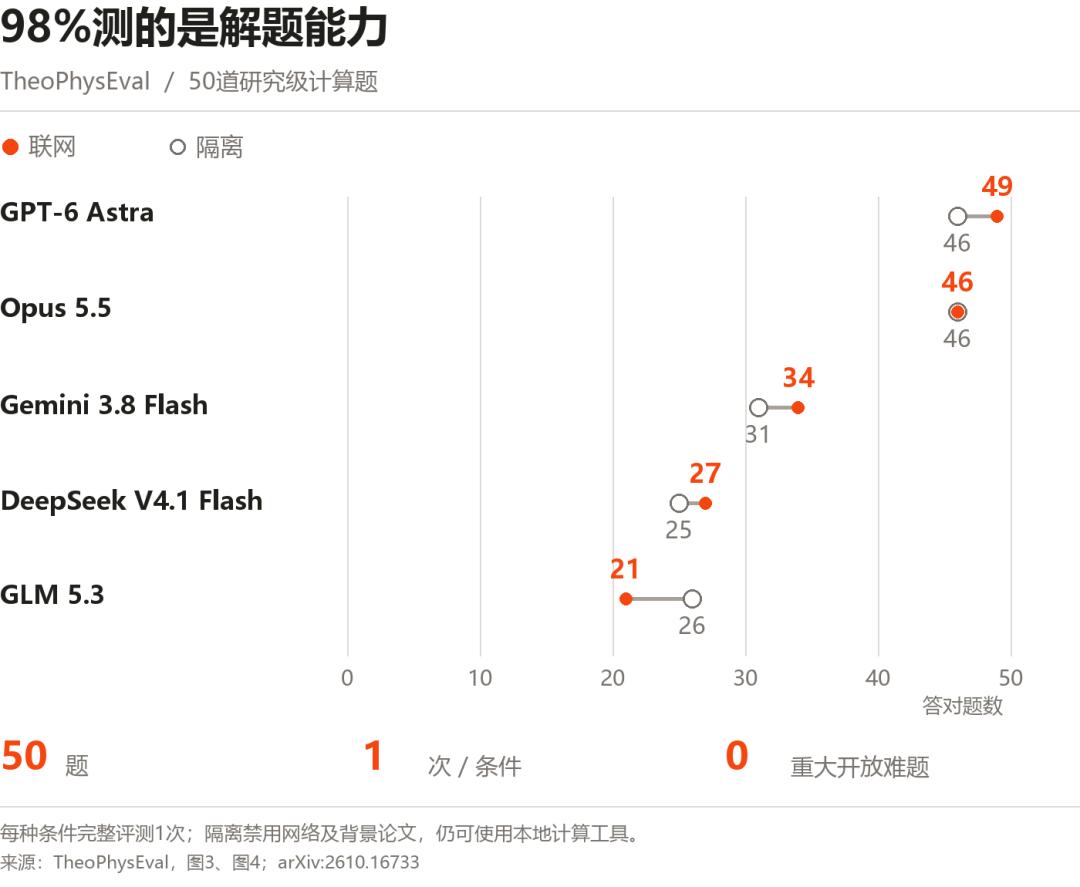
TheoPhysEval; network and access to background papers are disabled under isolated conditions, but local computing tools can still be used. All results are the single complete evaluation reported by the paper.
As for the most critical "AI developing the next generation of AI", Anthropic also used a rhetorical trick. The company's own research clearly acknowledges that fully autonomous design and development of the next generation of AI has not yet been realized. Claude is already very strong in executing experiments with clear goals, but there is still an obvious gap in judging what to research and what goals to choose.
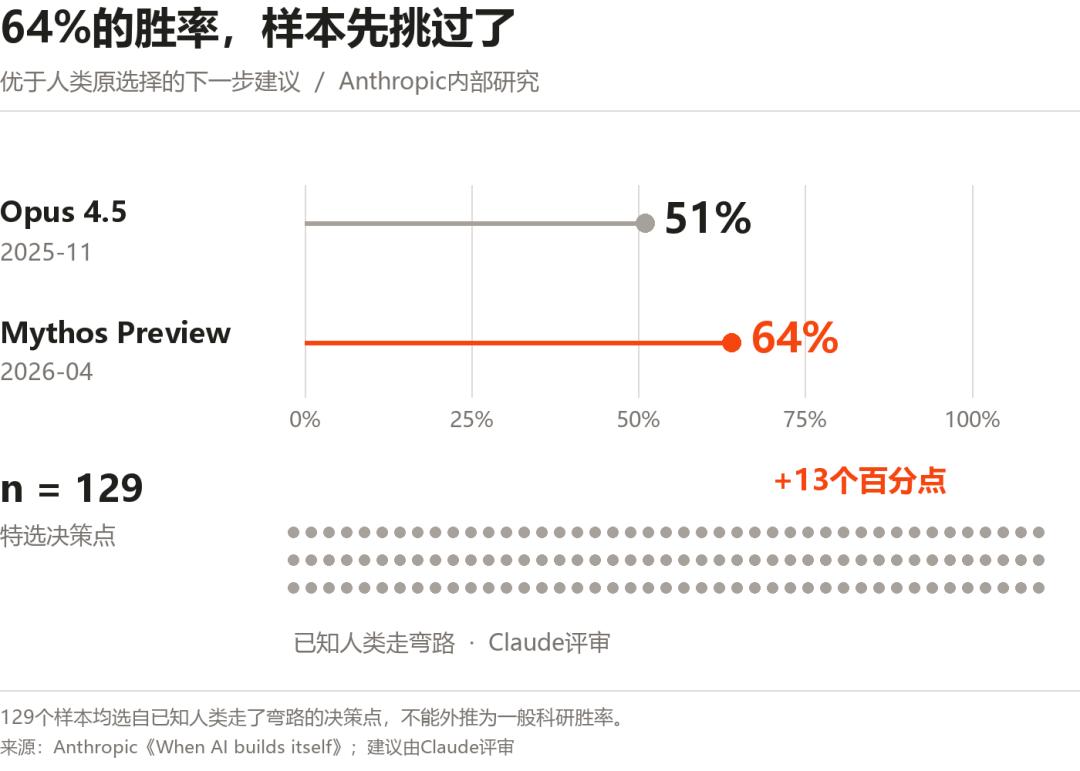
Anthropic internal research; this is the proportion where the next step suggestions in the selected sample are better than the original human choices, not the general winning rate of scientific research judgments.
It is indeed the consistent style of Company A to blurt out that "human development has reached the singularity".
03
The Most Important Goal Is for IPO
While Clark was talking about $44 trillion and the singularity on the stage, Anthropic off the stage was preparing for its IPO, that is, issuing shares to the public for listing. The company has to convince investors that buying its shares at a high price today will be profitable in the future.

Dario Amodei, CEO of Anthropic (archived photo). Photo: Kevin Lamarque / Reuters.