Anthropic has almost stopped recruiting junior employees, with the proportion of junior staff plummeting by 33% in a year and a half: Agents already work six times the working hours of human employees.
Anthropic CEO Dario Amodei once predicted that half of entry-level white-collar jobs could disappear by 2030. Now, data released by Anthropic itself has been reflected in its technical team: the proportion of junior employees has declined, while the working hours of AI Agents are growing rapidly.
An internal study by Anthropic shows that since the beginning of 2025, the proportion of junior employees in the technical department has dropped from 21% to 14%, with a relative decrease of about 33%; the proportion of junior employees among new hires has dropped even more, from 27% to only 9% in the same period; since December 2025, the number of recruitment postings for junior positions has decreased particularly significantly.
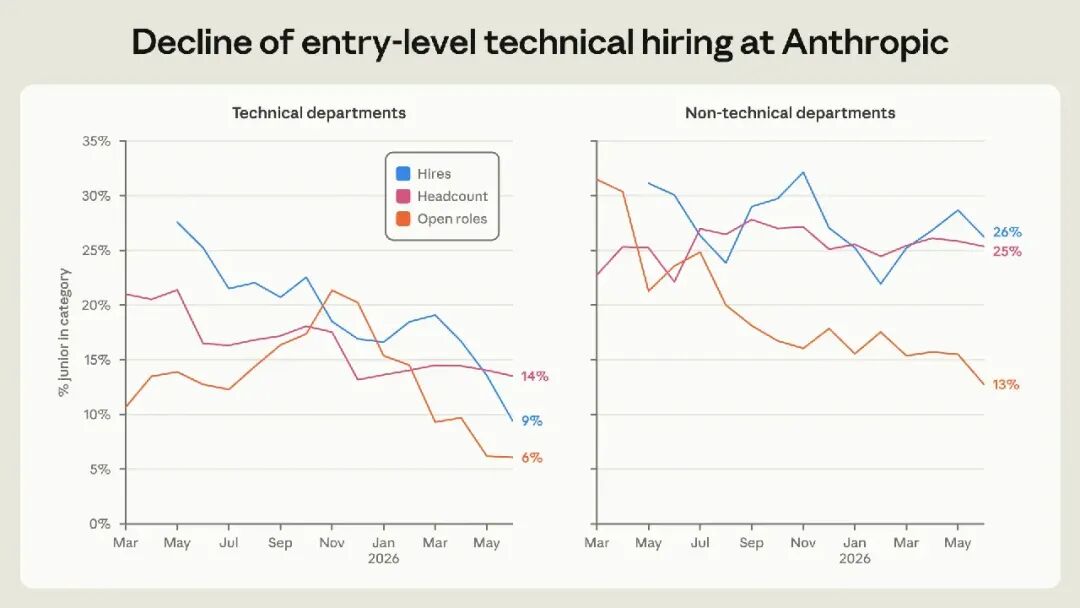
AI takes over coding work, junior recruitment shrinks accordingly
Core tasks that used to be the "practice" for junior engineers, such as writing code and finding bugs, are now increasingly handed over to Claude. As of August 2026, the overall working hour ratio of Agents to humans in the company has reached 6:1, and it is as high as 19:1 in the research department. Anthropic attributes this change to the leap in AI Agent capabilities.
The data also confirms the scale of this shift: the number of code changes submitted by engineers is 5.1 times that of before, the number of queries executed by data scientists is 3.1 times, and the number of contracts processed by the legal team is also 3.1 times. One employee stated bluntly in the report that the improvement in engineer productivity "has overnight changed our requirements for recruiting talents."
The acceleration of code delivery has also promoted the transformation of engineering infrastructure. Within four months, Anthropic's code merge volume increased by 12 times, and the company therefore built its own internal version control system to adapt to the continuously expanding engineering workload.
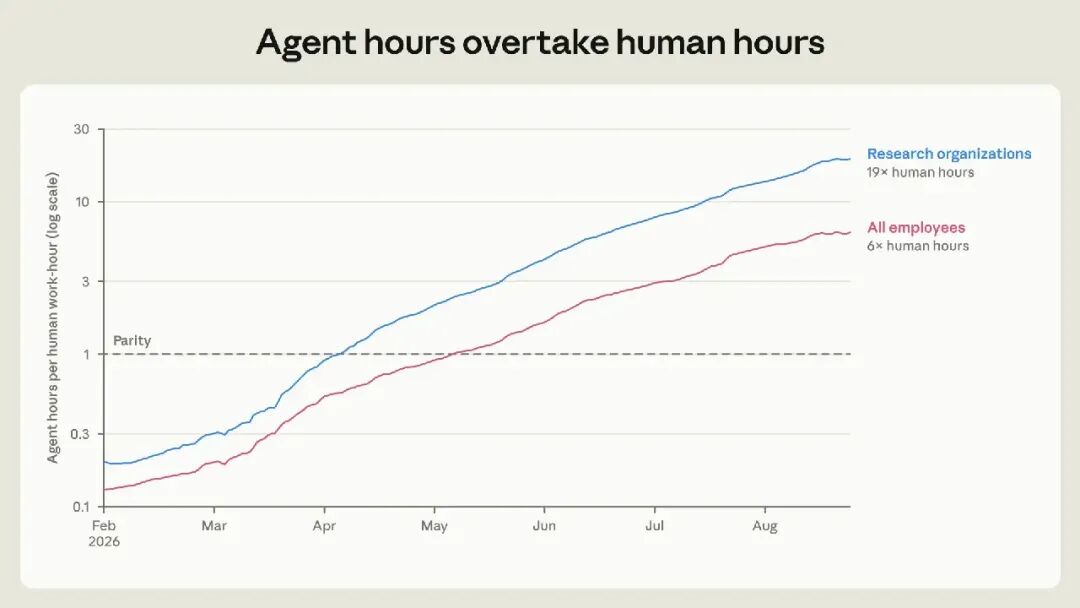
This change is not a simple "machine replaces human". The report shows that the proportion of employees in the technical department who do not write code directly at all has almost halved in the past year, the frequency of managers submitting code has almost doubled, and the ratio of engineers to product managers has expanded to about 17:1.
In other words, Agents not only replace the tactical work of junior positions, but also reshape the collaboration structure of the entire engineering organization — management and coordination positions are forced to deliver code in person, and the act of "supervising others to write code" itself is depreciating.
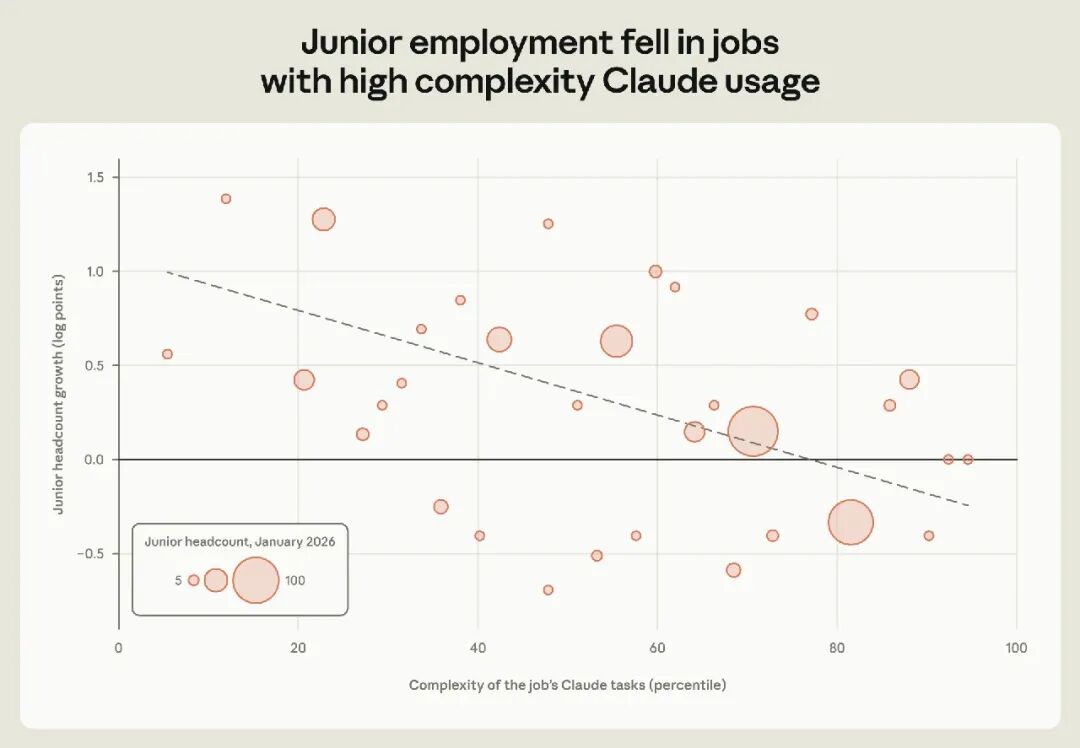
Figure note: Claude usage complexity and junior position employment growth.
At the same time, the absolute number of recruits in the technical department is still growing, but its proportion in the total number of the company's employees has dropped from 61% to 56% in the past year. The sales, finance and recruitment departments are growing faster, partly because coding Agents allow non-engineering personnel to build their own tools. Anthropic gives an example that a sales representative without any UI design experience built a custom dashboard and process integrating multiple tools in only three or four hours.
The number of sessions in which non-technical employees use programming Agents has also increased significantly: from about twice a month in August 2025 to 90 times a month in May 2026. This adoption rate is consistent with the growth trend of Agent programming tools across the industry in the same period. At the same time, some companies have begun to restrict the use of AI Agents for security reasons, and Amazon, JPMorgan Chase, Charles Schwab and Delta Air Lines have blocked AI Agents in some of their systems.
Anthropic said that the company has established an early warning system to identify positions that may be impacted, and prioritizes arranging internal transfers for employees instead of layoffs. In 2026, employees who have been employed for at least one year are 50% more likely to transfer to other departments every month than in 2025. For example, a product design team that used to be responsible for writing in-app copy for Claude.ai later built a "context graph" that allows Agents to write these copy by themselves; subsequently, the team switched to writing prompts and evaluations for Claude.
Anthropic believes that given that the company has deeply integrated AI Agents into its own workflow, its changes may indicate the direction of industry development. It remains to be seen whether other companies will show the same recruitment pattern after adopting similar tools. However, Anthropic's own data shows that in less than two years, the entry-level positions in the technical career development ladder have been very different from the past.
Virtually no junior hires: senior talents make up the majority
Anthropic's engineering team itself is like a rapidly expanding legion composed of senior infrastructure engineers.
Recruitment practitioner Sebastian Cuadros conducted an analysis based on public LinkedIn data: he crawled 5306 users who listed Anthropic as their current employer, screened out 1680 employees who are actually engaged in engineering positions, and further analyzed 7986 past job descriptions left by these people before joining Anthropic. The result deviates significantly from the conventional imagination of "cutting-edge AI labs".
This is an organization built in about 18 months. Among the engineers still at Anthropic, only 15 had joined before 2021. In 2025, the size of the engineering team expanded about three times, recruiting 686 engineers that year; as of June 2026, another 455 people were recruited. Half of the current engineering team has been employed for less than a year, 53% of the people joined in the past 12 months, and the median tenure is only 10 months.
This set of resume data also shows that Anthropic hardly recruits junior engineers. This tendency did not start with the rise of Agents — its recruitment threshold was originally set on the senior side. The median work experience of the 1680 engineers before joining the company is 12.2 years, and the middle 50% of them have 8.8 to 16.5 years of experience; only 50 people have less than 3 years of work experience, and 44% of people have 13 years or more of experience. Campus recruitment for fresh graduates basically does not exist.
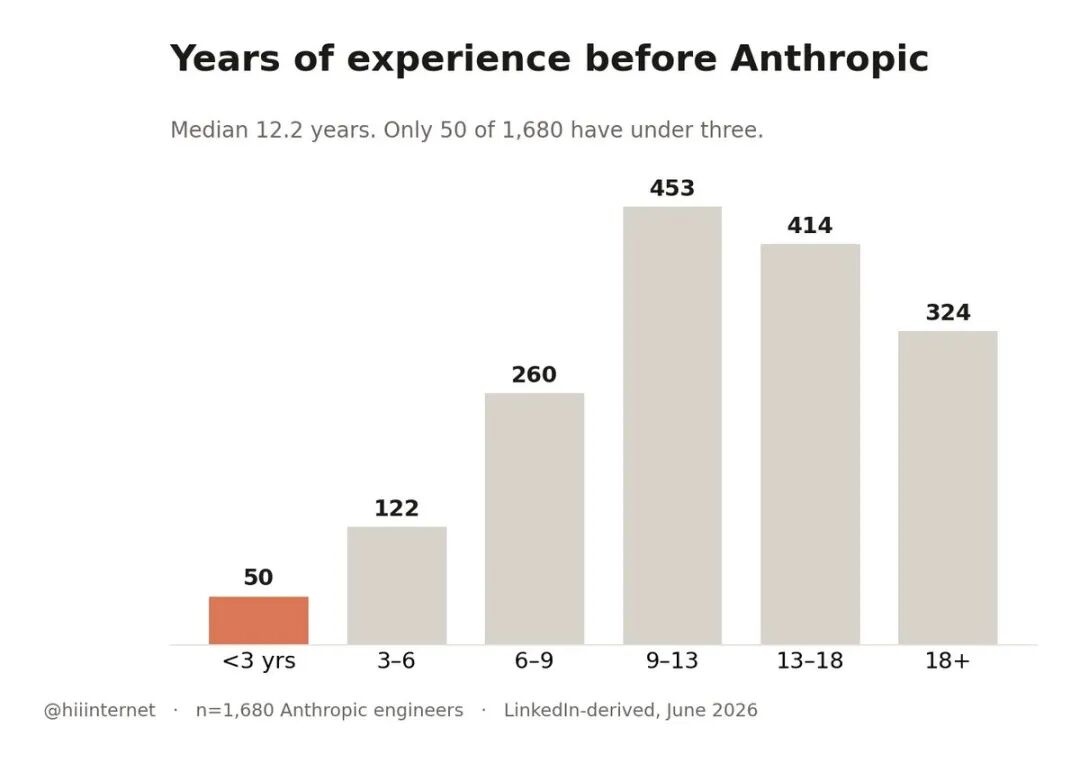
A typical profile of a newly recruited engineer is: 12 years of work experience, but only 10 months at the company.
The access for the very few young engineers also relies on high-intensity screening rather than conventional campus recruitment, which mainly relies on other high standards to make up for the lack of working years:
- First category is the internship pipeline. Half of them have internship experience in companies such as Meta, Google, DeepMind, Microsoft, and Amazon, in addition to Jane Street, Two Sigma, HRT, Optiver, and Nvidia.
- Second category is switching from quantitative trading to labs. 9% of them come from top trading companies, including Jane Street, Two Sigma, Five Rings, HRT, Optiver, and Citadel. These are young talents with backgrounds in mathematics and computer competitions, who enter AI labs through the high-frequency trading industry.
- Third category is AI alignment scholarships. 6% of them have been exposed to MATS, SERI, Redwood or ARC. This is an entry that is almost only open to junior talents, and is almost non-existent among senior engineers.
The typical profile of such young engineers is: MIT background, silver medal in the International Olympiad in Informatics, Codeforces rating of 2900+, and entered the field of reinforcement learning and AI security after about four years of work. They are screened based on competition rankings and papers, not years of work experience.
The fact that senior talents occupy the main body means that the company's current engineering capabilities are built on a group of "already trained" people; and the reduction of entry-level positions means that where the next batch of such people will come from, there is no answer for the time being.
Tragedy of the cognitive commons: who will pay for the saved training costs in the future
In a paper discussing AI and the training of professional talents, researcher Nolan Lovett calls this risk the "tragedy of the cognitive commons": enterprises use AI to replace entry-level work, and the efficiency gains belong to themselves; but if the entire industry reduces opportunities to train new people, the source of professional capabilities will also decrease when senior talents are needed in the future.
This bill will not mature for many years: Lovett points out that most of the senior professionals currently on the job were trained 5 to 20 years ago. Therefore, the full impact of the contraction of junior positions that began in 2023 may not appear until 2030 to 2045. The impacts on software engineering, financial analysis and legal research are particularly worthy of attention — these fields precisely rely on long-term training "starting from the junior level".
AI also brings another more hidden risk. People need professional knowledge to identify errors in AI outputs, and long-term dependence on AI may make it more difficult to accumulate such professional knowledge. Lovett calls this dependency a "verification bond": effective supervision of AI requires deep domain experience. In other words, the more AI does entry-level work for people, the harder it is for people to obtain the experience needed to supervise AI — this is a self-reinforcing cycle.
The reduction of junior positions does not mean that junior engineers no longer need to learn.
Kent Dodds, former Meta engineer and well-known developer educator, put forward an observation from a different perspective in an interview: The career path of engineers originally extends from writing code to team management, architectural decision-making and system design. Without AI, looking back at the career development path of software engineers five years ago, the higher an engineer goes, the more likely he is to become a team leader, or even a Technical Fellow; the higher the position, the less likely he is to understand all the details of the systems he manages.
"Now, we all seem to have become Technical Fellows or team leads, who can build software without understanding every detail."
But he also emphasized that just because you don't have to understand every line of code, you can't assume that the software will work properly — hiring a group of inexperienced junior developers to write bad software, no matter how good the product idea is, may fail, and technical rigor and clear direction are still indispensable.
The problem is that the growth path itself is changing. If newcomers at the bottom of the pyramid no longer need to master the basics of code, how can they grow to the level of managing Agents in the future? Dodds' answer is: A junior engineer growing into a senior engineer never relies on mastering the syntax itself, but on doing what senior engineers do and taking on the responsibilities of senior engineers.
"Since senior engineers no longer write as much code in person, junior engineers don't have to rely on typing syntax to reach the same level."
Of course, they will still lack some experience, and may need to deeply understand architectural decisions and trade-offs between different solutions. This has always been part of the growth process. If you want to move up, you have to dig down and understand the underlying things.
But he believes that it is entirely possible to become an architect without a technical foundation: "With current models, to build a good system, you need the right basic components; the lack of experience in building such systems will make this very difficult. But difficulty does not mean impossibility. I think models will continue to improve — you just tell the model what result you want, and it can ask you appropriate questions to confirm that it understands the requirements, and then build a system that meets the requirements. We will reach that point in the future."
If the work of "senior" itself has become directing Agents, making architectural trade-offs, and judging output quality, then the career entry path should be rebuilt around these capabilities, instead of continuing to start from practicing syntax.
Anthropic has chosen the easier path: only recruiting people who are already fully trained. This is completely rational for a single company, but when all companies make this choice, there will be no shortage of people who can write code, but a shortage of people who can judge whether the Agent's output is correct — and such people are not readily available in the recruitment market.
Reference Links:
https://officechai.com/ai/anthropic-has-seen-a-33-drop-in-junior-level-employees-since-early-2025-says-company/
https://www.anthropic.com/research/employment-at-anthropic
https://arxiv.org/pdf/2607.29380
https://www.youtube.com/watch?v=_BNWYC_DCQk
This article is from the WeChat Official Account "InfoQ" (ID: infoqchina), written by Tina, authorized for release by 36Kr.