Alumni of South China University of Technology, the total return of angel investment reaches 20 billion RMB.
Ten years of long journey has finally brought an extraordinary return.
The story started a week ago — Nexchip Semiconductor successfully listed on the ChiNext, with its share price skyrocketing on the opening day, making it another 100-billion-yuan valuation enterprise in the Guangdong-Hong Kong-Macao Greater Bay Area. Accompanied by the listing bell, a key figure behind "the first chip enterprise in Guangzhou" also stepped into the spotlight — Li Yongxi.
Back in the early 21st century, this alumnus of South China University of Technology left his job to found Jinyu Group, and later led Zhiguang Electric to the listing stage. Until 2017, Li Yongxi and Chen Wei, his fellow townsman from Chaoshan, jointly established Nexchip Semiconductor and made the first investment as the earliest backers.
Calculated by current market price, the return on that early investment has reached nearly 20 billion yuan in floating profit. Over the whole process, Guangdong state-owned capital has almost participated in every round of financing of Nexchip Semiconductor, and collectively reaped the rewards brought by time.
This, perhaps, is the best interpretation of venture capital.
Bet made 9 years ago, two Chaoshan fellow townsmen, 20 billion yuan floating profit
Let's go back to 9 years ago.
In 2017, Li Yongxi, founder of Jinyu Group, learned that Dr. Chen Wei, who returned from Singapore with a technical team, was seeking to set up a semiconductor project in Guangzhou. The two, both from Chaoshan, hit it off immediately and jointly promoted the establishment of Nexchip Semiconductor.
As the initiator of Nexchip Semiconductor, Li Yongxi did not take any position in the enterprise, but acted as an angel investor behind the scenes, and handed over the operation to two like-minded partners: Chen Jin from Zhiguang Electric served as the chairman, and Chen Wei took the position of CEO.
The prospectus shows that before IPO, Nexchip Semiconductor had 45 institutional shareholders in total, with no controlling shareholder or actual controller. The company was initially established on December 12, 2017, with a registered capital of 1 billion yuan, of which Yuxin Zhongcheng and Science City Group subscribed 800 million yuan and 200 million yuan respectively.
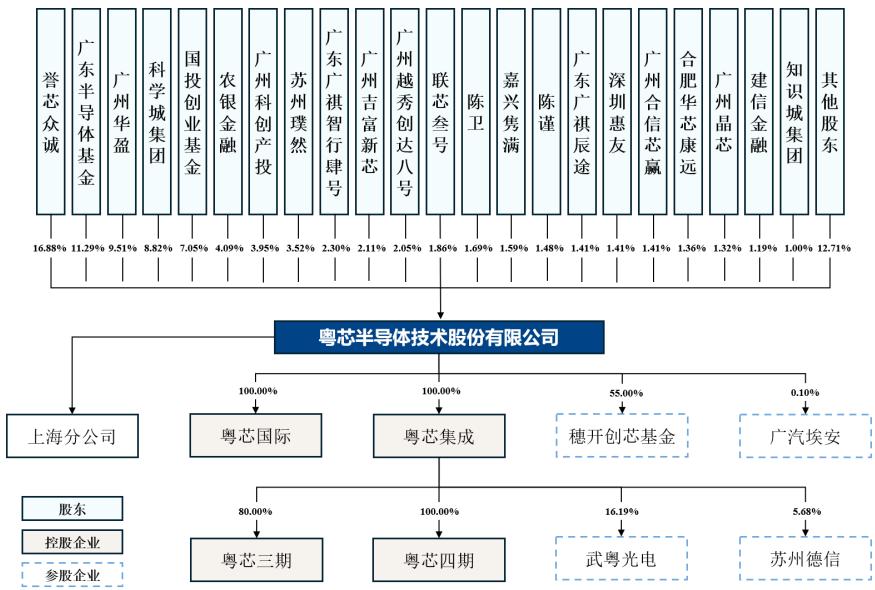
According to an announcement disclosed by Zhiguang Electric, Jinyu Group and Wanlian Tianze signed the Partnership Agreement of Guangzhou Yuxin Zhongcheng Equity Investment Partnership (Limited Partnership) in December 2017. Jinyu Group paid 150 million yuan of subscribed capital in full, then Yuxin Zhongcheng was officially registered, which mainly invested in Nexchip Semiconductor. Jinyu Group is the controlling shareholder of Zhiguang Electric, and Li Yongxi serves as the chairman of both enterprises.
In January 2019, when the first-phase project of Nexchip Semiconductor was about to be put into production, Zhiguang Electric subscribed for 30% of the limited partnership shares of Yuxin Zhongcheng with 156 million yuan. Two years later, Zhiguang Electric subscribed for 33.33% of the limited partnership shares of Jifu Xinxin with a total scale of 300 million yuan with 100 million yuan of monetary capital, and the latter is also a fund that invests in Nexchip Semiconductor.
It is worth mentioning that the actual controller of Guangzhou Huaying, the third largest shareholder of Nexchip Semiconductor, is also Li Yongxi after equity penetration. According to rough calculation, Li Yongxi indirectly holds more than 20% of the shares of Nexchip Semiconductor through multi-layer platforms in total.
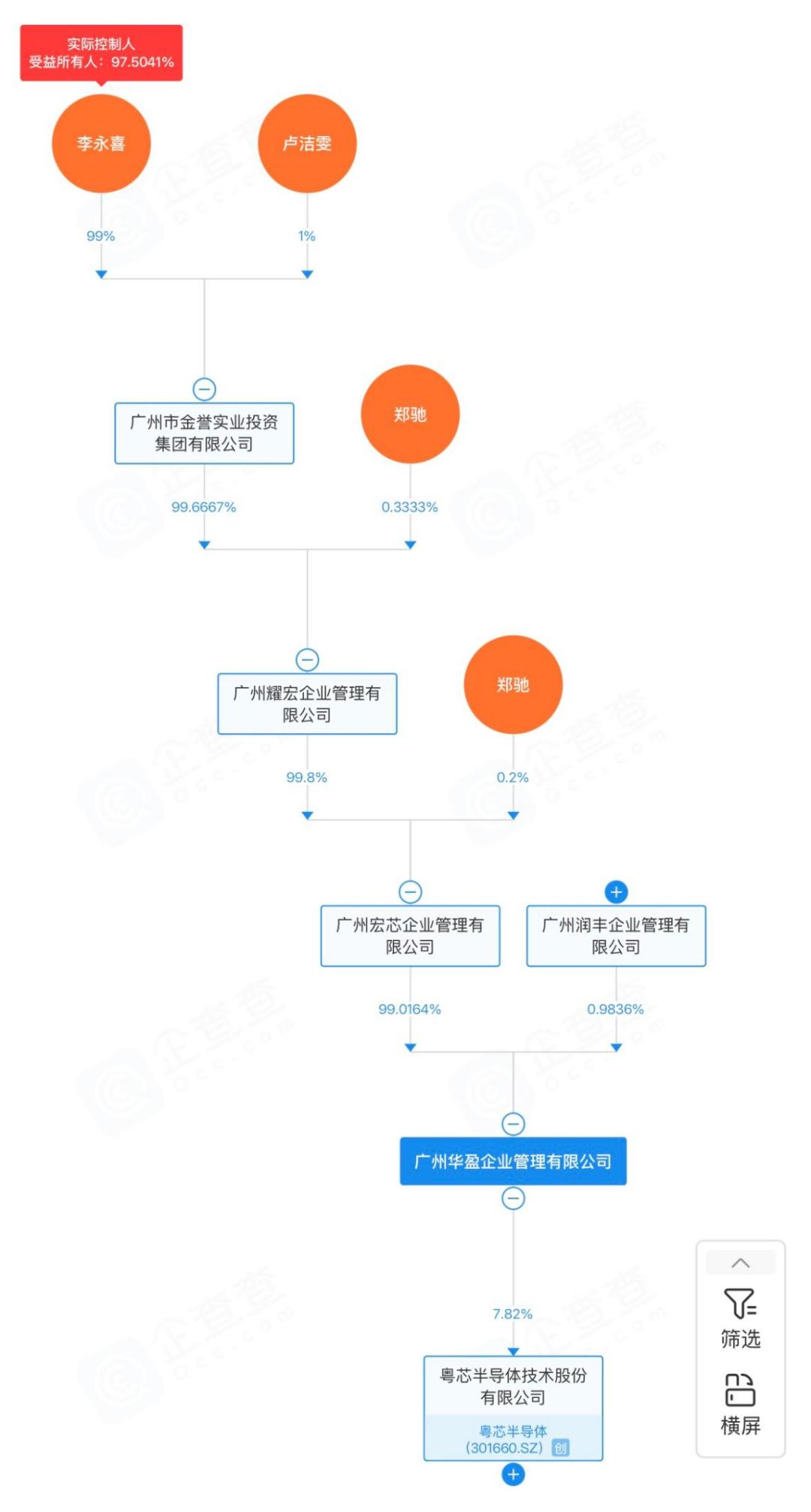
On the first day of listing, the share price of Nexchip Semiconductor rose by more than 270% at opening, with a market value exceeding 100 billion yuan. Calculated at the latest stock price, the market value of Nexchip Semiconductor indirectly held by Li Yongxi exceeds 20 billion yuan, and the floating profit of this investment made 9 years ago is nearly 20 billion yuan.
Li Yongxi once said frankly, "For chip manufacturing, it is very normal to invest tens of billions of yuan and make no profit within seven or eight years. Without government support, we can't even imagine doing this business."
For this reason, the figure of Guangdong state-owned capital appears in almost every round of financing of Nexchip Semiconductor —
Among them, Science City Group invested as a founding shareholder to jointly establish Nexchip Semiconductor, with a cumulative investment of 500 million yuan; Guangzhou Industrial Investment is the only strategic shareholder that has continuously participated in the whole construction of the first to fourth phases of Nexchip Semiconductor; Yuecai Fund led the investment in Nexchip Semiconductor for 3 consecutive rounds in 2021 and 2022, with a cumulative investment of 2 billion yuan, driving more than 20 billion yuan of social capital and bank loans; Yuexiu Industrial Investment has invested nearly 700 million yuan through various ways, and Guangzhou Yuexiu Industrial Finance Private Equity Fund Management Co., Ltd. has invested 450 million yuan to provide financial support for the construction of the fourth-phase project of Nexchip Semiconductor...
Having witnessed the whole process of Nexchip Semiconductor's rise, they have finally waited for the gift given by time.
Alumnus of South China University of Technology started his own business, owning two listed companies
Li Yongxi has been on this entrepreneurial road for 20 years.
Li Yongxi was born into an intellectual family in Shantou in 1964, and was deeply influenced by his family environment since he was a child. In 1982, he was admitted to South China University of Technology, majoring in electrical machinery in the Department of Electric Power. After graduating from university, he started working at Guangzhou Development Zone Construction and Development Corporation, starting as an ordinary employee.
After that, Li Yongxi successively served as the factory director of Guangzhou Mingzhu Power Plant, general manager of Guangzhou Mingzhu Power Co., Ltd., chairman and general manager of Guangzhou Mingzhu Power Enterprise Group, deputy commander of Hengyun Power Plant, executive deputy general manager of Guangzhou Development Zone Construction and Development Corporation, and other positions. At the age of 34, he had been appointed as the deputy director of the Guangzhou Municipal Economic Commission.
But at that time, Li Yongxi made an unexpected decision — to resign and go into business. In 2001, he took the lead in establishing Guangzhou Jinyu Industrial Investment Group Co., Ltd., taking electric power as the core business on the one hand, and expanding the real estate business sector on the other hand.
In 2002, Zhiguang Electric, which had just spun out from the Test and Research Institute of the former Guangdong Provincial Electric Power Bureau, fell into the dilemma of capital shortage. Therefore, under the leadership of Li Yongxi, Jinyu Group strategically invested in Zhiguang Electric and became its major shareholder. After five years of cultivation, Zhiguang Electric was successfully listed on the Shenzhen Stock Exchange in 2007, and Li Yongxi harvested his first IPO.
Nexchip Semiconductor has become Li Yongxi's "chip" career. At that time, Zhiguang Electric's main business was the development of power digital and information systems, and its involved fields had a large demand for chips, but it was constrained by foreign chip manufacturers. Li Yongxi once recalled in an interview that in the early days when they used chips from the United States, the US side always raised prices arbitrarily, sending a fax or email to notify only a few days in advance, with no room for negotiation, and they had to bite the bullet and accept it.
Later, Li Yongxi sent people to open up channels in Japan, and the company's chip supply was half from the United States and half from Japan. "I have been depressed about this matter. When will this kind of day of being led by the nose by others end? After all, at that time, China's chip design was still very weak, let alone chip manufacturing?"
Nexchip Semiconductor came into being under such circumstances. From piling in March 2018, the main plant was capped in October, equipment was moved in March 2019, production equipment was debugged and started wafer production in June, two process platforms were developed and passed reliability verification in September, and began to ramp up to mass production... It only took 18 months for Nexchip Semiconductor to complete the whole process, realizing the breakthrough from scratch to mass production.
Li Yongxi once calculated an account: "Mass production 20 months faster than others will directly save about 400 million yuan of capital cost and about 200 million yuan of labor cost, which is equivalent to saving 600 million yuan in total, which is very amazing."
We all know the follow-up story. Nexchip Semiconductor has rapidly risen to become "the first chip enterprise in Guangzhou", revitalizing the semiconductor industry ecology in Guangzhou.
A microcosm of the whole industry
Looking through the history of China's venture capital, the first investment is always full of legendary colors.
I still remember that when Wang Xingxing just graduated with a master's degree from Shanghai University in 2016, his quadruped robot XDog won the bonus in the entrepreneurial competition before, which made him have the idea of dropping out of school to start a business. Later, he looked for several investors he met in the entrepreneurial competition, but no one was willing to invest, so the idea of starting a business was dismissed, and he went to work for DJI.
It was not until August 2016 that Wang Xingxing got his first investment, with an amount of 2 million yuan, which led to the subsequent story of Unitree Robotics. Wang Xingxing once revealed that the money was invested by an individual investor in Beijing, "He took the initiative to find me, gave very loose terms, and transferred the money without even signing an agreement." With Unitree Robotics landing on the Sci-Tech Innovation Board, the person who made the first investment back then also surfaced, who is Yin Fangming, the current chairman of Galaxy General.
Xia Zuoquan, chairman of Zhengxuan Investment, once shared the story of his earliest bet on BYD with the investment community: in November 1994, he met Wang Chuanfu for the first time, when the latter had just started his business, but was in deep trouble due to lack of funds.
At that time, Xia Zuoquan did not understand the battery industry, but the two chatted all night at the first meeting, "I have met many entrepreneurs, but I have never met someone like Mr. Wang. His passion, ambition, firmness and confidence deeply infected me." Then Xia Zuoquan finalized the investment — in April 1995, he invested hundreds of thousands of yuan in BYD, and also became one of the three founders of the company.
In the high-threshold and long-cycle track such as semiconductors, state-owned capital institutions often play a more important role.
The most impressive story is undoubtedly Hefei's bet on CXMT — at the beginning of CXMT's establishment, Hefei state-owned capital deeply participated in the project through multi-layer platforms. From project landing, plant construction to successive capital increases, Hefei state-owned capital was never absent. Without the city's years of unremitting bets, the subsequent market value of hundreds of billions of yuan would be impossible to talk about.
But in the venture capital circle, legends are very rare. The real early-stage investment is more like a narrow escape from death. In the market tide, many technology start-ups have poor financial performance for a long time due to reasons such as large upfront capital investment and obstacles in achievement transformation, and may even "collapse before the dawn".
Liang Wenfeng once said, "Innovation is generated by itself, not deliberately arranged, let alone taught by others." Scientific and technological innovation cannot be achieved overnight, with a long return cycle and many uncertainties. At this time, "bold capital", "venture capital" and "patient capital" are even more needed.
Entrepreneurship is full of hardships. The innovation "from 0 to 1" is the most exciting, but before this moment comes, people often have to go through a long, arduous and lonely road, which requires the company of venture capital all the way. As Don Valentine said in *The History of Venture Capital*:
"Venture capital is not to look at the world from a god's perspective. It is also entrepreneurship, to start a business together with entrepreneurs."
This article is from the WeChat official account "Pedaily" (ID: pedaily2012), written by Liu Bo, authorized to release by 36Kr.