The latest conversation transcript of Jensen Huang: The future belongs to those who combine the physical world with artificial intelligence and define the next era.
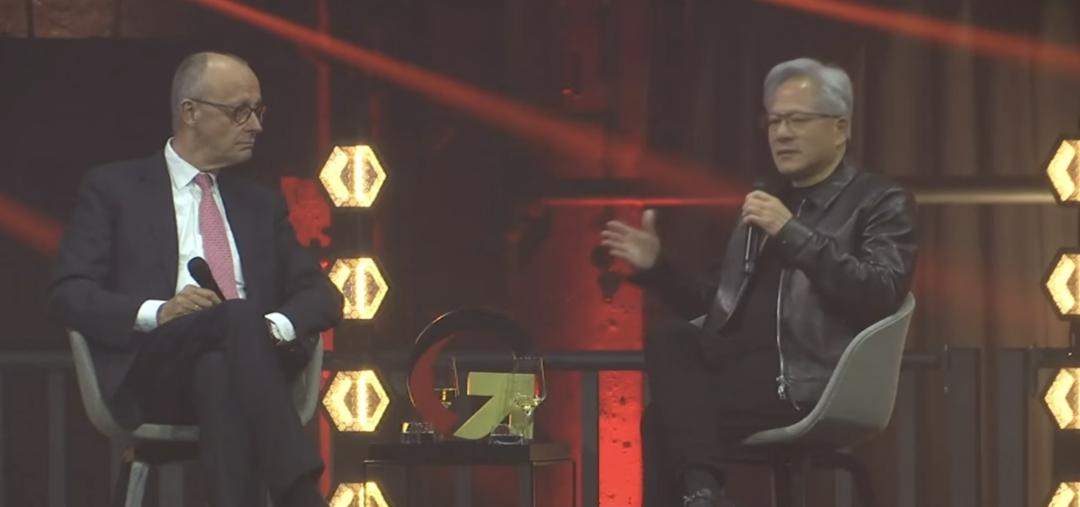
During a public dialogue in Germany, Jensen Huang, CEO of NVIDIA, held in-depth discussions with German Chancellor Merz on how AI will transform Germany's industry. Huang put forward a core judgment: In the future, every company will have two factories — one physical factory, and one digital factory. The digital factory will be so realistic that it can barely be distinguished from the real one. Germany's profound accumulation in electromechanical technology, engineering manufacturing and domain expertise is exactly its greatest advantage in the physical AI era. The core viewpoints can be summarized as: Electrons will never replace atoms; AI will not replace domain expertise, but only augment it.
The following is the collation of Jensen Huang's viewpoints:
I. Every company will have two factories in the future: a physical factory and a digital factory
In the future, every company will own two factories: a physical factory, and a digital factory. The digital factory will be so realistic that it is almost identical to the physical one. When you create a digital twin for your company, this digital twin will be so lifelike that it can almost pass for the real thing.
That's why I believe most people will work in the digital twin of their company in the future. They will build digital cars that come with digital brains; manufacturing plants will be staffed by AI robots, and robot-run factories will manufacture robotic cars. Everything will be software-driven, everything will be AI-driven.
Every company will build two things: the brain, and the products that carry the brain.
II. The next wave of AI is Physical AI: AI augments capabilities instead of replacing domain expertise
The next wave of AI is Physical AI, which refers to AI interacting with the physical world: robots, manufacturing, automobiles, heavy industry. These industries will never be replaced by digital technologies.
General artificial intelligence will never be able to replace the knowledge of domain experts. You can make general intelligence as smart as possible, but it will never be as smart as someone who is extremely specialized in a specific field of electromechanical technology. This capability is irreplaceable. Therefore, AI can only augment your capabilities, not replace them. You should treat AI as a new tool.
III. Data is a country's natural resource and should be transformed into national intelligence
A country's data embodies its culture, values, knowledge and experience. Data is a country's natural resource, and it belongs to the country.
You should import technologies, use these technologies to process data, and convert data into national intelligence. But you should not export your own culture, values, knowledge and history, and then import the "national intelligence" back. That makes no sense.
Of course you can use the world's best AI technologies and services, but you are fully capable of building your own AI. That is the first point.
IV. The software era is being reset, but electrons will never replace atoms
The last major industrial revolution was electrification. The past 50 years were the era of software programming, but now, computers can program themselves — you only need to tell the computer what you want to do. The advantages of the previous generation of software programming are being integrated into artificial intelligence. This is a complete reset.
At the same time, all digital technologies in the world cannot replace electromechanical physical technologies. Electrons will never replace atoms.
Your domain knowledge, your craftsmanship, your manufacturing capabilities will remain where they are. But you must make use of this new technology. This industrial revolution is so powerful that you cannot assume there will be a second chance. We should always assume there won't be one.
V. Aging population and skill inheritance: solidify domain knowledge with AI
At present, many enterprises are facing the challenges of shrinking workforce and aging population. Craftsmanship resides in people's knowledge and skills, but the working population is getting older generation by generation.
We must make full use of artificial intelligence to let AI encode, program, teach the skills, and keep them locally. Let AI re-engineer manufacturing capabilities. This is a real opportunity.
VI. Regulation: Security is not a hope, it is technology and engineering
Safety comes first. Without safe products, this industry will have no future, just like self-driving cars will have no future if they are not safe. Safety and capability are not mutually exclusive, they are integrated and must advance together.
Regulation should have three pillars:
First, the technology industry must invent safety technologies. Without technology, there can be no regulation. Safety is not hopes and dreams, safety is technology and engineering. Countries with strong capabilities in science, mathematics and technology should invent safety technologies.
Second, companies must follow best practices. Young companies are still growing and may make more mistakes than they should. Enterprises must deliver best practices, best methods, in-depth engineering and rigorous methodologies.
Third, industry and government regulation. AI has two layers just like the Internet: it is difficult to regulate the Internet itself, but it is less difficult to regulate Internet applications. Applications should be regulated immediately. If a certain AI technology is applied to new products not covered by existing regulatory agencies, the regulators must assess it as soon as possible to ensure that the regulation covers AI.
If the industry does not thrive, there will be nothing to regulate. We hope the AI industry can thrive while remaining safe and responsible. Balance is very important.
VII. Investing in the future: believe in deep science, deep mathematics and the entrepreneurial ecosystem
I believe in deep science and deep mathematics, which are the foundation of manufacturing, and also the foundation of the deep science of artificial intelligence. There is technical expertise, deep science and deep mathematics here.
In the past year, we have invested nearly 1 billion US dollars; this week we invested in four new companies. In many ways, we are already one of the largest venture capital institutions. Because I believe in the science, technology and talents here.
In the past two years, half of the newly established startups are AI companies. This is quite remarkable. For other venture capitalists, you'd better hurry up, otherwise all the good deals will be taken by me.
Conclusion
Jensen Huang's core judgment can be condensed into a few sentences: In the future, every company will have a physical factory and a digital factory; the next wave of AI is Physical AI, which augments domain expertise instead of replacing it; data is a country's natural resource and should be transformed into national intelligence; the software era is being reset, but electrons will never replace atoms; security is not a hope, but technology and engineering; regulation requires three pillars of technology, best practices and government rules to move forward together. Opportunities will not come automatically, but those who seize the combination of AI and the physical world will define the next era.
This article is from the WeChat official account "Backwave Evolution Planet", author: Mark, published with authorization from 36Kr.