$1.1 Billion: China's first large overseas export deal for the generative AI-LNP platform has been landed, and Eli Lilly's bulk acquisition logic has changed.
The AI pharmaceutical track is experiencing intensive value realization.
On October 19th, METiS Therapeutics (7666.HK) and Eli Lilly officially announced a strategic cooperation to jointly promote breakthroughs in tissue-specific LNP delivery technology, with a total amount of up to 1.1 billion US dollars. This marks the first large overseas order for China's generative AI-LNP platform, and also the world's largest AI-driven extrahepatic LNP delivery platform cooperation in terms of transaction scale: large pharmaceutical companies are not only paying for single pipeline assets, but also starting to pay milestones for platform capabilities, locking in priority rights for long-term R&D cooperation.
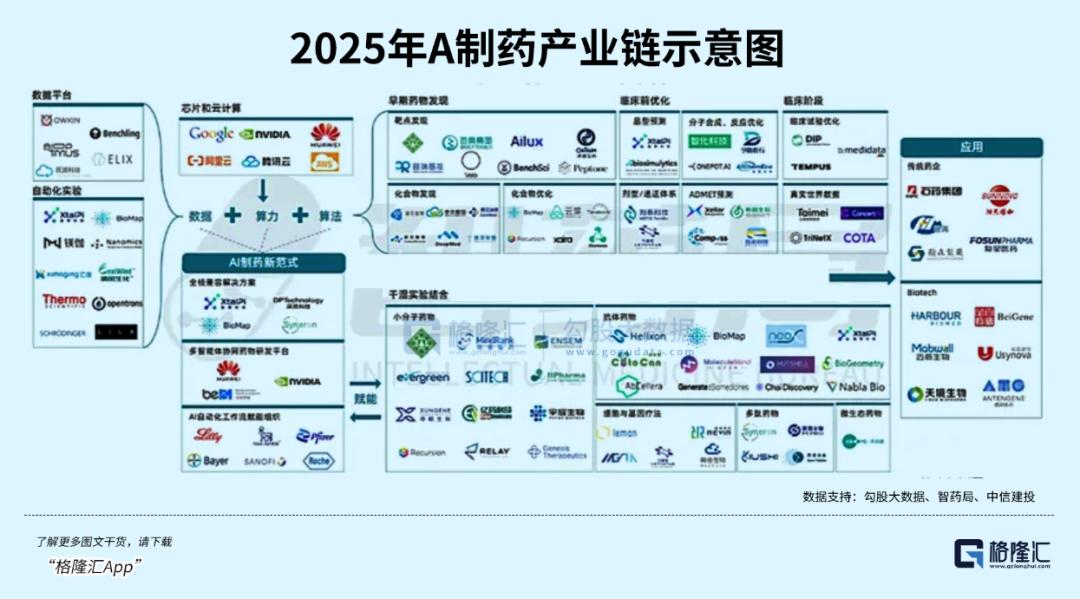
The latest research report from CITIC Construction Investment pointed out that AI4S is advancing from model capability competition to the critical point of industrialization. With the four-fold resonance of technology, industry, demand and policy, the value anchor is upgrading from model capability to scientific research productivity, data assets and systematic biological design. The AI pharmaceutical industry chain has evolved into a networked empowerment system with platforms and technology middle platforms as the core, and in-depth collaboration between upstream, midstream and downstream.
Eli Lilly's AI investment landscape is the best footnote to this trend. From NVIDIA's computing power base, to Insilico Medicine's small molecule generation, to Chai's biologic drug design, to Profluent's gene-editing enzymes, and then to Kelonia's in vivo gene delivery — Eli Lilly is building an AI-native pharmaceutical closed loop. This time, METiS Therapeutics has filled the last missing part of this closed loop for Eli Lilly: delivery.
However, the investment significance of this event goes far beyond a single BD deal. What Eli Lilly bought is not just an LNP formula, but the systematic capability of METiS' NanoForge platform as a Biological AI infrastructure. This means that the valuation logic of METiS Therapeutics is shifting from a pipeline company to a platform infrastructure company — and the Hong Kong stock market has not fully priced this yet.
01
Delivery: Why Has It Become the Last Piece of the Puzzle in Eli Lilly's AI Landscape
Breaking down Eli Lilly's previous moves around AI, every layer of layout is actually answering the same question: How to make drugs reach patients faster, more accurately and more predictably.
At the computing power layer, Eli Lilly and NVIDIA have jointly built LillyPod and the AI Co-Innovation Lab, with a total joint investment of up to 1 billion US dollars within 5 years. At the biologic drug design layer, it invested in Chai Discovery. At the gene editing tool layer, it cooperated with Profluent with milestones of up to 2.25 billion US dollars. At the in vivo gene delivery layer, it acquired Kelonia Therapeutics for up to 7 billion US dollars. At the manufacturing layer, it uses digital twins, AI quality inspection and robot technology to solve the GLP-1 production capacity bottleneck.
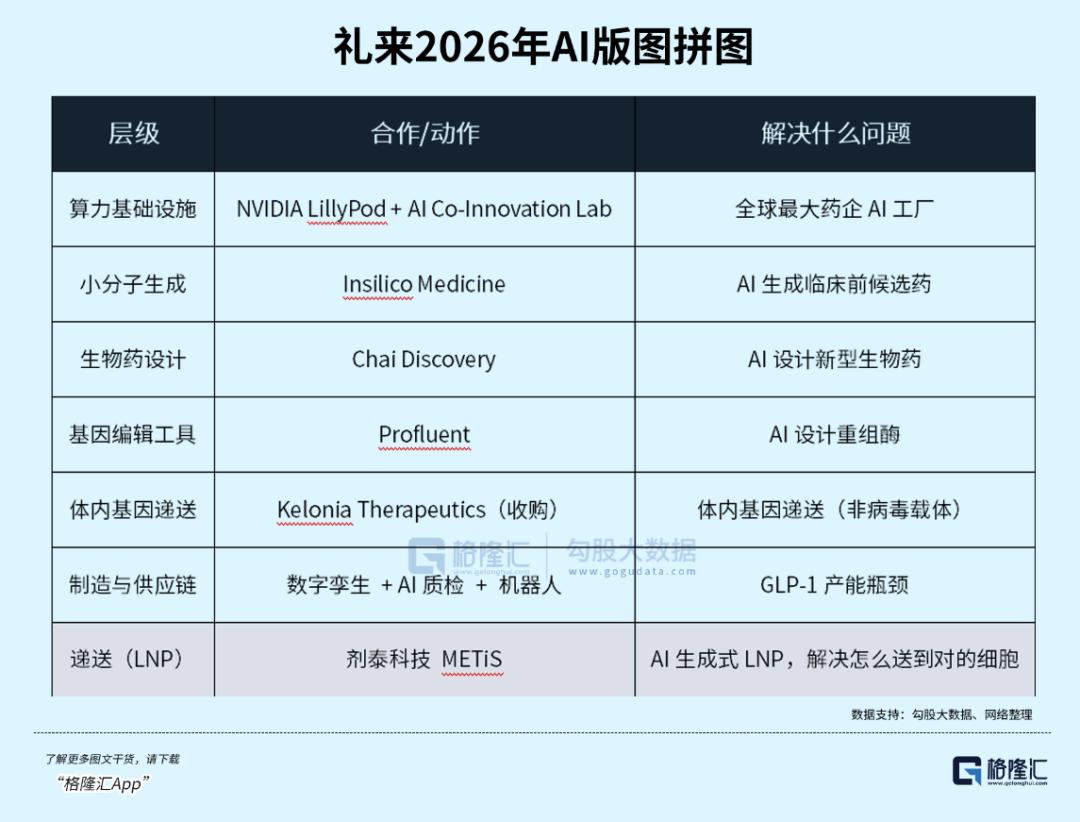
Now, the delivery layer has also been completed.
If NVIDIA provides the computing power base, Insilico Medicine, Chai Discovery and Profluent generate three types of "warheads", and Kelonia provides in vivo gene delivery tools, then what METiS Therapeutics complements is the "ballistic system" that allows all these molecules and tools to reach target cells. Without delivery, the previous molecular design is nothing more than "having bullets but no guns".
Diogo Rau, Chief Information Officer of Eli Lilly, once publicly stated that Eli Lilly's AI logic covers the whole chain — manufacturing, discovery, delivery and clinical practice. The emergence of this cooperation with METiS also shows that Eli Lilly has recognized that delivery is no longer just a chemical formulation problem, but an AI-engineerable problem.
This judgment was not easy to come by. Over the past few decades, delivery has long played a supporting role in drug R&D. In the era of small molecules, the delivery problem was relatively simple: with oral administration or injection, the drug could distribute to the target site by itself. However, in the era of nucleic acid drugs, gene editing, mRNA therapies and in vivo cell therapies, delivery has become a decisive bottleneck. Payloads such as siRNA, mRNA and CRISPR components have large molecular weights, are charged and easily degraded, and cannot enter cells at all without a delivery system. The emergence of LNP has solved part of the problem, but the capability boundary of traditional LNP is also very clear, which is mainly limited to liver enrichment.
What Eli Lilly wants to do is to expand delivery from the liver to more organs and more cell types. This is not an unnecessary improvement, but the key to determining whether a new generation of therapies can be established.
02
Why METiS? The Technological Watershed of Generative AI-LNP
The direction is clear, and the problem follows. There are not a few companies working on LNP around the world, why did Eli Lilly choose METiS?
To answer this question, we must first see where traditional LNP has gone.
For a long time, the R&D of traditional LNP has highly relied on chemists' accumulated experience and high-throughput blind screening. A lipid library often takes several years to polish. This model is not only low in efficiency, but also forms an extremely high patent barrier. Established players such as Acuitas and Genevant have taken the lead by virtue of their accumulated lipid structures and patents over the years, and latecomers who want to enter this field often have to pay high tolls.
In March this year, Moderna spent 2.25 billion US dollars to reach a settlement with Genevant and Arbutus, but what it bought was only the "right to use freely" of the verified LNP in infectious disease mRNA vaccines, which solved the problem of patent freedom, rather than the right to choose next-generation delivery technologies.
More critically, in the face of new therapeutic demands, the traditional route has reached its ceiling. When the industry goal shifts from liver enrichment to extrahepatic organs or tissues such as lung, spleen and tumor, and even further to highly selective delivery to specific cell types in tissues, the chemical space that can be explored expands exponentially. Facing tens of millions of structural combinations, it is completely impossible to rely on manual experience for design and trial and error.
To break this bottleneck, a brand-new computing paradigm must be introduced, and the intervention of AI has become inevitable.
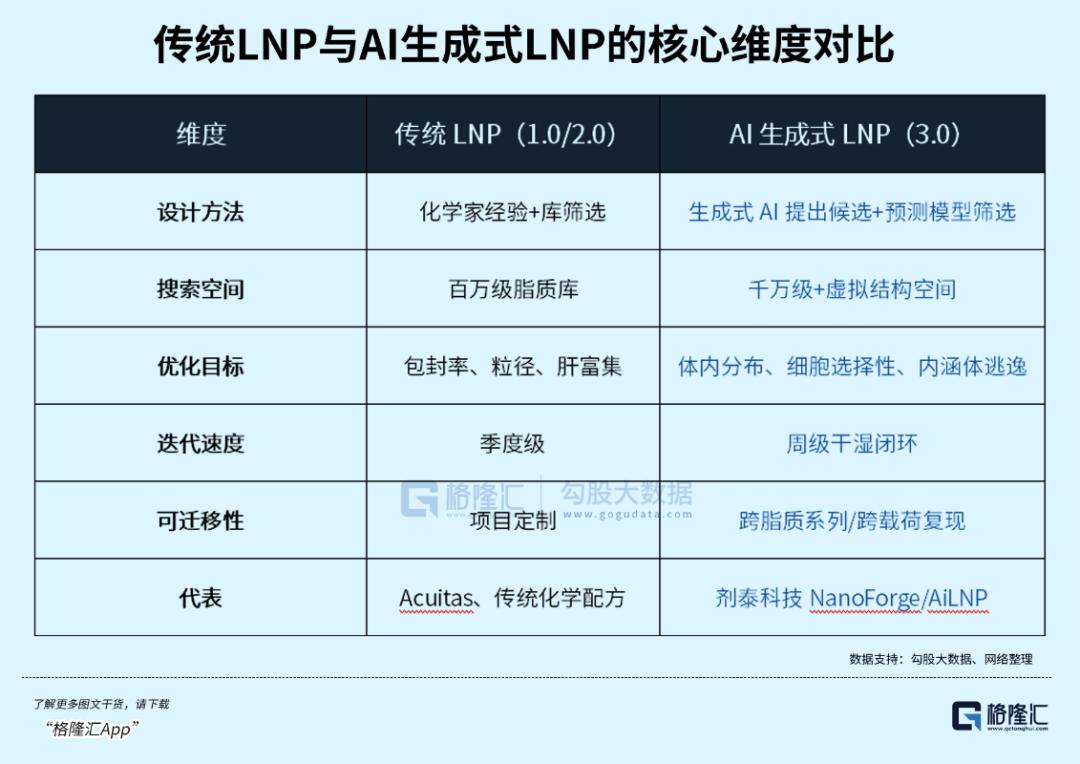
METiS' solution is to use generative AI to completely reconstruct the underlying logic of lipid discovery. Its NanoForge platform has accumulated more than 10 million lipid structures and 100,000 experimental data points. On this basis, the AiLNP platform is equipped with the AI for Nano lipid de novo generation algorithm, the lipid language foundational model, the METiS intelligent agent and the high-throughput dry and wet experiment closed loop.
The core subversion of this system is that it is no longer limited to screening known structures, but can generate completely new lipid molecules that do not exist in nature just like generating language. The lipid language foundational model allows AI to deeply understand the relationship between structure and delivery performance; the algorithm can generate thousands of candidate structures a day, and the prediction model quickly picks out dozens of the most promising ones, and then flows back data after entering wet experiment verification. The efficiency brought by this "dry-wet closed loop" may bring an order-of-magnitude dimensionality reduction strike.
Of course, what Eli Lilly is interested in may not only be the AiLNP point, but the full-stack system capability behind NanoForge. In addition to AiLNP, NanoForge also includes AiProtein responsible for protein and antibody design, AiRNA responsible for nucleic acid sequence design, and AiTEM responsible for small molecule formulation development. These four platforms form a complete Biological AI closed loop, which can simultaneously solve the problems of "what the drug is", "how to deliver it" and "how to make it into a drug".
The value of this closed loop has been verified by real money from leading external pharmaceutical companies. As early as last August, METiS announced that the AiTEM platform would be deployed locally at Hengrui Medicine. In MTS-004, China's first AI-enabled formulation new drug that completed Phase III clinical trials, AiTEM undertook core modeling and prediction, compressing the preclinical formulation optimization cycle from the industry average of 1 to 2 years to less than 3 months, and promoting MTS-004 to take only 38 months from project initiation to the completion of Phase III clinical trials.
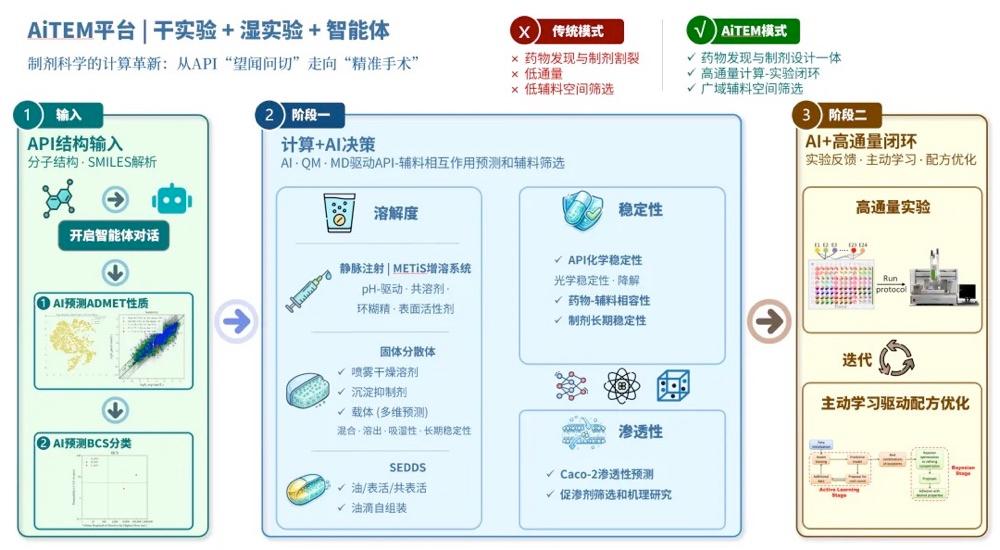
(Source: METiS Therapeutics)
Hengrui's order and Eli Lilly's order point to the same thing at the underlying logic level: what leading pharmaceutical companies value is the system capability of the NanoForge platform to continuously produce and optimize drugs. METiS is not selling a pipeline, nor a set of SaaS software, but exporting a set of underlying infrastructure that jointly defines the next-generation technology route with pharmaceutical companies.
Back to this cooperation, METiS is helping Eli Lilly complete a key technological leap: from "organ targeting" to "tissue and cell-level selective delivery". Traditional organ-level delivery only needs to solve the enrichment problem, while cell-level delivery needs to break through multiple barriers such as cell recognition, uptake and intracellular functional release at the same time. Breaking through this technical barrier is expected to enable new generation treatment modes such as nucleic acid drugs, gene editing, mRNA therapies and in vivo cell therapies to completely get rid of the dilemma of insufficient delivery selectivity, and greatly expand the boundary of druggable targets.
03
Two-way Verification by Industry and Capital, the Moment of Platform Value Reassessment
This cooperation between Eli Lilly and METiS is enabling the industry and capital market to make judgments on the same thing from two directions at the same time. These two judgments eventually point to the same conclusion: the platform value of METiS Therapeutics is being re-priced.
The change at the industrial level is not what Eli Lilly bought, but the nature of the transaction subject has changed.
In the past, MNCs bought pipelines, which were a formed molecule or a verified drug. Eli Lilly's round of layout shows that it has begun to pay for the capability to continuously produce molecules. The subject has not yet entered the clinic, but the platform itself has been regarded as a priceable asset.
The core of this METiS deal is not just a certain LNP formula, but the full-chain capability of NanoForge from lipid generation and delivery design to protein design and nucleic acid optimization. Delivery is the entry point, and the platform is the real object that Eli Lilly has locked in.
This change in nature is directly reflected in METiS' business model. The company presents a structure of simultaneous monetization through three paths: product authorization, platform services and ecological cooperation. The global authorization of MTS-128 corresponds to product cooperation revenue, the implementation of AiTEM at Hengrui and this cooperation with Eli Lilly correspond to platform service revenue, and the OpenCGT project corresponds to ecological cooperation revenue. The three revenue lines correspond to three different pricing logics, and also correspond to three different market reference systems. This diversified revenue structure itself shows that platform capabilities already have independent commercial value, rather than just technical advantages in a certain link.
The active layout of industrial capital is backed by a highly certain incremental market.
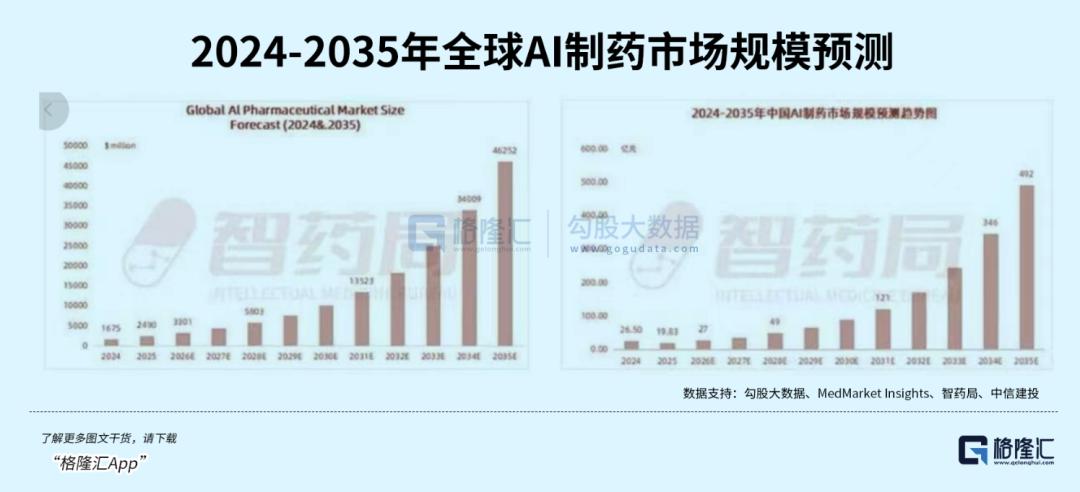
According to the data forecast in the CITIC Construction Investment research report, the global AI pharmaceutical market size is expected to exceed 46.2 billion US dollars by 2035, with a compound annual growth rate as high as 35%. The Chinese market has shown extremely strong outbreak elasticity, and it is estimated that the market size will reach 49.2 billion RMB in 2035, becoming one of the most certain incremental markets in the global AI pharmaceutical industry.
In this rapidly expanding broad blueprint, whoever can provide the underlying Biological AI infrastructure will be able to seize the dividends of the next round of life science industry upgrading. As one of the rare representative platform targets, the market ceiling of METiS Therapeutics is expected to be further opened.
It is precisely based on this broad market prospect and industrial verification that the valuation anchor at the capital level is also shifting.
In the past, the market valued AI pharmaceutical companies by looking at the number of pipelines and clinical progress, using the traditional Biotech framework. However, as the commercial verification of platform capabilities is gradually implemented, the market has begun to realize that the value of such companies cannot only be measured by the success or failure of pipelines. The primary market has paid a significant premium for the capabilities of AI pharmaceutical platforms, and AI pharmaceuticals have become one of the important financing directions in the innovative drug field. The secondary market is relatively lagging behind, and there is still the inertia of pricing based on the success or failure of a single pipeline. This gap means that when platform capabilities continue to be verified by industrial capital, there is room for valuation repair in the secondary market.
The cooperation between Eli Lilly and METiS just provides such a verification node. The world's most demanding industrial capital is willing to price METiS' platform capability, and this signal will be gradually transmitted to the capital market, pushing the market to re-examine the value of such platform-based companies.
Industrial verification provides a pricing anchor for the capital market, and the re-pricing of the capital market will in turn accelerate the concentration of resources to platform-based enterprises. METiS Therapeutics is exactly at this intersection. It is neither a traditional Biotech that bets on the future relying on a single pipeline, nor a software company that only sells algorithm services. Its value lies in a system that can continuously generate innovative assets.
Once the platform value is confirmed by both the industry and capital, the ceiling of METiS Therapeutics will no longer depend on the success or failure of a certain drug, but on the boundary that this system can be replicated and scaled up.
04
Final Notes
Overall, Eli Lilly's 2026 AI investment landscape reveals a clear logic: computing power is the foundation, molecules are warheads, and delivery is the ballistic system. The significance of the METiS cooperation does not lie in the BD transaction itself, but in the fact that it proves that leading pharmaceutical companies have recognized that AI can not only discover molecules, but also redefine how molecules reach cells.
In the past, delivery was an auxiliary link in drug R&D, hidden in chemical formulation and process development, and it was difficult to be valued separately. Now, the world's most demanding industrial capital is willing to pay down payment and milestones for a delivery platform, which itself shows that delivery has changed from a cost item to an asset item. Once the pricing anchor appears, the entire AI pharmaceutical valuation framework will be adjusted accordingly. The number of pipelines and clinical progress are still important dimensions, but whether the platform can continuously generate assets and be adopted by more partners will increasingly become the core variable of valuation.
METiS Therapeutics is exactly on this migration path. The four platforms of NanoForge form a complete Biological AI closed loop, with more than 10 R&D pipelines covering tumors, immunology, metabolism and central