Anthropic Scientists: If AGI arrives within three years, is it still meaningful to pursue a PhD and plan for a tenured academic career?
Recently, a speech delivered by an Anthropic scientist has been unearthed again, sparking widespread attention and heated discussions on the social platform X.
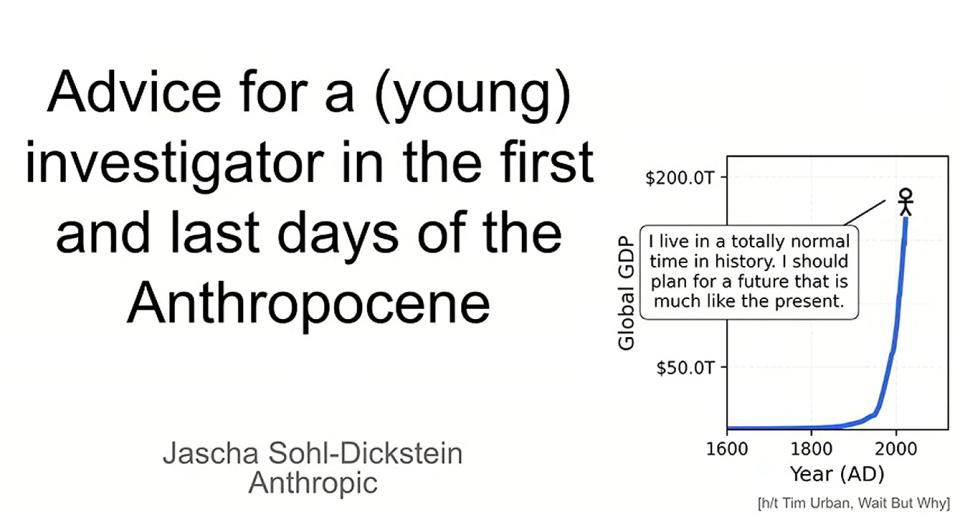
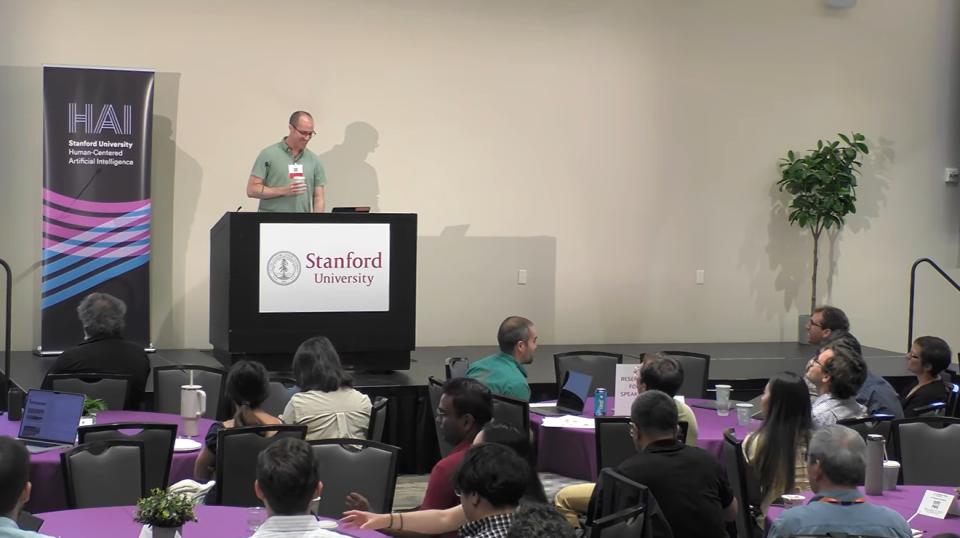
Jascha Sohl-Dickstein, the Anthropic scientist and one of the early researchers of diffusion models, delivered a speech titled Advice for a Young Investigator in the First and Last Days of the Anthropocene at the Physics and AI Conference held at Stanford University in June 2026. In his view, the rapid advancement of AI capabilities will not only transform scientific research methods, but also may shake the long-standing academic career planning that has been adopted for many years.
This viewpoint is a problem worthy of attention and reflection in the current AI era: when technology may profoundly reshape the scientific research system in a few years, and we have clearly perceived the rapid development of AI technology, can people still plan their careers based on the experience of the past few decades?
Sohl-Dickstein's judgment is based on a set of data related to computing scale and AI capabilities: in the past decade, the training computation volume of the largest model has increased by about 10 million times. He believes that in the past seven months or so, AI models have begun to solve some of the Erdős problems that have long plagued mathematicians before; if the growth trend continues, the computing power in 2030 may reach about 10,000 times that of 2025. In his view, in an environment of exponential growth, following the past career planning may no longer provide the expected stability.
His suggestions focus on several aspects: Integrate AI into daily research as early as possible, and focus your research on problems that can continuously benefit from the improvement of computing power and model capabilities; re-evaluate the risks of the traditional academic path, and do not regard doctoral degree, postdoctoral research and tenured faculty position as naturally safe choices; make good use of AI to undertake coding, execution and verification work, while retaining your own judgment and thinking about the problems.
The most notable sentence in the speech is: "Writing is thinking. If you outsource writing, you are actually outsourcing your thinking as well."
This view also reflects Sohl-Dickstein's judgment on scientific research in the AI era: using AI to improve efficiency does not mean giving up independent thinking. Facing the major changes that may come in the next few years, young researchers should not only learn to use AI, but also re-examine their research directions and career plans, think about which capabilities are still important, and which choices are worthy of long-term investment.
The following is the transcript of Sohl-Dickstein's speech, with deletions made without changing the original meaning:
01 The Exponential Growth of AI Has Just Begun
The title of today's speech draws on the work of Santiago Ramón y Cajal, a Nobel laureate and one of the founders of modern neuroscience.
Let's first look at the global GDP growth curve. We are used to understanding the future as a linear extension of the present, but if we observe the long-term changes of GDP with a logarithmic coordinate, we will find that exponential growth has lasted for a very long time. AI is also going through a similar process.
If you accept this judgment, you should reconsider your career, research projects and life plans.
Human activities have left indelible traces on the earth. For example, mass species extinction is underway, and radioactive materials from nuclear tests are also left in the strata. Even billions of years later, these traces may still prove that humans once existed. Based on this, some people in the scientific community proposed that the period when humans have profoundly affected the earth's environment be called the "Anthropocene".
With the continuous enhancement of AI capabilities, humans may soon no longer be the only intelligent force that can change the world on a large scale. When this era ends will largely depend on the development of AI.
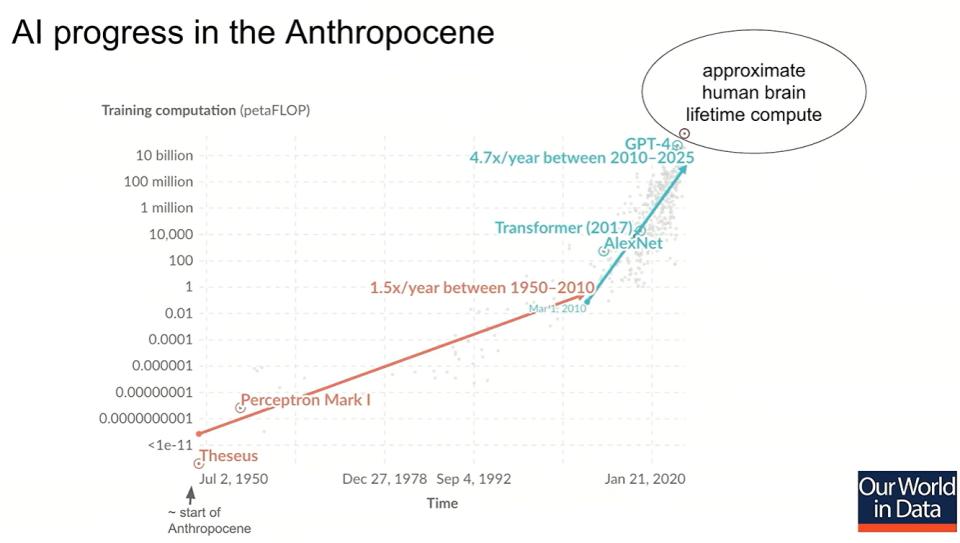
In the past decade, the amount of computation used to train the largest AI model has increased by about 10 million times. According to my rough estimate, this scale is gradually approaching the amount of computation completed by the human brain in a lifetime.
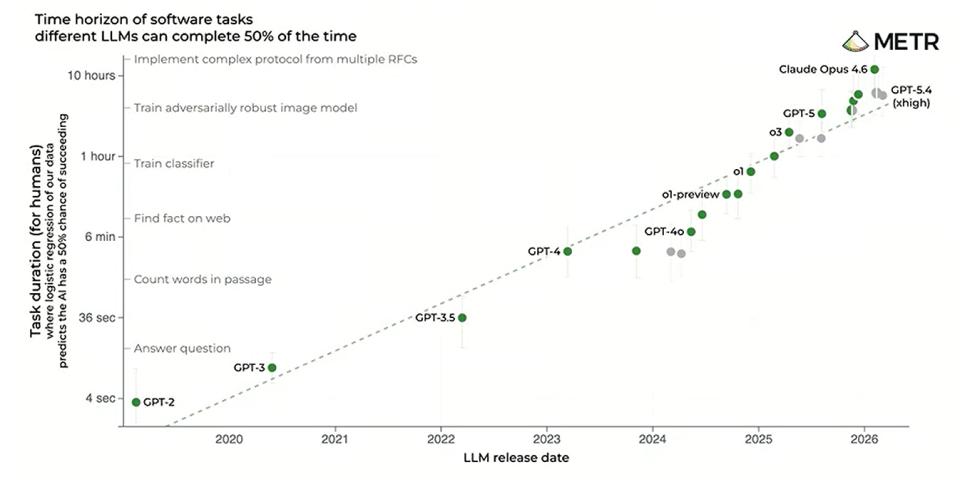
AI capabilities are also improving rapidly. A study examined the software tasks that the model can independently complete with a 50% success rate, and measured its capabilities by the time it takes humans to complete similar tasks. In less than a year, the time span of tasks that the model can handle has increased by about 10 times, exceeding my previous prediction for 2026 to 2027.
Similar changes have also taken place in the field of mathematics. Paul Erdős left a large number of unsolved mathematical problems. In the past seven months or so, AI models have begun to solve some of these problems, pushing the known boundary of mathematical research.
These advances show that AI capabilities are not only improving efficiency on existing tasks, but also beginning to enter fields that previously required human researchers to explore and make breakthroughs.
02 When Will AGI Possibly Arrive
A year ago, I gave an early version of this speech at Harvard University. At that time, some people thought that discussing the upcoming arrival of AGI was too radical. But now, this is a problem that can be discussed openly and seriously.
Former British Prime Minister Rishi Sunak once emphasized that AGI competition has fundamental geopolitical significance. Former US President Barack Obama also pointed out that the impact of AI will exceed that of smartphones and come even faster. Former Google CEO Eric Schmidt predicted that AI will reach or even surpass the top human intelligence level in a few years.
Although the work of programmers has not been completely replaced as a whole, AI has taken over many of these tasks, and the content of work is changing accordingly.
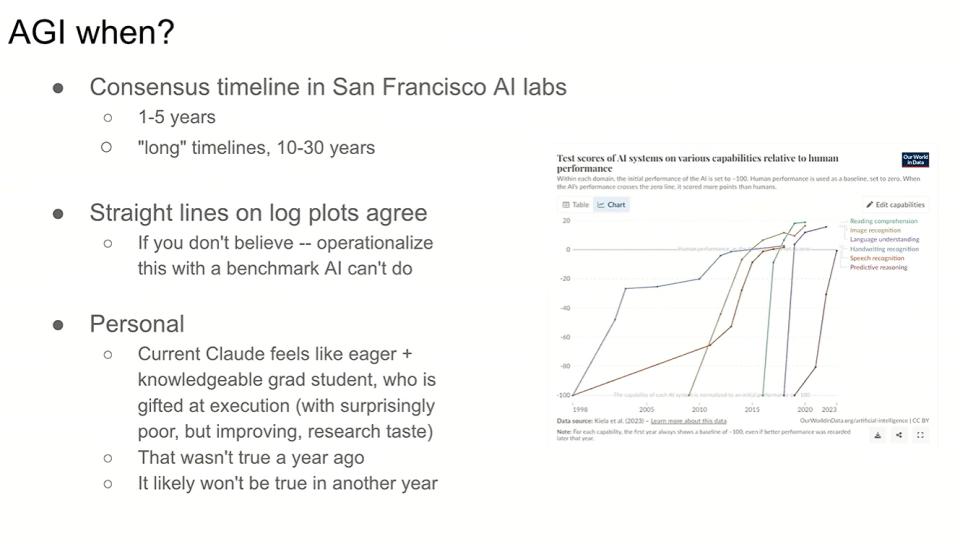
If you are in the AI industry in San Francisco and ask people when AGI will arrive, many people will answer: within a few years. Even if some people think the timeline is longer, after further questioning, you may find that the long term they mentioned is only about ten years.
This is very different from discussions in other scientific fields. For example, in the field of biotechnology, if you ask when cancer can be cured, researchers usually explain the difficulties involved and why it will take a long time. But when I communicate with AI researchers, they often think that there are no clear technical barriers from current models to superintelligence.
Another phenomenon worthy of attention is that in the past, many AI benchmarks took more than ten years to reach human level, but now new benchmarks may be broken in a few months to a few years. I participated in the creation of the Big Bench benchmark, and even before the paper was officially published, some studies have achieved new state-of-the-art results on some of its tasks.
If you think AI will not continue to make progress on a certain key capability, I suggest converting this judgment into quantifiable indicators, establishing benchmarks, and continuously tracking. Don't just stay at the vague judgment that "AI is not smart enough".
On the road to AGI, our methods are obviously still very inefficient. Compared with current methods, the human brain may be several orders of magnitude higher in data utilization efficiency. But inefficiency does not mean that the method does not work.
What surprises me over and over again is that we just expand some quite simple methods by an order of magnitude, and they can still bring obvious progress. Therefore, I can't see a clear hard obstacle that can stop us from moving forward for the time being.
If we take these timelines seriously, the first thing to consider is: how to ensure that the research you are doing is still valuable when it is completed. A situation to be alert to is that you spend two years making seemingly significant progress, but when you finish, others only need to give the latest base model a prompt to get better results.
Therefore, I suggest choosing targeted research projects, cooperating with others, and advancing the work as soon as possible to ensure that your research progress can keep up with the growth of AI capabilities.
Richard Sutton published The Bitter Lesson in 2019, which provides an important perspective: in the long run, general methods that can make full use of computing resources are often more effective than specific methods that rely on manual design.
This experience has two aspects:
On the one hand, if your research can continue to improve with the increase of computation and intelligence level, and even in turn promote the development of AI capabilities, its value may far exceed expectations.
On the other hand, If a problem is destined to be solved by the expansion of model scale, you should seriously consider whether this work will still have independent value when you complete your research.
Eventually, robots will enter laboratories and undertake practical work. Although it is difficult to predict the specific time, I will be surprised if we still do not have robots that can replace humans to carry out physical experiments in the next 10 to 15 years.
In addition, if the theory cannot effectively predict the experimental results for a long time, this in itself shows that there is still room for improvement in theoretical research. If AI can improve the predictive ability of theories, we will have the opportunity to reduce the number of experiments that need to be carried out.
Of course, the effect depends on the specific application and whether the tools are easy enough to use. If the interaction cost of using AI exceeds the benefits it brings, it will be difficult for it to really play its role.
03 Turn AI into a Daily Research Tool
I use Claude every day. For me, it is like a graduate student with extremely strong execution ability and high willingness to work, but its research intuition and judgment still have obvious deficiencies at present.
A year ago, I still needed to check every detail of its work thoroughly. Now, I can give it a high-level problem, let it generate charts, and then judge what to do next according to the results. I think this way of working will continue to change.
I basically no longer write code myself, and even rarely read code, but I still use code to complete research tasks every day.
I suggest you use existing AI tools as much as possible, including using them to brainstorm, iterate research ideas, analyze data, generate visualization results, and check loopholes in papers and research.
I often ask AI to help me build a customized dashboard and generate several pages of charts for me to analyze out of curiosity about a certain problem. This kind of work may have taken more time in the past, but it is much easier now.
Even if Claude can write most of our research code, graduate students still need to understand what the code is doing, but they don't necessarily need to write every line of code personally as they did in the past. It's a bit like moving from punch card programming to Python. Using higher-level tools means that you may no longer need to understand every detail inside the computer, but can focus on higher-level problems.
The key is that you must be able to question the results of the model. For example, after letting the model generate a chart, you need to check whether the chart is consistent and whether the conclusion is reasonable, instead of directly accepting its explanation. Especially for graduate students, they should realize that their time is very valuable. The purpose of using tools is to invest time in more worthy things, not to prove that you can complete every technical step independently.
I encourage everyone to use AI for writing feedback, but don't let it write the first draft for you. The reason is simple: writing is thinking. If you outsource writing, you are actually outsourcing your thinking. You need to organize the language personally to figure out what you really want to express, whether the argument is valid, and which problems are not yet clear.
It is very valuable to let AI help you find loopholes, put forward objections and check arguments. But if you directly let it generate the first draft, you may get a seemingly complete article before you really understand your own research.
04 If You Believe AGI Is Coming Soon, You Should Change Your Career Planning
The direct cause of this speech was a conversation I had with a very capable graduate student. He told me that he thought AGI might arrive in three years. But a few minutes later, he began to plan: finish his doctorate in a few years, then do postdoctoral research, and then apply for a university faculty position.
I think there is an obvious contradiction here. If you believe that a world-changing technology is coming soon, you should align your other judgments with this belief.
I don't know what academic research will be like in ten or twenty years, nor what most jobs will be like by then. But I am quite sure that they will be very different from today.
People usually weigh risks and rewards and choose a relatively safe path, even if the other path may bring higher rewards. But if AI does trigger large-scale social changes, you are already facing high systemic risks. Traditional safe choices may not reduce this risk, but may make you give up greater potential returns. So, I suggest you do interesting things instead of blindly pursuing seemingly safe choices.
If your time is limited and the future impact is so significant, you should choose things that you are proud of. When you look back on your career many years later, you will hope that you have contributed to an important result. This also means that we should pay attention to research that may positively affect the development direction of AGI, rather than only pursuing short-term results.
Some people think that the development of AI has gone beyond the scope that individuals can influence. I think this idea is wrong. According to the current trend, by 2030, the computing power may reach 10,000 times that of 2025. At that time, today's computing scale will be almost indistinguishable from zero on a linear graph.
This means that we are still in the early stage of exponential growth. At this stage, small decisions may have very large long-term impacts.
There are many similar examples in history. The standardization of email protocols enables information exchange between different systems; the Haber-Bosch process makes large-scale synthetic ammonia possible, profoundly changing agriculture and food production; the early medical and legal organizations established in the United States have also long affected the institutional structure of these two industries.
None of these developments are inevitable. Some early technical choices and institutional arrangements have ultimately shaped today's world. The same is true for AI. What problems you choose to study, where you work, how you evaluate a certain capability and risk, and whether you make your ethical stance public, may all affect the future development direction of technology.
I think at a certain stage, humans can complete work that could not be done in an entire career in the past by managing and coordinating teams of AI agents. You may only need one week to complete tasks that used to take years of exploration. This will be an amazing period.
But I also think there may be another stage afterwards: AI surpasses humans in more and more cognitive tasks, and humans can no longer provide the same level of gain for AI with their own intelligence. Therefore, we should make full use of the immediate opportunity to master these tools as much as possible, and use them to do more valuable things