In less than 72 hours, both DeepSeek and MiniMax have delivered their new releases, and the Flash series are collectively challenging flagship-tier models.
Once upon a time, the most critical competition for large models centered on pushing the upper limit of capabilities. But as the second half of the year arrived, the landscape has shifted: the industry now focuses more on which player can translate model capabilities into truly affordable productivity for developers and enterprises at lower costs.
On October 17, DeepSeek unexpectedly released the V4.1 Flash-1017 update. Almost at the same time, MiniMax also unveiled its M3.1 Flash. The latter previously appeared in the developer community under the alias of the anonymous model Space Bunny, and its identity has finally been officially revealed now.
The successive launches of the two models have brought new highlights to the Flash track of domestic large models.
In the latest evaluation data, M3.1 Flash scored 74 points in the DeepSWE test, second only to the 77 points of DeepSeek V4.1 Flash-1017; in the financial Agent evaluation BankerToolBench, it scored 76.2 points, tying for first place with Claude Opus 5. At the same time, MiniMax has cut the input and output prices of the new model to half of those of the previous generation M3, and reduced the cache reading price by about 75%.
The simultaneous advancement of price and capability is the notable highlight of this round of updates.
In the past, Flash usually meant a trade-off: sacrificing partial capabilities in exchange for faster response and lower cost. But the consecutive outstanding results delivered by DeepSeek and MiniMax are challenging this long-standing industry convention.
01
A new strong competitor has entered the Flash arena
Tonight, MiniMax M3.1 Flash is officially released. The pleasant surprise in this update is that as a Flash-tier model, its capabilities have been greatly improved.
According to MiniMax's disclosure, compared with the previous generation M3, M3.1 Flash has made remarkable progress in programming, cybersecurity, and complex Agent tasks. In multiple evaluations, it is already capable of competing head-on with flagship models, and even scores higher in some metrics.
In addition, M3.1 Flash scored 61.7 points in OSWorld V2, which measures AI computer operation and cross-application task execution capabilities, and 29.6 points in Agents' Last Exam (ALE), which assesses the ability to complete real professional work scenarios and complex tasks, both ranking first among domestic models.
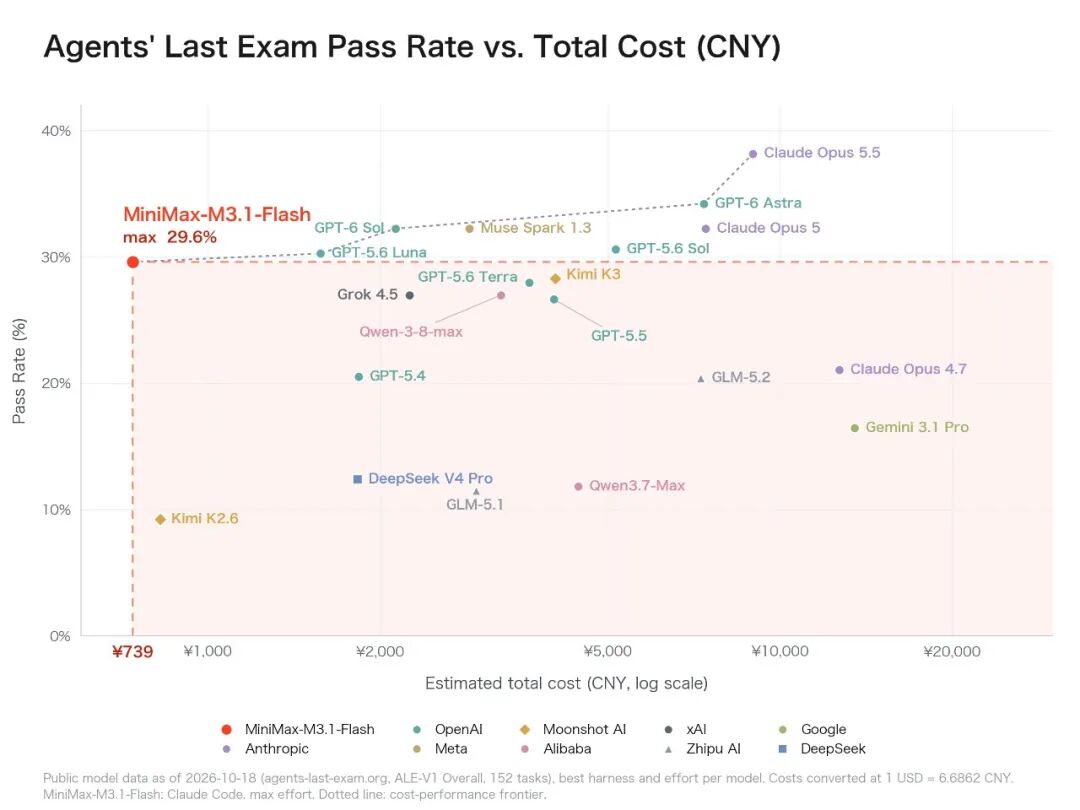
What is even more noteworthy is the cost of completing these tasks. M3.1 Flash has a higher pass rate than other flagship domestic models, while the total cost of running the full set of evaluations is lower. This means that Flash models are not only starting to challenge the capabilities of flagship models, but also attempting to complete complex professional tasks at lower costs.
In the DeepSWE v1.1 evaluation, M3.1 Flash achieved a score of 73.7%, which is also significantly higher than many flagship models. This further proves that in the evaluation of specific programming tasks, the capability gap between Flash models and flagship models is no longer an insurmountable barrier.
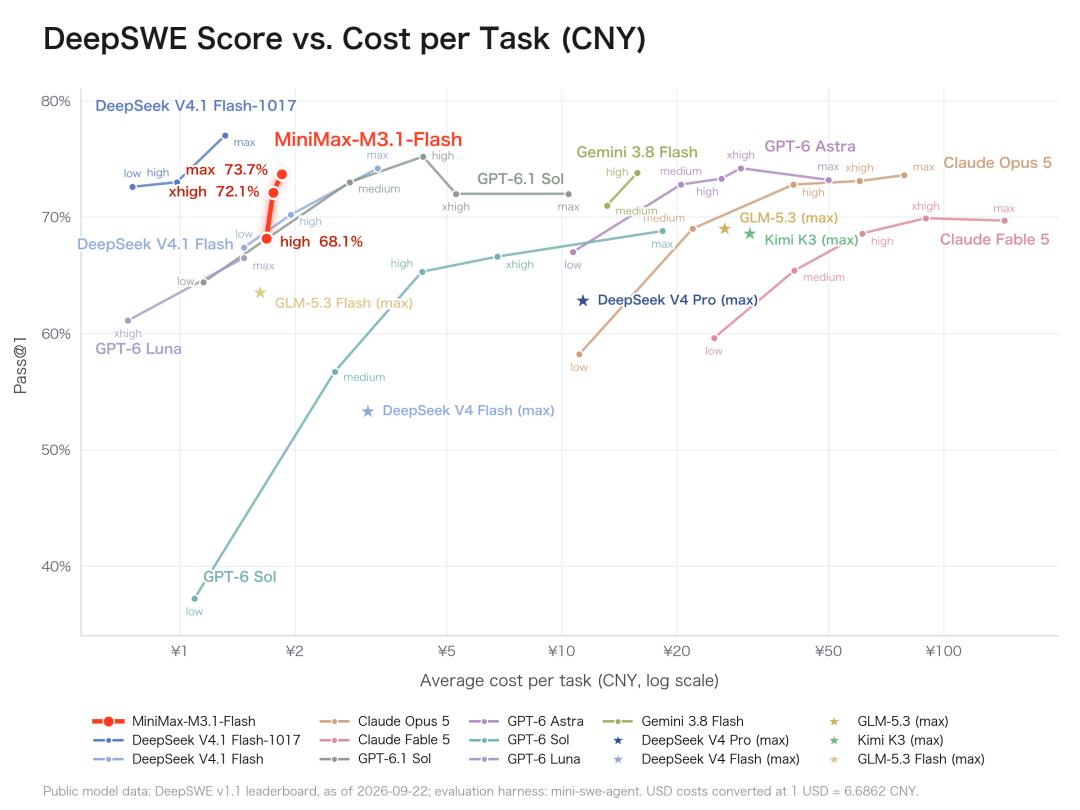
Cybersecurity and complex Agent tasks are the areas where M3.1 Flash seeks to further expand its advantages.
In the CyberGym benchmark test, the model obtained a high score of 82%, close to the 83.6 points of GPT-5.6 Sol. CyberGym covers 1507 historical vulnerabilities from 188 real software projects, mainly testing the model's ability to analyze software vulnerabilities.
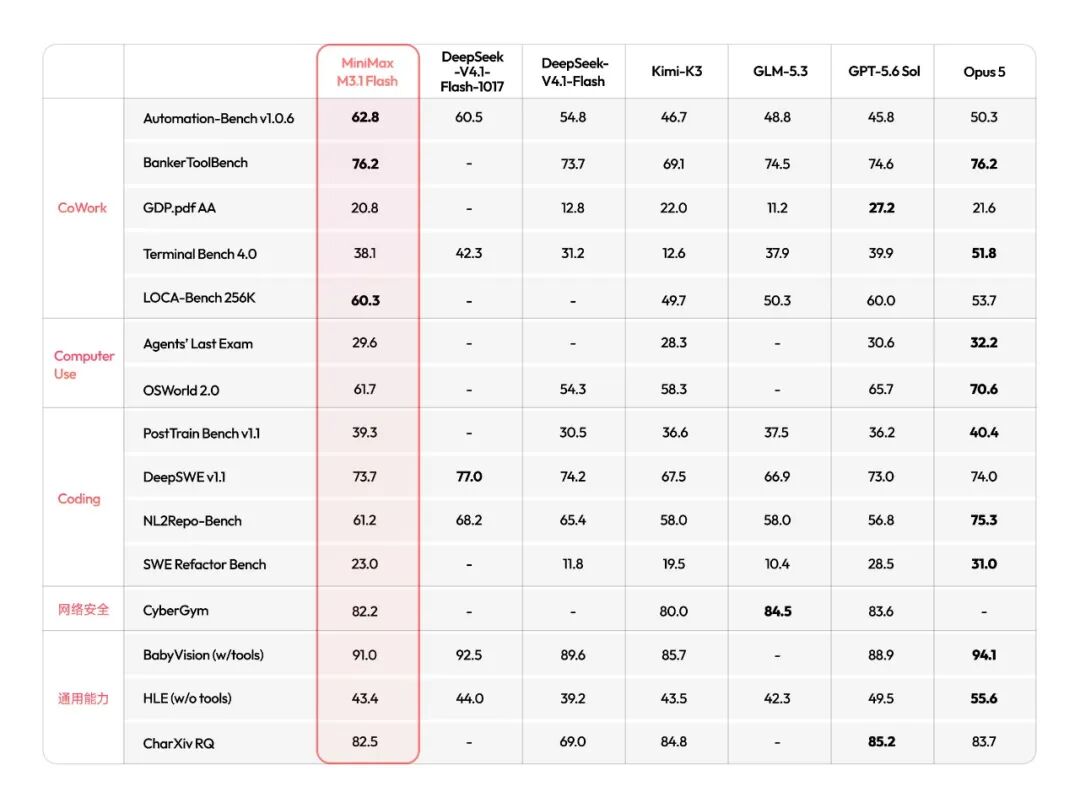
In Automation-Bench v1.0.6, M3.1 Flash scored 62.2 points; in BankerToolBench, it scored 76.2 points, tying for first place with Claude Opus 5. The latter focuses on multi-step planning, cross-document consistency, business compliance and complex tool calls in financial scenarios.
This means that in programming, financial tool invocation and some enterprise automation tasks, lightweight models are also beginning to have the ability to participate in high-complexity work.
Previously, Space Bunny attracted widespread attention in the developer community as an anonymous model. Its identity once sparked widespread public speculation. In addition to its performance, speed was also one of the most frequently mentioned features in feedback from numerous developers at that time. As MiniMax officially claims ownership of this model, the connection between Space Bunny and M3.1 Flash has gradually become clear.
Thanks to the use of a more aggressive sparse structure, the output speed of M3.1 Flash in daily usage scenarios can reach 200+ TPS, with the median (P50) stably reaching 170+ TPS, which means generating 170 Tokens per second.
For ordinary users, a faster model response means shorter waiting time. But for developers, the significance of speed goes far beyond interactive experience.
When the model undertakes continuous tasks such as code writing, automated office work, and data processing, the response speed will directly affect the overall efficiency of the workflow. Especially in Agent scenarios, the model needs to repeatedly understand tasks, call tools, read results, and then decide on the next action. The time saved in a single call can keep accumulating across multiple rounds of execution.
02
The two Flash powerhouses both deliver extremely high cost-effectiveness
By choosing to launch M3.1 Flash at this point in time, MiniMax has formed a "dual strong Flash landscape" with DeepSeek.

On October 17, DeepSeek released the V4.1 Flash-1017 update. Previously, DeepSeek had already built a distinct market reputation for its low-cost models. This update further pushes its programming capabilities to the forefront, and further strengthens the competitiveness of its Flash models.
MiniMax followed closely behind, and the two share some similarities in their core advantages.
For example, both vendors are positioned in a similar price range, directly pushing cost-effectiveness to the maximum.
M3.1 Flash charges 1 yuan per million tokens for input, 4 yuan per million tokens for output, and 0.1 yuan per million tokens for cache reading. Compared with the corresponding prices of M3 (input ≤ 512K tokens), the unit prices for input and output have both decreased by more than 50%, and the unit price for cache reading has decreased by more than 70%. Its pricing is about half of the peak price of DeepSeek V4.1 Flash-1017; in scenarios with cache hits, the prices of the two are roughly the same.
However, it should also be noted that DeepSeek has different pricing for peak and off-peak hours. The actual cost is also affected by the cache hit rate, the ratio of input to output tokens, and the number of task execution rounds, so the final cost of all scenarios cannot be simply derived from a single price.
But the trend driven by the two together is already very clear.
When model capabilities are close, price differences will change developers' choices; when prices drop further, applications that could not be deployed on a large scale in the past due to excessively high costs may also regain commercialization opportunities.
For enterprises, what really matters is not how many points a certain model scores higher on the leaderboard, but how much it costs to complete the same task, how much time it takes, and whether repeated model calls are required after a failure.
Therefore, DeepSeek and MiniMax are more like two important options in developers' toolkits. What they jointly promote is the rebalancing between model capabilities and usage costs.
In MiniMax's DeepSWE evaluation, DeepSeek V4.1 Flash-1017 scored 77 points, and M3.1 Flash scored 74 points, with a very small gap between the two. For developers focused on code generation, code modification and software engineering tasks, after the release of MiniMax M3.1 Flash, DeepSeek is no longer the only benchmark for cost-effectiveness.
In MiniMax's BankerToolBench evaluation, M3.1 Flash scored 76.2 points, tying for first place with Claude Opus 5. Combined with its performance on Automation-Bench, MiniMax's advantages lie more in complex task planning, tool invocation and cross-system workflows.
Their core alignment is also consistent: there can be a cheaper and more user-friendly way to make AI do a good job.
03
MiniMax is making a strong comeback
For MiniMax itself, the launch of M3.1 Flash has another layer of significance: it provides an opportunity to re-examine the capabilities of MiniMax's text models.
Over the past period of time, MiniMax has been more widely recognized in the market for its multimodal capabilities. In contrast, the competition in the text model sector is more brutal. Reasoning, programming, and tool invocation all require long-term investment; and when model capabilities gradually converge, price, speed and actual task completion rate will become new dividing lines.
The previous M3 did not fully dispel the public's doubts about the capabilities of MiniMax's text models. M3.1 Flash tries to address these concerns with more concrete results.
Judging from the evaluation data, the new model has been significantly improved compared to M3, while maintaining a fast output speed. Its performance in programming, cybersecurity and complex Agent tasks also gives MiniMax the opportunity to re-enter the core competition in the text model track.
For MiniMax, what is more worth paying attention to next is whether this capability improvement can be extended to a wider range of task scenarios, and whether it can continue to improve the reliability of the model while maintaining its speed and price advantages.
As for whether MiniMax can re-establish its competitive position in the text model sector through this launch, M3.1 Flash is more like a new starting point rather than the final answer. With the new capabilities brought by the Flash update, we can look forward to the release of MiniMax's Pro model. At least judging from the disclosed evaluations this time, the release of M3.1 Flash has given MiniMax more convincing leverage in the text model competition.
The background of this competition is that the large model industry is shifting from capability demonstration to efficiency competition.
When the capabilities of models are sufficient to undertake more and more real tasks, enterprises will no longer only care about parameter scale and leaderboard rankings, but the comprehensive cost of completing tasks. Cheaper Tokens, faster response, and fewer invalid calls will eventually be converted into measurable business benefits.
The successive moves by DeepSeek and MiniMax have made Flash no longer just a low-cost alternative to flagship models. It is becoming an independent competitive track: models on this track need to be smart enough, fast enough, and cheap enough.
The next round of competition for domestic large models may no longer be about who can push the price to the lowest, but about who can still do complex tasks well when the price is already low enough.
This is the question that MiniMax needs to continue to answer after returning to the competitive arena.
This article is from the WeChat Official Account "Phoenix Tech", written by Dale, edited by Dong Yuqing, and published by 36Kr with authorization.