DeepSeek ranks first, MiniMax comes second, the two domestic Flash twin stars are taking the entire industry by storm.
DeepSeek just made a move, and another blockbuster product is coming in hot!
Two days ago, DeepSeek released V4.1 Flash-1017, putting "wish-driven programming" on the table.
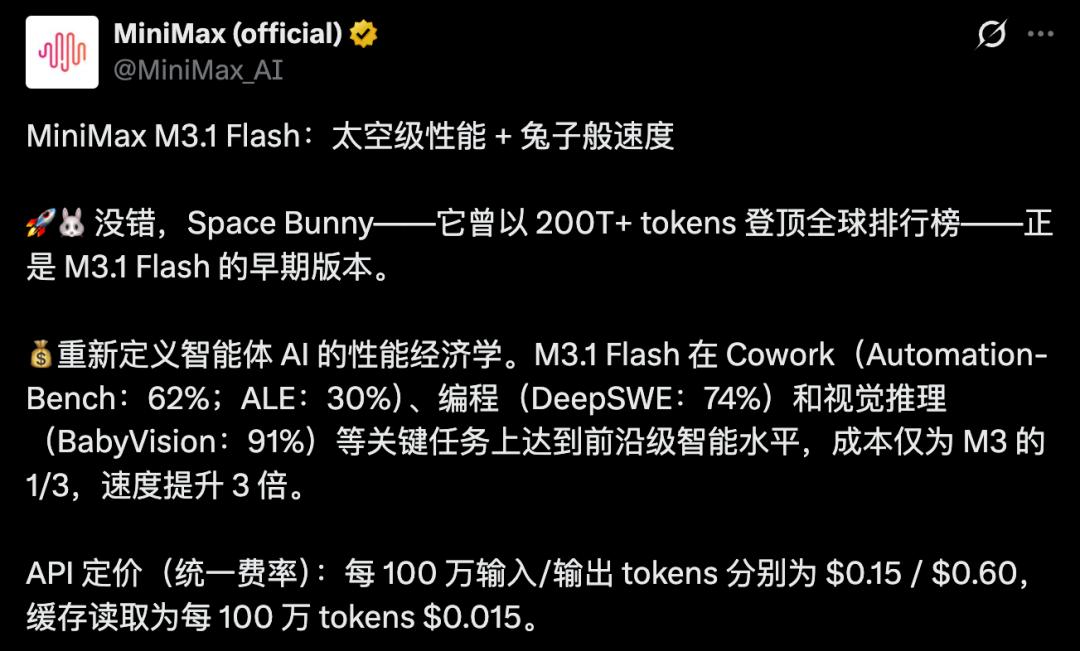
Right after the weekend, MiniMax followed up with a major launch, and M3.1 Flash has just been officially released!
In terms of cost-effectiveness for coding, DeepSeek ranks first, and M3.1 Flash ranks second.
On Agent tasks, it directly took first place across the board on Automation-Bench, and it only cost 739 yuan to complete the ultimate Agent exam ALE!
The price is more than 50% lower than the previous generation M3, the cost-effectiveness is absolutely unmatched!

In just two days, two domestic large model providers launched their new products one after another, pushing the competition in the Flash segment to a whole new level!
Programming Performance Matches Flagship Models
Agent Performance Surpasses Opus 5
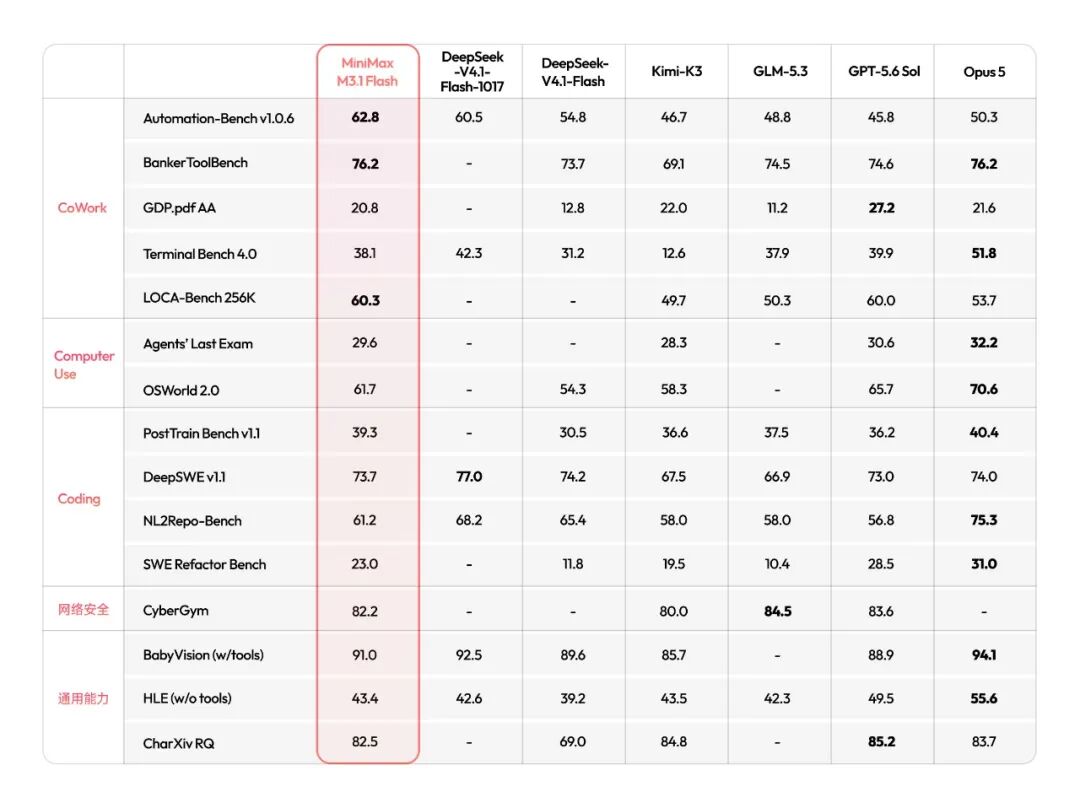
On the official overall leaderboard, M3.1 Flash competed with 15 benchmarks alongside models including DeepSeek, GLM, GPT-5.6 Sol, and Claude Opus 5. Its strongest capability lies in CoWork, where it took 3 first places out of 5 categories; its DeepSWE programming performance is on par with flagship models, and it also ranks in the first echelon in cybersecurity.
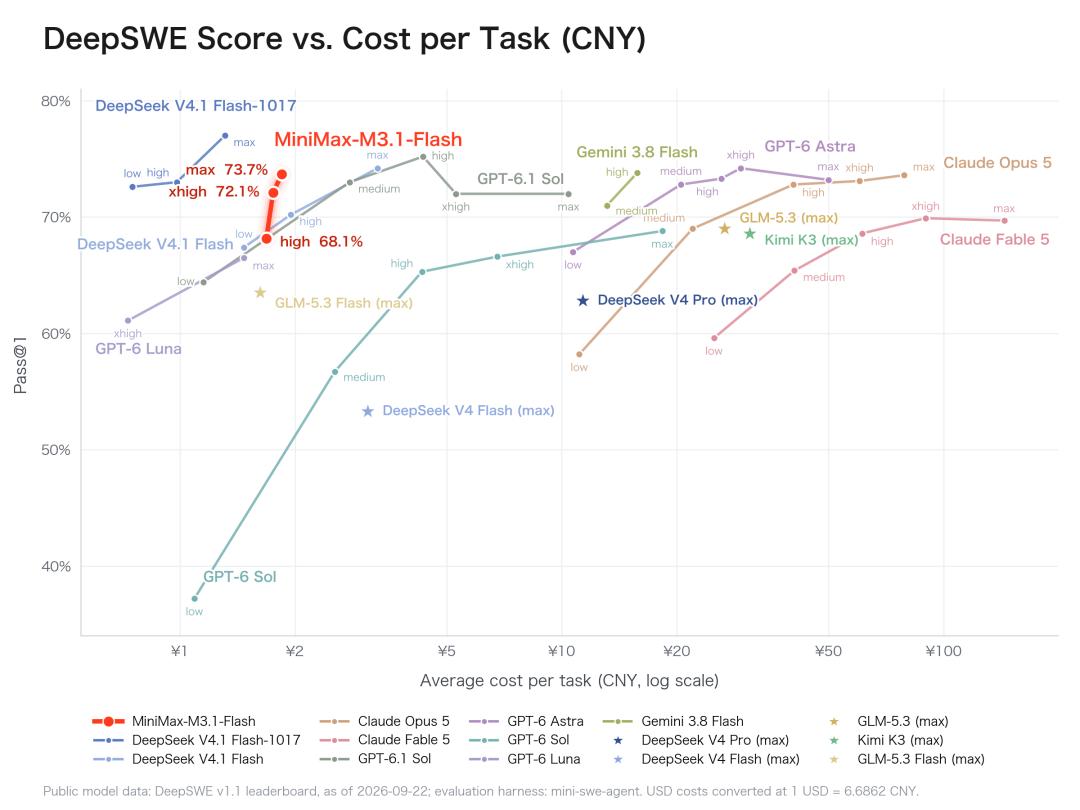
The software engineering benchmark DeepSWE v1.1 tests the entire development pipeline, including code understanding, feature development, issue fixing, test and verification, all of which need to be completed by the model itself. M3.1 Flash scored 73.7 points at the max tier, surpassing OpenAI's flagship GPT-5.6 Sol (73.0 points) and leaving GLM-5.3 (66.9 points) far behind.
With such outstanding results, the single-task cost of M3.1 Flash on DeepSWE is less than 2 yuan.
At this price point, the only model with higher performance is the recently released DeepSeek V4.1 Flash-1017.
For roughly the same score around 73%, a single task on Claude Opus 5 costs more than 70 yuan, which is over 40 times that of M3.1 Flash.
DeepSeek and MiniMax, the two players, have effectively brought flagship-level performance down to a cost of just one or two yuan per task.
What really makes M3.1 Flash stand out is its CoWork and complex Agent workflow capabilities.
Automation-Bench is built and open-sourced by Zapier, with all 600 tasks coming from real enterprise business processes covering sales, marketing, operations, customer service, finance and HR. It tests whether the model can complete a full end-to-end task across multiple SaaS systems.
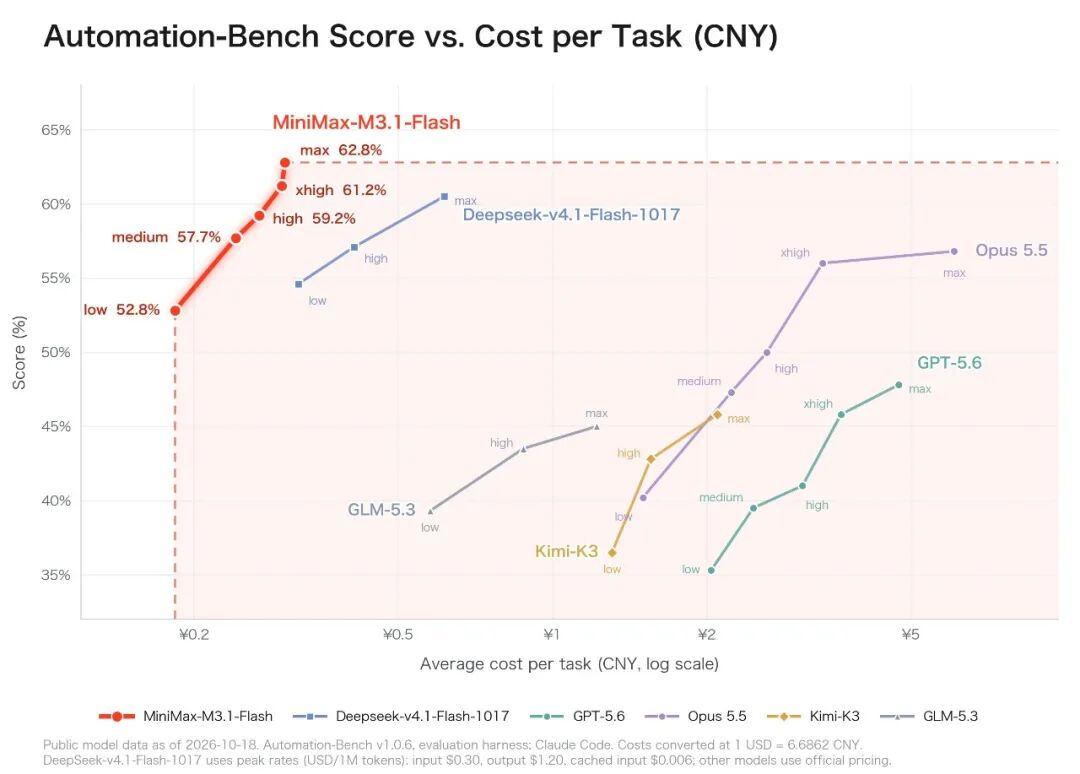
M3.1 Flash scored 62.8 points here, taking the first place across all entries!
It outperformed Opus 5 by nearly 12 points, outscored GPT-5.6 Sol by more than 16 points, and even surpassed the newly released DeepSeek V4.1 Flash-1017 (60.5 points).
What's even more impressive is the cost. On this cost vs. performance chart, all other models fall to the lower right of M3.1 Flash, meaning they cost more but deliver lower scores.
Even when running at the medium tier, a single task on M3.1 Flash only costs around 0.25 yuan, and its score already exceeds the performance of the latest Opus 5.5 running at full max tier. Running one task on Opus 5.5 costs about 6 yuan, which is more than 20 times more expensive.
Even at the highest max tier, a single task only costs around 0.3 yuan. Running 1000 real enterprise tasks across multiple SaaS systems costs only about 300 yuan in total!
On LOCA-Bench 256K, M3.1 Flash also ranks first across all entries, with a score of 60.3 points surpassing GPT-5.6 Sol (60.0 points) and Opus 5 (53.7 points).
The BankerToolBench for financial scenarios tests multi-step planning, cross-document consistency, financial compliance and chained tool invocation. M3.1 Flash scored 76.2 points, tying for first place with Claude Opus 5, outperforming GPT-5.6 Sol (74.6 points).
The cybersecurity test CyberGym covers 1507 historical vulnerabilities in 188 real software projects. M3.1 Flash scored 82.2 points, ranking alongside GLM-5.3 (84.5 points) and GPT-5.6 Sol (83.6 points) in the global first echelon.
Flash Takes On Complex Tasks
700 Yuan Outperforms Models Costing Tens of Thousands
In the Computer Use field, the explosive performance of M3.1 Flash is even more astonishing. On both OSWorld 2.0 and ALE benchmarks, it ranks first among all domestic models, and the total cost of completing the full ALE test is only 739 yuan!
OSWorld 2.0 is launched under the leadership of XLANG Lab of the University of Hong Kong, with 108 long-process tasks covering 7 major fields. A skilled human user usually takes about 1.6 hours to complete one task.
M3.1 Flash scored 61.7 points, more than 7 points higher than DeepSeek V4.1 Flash (54.3 points).
Agents' Last Exam (ALE), literally meaning "the final exam for Agents", is led by Berkeley RDI and built with the participation of hundreds of industry experts, covering 13 major industries and 55 sub-sectors.
The pass rate of M3.1 Flash is 29.6%, close to GPT-5.6 Sol (30.6%) and Claude Opus 5 (32.2%).
ALE has a total of 152 tasks, and the 739 yuan is the estimated total cost to complete the full test suite.
On the cost chart of ALE, among more than 20 models, it costs the least!
Among the 7 models with higher pass rates than it, the cheapest one, GPT-5.6 Luna, costs about 1600 yuan, which is more than twice its cost.
GPT-5.6 Sol only scores 1 percentage point higher but costs more than 5000 yuan; Claude Opus 5 and GPT-6 Astra cost more than 7000 yuan, and Claude Opus 5.5 costs close to 9000 yuan.
The total bill for Claude Opus 4.7 and Gemini 3.1 Pro exceeds 10,000 yuan, but their pass rates are only 21% and 16.5% respectively, which are far behind M3.1 Flash.
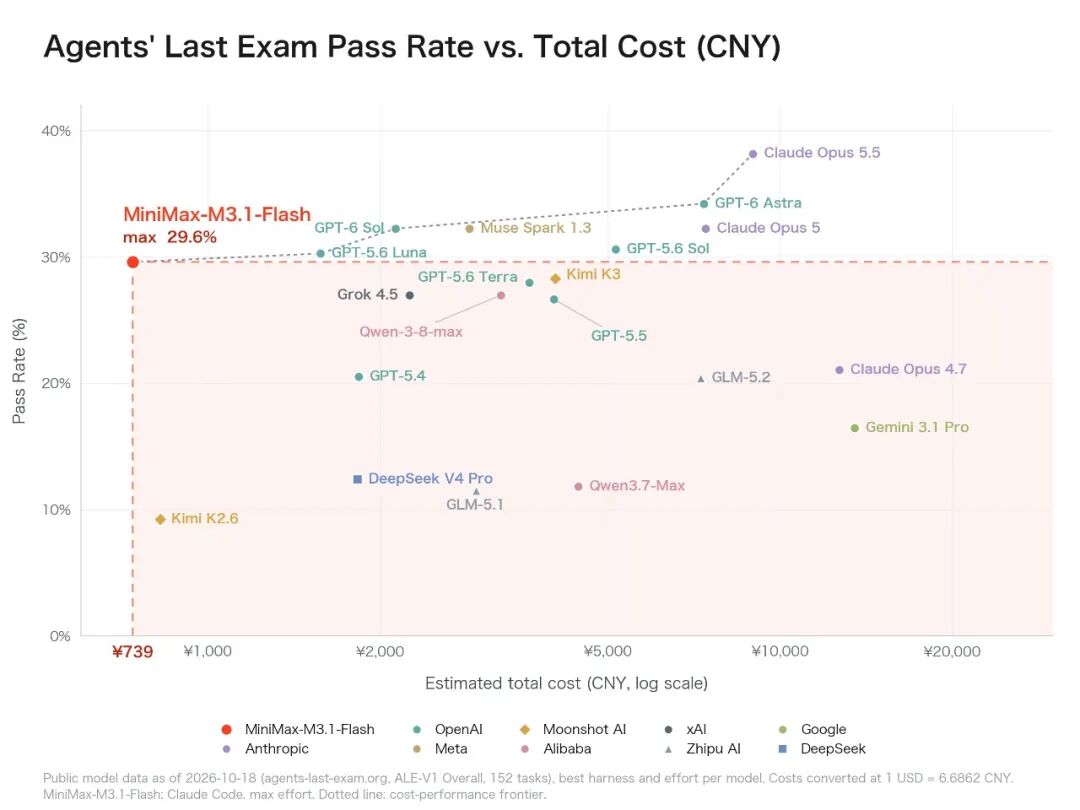
The dotted line on the chart connects the highest-scoring model at each price point. M3.1 Flash stands right at the starting point of this line.
Spending just over 700 yuan beats models that cost over 10,000 yuan, with a cost difference of more than 10 times!
Prices Have Dropped Sharply, Cut by More Than Half
Per million tokens, the input price is only 1 yuan, the output price is 4 yuan, and cache reading costs 0.1 yuan. For Agent tasks, the comprehensive usage cost is 70% lower than the previous generation.
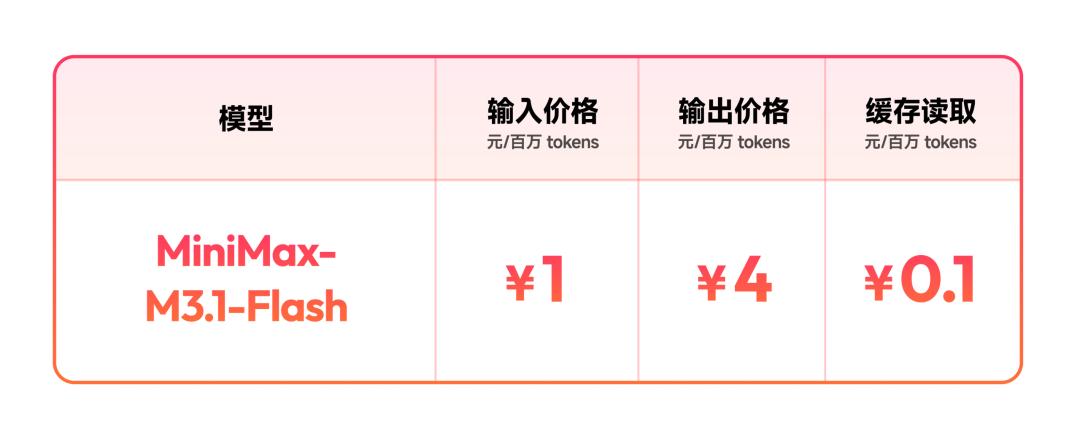
As another domestic Flash model, DeepSeek V4.1 Flash-1017 adopts two-tier pricing for peak and off-peak hours.
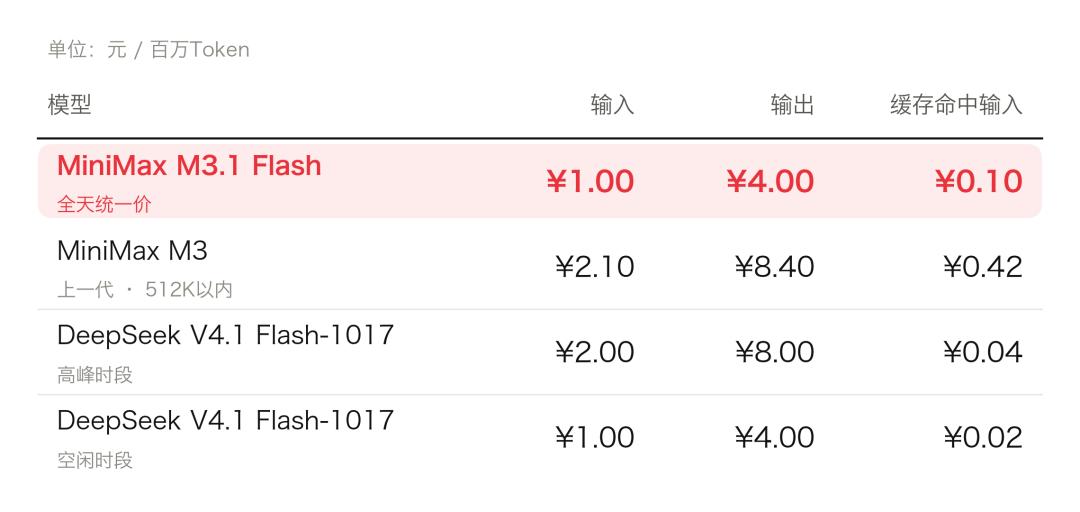
Many enterprises' business activities are concentrated in daytime on workdays, which exactly falls into DeepSeek's peak hours, with input at 2 yuan and output at 8 yuan, which is twice as expensive.
M3.1 Flash has no time-based tiered pricing, it is priced at the off-peak rate of DeepSeek 24/7.
For heavy usage scenarios with high cache utilization, calculated based on 1 billion input tokens. With a 90% cache hit rate, the input cost of M3.1 Flash is 190 yuan, 46 yuan cheaper than DeepSeek's 236 yuan during peak hours. When the hit rate rises to 95%, the cost is 145 yuan vs 138 yuan, which is almost on par.
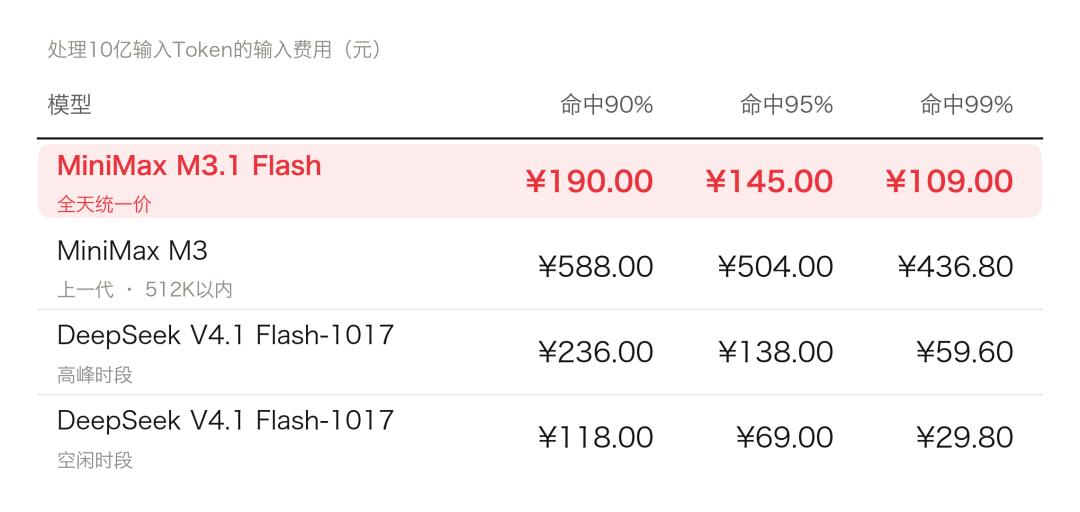
Only when the capability is sufficient and the cost is low enough can Flash models become the primary workhorse for users.
Speed Surpasses 200+ TPS
MiniMax Makes a Strong Comeback in the Text Model Arena
Low cost alone is not enough. To support long-process tasks, speed also needs to keep up. The daily output speed of M3.1 Flash can reach 200+ TPS, with a stable median of 170+ TPS, while the previous generation M3 was only 100+ TPS according to official documentation.
Anyone who writes code knows that frustration: the model fixes one round of issues, you find more problems, and you have to wait for the next round. After several cycles, your inspiration is gone, and your coffee has gone cold.
This is exactly where M3.1 Flash excels. Its predecessor was the mysterious model "Space Bunny" that went viral across the internet not long ago, and the most common feedback from users was that it is extremely fast.

MiniMax officially acknowledged its identity with a simple line "Welcome back, Space Bunny". During its anonymous period, Space Bunny processed over 200T tokens!

The official release version inherits this ultra-fast gene, and is equipped with a more aggressive sparse attention architecture, boosting online inference speed by nearly 3 times.
The moment you hit the enter key, lines of code are already scrolling across the screen.
AI developer Ivan Fioravanti tested it via API and exclaimed "It's just fast!"!
