Just now, the mysterious space rabbit that has dominated all screens across the entire internet has been unveiled, and it comes from the new model of MiniMax.
The mysterious Space Bunny has finally been claimed.
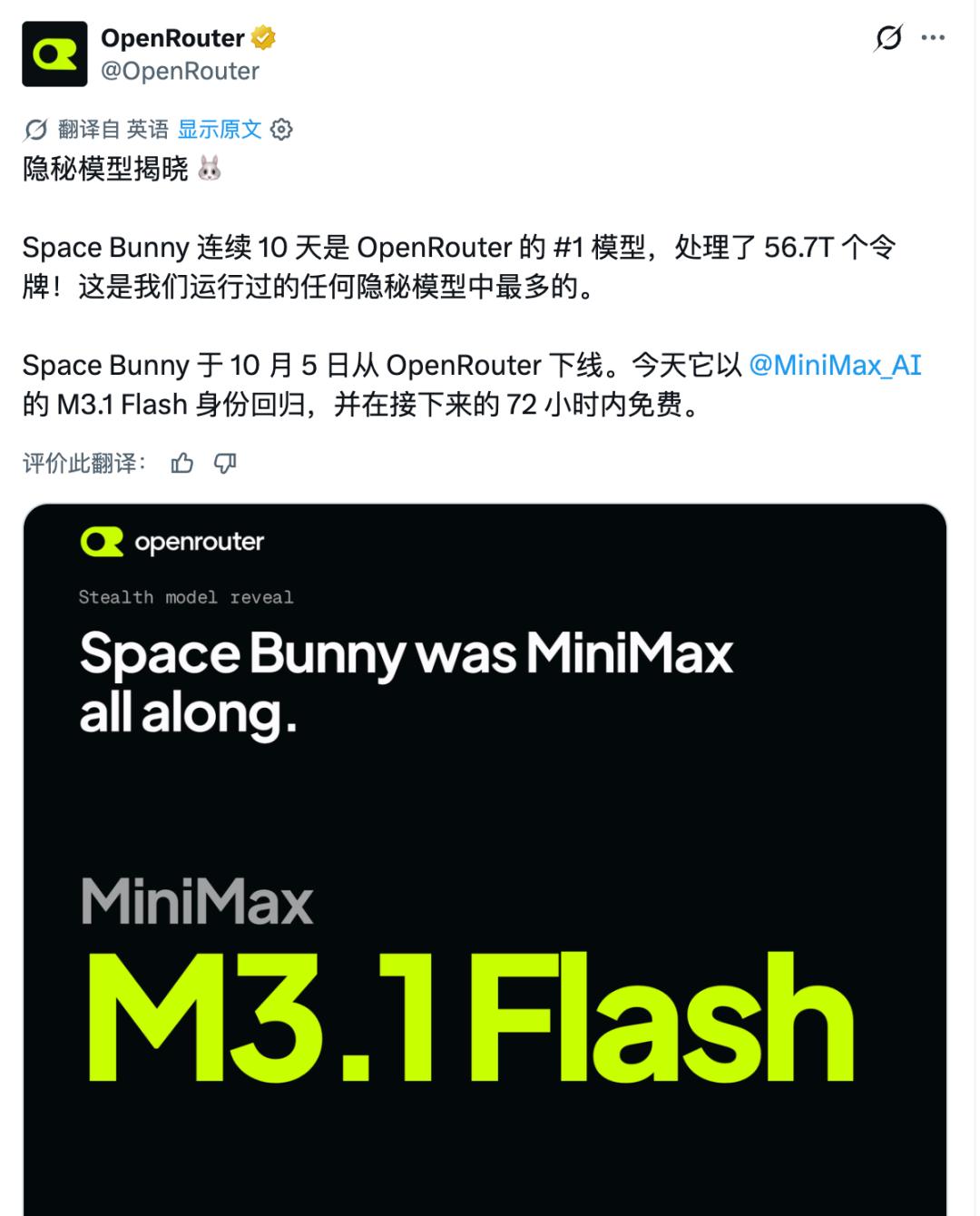
Just now, MiniMax announced the update of MiniMax M3.1 Flash, and revealed that Space Bunny, which previously processed over 200 trillion Tokens under an anonymous identity, is exactly the early version of this model.
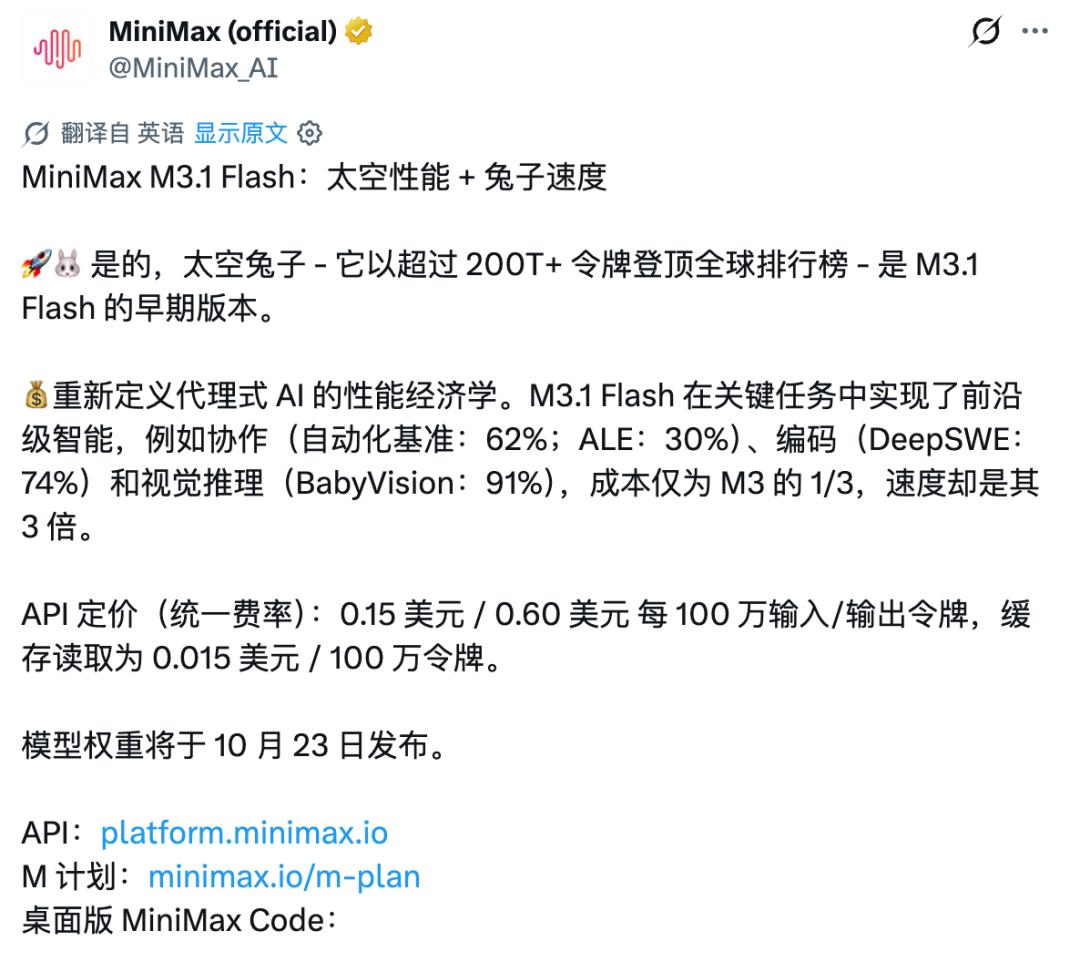
According to the official introduction, M3.1 Flash has achieved generational improvements in complex Agent tasks, programming, computer operation and cybersecurity, with online inference speed increased by nearly 3 times, and the comprehensive usage cost of Agent-type tasks reduced by 70% compared with the previous generation.
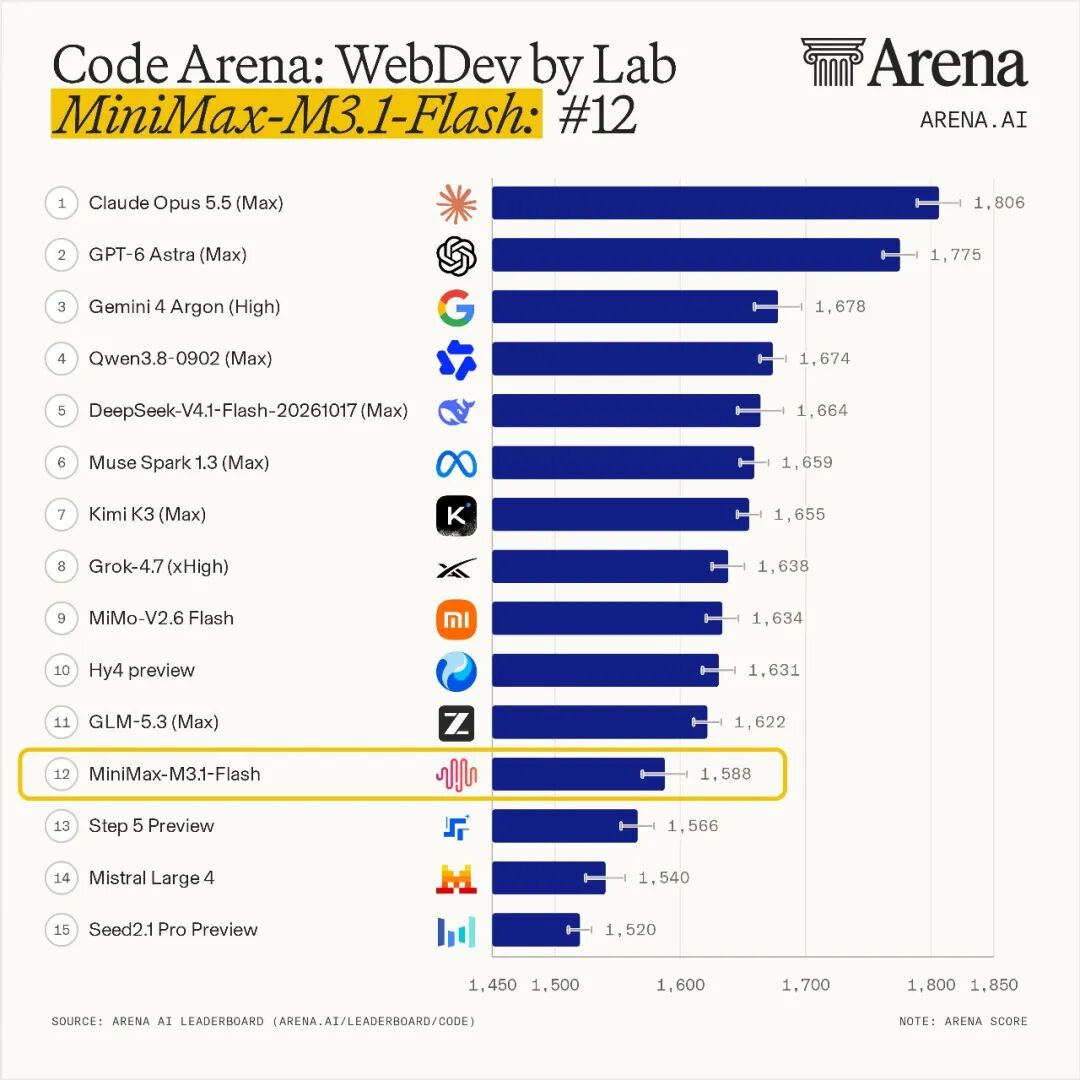
As AI starts to operate software, write code and execute enterprise workflows, the multi-step reasoning and tool calls required to complete a single task also make speed and cost more critical.
In this release, in addition to publishing capability evaluations, MiniMax also demonstrated cost comparisons under different tasks, trying to answer how much work the model can complete and how much it costs to finish these tasks.
According to the officially published evaluation table, M3.1 Flash scored 62.2 points in Automation-Bench v1.0.6, higher than the 60.5 points of DeepSeek V4.1 Flash-1017, ranking first among the models participating in the comparison in the table.
This test uses 600 tasks to examine the model's ability to handle work such as sales, marketing, operations, customer service, finance and human resources in enterprise business processes across SaaS systems.
In BankerToolBench, which involves multi-step planning, cross-document consistency, financial business compliance and continuous tool calls, M3.1 Flash scored 76.2 points, tied with Opus 5. In the long-context task evaluation LOCA-Bench 256K, its score is 60.3 points, slightly higher than the 60.0 points of GPT-5.6 Sol.
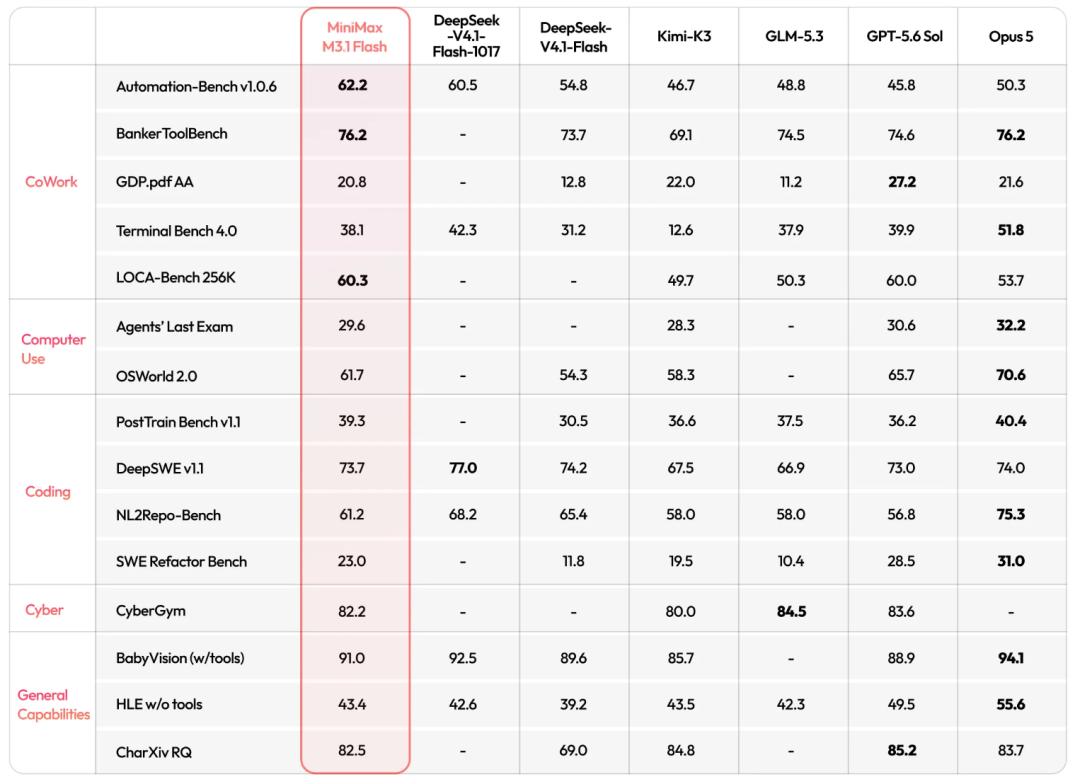
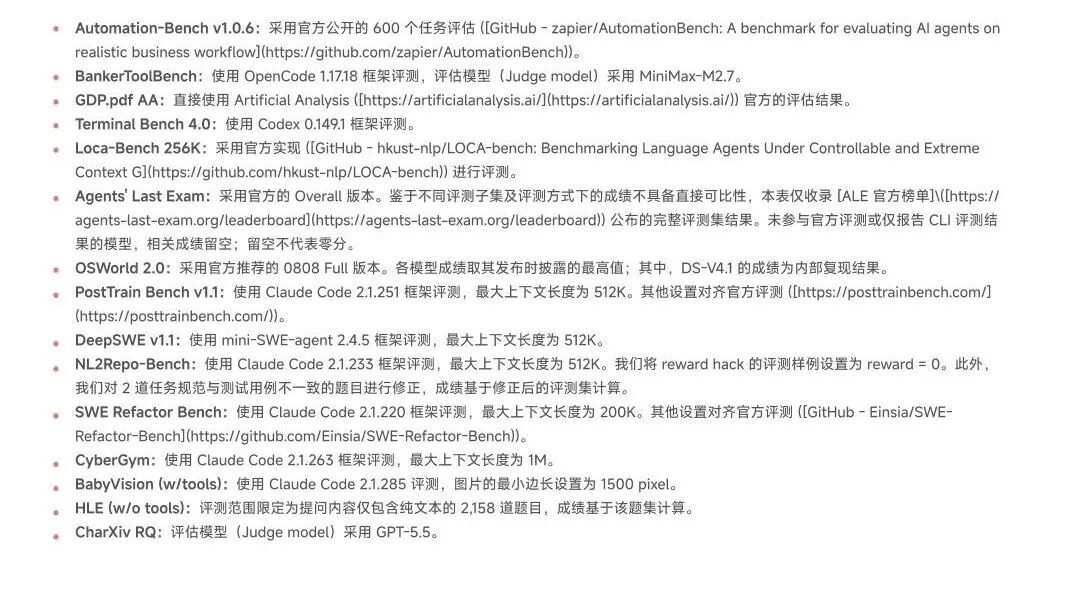
In terms of software development, M3.1 Flash achieved a score of 73.7% in DeepSWE v1.1, close to the 74.0% of Opus 5, higher than the 73.0% of GPT-5.6 Sol, and lower than the 77.0% of DeepSeek V4.1 Flash-1017. This evaluation requires the model to independently complete code understanding, function development, problem repair and test verification, examining the full software development process.
Computer operation is also the key focus of this update.
M3.1 Flash scored 61.7 points in OSWorld 2.0 and 29.6 points in Agents' Last Exam (ALE). The former examines the ability of computer operation and cross-application task execution, while the latter focuses on computer operation scenarios with actual economic value. According to the officially published comparison results, both scores rank first among domestic models, and the OSWorld 2.0 score is higher than the 58.3 points of Kimi K3 and 54.3 points of DeepSeek V4.1 Flash.
In terms of cybersecurity, the evaluation table shows that M3.1 Flash scored 82.2 points in CyberGym, higher than the 80.0 points of Kimi K3, and lower than the 83.6 points of GPT-5.6 Sol and 84.5 points of GLM-5.3. MiniMax stated that internal security experts have also conducted in-depth evaluations on scenarios such as code auditing, vulnerability patching, penetration testing, malicious code analysis and reverse engineering, and the model has performed well in all these tasks.
To improve inference efficiency, MiniMax adopts a more aggressive sparse attention architecture. According to official data, the output speed of M3.1 Flash in daily usage scenarios can exceed 200 Tokens per second, with the median speed reaching over 170 Tokens per second.
In terms of pricing, the input price of M3.1 Flash is 1 yuan per million Tokens, the output price is 4 yuan per million Tokens, and the cache read price is 0.1 yuan per million Tokens. The official stated that in Agent-type tasks, the comprehensive usage cost of the model has been reduced by 70% compared with the previous generation.
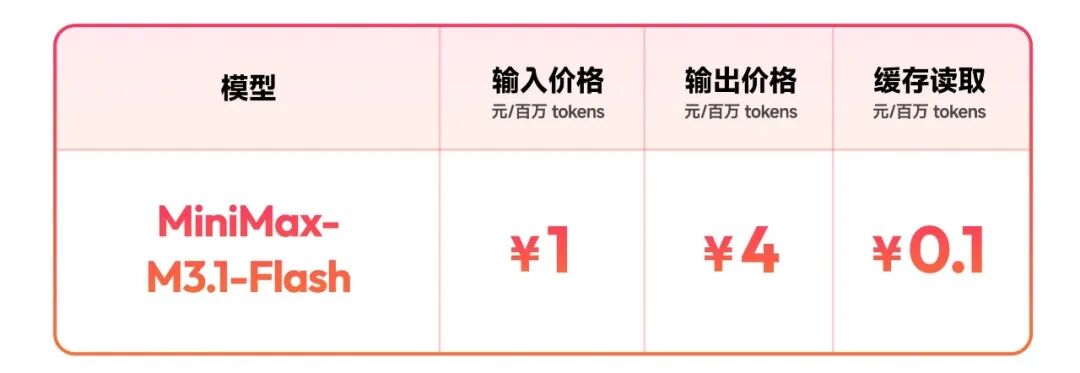
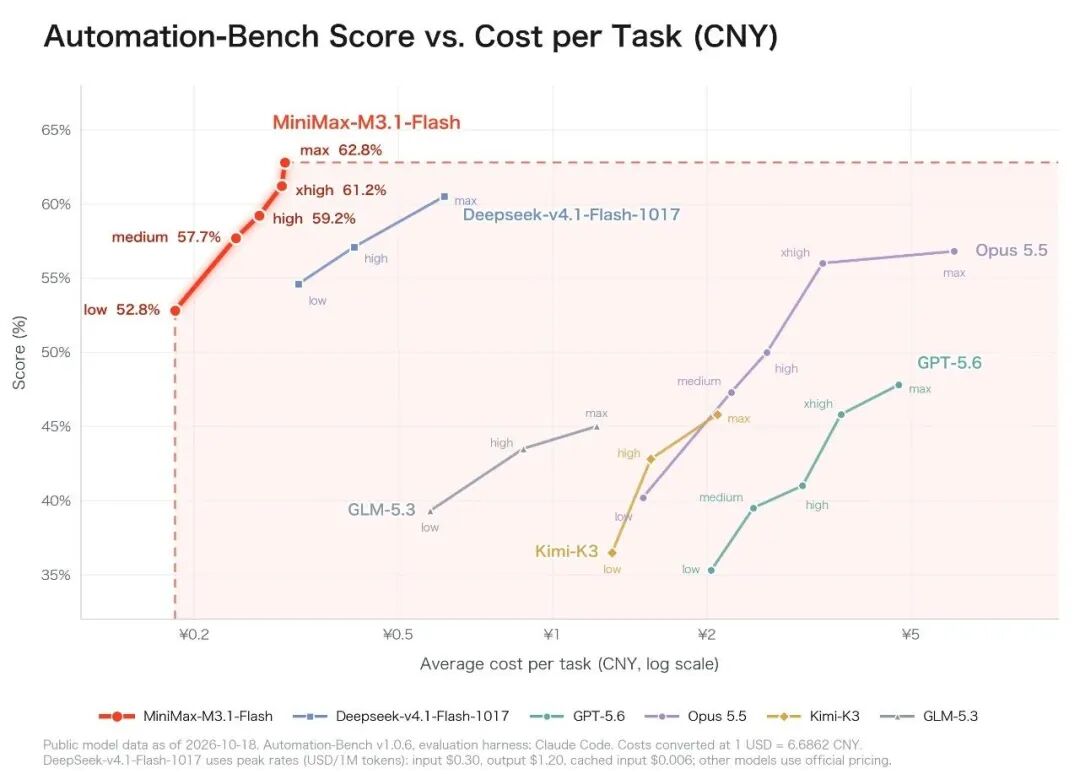
Specific to actual tasks, one example given by MiniMax is that it costs less than 0.3 yuan to let the model try to complete an enterprise workflow task.
In Automation-Bench, as the inference gear increases from low to max, the score of M3.1 Flash increases from 52.8% to 62.8%.
Estimated according to the position in the figure, the average cost of each task is about 0.18 yuan to 0.30 yuan, which is lower than DeepSeek V4.1 Flash-1017 under all gears shown in the figure. However, the DeepSeek price used in this figure is the peak hour price, and the official pricing is adopted for the other models.
In DeepSWE, the scores of M3.1 Flash at high, xhigh and max gears are 68.1%, 72.1% and 73.7% respectively, and the corresponding average task costs are all within 2 yuan.
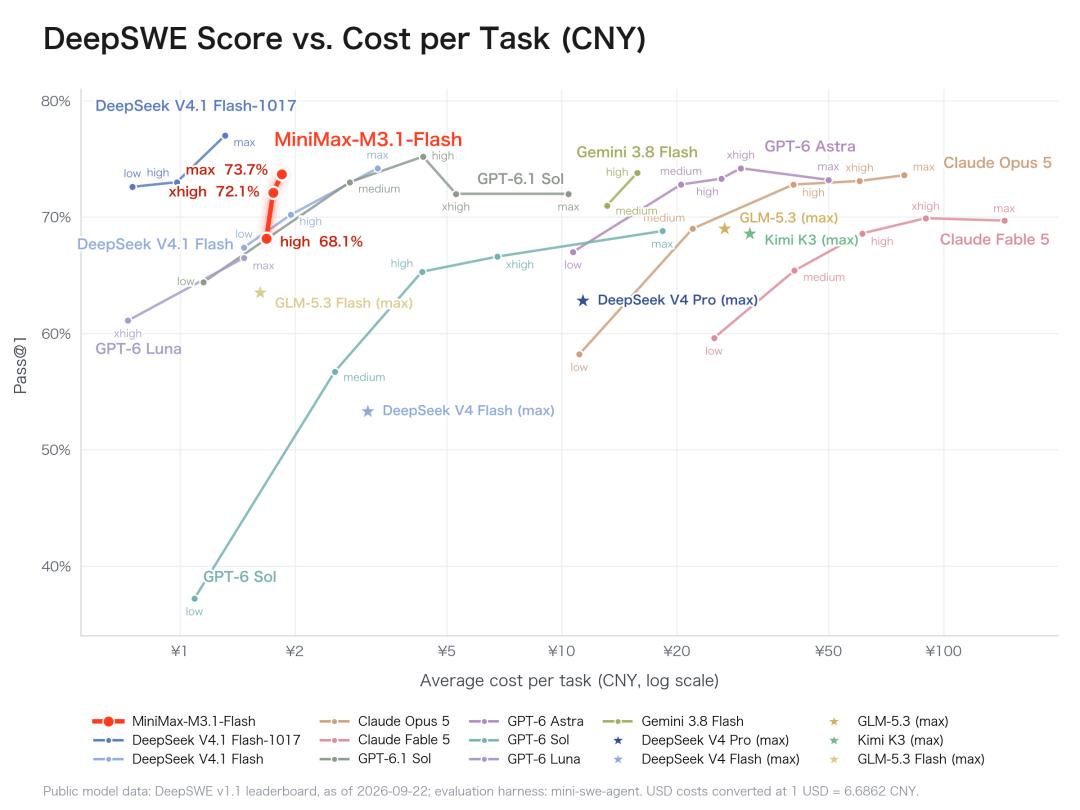
In contrast, when Claude Opus 5 in the figure reaches a score of about 74%, the average cost per task has reached dozens of yuan. However, DeepSeek V4.1 Flash-1017 shows both higher scores and lower costs in this test, indicating that the cost-performance advantage of different models is still related to specific tasks.
The ALE comparison chart shows the estimated total cost of completing the entire evaluation. In the Overall evaluation containing 152 tasks, M3.1 Flash achieved a pass rate of 29.6% with an estimated total cost of about 739 yuan, making it the lowest-cost model in the chart.
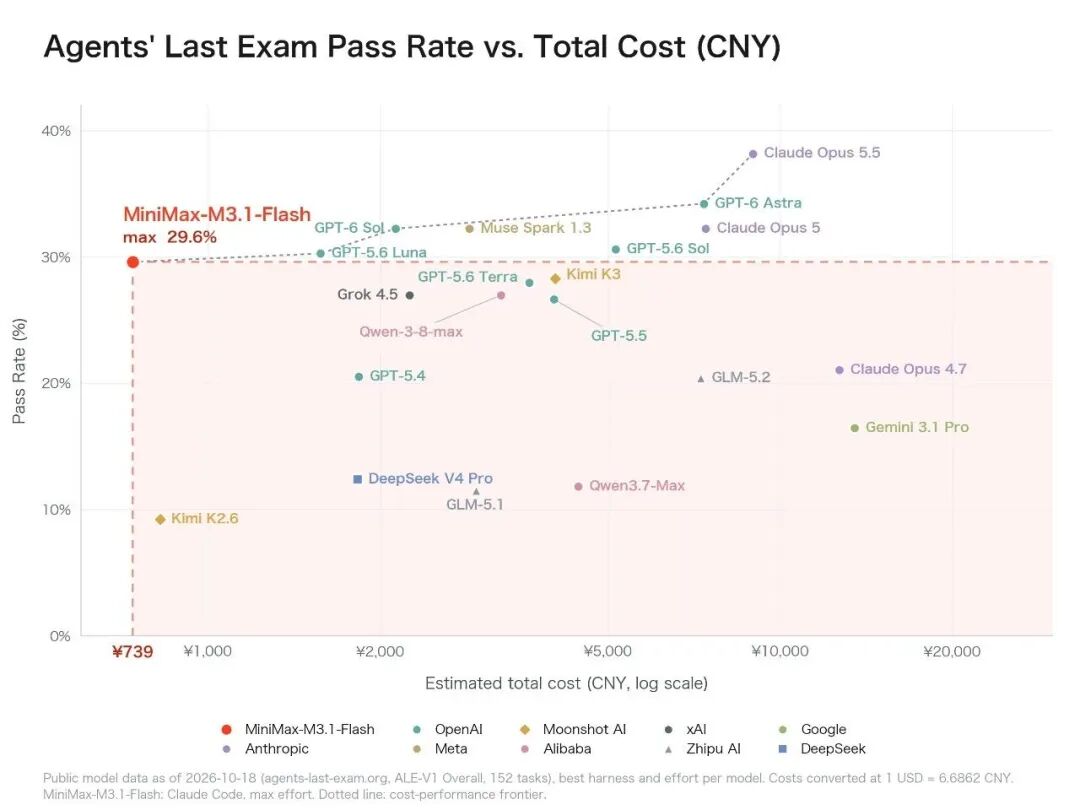
As a comparison, the pass rate of GPT-5.6 Sol is about 30.6%, and the estimated total cost is about 5000 yuan; the pass rate of Claude Opus 5.5 is about 38%, and the estimated total cost is close to 9000 yuan. Each model adopts its own best-performing operation framework and inference configuration.
Combined with these results, the positioning of M3.1 Flash is very clear: to support high-frequency, high-intensity large-scale Agent calls with extreme cost control. After all, in the real business of massive calls, the few yuan saved in a single call multiplied by the scale is a real money moat.
At present, M3.1 Flash has been launched on MiniMax API, M Plan and MiniMax Code, and the model weights will also be open sourced in the near future.
It is worth mentioning that when APPSO logged into the official website of Minimax Code, it found that in conjunction with this update, MiniMax Code simultaneously launched two time-limited benefits.
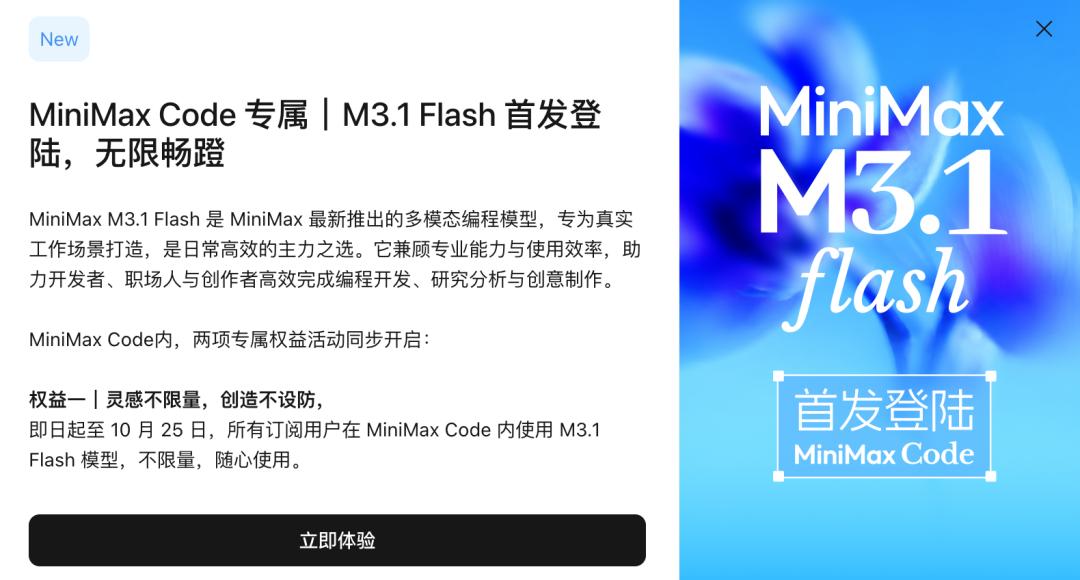
From now to October 25, all subscribers can use M3.1 Flash unlimitedly in MiniMax Code;
From now to October 31, users who newly subscribe to or upgrade to M Plan can enjoy a 50% discount for the first month, and renew at the original price from the second month.
In addition, MiniMax also buried an easter egg: the Pro version focusing on higher intelligence ceiling is already on the way, and it will form a high-low match with the Flash series that focuses on high efficiency and low cost in the future.
This article is from the WeChat official account "APPSO", the author is APPSO that discovers tomorrow's products, and is published by 36Kr with authorization.