The first batch of active ETFs have been officially approved: the issuance will be launched as early as this Friday, with a maximum fundraising cap of 2 billion yuan for each single product.
The era of domestic active ETFs is gradually approaching.
On October 19, the first batch of 18 active ETFs was officially approved. Wu Qing, Chairman of the China Securities Regulatory Commission, stated at the opening ceremony of the 2026 Financial Street Forum Annual Meeting on the same day that this is an important measure to promote the innovative development of fund products and will also bring more incremental capital to the market.
Caixin New Media learned from industry insiders that these products will be launched for subscription as early as this Friday, with a maximum fundraising limit of RMB 2 billion each.
12 Products Have Adjusted Names
In terms of the listing and trading venues of the first batch of active ETFs, the Shanghai Stock Exchange and Shenzhen Stock Exchange each have 9 products.
The products under the Shanghai Stock Exchange camp include: E Fund Quality Balanced Active Management ETF, ChinaAMC Quality Selection Active Management ETF, Huatai-PineBridge Value Select Active Management ETF, Harvest Balanced Strategy Smart Selection Active Management ETF, Huaan Balanced Smart Selection Active Management ETF, China Merchants Value Smart Selection Active Management ETF, Yongying Prosperity Balanced Active Management ETF, Ping An Dividend Prosperity Active Management ETF, JPMorgan Large-cap Growth Active Management ETF.
The products under the Shenzhen Stock Exchange camp include: Southern Asset Management Balanced Allocation Active Management ETF, Fullgoal Value Optimized Quantitative Stock Selection Active Management ETF, Penghua Value Premium Selection Active Management ETF, Guotai Xinhui Balanced Return Active Management ETF, Tianhong Balanced Quantitative Stock Selection Active Management ETF, ICBC Credit Suisse Dividend Active Management ETF, Huabao Balanced Select Active Management ETF, CCB Principal Balanced Optimization Active Management ETF, Dacheng Dividend Smart Selection Active Management ETF.
From the final approved list, it can be seen that the names of 12 products have been adjusted compared with the names submitted for approval. Among them, the products of 6 fund companies including E Fund, Yongying, Huaan, Southern Asset Management, CCB Principal and Huabao have added the "balanced" label to their names; the products of 3 fund companies including Tianhong, Harvest and Fullgoal highlight the "quantitative" attribute in their names; the products under JPMorgan and Ping An emphasize the "large-cap" and "dividend" labels respectively; the product name of ChinaAMC has been streamlined, removing the word "value".
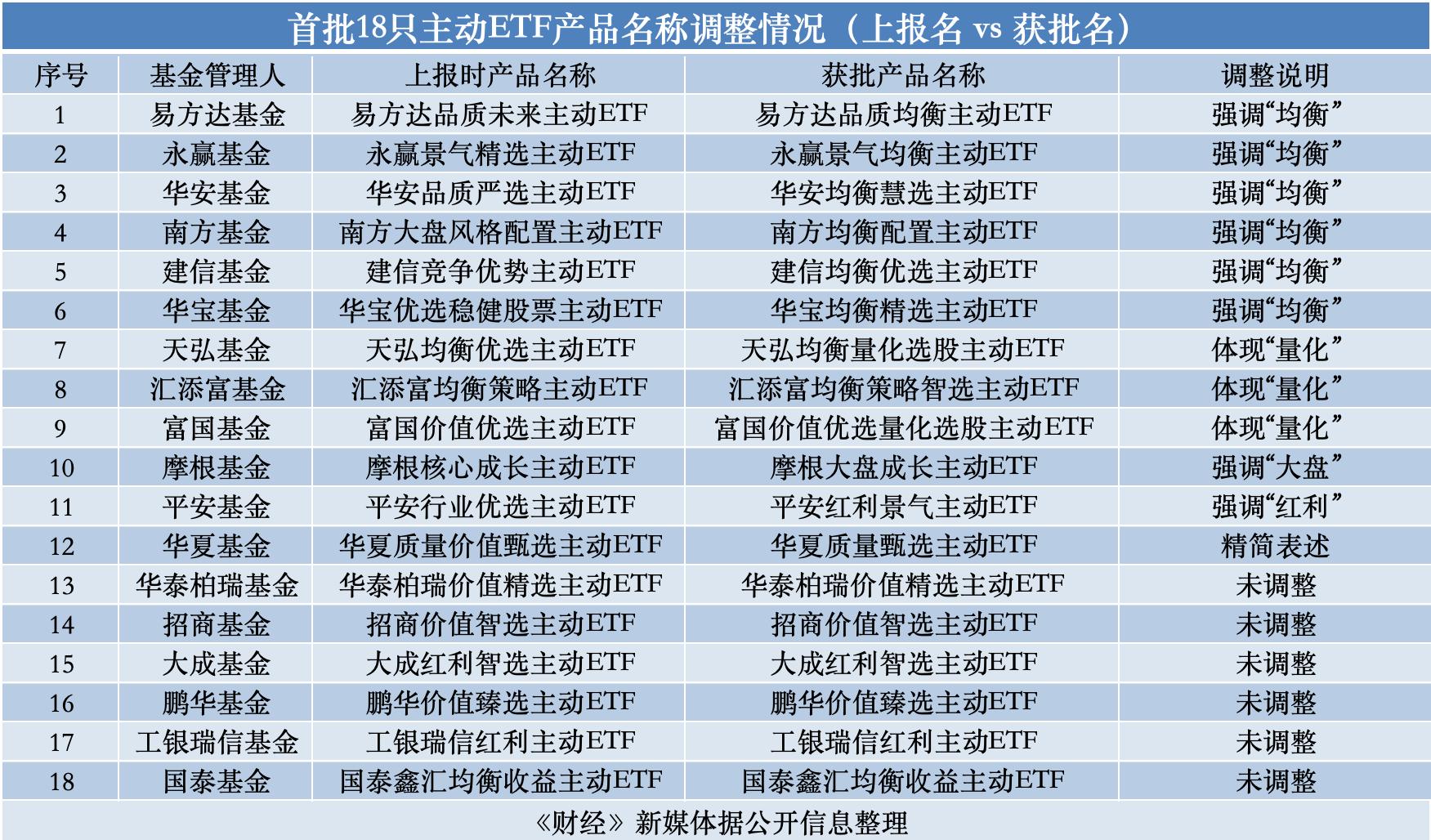
Overall, the first batch focuses on robust investment strategies with large market capacity and space. Among them, there are 9 balanced strategy products, 4 value strategy products, 3 dividend strategy products, 1 quality strategy product, and 1 large-cap growth strategy product.
In terms of stock selection strategies, 13 products adopt the fundamental active stock selection strategy, carrying out refined investment relying on the in-depth research of fund managers; 5 products adopt quantitative strategies, among which the products under Fullgoal and Tianhong are pure quantitative strategies, and the products under Harvest, China Merchants and Dacheng are integrated strategies of "quantitative + fundamental".
Four Major Advantages of Active ETFs
As an innovative fund product, the launch of domestic active ETFs is of far-reaching significance.
"This is a milestone step in the development process of China's fund industry," the co-director of the Active Equity Investment Department of Huatai-PineBridge Fund pointed out. Over the past decade, the domestic ETF market has achieved leapfrog development from scratch and from weak to strong, with continuously expanding scale and increasingly diversified varieties. But objectively speaking, the expansion of ETFs is mainly concentrated in passive index products, and active management has been absent for a long time; domestic active funds still take traditional over-the-counter open-end products as the absolute main force.
From a global perspective, active ETFs have become one of the fastest-growing investment categories in the international asset management market. ChinaAMC cited a set of data from Bloomberg: as of June 30, 2026, the total size of global active ETFs reached 2.5 trillion US dollars. Since 2016, its compound annual growth rate has reached 49%, far exceeding the 22% growth rate of the overall ETF market.
In essence, active ETFs combine the "gene" of active management and the "shell" of ETFs into one. ChinaAMC stated that different from traditional passive index ETFs, it is no longer restricted by index constituent stocks, and fund managers can independently select stocks and dynamically adjust positions based on macro research and individual stock research, with the core goal of pursuing Alpha returns exceeding the performance benchmark; different from traditional over-the-counter active funds, it is listed and traded on stock exchanges, allowing investors to buy and sell in real time during trading hours and enjoy all the trading conveniences of ETFs.
ChinaAMC believes that the development path of overseas markets shows that active ETFs can effectively match the active investment needs of medium and long-term funds such as insurance and pension funds, as well as on-site individual investors, and are the "key factor" for the future evolution of the public offering fund industry pattern.
In Yang Jinghan's view, active ETFs have multiple advantages compared with traditional over-the-counter active funds.
First, the transparency has been greatly improved. Active ETFs need to disclose the complete positions of the previous trading day through PCF every trading day, while traditional over-the-counter products only announce the top ten positions at the end of each quarter. In the past, investors might face the situation that fund managers have adjusted positions in the middle of the quarter, but could only make judgments based on lagging information, leading to untimely information update and difficulty in understanding the operation. The fully transparent "what you see is what you get" mechanism of active ETFs enables investors to track the latest operations of fund managers in real time, effectively reducing information costs and enhancing trust.
Second, the expense ratio is competitive. The comprehensive expense ratio of active ETFs is significantly lower than that of traditional over-the-counter active products, which conforms to the downward trend of global public offering fund expense ratios. The fees saved in the long run are expected to be converted into actual returns for investors and improve the holding experience.
Third, the trading mechanism is flexible and efficient. Active ETFs have the dual conveniences of secondary market trading and primary market subscription and redemption, breaking the single mode that traditional active funds can only be subscribed and redeemed at the net value of the fund on the same day, providing investors with a more efficient liquidity management tool.
Fourth, the operation is more robust. The in-kind subscription and redemption mechanism of ETFs enables large-scale subscription and redemption to be completed through the delivery of a basket of stocks, without the need to forcedly sell stocks in the secondary market, which is expected to reduce net value impact and transaction costs, help fund managers execute established strategies more calmly, and better protect the interests of holders.
This article is from "Caixin New Media", author: JIANG Jinli, editor: JIANG Shizhou, published with authorization from 36Kr.