Who on earth would pay for the Yiyan AI App?
Have you done Vibe Coding today?
Ten years ago, the slogan "Everyone is a Product Manager" gave rise to many startup myths. Now, a more popular and radical "road to success" is called "Everyone Can Do Vibe Coding".
It is regarded as the golden rule by "creativity-first advocates". Simply speak out your requirements to AI, and you can create an app with complete functions, exquisite design, and even available for paid listing.
Open social media, and a large number of contents about "zero-code app development" and "how much passive income Vibe Coding brings me" will make you feel extremely excited. Some people build a product in more than ten days, and achieve an annualized revenue of hundreds of thousands of dollars in just a few weeks.
You feel a little dazed, but more excited. You immediately open the AI dialog box, pay for a $20/month membership, and start consuming tokens.
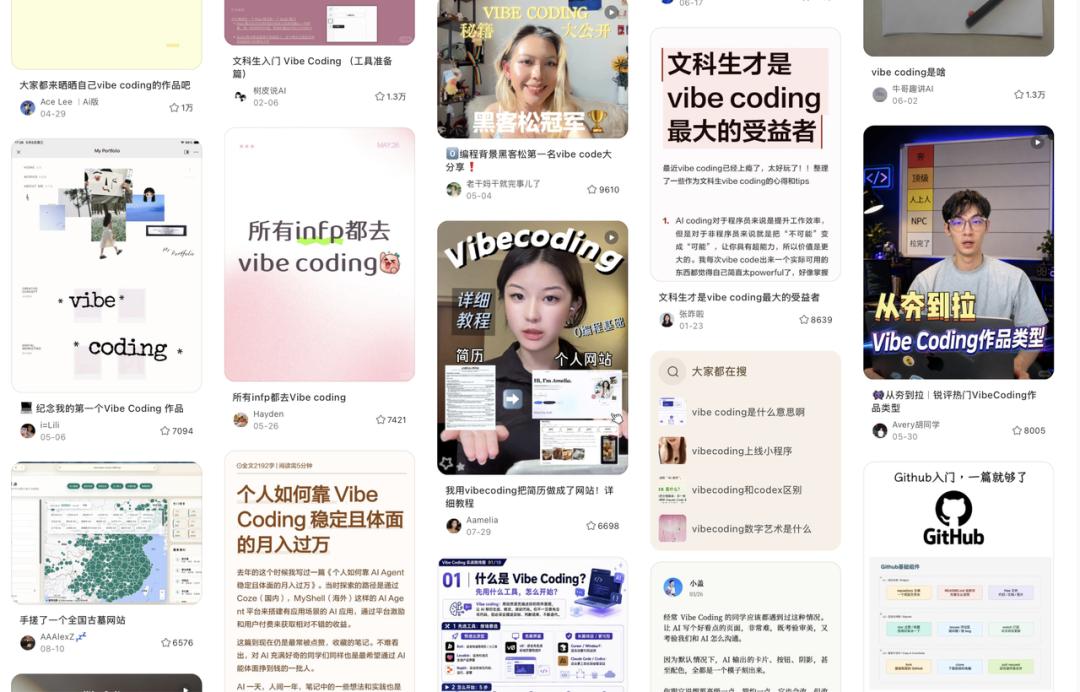
Screenshot from Xiaohongshu
The technical barrier of "I have an idea but I can't write code" has disappeared. But this is almost the easiest problem to solve in the whole process of developing a product. When you decide to launch the product you spent several nights making to the market, you unexpectedly find that technology has become so democratized.
Since everyone can make apps, why would others become your users and pay for you?
The problems you encounter start to become realistic.
AI is mass-producing apps, but there are not enough users.
Every Idea Is Waiting to Become a Business
This year, Lovable released a report. Lovable is the world's fastest-growing Vibe Coding platform. It surveyed more than 14,300 users, 80% of whom are from non-technical positions. 54.6% of respondents said they are currently "building a business"; 24.6% are doing it as a side hustle; 60.5% have not made money yet, but have planned to monetize their products.
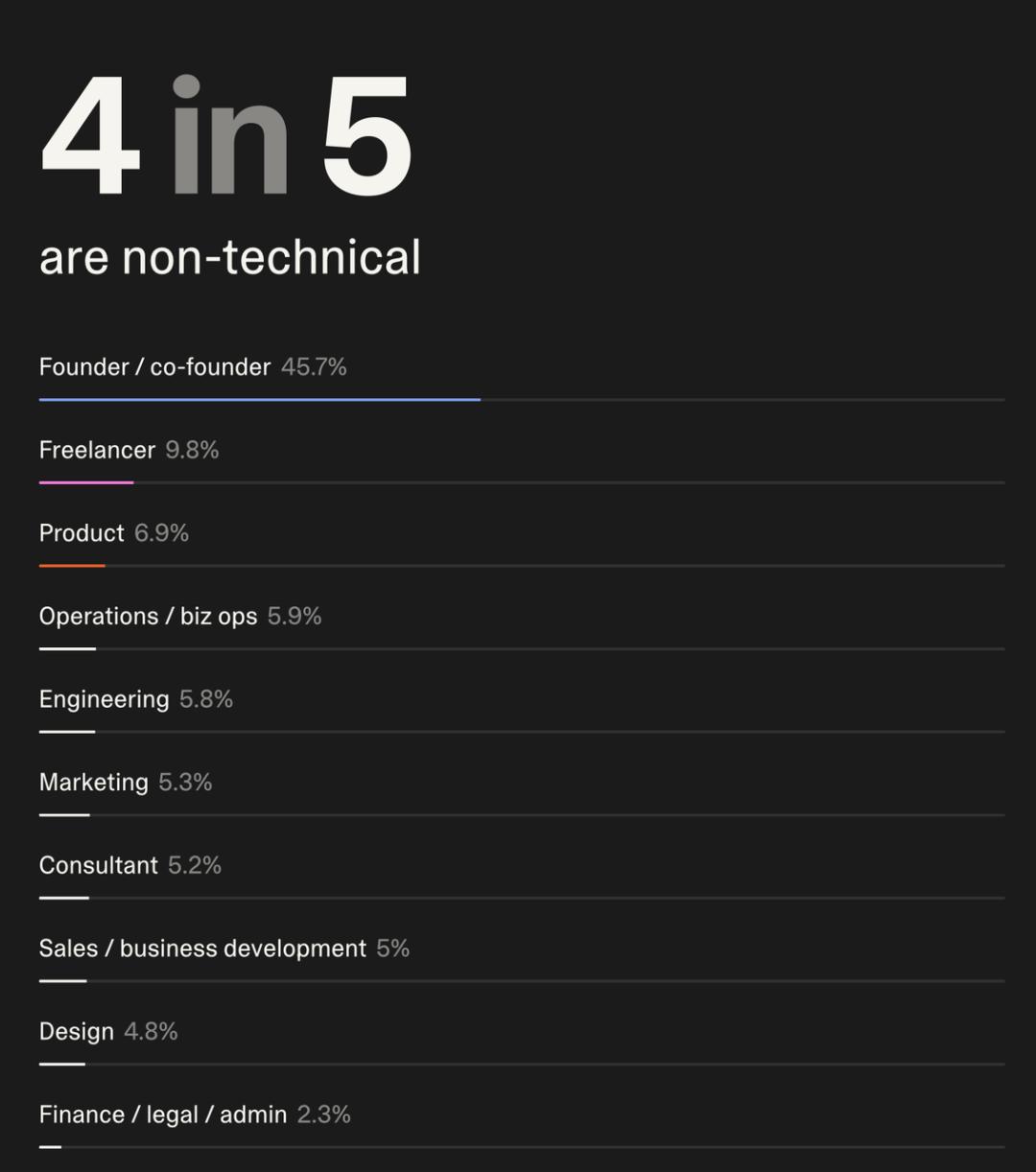
80% of Lovable's users do not have a technical background | Lovable
It's not that making money is bad, but the process of making money is extremely mentally draining.
In the past, to develop an app, even if its functions were not complex, you needed people to write front-end code, back-end code, connect databases, debug and launch the product. AI programming for the first time allows people who have never touched code to create a product and realize a small requirement.
For example, some people don't want to subscribe to accounting apps, so they use AI to make a "custom private version" where they can add any functions they want without watching ads; some people make a mini-program for hospital appointment registration for their parents; some players use AI to make game mods...

These usages are very close to the original intention of Vibe Coding.
But when making money becomes the goal, Vibe Coding changes from a way of entertainment to a set of "narratives" about entrepreneurship, independent development, flexible employment, and AI side hustles.
People only see that AI has greatly reduced the trial-and-error cost of development, but ignore that the problem faced by developers now is no longer a technical development problem, but a business problem.
In the past, the high development cost acted as an invisible filter for the market. Before a startup team started to develop a software, they had to conduct market research and evaluate costs and benefits. The same is true now: AI can't answer for you that apart from your own interest, who else needs this app?
Everyone Is Making Apps, Who Will Use These Apps?
NBER (National Bureau of Economic Research) updated a study targeting more than 500,000 GitHub developers in September this year. The researchers wanted to find out how much of the newly added code after AI accelerates software production has finally been turned into real products.
The study covered several generations of AI programming tools from the early code auto-completion tools to the 2026 generation of tools that can modify projects independently.
The result is that AI is getting better and better at writing code, and the code output is indeed growing rapidly. The earliest AI that could only help programmers complete a few lines of code increased code output by about 30%; AI that can modify code according to complete tasks increased code output by about 180%; for Agents that can work continuously autonomously, the maximum code output increase reached about 240%.
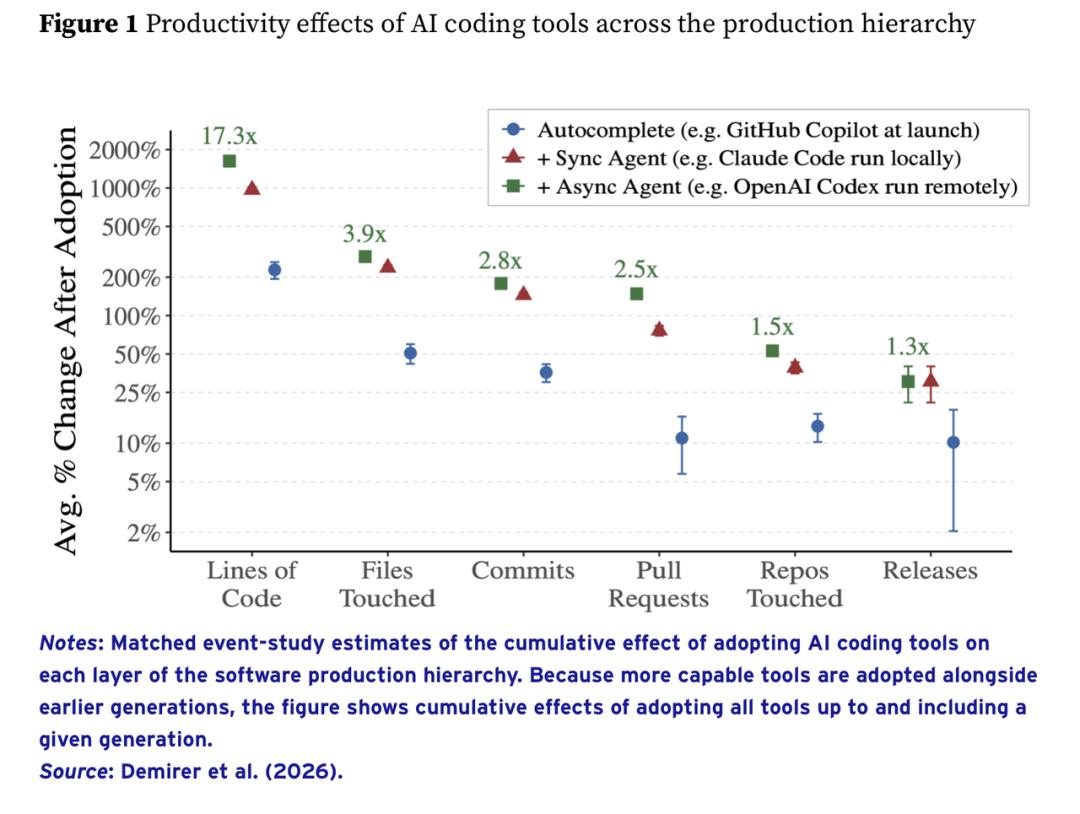
The amount of code increases with the improvement of AI programming capabilities, but the number of final finished software does not increase proportionally | NBER
However, these newly added codes have not been turned into real software in equal proportion. In the study, the total number of projects only increased by about 80%, and the number of officially released versions only increased by about 30%.
The researchers also checked four mainstream app markets, and the number of new apps has indeed increased significantly. In particular, the number of newly launched apps on the App Store roughly doubled from the beginning of 2025 to April 2026.
However, the total usage of these new apps in the first three months after launch has not increased, and even declined. Many apps have not even completed the most basic cold start target of "10 ratings and 100 downloads". The fact that apps are easier to make does not mean that the market suddenly needs so many apps.
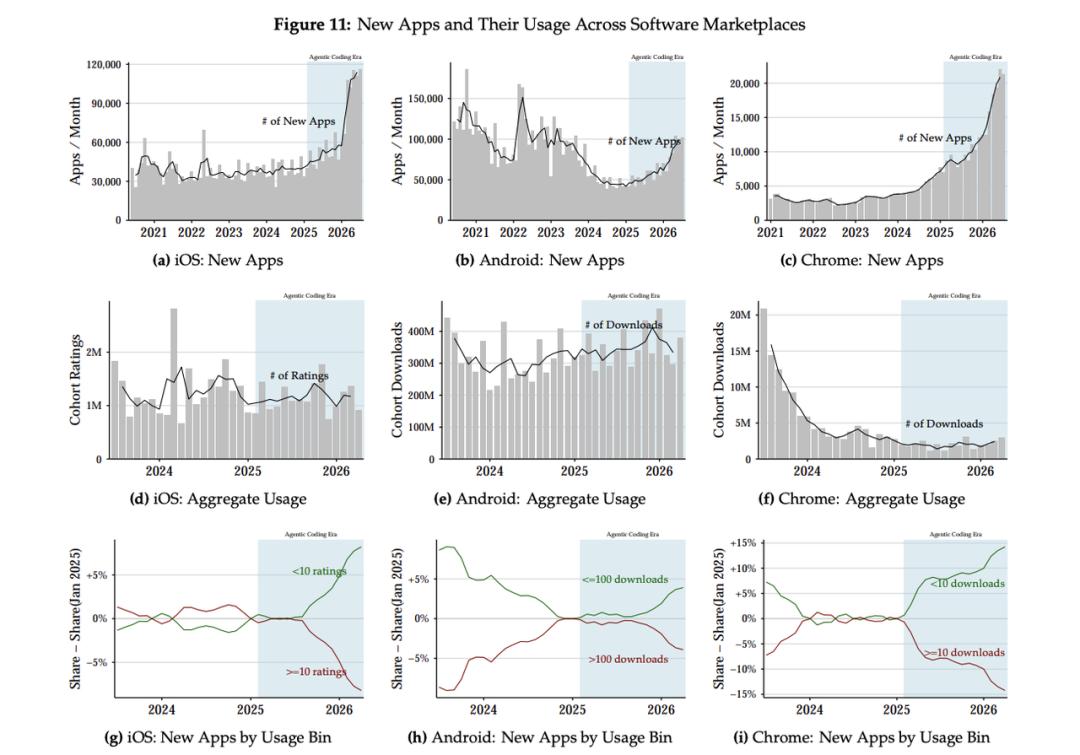
After 2025, the number of apps exploded, but the usage volume did not increase significantly | NBER
However, the "social circles" outside Github are full of a large number of startup myths.
Stanley is an AI content tool launched by Stan, a creator monetization platform. It can help creators rewrite existing content into posts suitable for publishing on platforms such as LinkedIn and Instagram.
The two founders of Stan spent about 14 days making the first version of Stanley with Vibe Coding. Six weeks after the LinkedIn version was launched, it achieved an annualized revenue of about 200,000 US dollars, and exceeded 1 million US dollars a few months later. By this summer, the annualized revenue of the entire Stan platform was about 41 million US dollars.
But these are only the results outsiders see.
The full picture of the story is that Stan was already providing creator monetization services, and had accumulated mature creator users and distribution channels.
When the founder first had the idea of this product, he took the initiative to contact potential customers to conceive topics for them, and kept asking them, "Is this product useful to you? If it goes online, are you willing to subscribe?"
During the formal development, they made the entire Vibe Coding process public online, attracting test users while developing the product. "14 days to complete development" was the first wave of successful marketing.
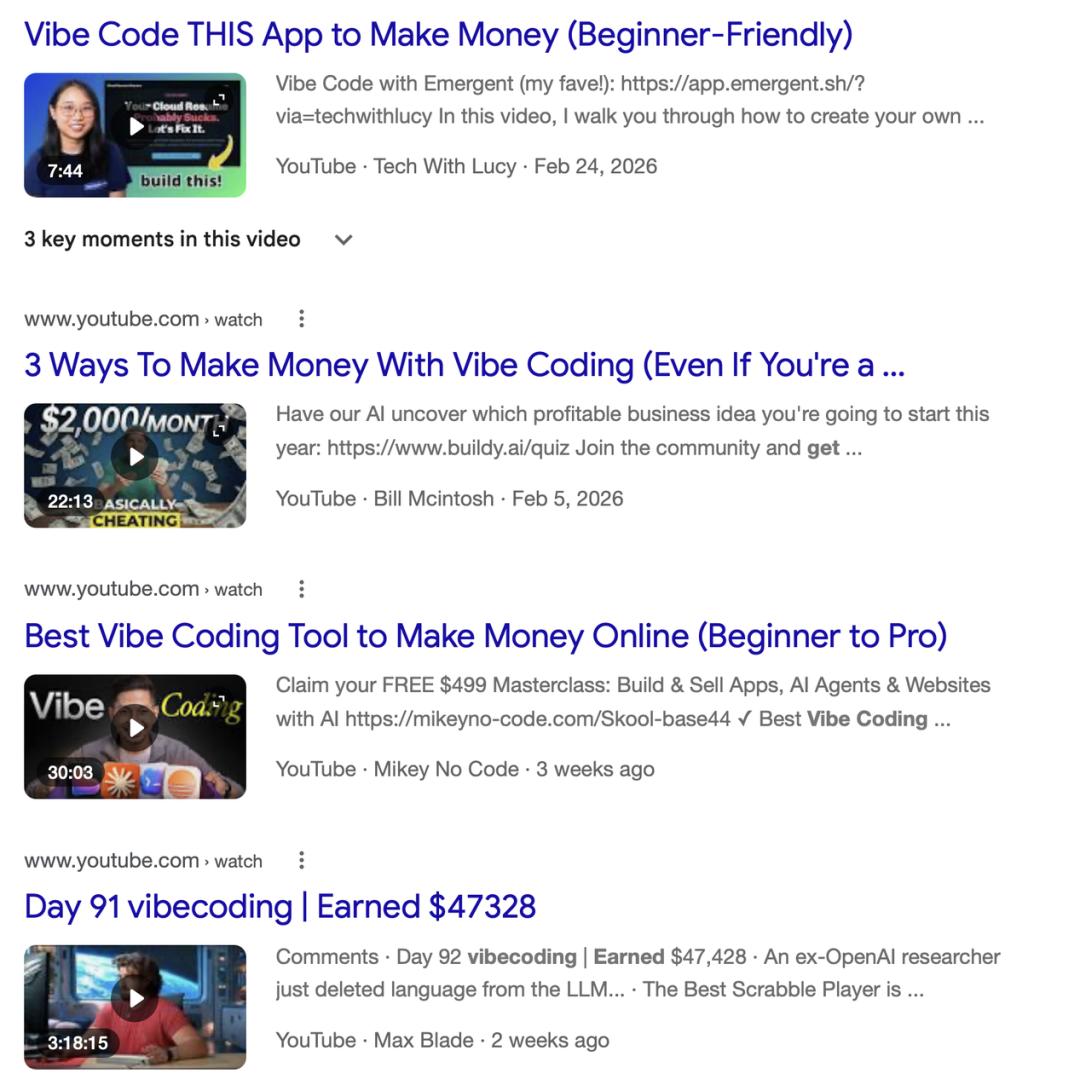
It is not clear whether you can make money through Vibe Coding, but you should definitely make money by running self-media accounts | YouTube
The biggest illusion created by Vibe Coding is that you see the final answer left by others, but mistake it for the problem-solving process.
AI Cannot "Define" a Product
There is no doubt that AI has accelerated the productization process.
In the past, when developers verified an idea, they would first make a complete design and a high-fidelity prototype, and in the end they could only achieve 60% to 70% of the expected effect of the finished product. Now AI undertakes a large number of specific development and implementation work, and helps developers verify various ideas quickly — an idea can be immediately turned into a demo, connected to real data, and installed on a mobile phone for use, so its advantages and disadvantages will be exposed quickly.
A developer friend gave me an example. His team developed Readmate, a tool for managing highlights in WeRead.

Image source: Readmate
The first version made by AI has reached the "usable" standard. But they found that AI lacks judgment.
For example, a golden quote of more than ten words and a long highlight of two to three hundred words need different processing methods, which lead to great differences in user experience: short sentences should be eye-catching, and long sentences should be easy to read; different fonts, mixed Chinese and English text layout, different screen sizes... will all affect the viewing experience. AI cannot answer the question of whether "good-looking appearance" is more important or "comfortable reading rhythm" is more important.

The team made many attempts on different fonts, typesetting and display methods | Readmate
The time saved by AI still needs to be used for manpower to polish things that AI is not good at. In other words, AI can "make" a product, but cannot "define" a product.
The stronger AI is, the less important and scarce the ability to "implement functions" will be. In his opinion, what differentiates Vibe Coding products from each other is the understanding of users, and how much manpower and time cost developers are willing to spend to "dig deep" into their own products.
For mature teams, AI has greatly reduced their daily trial-and-error cost, allowing them to act with clear targets.
For example, the developer friend mentioned above told me that his team will temporarily use AI to write various small tools during the development process to facilitate font adjustment, typesetting and visual effect display, and discard these tools after use. These small tools are very useful, but they would not have taken the trouble to develop them specially before.
Many clear UI implementations, data processing, repetitive code, refactoring and debugging in the product, including a large number of specific front-end work on the official website, can now be directly handed over to AI.
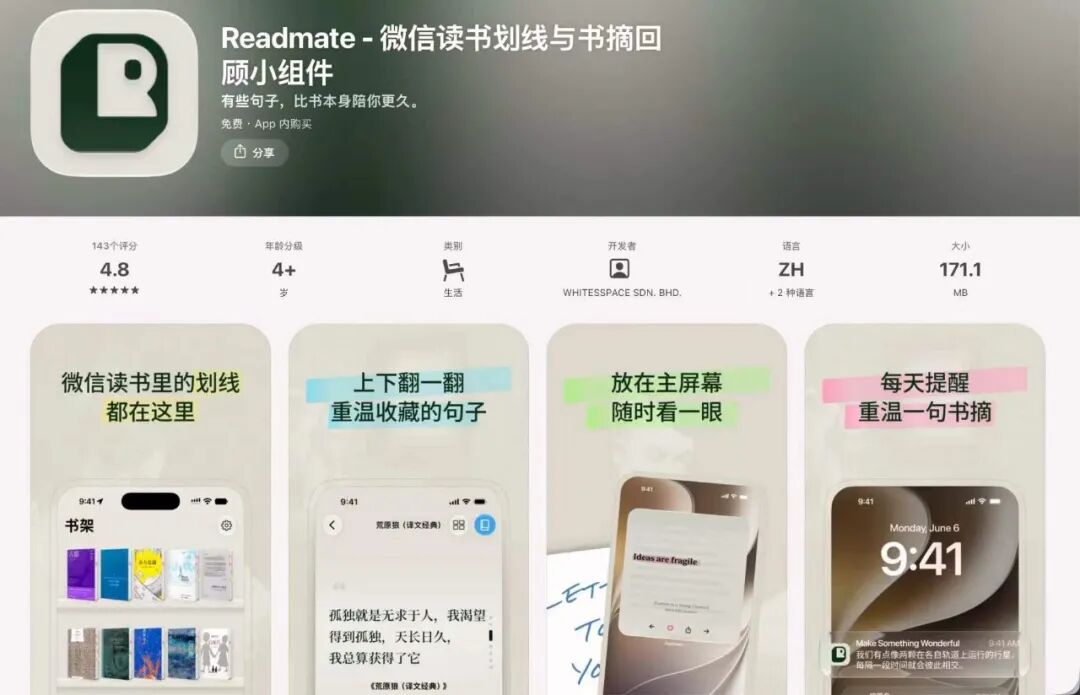
Less than a month after Readmate was launched, it received 143 ratings with an average score of 4.8 | App Store
But for many ordinary people, they only see a normal concept being promoted to a popular narrative. We have witnessed many similar examples, from the popular "spiritual wellness" trend to "knowledge payment" in previous years. The so-called Vibe Coding is also going through a similar narrative and a similar "overheating" process.
AI can replace people to make apps, but it cannot replace people to answer the questions: who will use it? Why use it? Where is its uniqueness? These are judgments beyond technology.
However, these judgments are the real reason behind the myth of "making a million-dollar product in 14 days".
References
[1] https://cepr.org/voxeu/columns/writing-code-versus-shipping-code-productivity-effects-across-generations-ai-coding?utm_source=chatgpt.com
[2] https://thebuildeconomy.lovable.app/?utm_source=chatgpt.com
This article is from the WeChat official account "Guokr" (ID: Guokr42), author: Gaoji Dongwu, editor: Shen Zhihan, published by 36Kr with authorization.