The Trillion-Yuan AI Industry: Don't Just Fixate on Robots
At this year's China International Industry Fair, there is a very intuitive change: a group of embodied intelligence enterprises have intensively unveiled their implementation achievements. At the same time, the value of Physical AI and Industrial AI is moving from concept to the forefront.
Keen investment institutions have long sensed the trend and made early layouts.
In the research report released by Soochow Securities in October 2025, a key judgment was given: Industrial AI is a market worth trillions of yuan.
Pascal Daloz, Global CEO of Dassault Systèmes, revealed that Dassault Systèmes has established its first venture capital fund in China, with a fundraising scale of 750 million RMB in the first phase, focusing on cutting-edge industrial AI fields such as Physical AI and embodied intelligence; the global semiconductor team of Morgan Stanley has also listed the humanoid robot track as a key focus direction.
The penetration rate is also steadily increasing. The China Academy of Information and Communications Technology predicts that the industrial AI penetration rate of leading industrial enterprises is expected to reach 60% in the next three years. The AI application proportion in the production and manufacturing links that used to be in the "moderate growth stage" has risen from 19.9% in 2024 to 25.9% in 2025. This means that industrial AI has just started in the main battlefields such as production lines and workshops.
How to turn AI from an industrial trend into implementable solutions in workshops and enjoy the dividends brought by technology is the core of the industry's current exploration.
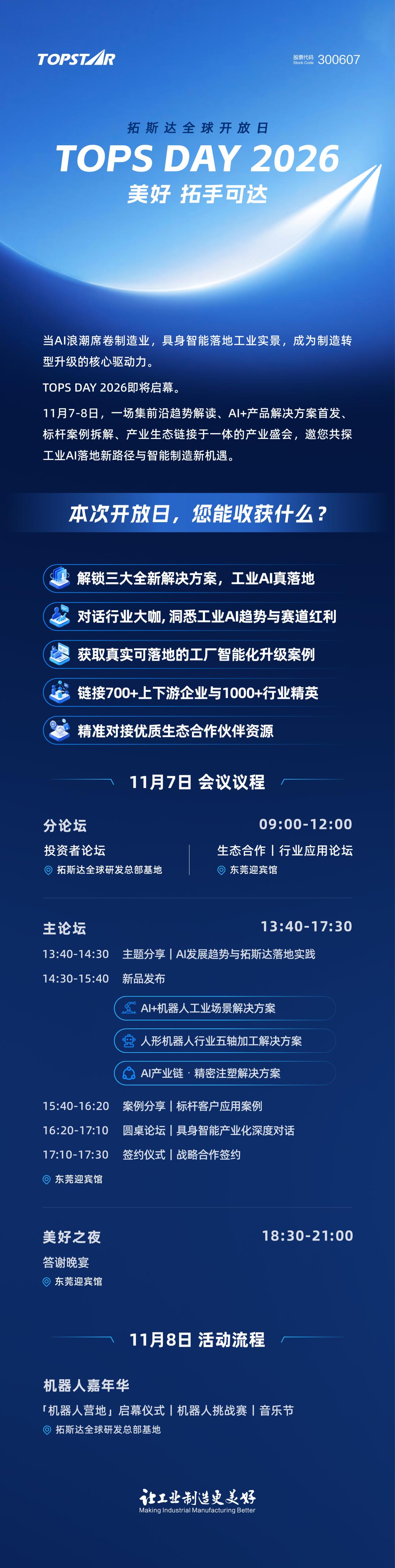
TOPS DAY 2026 Tuosida Global Open Day (hereinafter referred to as the Open Day) will focus on demonstrating this set of industrial implementation practices.
Embodied Intelligence Is Redefining Industrial Robots
According to the official news of Tuosida, the Open Day will focus on releasing a number of new products, and the industrial embodied intelligent solutions will make their debut.
An intuitive change is taking place in the manufacturing industry: multi-variety and small-batch orders have become the norm, spreading from electronic manufacturing to automotive parts, medical devices and home appliance industries, and the frequency of model changeover has been compressed from weekly to daily or even minute-level. The reform of the order structure forces robots to improve their flexibility, bringing broad application space for industrial embodied intelligence.
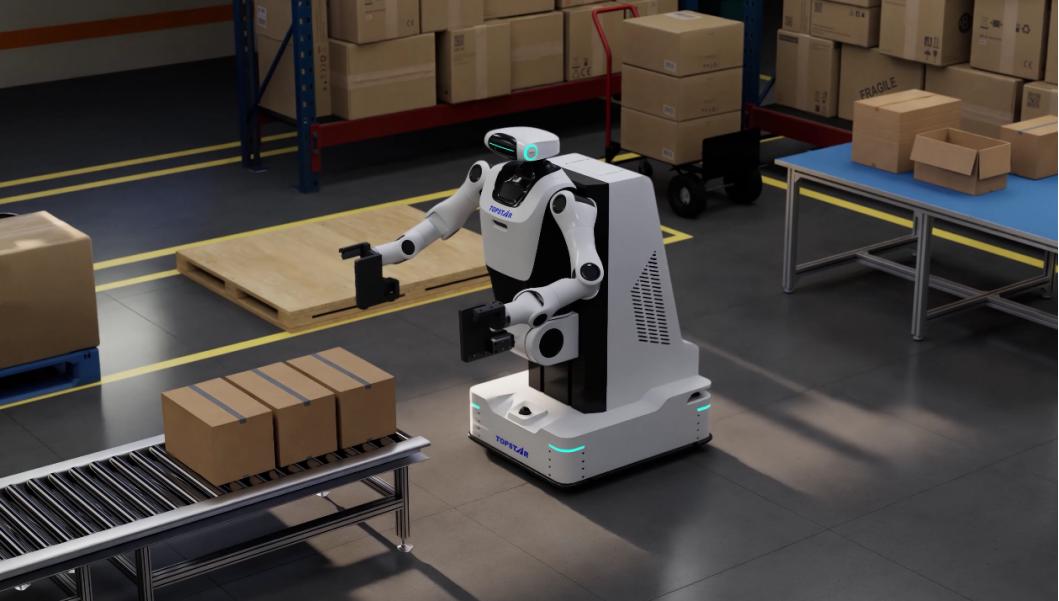
A number of industrial embodied products of Tuosida target the flexible demands of segmented scenarios: the wheeled humanoid robot Xiao Tuo box handling and palletizing solution can independently identify the specification and position of the box, dynamically generate handling strategies, without modifying procedures or replacing fixtures; the humanoid dual-arm robot special-shaped part sorting solution allows operators to issue tasks by voice to complete production changeover, without requiring engineers to rewrite codes, and the production changeover time is compressed from hour-level to minute-level; the AI flexible sorting workstation can complete formula production changeover in as fast as 5 minutes. These application cases prove that industrial embodied intelligence is solving real problems on production lines.
In the process of promoting industrial intelligence, Tuosida has also found a feasible path for upgrading existing equipment.
Many manufacturing enterprises have already deployed industrial robots. If all old equipment is replaced with new ones along with the AI wave, the costs of equipment procurement, production line transformation and shutdown debugging will be extremely high, which is an intelligence threshold that the vast majority of small and medium-sized enterprises cannot afford.
The industry is facing a dilemma: without upgrading, it cannot keep up with the trend of flexible production; full upgrading requires large investment, slow return on investment and serious waste of resources.
The idea put forward by Tuosida is to embed AI capabilities into old equipment, and its proposed solution is a set of data acquisition matrix:
The first is real machine data acquisition. Engineers teach robots to complete operations, and the gripper synchronously records vision, force and position information, which is converted into AI training data. This gripper is plug-and-play, no re-adjustment is required when replacing different robot models, and the positioning accuracy control error is less than 0.25%, which is sufficient to adapt to most industrial scenarios.
The second is virtual simulation. The production line scenarios are reproduced in the digital environment, generating a large amount of edge working condition data to supplement the samples that are difficult to collect in real scenarios. Customers do not need to replace equipment or master AI technology. Tuosida can complete data collection, model training and implementation deployment, endowing old production lines with new capabilities, helping traditional automation enterprises to collect factory data at low cost and accumulate data assets.
The Imagination of the AI Industry Goes Beyond Embodied Intelligent Robots
The pulling effect brought by the AI industry is not limited to robot terminals. Humanoid robots generate processing demands for joints, structural parts and precision transmission parts; the expansion of computing power drives the construction of data centers, and the server side also releases a large number of orders for plastic components, and this part of demand is spilling over to traditional processing plants.
How to seize the industrial dividends in the AI era has become a proposition of concern for many plastic and metal processing enterprises.
On the day of the Open Day, Tuosida will release humanoid robot parts processing solutions and AI industry chain · precision injection molding solutions, targeting the opportunities of the above two industrial chains.
The mass production of humanoid robots cannot bypass the precision processing step. Efermi, a holding subsidiary of Tuosida, has mature processing solutions. Aiming at the technological requirements of core components of humanoid robots, it has overcome industry pain points such as high precision, high consistency, high yield and large-scale delivery. Its self-developed 5-axis linkage CNC machine tool can be used for processing precision transmission parts required by robots, such as finger joints, load-bearing hip bone connectors, thoracic structural parts, plantar components, limb structural parts and joint structural parts.
Beyond the humanoid robot track, AI computing power infrastructure also opens up incremental space for precision manufacturing. Companies such as Amazon, NVIDIA and Meta have successively locked in production capacity related to optical fibers, optical cables and optical connections, and market attention is extending from optical fibers and optical cables to links such as MPO connectors and optical fiber components. Tiny components are leveraging the trillions-level AI industry dividend.
The market size of the connector segment is not small. According to the research report of Sinolink Securities, the high-speed line module products account for 3%-5% of the value of the entire AI server. Estimated at 1.3 million yuan per AI server, the value of the connector module part alone is about 50,000 yuan. The usage of high-speed connectors for a single AI training server has risen from about 120 pieces in 2024 to more than 210 pieces predicted in 2026. The global high-speed connector market size is expected to exceed 48 billion US dollars in 2026, among which the growth rate of high-frequency and high-speed connectors related to AI computing power is as high as 62%.
Such connectors belong to precision injection molded products. As the core component of MPO connectors, MT ferrules have strict requirements on fiber hole position, aperture, end face morphology and material dimensional stability. For manufacturing enterprises deeply engaged in the injection molding field, this is a clear upgrading path. AI server connectors and high-end optical modules continue to iterate, the computing power industry chain is booming, and the demand for upstream precision structural parts is rapidly released. Tuosida will help customers quickly undertake this part of upstream market demand through corresponding solutions.
A Competition of Full-Chain Collaboration
The release of AI industry dividends requires the coordinated advancement of the entire industrial chain. It is impossible to go far by fighting alone, which has become a consensus in the industry. Xiao Song, President of Siemens Greater China, once said: "Industrial scenarios are diverse and complex. No single enterprise can master the whole process, and ecological co-creation is the only way out." In addition, JD Industrial has also launched the "Baichuan Plan", intending to join hundreds of upstream partners to break data silos; the "Digital-Physical Resonance" action of the Ministry of Industry and Information Technology is also a full-chain layout covering data, models, scenarios and industrial ecology.
In 2026, the capital competition in the industrial intelligent agent track is shifting from simply betting on technical routes to comprehensive judgment on productization, large-scale delivery and continuous operation capabilities. Commercial closed loop has become the core evaluation criterion.
According to the information officially released by Tuosida, in the previous survey, it has received enthusiastic attention from a large number of industry partners on topics such as industrial AI implementation and AI industry opportunities.
In addition to three sets of brand new solutions, there are several things worth paying attention to at TOPS DAY 2026 this year around this direction.
The founder of Tuosida will share Tuosida's thinking and practice in the AI era around the evolution of the AI industry and the transformation of industrial intelligence. The scene will gather representatives of enterprises and the industry to jointly discuss how enterprises can seize the next-generation intelligent manufacturing track and build first-mover advantages under the AI wave.
The sub-forums cover three directions: ecological cooperation, investors and industry applications, to jointly explore the path of industrial chain collaboration and industrial implementation. The event brings together more than 700 enterprises at home and abroad and more than 1,000 industry elites to discuss the implementation path of industrial AI. On the robot camp on the second day of the event, Tuosida added a robot carnival for the first time, moving the product experience in the workshop to the event site.
This event, scheduled to be held from November 7 to 8, has now officially opened the registration channel (obtained in the comment area below). At that time, 36Kr will broadcast the whole event live.
Under the trillions-level AI wave, opportunities are not limited to the embodied intelligence track. More opportunities worthy of in-depth exploration are hidden in production lines, workshops, and in those seemingly less "sexy" precision processing and injection molding production lines.
All of these will be presented one by one at TOPS DAY 2026 Tuosida Global Open Day.