Amazon already has more than 1 million robots, so what does the future hold for its human employees?
No organization in the world operates more robots than Amazon.
The company already has over 1 million robots working around the clock in its warehouses worldwide to support the delivery of tens of millions of same-day and next-day parcels every day; as Amazon builds new factories to mass-produce increasingly capable robot employees, it is gearing up to significantly expand this robot fleet in the coming years.
Despite deploying so many robots, Amazon remains the second-largest corporate employer in the world with more than 1.5 million full-time and part-time human employees, according to its 2025 annual report.
Amazon executives say the growing robot fleet has taken on the most arduous tasks in fulfillment centers that most easily cause physical fatigue and injuries, thus reducing the burden on human employees.
But labor advocacy groups and independent researchers point to evidence that AI-driven warehouse automation is not all beneficial for humans working side by side with robots.
"Most of the automation we have seen over the past 100 years usually takes place far away from workers, where you take high-risk tasks out of workers' hands in a way that is not physically proximate,"
said Brad Greenwood, a professor of business at George Mason University. "The rise of collaborative robots has really changed this dynamic for two reasons: first, it is physically right nearby, and second, robots have the ability to set the pace of work."
In many ways, robots and AI are well suited to the non-stop work rhythm that already exists in e-commerce fulfillment centers. Amazon, in particular, has made fast delivery promises to its 200 million Prime subscribers, which requires hundreds of thousands of human employees to quickly assemble and dispatch customer orders that often contain a dazzling variety of products.
A large amount of work in fulfillment centers also frequently involves "dull, dirty and dangerous" tasks that people may prefer to hand over to robots. According to the U.S. Occupational Safety and Health Administration, the injury and illness rate of workers in the U.S. warehousing industry is usually more than twice the average of all industries.
"Nearly 2 million people work in the U.S. warehousing industry, which is characterized by extremely high turnover rates and very high workplace injury rates," Greenwood said.
But robots are still far from being able to handle many different tasks that human employees can complete. As a result, Amazon still has a huge human workforce working in tandem with the company's growing fleet of wheeled robots and robotic arms, and the workplace can become complicated when humans are expected to keep up with the pace of their robot counterparts.
Amazon's Robotics Era
Amazon quickly built its own robot fleet after making the key decision to acquire robotics company Kiva Systems in 2012.
Kiva was one of the first companies to pioneer wheeled mobile robots that bring shelves full of items to warehouse workers, instead of requiring people to constantly walk around fulfillment centers to pick items from shelves.
After the acquisition, Kiva was renamed Amazon Robotics and focused on deploying a range of mobile robots and robotic arms that are mostly manufactured in-house at Amazon's factory in Massachusetts.
This year, the company also announced that it will build more production plants in Austin, Texas and Greenwood, Indiana to produce more robots in the future.
"We have a theme around how we think about helping our staff and employees meet challenges, and how we make customers' lives better through these technologies," said Scott Dresser, Vice President of Amazon Robotics. "At every step, we are solving a set of hard or deep technical challenges to make that happen."
The majority of Amazon's 1-million-strong robot fleet still consists of these wheeled mobile robots. The company claims that its robot system called Sequoia can identify and store items in fulfillment centers up to 75% faster by coordinating a large number of such robots.
The Hercules and Titan robots, each as large as a billiard table or a grand piano, cruise through warehouse aisles to retrieve tall fabric shelf units called pods that are filled with plastic totes, then bring them to human employees at individual workstations.
Such mobile robots usually travel along grid lines of stickers laid on the ground and stay in fenced areas away from human employees. But the latest mobile robot, Proteus, is equipped with sensors that allow it to move more freely and operate safely around humans and other objects.
When these mobile robots travel in swarms through narrow aisles between rows of storage bays, they sometimes cause robot traffic jams. That is why Amazon has started using a suite of AI foundation models called DeepFleet to coordinate robots, which can help predict potential robot congestion in advance.
Recently, Amazon has deployed a growing number of robotic arms that can grab items stored high up in inventory bays, sort parcels and place them on top of carts or mobile robots, and handle many different individual items ordered by Amazon customers when shopping online.
According to Amazon CFO Brian Olsavsky during the July earnings call, the company expects to more than double its existing robotic arm fleet this year, while Dresser said the number of robotic arms currently deployed is in the thousands.
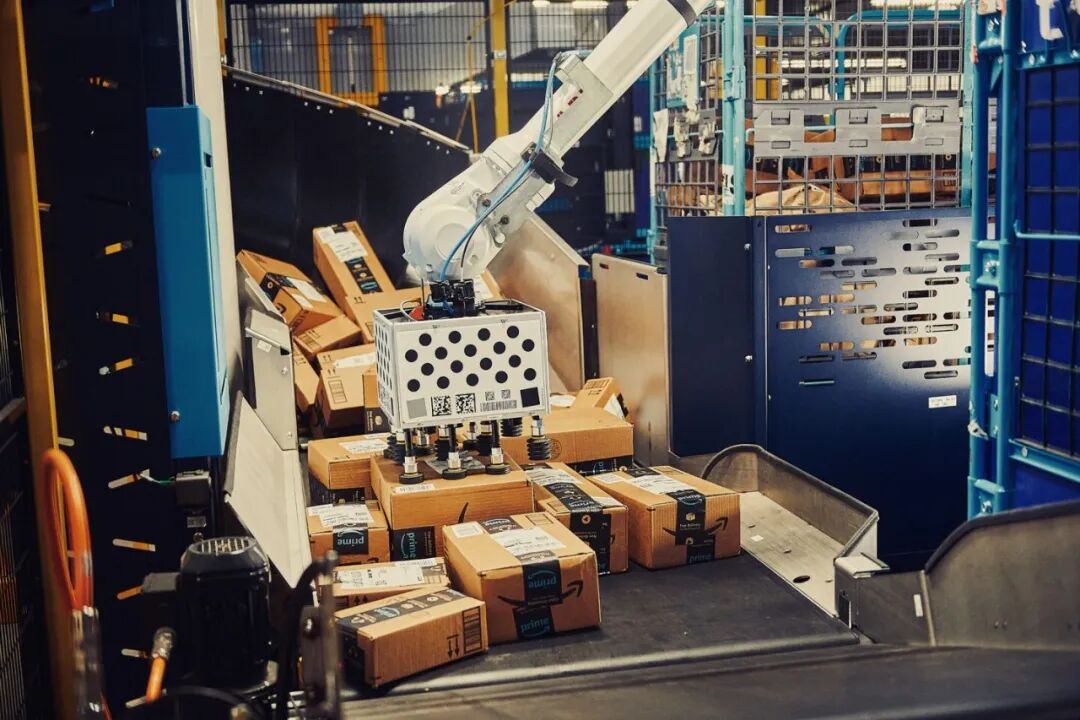
The Cardinal robotic arm system uses a suction cup system to grab boxes from a pile of Amazon parcels and stack them in a rolling cart.
The Robotic Arm Race
Amazon originally purchased third-party robotic arms to help move and stack heavy pallets and boxes inside its fulfillment centers.
But the first robotic arm Robin developed in-house by Amazon Robotics, used to sort individual mail bags and boxes from messy piles of parcels, began testing in 2021, and then made its debut at a facility in Lakeland, Florida in 2022.
"With Robin, we really made our first attempt to mix many customer orders together and build advanced robotics to identify items in the scene, develop strategies for how to grab them, and build motion plans that can successfully place them on some mobile drive unit," Dresser explained.
The robotic arm uses eight suction cups to grab individual parcels. But before taking any action, the robot software analyzes the top-down view of the conveyor belt full of parcels and quickly sorts out possible picking actions.
In a 2023 research paper, the Amazon Robotics team described several picking strategies they developed for robots in the early days, but each had its own limitations.
One strategy that prioritizes picking larger parcels encounters challenges when smaller parcels are located above or overlapping with larger parcels.
Another strategy that tends to pick items near the top of the parcel pile cannot retrieve "unreachable picking targets" and partially buried parcels in practice.
The improvement came from replacing such manually designed algorithms with an AI method called machine learning. The machine learning model was initially trained on more than 394,000 picking actions of deployed robotic arms to estimate the picking success probability, and then used an online pick sorter to prioritize the optimal actions for the Robin robot.
In this trial, the best-performing machine learning method achieved a success rate of 93.73%, while the best-performing traditional algorithm had a success rate of 92.28%.
At first glance, this may seem trivial, but it means that over a work shift involving more than 1 million total picks, the machine learning method produced about 16,500 fewer failed picks than the traditional method. For an operation like Amazon that prioritizes speed and efficiency at scale, this matters.
The Amazon Robotics team further demonstrated that in an experiment involving 2 million picks, this machine learning method can reduce the failed pick rate by 20%, using a robot workstation simulating the operation of Amazon's Robin robot fleet. They presented this work at the International Symposium on Experimental Robotics in July 2025.
Next came Cardinal, a robotic arm that can place parcels weighing up to 50 pounds into wheeled carts that are eventually sent to waiting Amazon trucks at loading docks. These robots first began operating at a facility in Nashville, Tennessee in November 2022.
"Think of it as a game of Tetris: you're sorting parcels, putting them into carts, and you want to be able to pack them as densely as possible," Dresser said. "Dense containers are great from a sustainability and shipping cost perspective."
Cardinal builds on the parcel grabbing and manipulation experience gained during Robin's development, while adding the ability to densely pack customer orders into carts.
Dresser said Amazon has just begun to deploy Cardinal on a larger scale and will continue to do so in the coming years.
The Sparrow robotic arm system can handle millions of different products while packing container-sized totes.
AI-Driven Robot Successors
Robin and Cardinal can handle dozens of parcel variants. But the newer Sparrow robotic arm was developed to tackle more challenging tasks, handling hundreds of millions of products of varying shapes and sizes that could end up in customer orders.
Specifically, Sparrow focuses on consolidating items from partially filled container-sized totes to create densely packed totes. As items are picked during customer order fulfillment, Sparrow continuously replenishes these totes.
"When we think about how AI is applied to the physical robotics space, Sparrow is really the first place where we've really deployed foundation models to deal with the high diversity of products," Dresser said.
Dresser explained that such foundation models help the Amazon Robotics team efficiently identify and categorize those hundreds of millions of items, enabling the development of new grasping strategies, and they also eliminate the need to manually code for every single item.
Recently, the Amazon Robotics team created a foundation model for robot perception that can handle novel, never-before-seen products that could end up in Amazon fulfillment centers. The team also developed a general action model that is compatible with different types of robotic arms that may use different combinations of suction cups and finger grippers.
"If you need to build ad-hoc perception models for every one of these tasks and every physical morphology, that's simply not scalable," Kapil Katyal, Senior Manager of Applied Science at Amazon Robotics, said during a speech at the Intelligent Robots and Systems Conference held in Pittsburgh on September 29.
"So one of the initiatives our team has taken is to design a foundation model that can be adapted to any new robot morphology we deploy, and to all the perception tasks we need to perform on those robots," Katyal said.
Most robotic arms rely primarily on vision. But Amazon's latest robotic arm, Vulcan, for the first time combines vision with force feedback sensors that provide tactile sensing. This allows the robot to accurately pick or place items inside fabric-covered inventory bays.
"You need to be able to insert items, create space, or pull something out," Dresser said. "These are all very difficult things for traditional non-tactile systems today, like the suction cup-based systems that Sparrow includes."
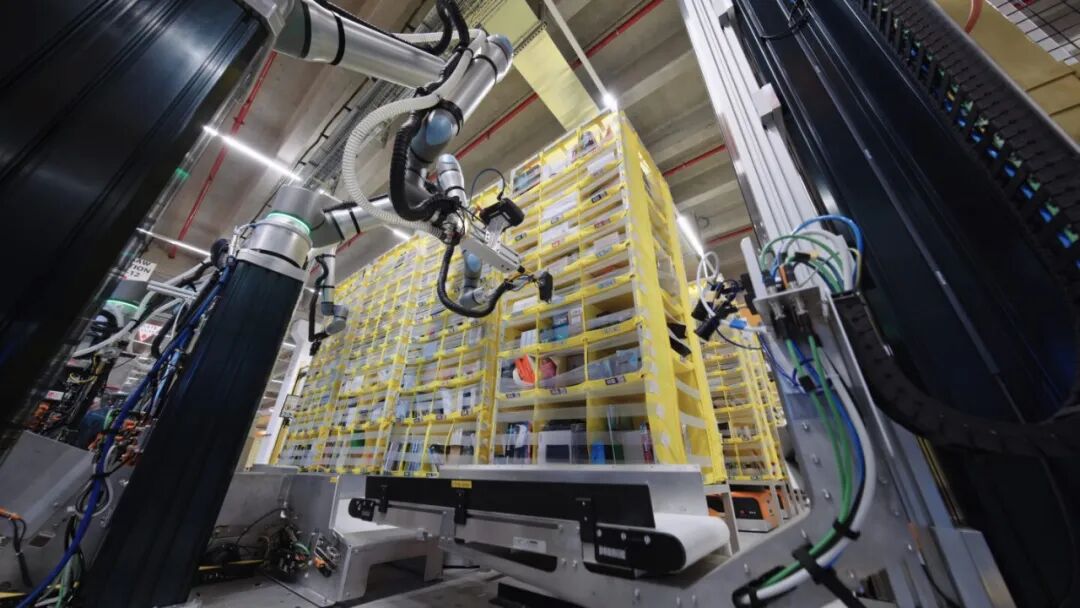
Vulcan began operating in Amazon fulfillment centers in Spokane, Washington and Hamburg, Germany in 2025. It has not been widely deployed yet, but Dresser said the company expects to scale up the use of this robotic arm in 2027.
The Vulcan robotic arm is equipped with force feedback sensors that provide tactile sensing for picking and placing items in tall inventory bays.
What Is the Impact on Humans?
According to Amazon, every new robot benefits the company's human workforce. For example, Vulcan focuses on picking and placing items located on the top rows of inventory bays that would otherwise require people to use step ladders, while handling items located at positions close to the ground. This allows employees to focus on picking and placing items within a more comfortable reach range.
But over the years, investigations by labor advocacy groups, journalists and the U.S. Congress have painted a less rosy picture of Amazon's automation push.
Reports released in May 2021 and April 2022 by the Strategic Organizing Center (SOC), a union alliance based in Washington D.C., showed that Amazon's robot warehouses had higher injury rates than non-robot warehouses. The analysis used injury data reported by the company to the U.S. government from 2017 to 2020.
"Amazon likes to talk about its latest robots because it doesn't want to talk about the tens of thousands of Amazon employees who get injured every year because of Amazon's obsession with maximizing speed and minimizing costs," said Joan Moriarty, Director of Strategic Research and Campaigns at SOC.
The organization also collected responses from nearly 1,000 Amazon employees in an online survey conducted in February 2021. "Employees consistently reported that the presence of robots raised the expected work pace inside Amazon facilities, forcing them to make fast, repetitive movements that significantly increased the risk of injury," Moriarty said.
The U.S. Senate Committee on Health, Education, Labor and Pensions (HELP) also launched an investigation in 2024 led by Senator Bernie Sanders (I-Vermont). The committee's report noted that Amazon's internal data also shows a link between robot productivity and increased stress on human employees, leading to higher injury rates.
Amazon says these reports are flawed and rely on older data that predates the deployment of its most modern robots, including the robotic arms that have been put into operation in the past few years. The company also touts that its overall workplace injury rate has improved, but does not detail the possible differences between robot warehouses and non-automated warehouses.
"All these claims miss the fact that since 2019, our global recordable incident rate has improved by 43%, and our global lost-time incident rate, which includes the most serious injuries requiring employees to take time off work, has improved by 70%," an Amazon spokesperson said in a statement. "Our year-over-year continuous improvement has gone hand in hand with the growth of robotics across our operations network."
The most nuanced findings about Amazon's automation push may come from a study published in the journal ILR Review in April 2025.
The analysis shows that Amazon's robot warehouses had 40% fewer serious injuries than older fulfillment centers, suggesting that having robots take on the most strenuous and high-risk tasks brings some benefits.
However, the same study also found that robot fulfillment centers saw a 77% increase in less severe injuries related to physical strain from repetitive motions.
"At the very least, this situation seems to manifest through one of the mechanisms of work pace, because the pick rates in robot fulfillment centers are sky-high," said Greenwood of George Mason University, who is one of the co-authors of the paper.
Greenwood said that part of the automation-driven acceleration of work pace could mean "robots are setting the pace of work" and prompting human employees to perform certain repetitive actions faster. "This appears to be exactly the driving force behind the sprains and strains we observed," he said.
The study partially used Amazon corporate data obtained by journalists from Reveal and the Center for Investigative Reporting, covering weekly data from more than 150 Amazon warehouses from 2016 to 2019. Despite the older data, Greenwood said the findings are still relevant to Amazon's ongoing automation efforts.
"I haven't seen a lot of evidence that these dynamics are changing, because turnover in the warehousing environment remains extremely high, and this is not just Amazon," Greenwood said.
Greenwood and his colleagues also analyzed online comments posted by Amazon fulfillment center employees on Reddit. In these comments, Amazon employees described work in robot fulfillment centers as less physically stressful, but mentally exhausting due to repetitiveness and a faster pace associated with higher productivity expectations.
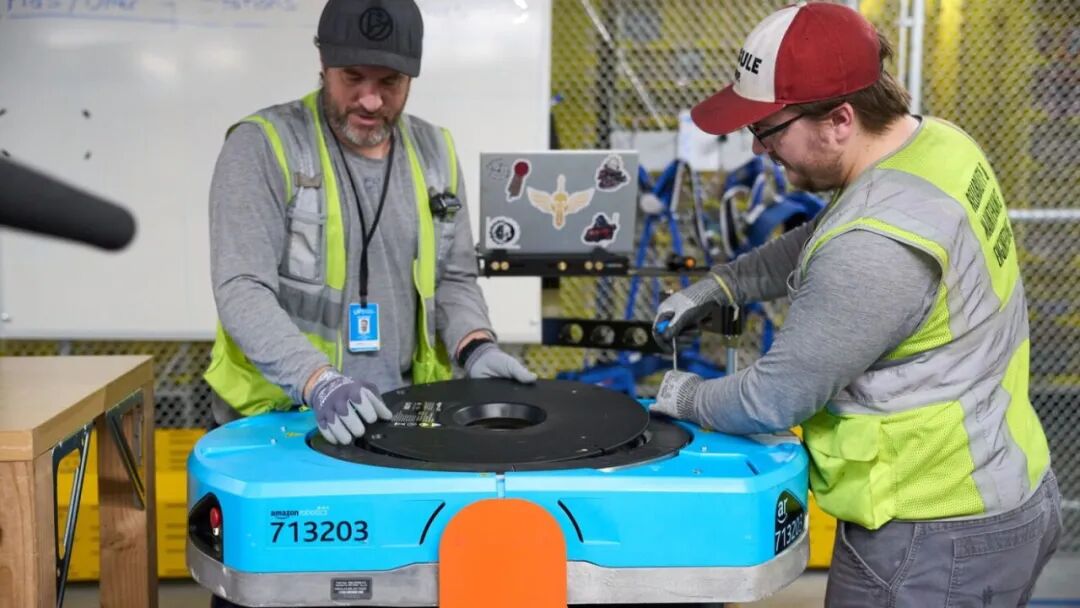
Amazon has created new jobs for employees to build and maintain mobile robots and robotic arms.
The Future of Work
An obvious question is whether automation efforts by Amazon and other companies will eventually replace some potential human hires with robots.
For its part, Amazon has always framed its robotics push as providing new job opportunities for human employees. Fulfillment centers with advanced robots typically require 30% more employees to work in reliability, maintenance and engineering roles, and new facilities for manufacturing more robots are reportedly set to bring more than 300 jobs each.
"As we recognize that every robotics technology development can change the nature of work, we are providing employees with opportunities to upskill and learn some of these things," said Dresser of Amazon Robotics. "In fact, we have increased the number of robot maintenance technicians in