DeepSeek has no "minor" updates, and our hands-on test of the new DeepSeek model demonstrates its "wish-based programming" feature.
Never trust DeepSeek's "a minor update".
The recent domestic models have been unusually quiet, with no new releases and no pre-launch promotions. Amid the silence, DeepSeek has made a new move, updating DeepSeek-V4.1-Flash to DeepSeek-V4.1-Flash-1017.
Judging only by the name, it just added a suffix, which most people would assume is just a small iteration. But after reviewing the tests and cases, DeepSeek-V4.1-Flash-1017 is far from ordinary.
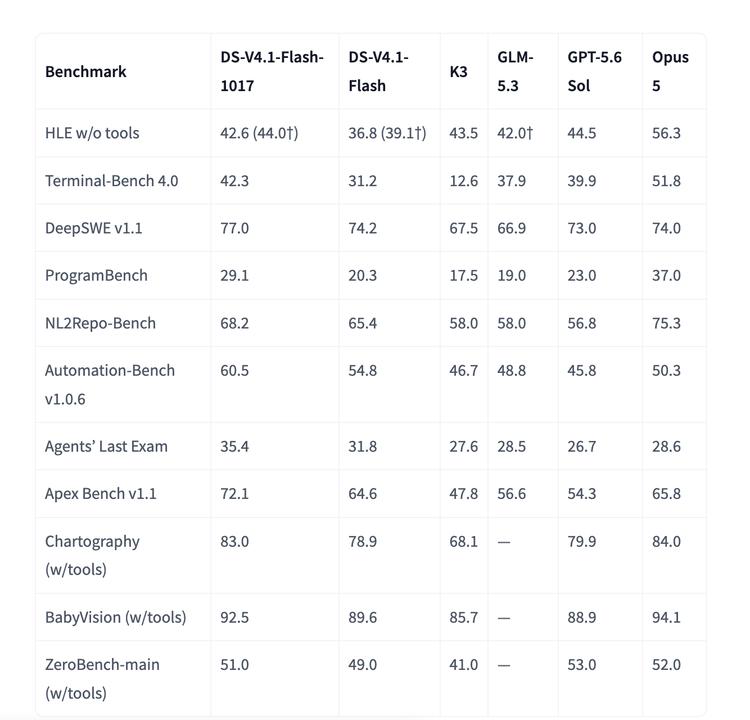
In the official published evaluations, the 1017 version has improved in all capabilities compared to the previous generation. Among them, the improvements in terminal operation and software reverse engineering are obvious: the Terminal-Bench 4.0 score rose from 31.2 to 42.3, and the ProgramBench score rose from 20.3 to 29.1, an increase of 8.8 points.
Compared with GPT and Claude, the 1017 version outperforms GPT-5.6 Sol in 9 of the tests, and has achieved a leap from lagging behind to overtaking in terminal operation and software reverse engineering. Compared with Claude Opus 5, it leads in four tests: DeepSWE, Automation-Bench, Agents' Last Exam and Apex Bench.
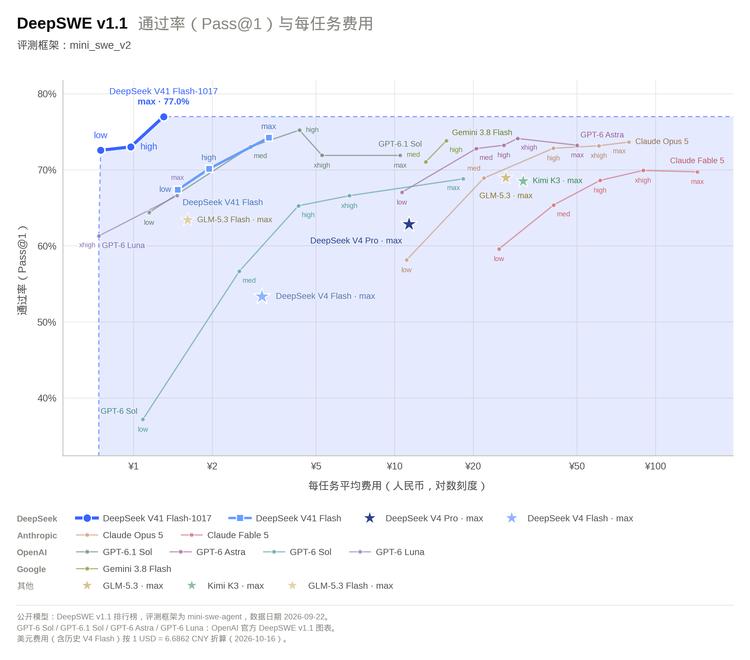
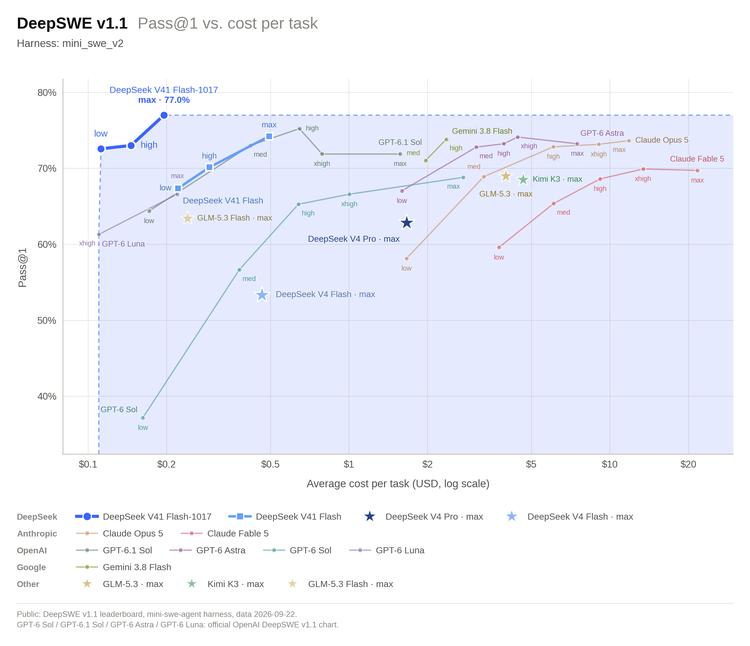
Upholding the tradition of not wasting any of users' resources, DeepSeek-V4.1-Flash-1017 has improved its capabilities while reducing the cost of completing a single task. According to the report estimates, the average cost of a single DeepSWE evaluation task has dropped from about $0.49 to about $0.20, a decrease of about 60%.
This update also focuses on developing full projects from scratch. The official demonstration includes 3D modeling of the Palace Museum, web-based car racing games, the Godot remake of *Portal 2*, and the civilization evolution scene *Valley of Ages*. It states that these projects only used a small number of prompts and reference materials, and the number of interaction rounds was also very short.


In its official account, DeepSeek claims that "wishful programming comes true with one click". Let's test several projects to see what it is really capable of.
1
Actual Test of DeepSeek-V4.1-Flash-1017
Test 1: Turn a piece of paper into a seaside town
The first task is a 3D web page. The requirement is to turn a paper-cut on the desktop into a seaside town. As the mouse scrolls down, the walls flip up from the cardboard, the gable roofs close, the lighthouse, the pier and the paper waves stand up one by one, and the camera slowly shifts from a top-down view to an oblique view. The thickness, fold lines and projection of the paper are all retained, and the entire page looks like a pop-up book that is unfolding.

As can be seen from the GIF, after the houses are erected, they still look like they are made of paper. The thickness, creases and projection maintain the texture of a pop-up book, and the lighthouse and time slider make people interested in continuing to explore. Especially when you drag to dusk, the sky, sea surface and window lights change together, and several functions cooperate with each other, making the whole town more complete.
Test 2: Let the code generate two full popular science videos
The other two tasks add requirements for sound and narrative. I believe many people have come across short popular science videos with simple pictures and voiceovers that clearly explain a topic. Now DeepSeek can truly generate them with one click, no secondary processing required.
This type of task puts forward requirements for the narrative sense, camera angle and sound of web-based videos.
*Earth: From Fiery Rock Sphere to Blue Planet* is about two and a half minutes long, dividing the evolution of the Earth into 13 chapters. The camera travels back from today's blue Earth to the fiery rock sphere at the beginning of its formation, cuts the section to show the internal layers, then dives into the shallow sea where microorganisms live. Cambrian creatures swim across the camera, the dust raised by the asteroid impact covers the sky, and finally returns to the modern Earth.
What is particularly impressive is that the pictures and commentary cooperate to tell a complete story. When the section is expanded, the voiceover explains the layers of the Earth; when the camera enters the seabed, the narrative turns to life changes, and the Chinese subtitles follow the corresponding paragraphs. It can already organize several audio-visual elements into a coherent video.
*The Birth of a Grain of Salt* focuses on a salt pan in Yangpu, Hainan. In about two minutes, the camera pulls back from a close-up of salt crystals, gradually unfolding the salt production process: seawater flows into the mud ground, salt workers turn over and dry it with wooden rakes, the salt mud is put into the filter tank, and the brine is sent to the stone trough for solar evaporation. The miniature scene and warm color tone run through the whole film, giving the craft a unified visual style.
The two scale switches in the film are used very appropriately. When filtering, the camera cuts the tank body to show the sediment and thatch layer. When crystallizing, it enters the microscopic view to show the process of water reduction and gradual crystal formation.
The two delivered works are both audio 3D web pages. The main pictures are rendered in real time by code, the Chinese voiceover comes from speech synthesis, and the background music and environmental sounds are also packaged with the project.
Although the pictures still have an obvious simplified model feel, especially the paleontology in the Earth chapter, as well as the characters and utensils in the salt pan, which are still far from the cinematic documentary quality required by the prompts, they can completely replace short videos after a little polishing.
Test 3: Mobius Bus
The third project puts the bus on a Mobius ring in space. The exterior camera can be rotated to observe the entire road, switch to the follow-up view, and the bus drives along the twisted road, with the body tilting accordingly. After entering the cockpit, the steering wheel and windshield enter the frame, and the road ahead and the distant starry sky flip together in the field of view. Site cards will pop up along the way, prompting parking and check-in conditions.
The most interesting part of this project is that the spatial characteristics of the Mobius ring are integrated into the driving experience: after one lap, the vehicle is upside down, and after another lap, it returns to its original posture. The modeling of the bus and cockpit is still relatively simple, but the road shape, vehicle movement and camera changes can cooperate with each other, which already has the rudiment of a small space driving game.
2
Why not name it V4.2-Flash, but only add a suffix?
DeepSeek previously upgraded from V3 to V4, and then to V4.1, and the version number changes were accompanied by adjustments to the underlying architecture.
From V3 to V4, the attention mechanism and the connection method between model layers were modified; when it came to V4.1-Flash, an asymmetric Causal Encoder-Decoder structure was introduced, allowing different activation scales for processing input and generating output.
This 1017 version continues to use the original architecture, the backbone parameter remains 552B, and the scale of 8B input activation and 16B output activation has not changed.
So where are the improvements?
The base model has not been updated, but capability enhancement and cost reduction have been achieved. To explain these changes, we need to look at the improvements in post-training and task execution efficiency.
Self-feedback Reinforcement Learning
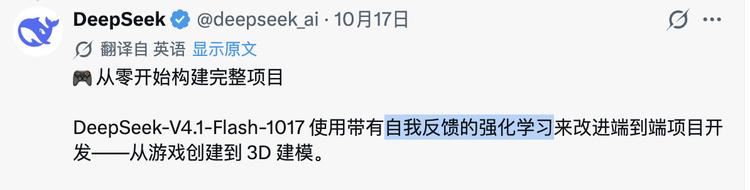
In its release notes, DeepSeek explicitly attributes the improvement in full project development capabilities such as game development and 3D modeling to reinforcement learning with self-feedback.
How does self-feedback help train this capability? The official has not announced the specific method, and we can make a simple guess based on the characteristics of this type of task.
When you ask an AI to write a function, you can usually use tests to check whether the result is correct. But when you ask it to make a car racing game, there are far more troubles.
For example, the car and the track are drawn, but the car will go through the wall as soon as you start driving. After the collision bug is fixed, you test it again and find that the timer does not reset when the race restarts.
Each function is not complicated when viewed alone, but when combined, there are countless problems. The model needs to decide what to do next based on the previous results, and ensure that these functions can finally run in coordination.
A possible approach is to let the model participate in checking its own development results during training: compare with the original requirements, find out the uncompleted functions, judge whether there are conflicts between previous and subsequent operations, and then give an evaluation.
If these evaluations are reliable enough, they can be converted into training rewards to adjust model parameters, so that the development method of "being able to complete the whole project" is more likely to appear in subsequent tasks.
Finding and fixing a bug on the spot solves the current project; using feedback for training is to hope that the model can make better choices when encountering similar problems next time.
The hardest part of this path is also whether the evaluation is reliable. The model must be able to find where it went wrong, otherwise a seemingly reasonable self-evaluation will only lead it further and further down the wrong path.
Slim down the reasoning process
Another change of DeepSeek-V4.1-Flash-1017 is to shorten the task running time and output length. As a result, the unit price of the API has not changed, but the cost required to complete a task has decreased.
The API is billed by the number of input and output tokens. The less content the model generates when completing a task, the lower the output cost. Capability improvement and cost reduction can happen at the same time, the key is how much content it uses and how many things it completes.
This is especially useful for Agents. When developing a project, the model often needs to read files repeatedly, modify code, and then continue processing according to the results returned by the tools. The bill will count all the consumption in these processes, which is far more than the final reply seen by the user.
Moreover, a piece of content may be billed more than once. If it is kept in the history record, the subsequent call will send this history to the model again, which will generate input fees.
Generating less redundant content can not only reduce the current output overhead, but also reduce the burden of reading history later.
Although cache hits can make re-reading cheaper, isn't it even cheaper not to generate the redundant content in the first place?
Complement search and access capabilities beyond the model
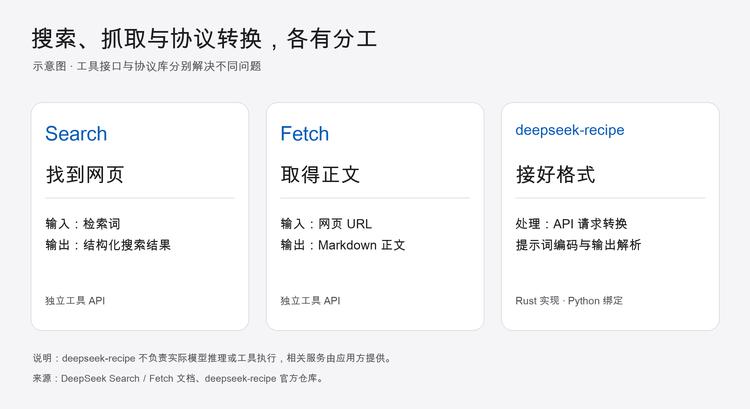
With the release of DeepSeek-V4.1-Flash-1017, DeepSeek has also split the capabilities of its self-developed search engine into two public interfaces: Search and Fetch. The search service that originally supported its own products can now be connected to developers' own applications and Agents.
For example, if you ask an Agent to make a mini-program, it needs to go to the mini-program development website to find relevant documents and confirm how to use the interface now.
Search is responsible for finding web pages by keywords, returning titles, links and summaries to help the model filter materials. After selecting the page that needs to be read carefully, Fetch will grab the text according to the URL and organize it into Markdown text that is convenient for the model to read.
One is responsible for finding materials, and the other is responsible for organizing materials.
In terms of pricing, Search and Fetch are billed at RMB 5 per thousand successful requests respectively, which is about $0.75. No fees are charged for failed requests, no search results or crawling timeouts.
3
A small step that can be taken continuously is also a big step
Looking back, DeepSeek-V4.1-Flash-1017 continues to use the original architecture and parameter scale, and the main version number has not been increased.
A sentence written in DeepSeek's description explains everything: the full project development capability is attributed to reinforcement learning based on self-feedback.
Of course, how far this path can go depends on how accurate its self-scoring is. DeepSeek has not yet disclosed the details of this part, and we can only verify it while using it.
However, combining self-feedback training, reasoning slimming, and the newly opened Search and Fetch interfaces, the idea behind DeepSeek's this "minor update" is actually very clear: the base model remains unchanged, and the focus is on post-training and task execution efficiency.
The generation replacement of the underlying architecture is certainly exciting, but improving capabilities through post-training on the existing base model and reducing the cost of a single task is a path that can keep moving forward without waiting for a major version update.
This article is from the WeChat official account "Silicon Star Pro",