Stop obsessing over humanoid robots, exoskeletons are starting to be "worn" into everyday life.
Zhang Heng climbed Mount Tai during his vacation.
What impressed him the most was neither the endless steps nor the lush greenery everywhere, but the tourists trying on exoskeletons at the Zhongtianmen service point. "80 yuan for 3 hours, the batteries are fully charged, which can save a lot of effort," the merchant said that after the device can be put on in just over ten seconds, people can easily climb the Eighteen Bends and experience this high-tech assistance equipment known as the "new scenic area cable car".
This is not a unique sight at Mount Tai. During this year's National Day holiday, more than 50 mountain scenic spots across the country launched lower limb exoskeleton rental services. On the steps of Mount Tai, Mount Hua, Huangshan Mountain and Mount Emei, there are more people wearing "mechanical legs" on their legs. Data from the Ministry of Commerce shows that from October 1 to 6, the sales of exoskeleton assistive devices on key platforms increased by 12.8% year-on-year, outperforming the 10.4% growth of outdoor sports equipment in the same period.

In the past, when Zhang Heng saw exoskeletons online, he always thought they were assistive devices for people with limited mobility. But most of the tourists trying on the devices in front of him were just ordinary climbers. With the belt fastened and the bracket buckled, even middle-aged people in their 40s and 50s showed the eagerness to try that is often seen in young people.
Looking at them, Zhang Heng had an idea: "Why don't I give it a try too?"
This idea just reflects the ongoing changes of exoskeleton robots: the professional equipment that used to appear in rehabilitation institutions and laboratories has now entered scenic spots and become an outdoor gear that ordinary people are willing to pay dozens of yuan to experience.
The past two years can be regarded as the first year of exoskeletons expanding their user circle. Not only in popular scenic spots, but related companies also frequently announce financing news of 100 to 200 million yuan. According to IDC data, the market size of domestic exoskeleton products last year was about 1.6 billion yuan, among which the annual shipment of consumer-grade products was close to 20,000 units, seeing the fastest growth.
However, it may not be that simple for a device to truly "wear" into the lives of ordinary people.
1
Eve of Outbreak: When Exoskeletons "Step" into Reality
When it comes to embodied intelligence, people often first think of humanoid robots: they can walk, grasp, and even complete some simple housework. But in this track, a number of products have entered real life before humanoid robots, and obvious changes are taking place.
Exoskeleton robots are one of them.
Improving human body functions and becoming an enhanced version of human beings has always been the desire of scientists. For example, injecting Steve Rogers with a super serum to transform him from a thin soldier into Captain America, or the giant mecha operated by two people in *Pacific Rim* or the nano armor of Iron Man.
And exoskeleton robots are one of the solutions that have moved from science fiction concepts to reality.
Simply put, an exoskeleton is a robotic device worn outside the human body that can sense human movements and provide power assistance. It can identify the user's movement intention through data such as myoelectric signals, gait and inertia, and then provide corresponding assistance through motors, batteries and control systems, cooperating with the human body to complete movements such as walking, lifting and carrying heavy loads.
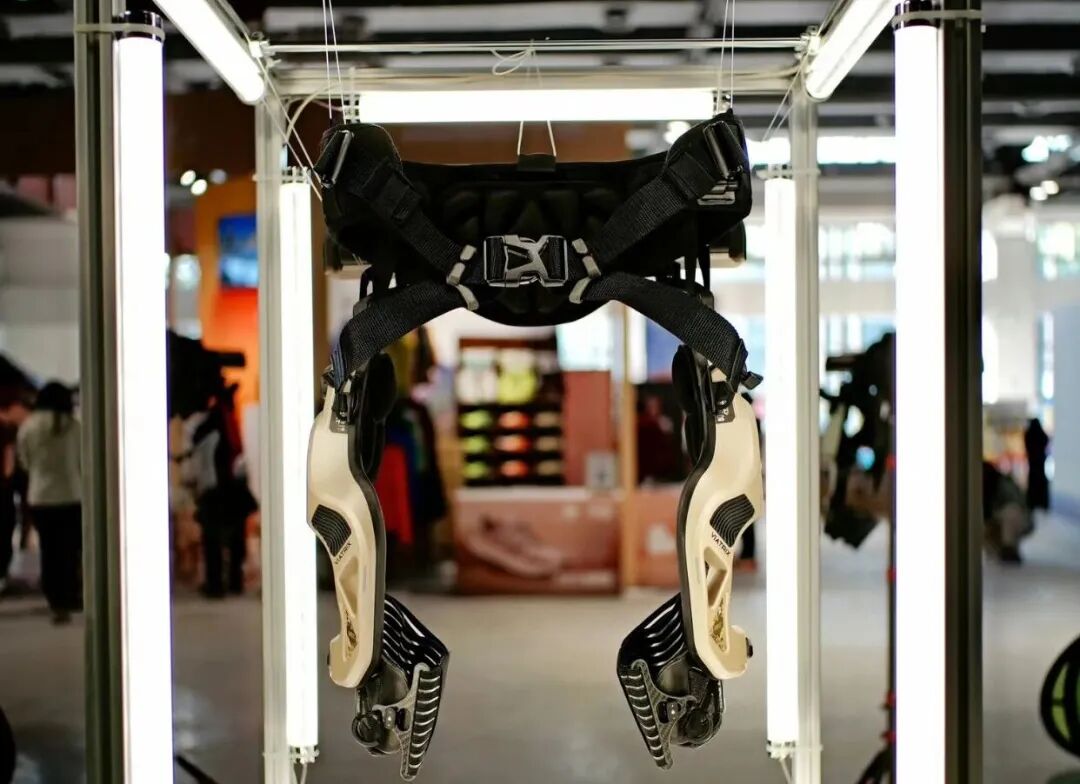
But the exoskeleton is not a simple mechanical bracket worn on the body, but a practical tool. In medical scenarios, exoskeletons can help patients carry out rehabilitation training; outdoors, they can reduce physical consumption during mountain climbing and hiking; in industrial and rescue scenarios, they can help staff carry more supplies and reduce injuries caused by long-term heavy loads.
Compared with humanoid robots that try to replicate or even replace human beings, exoskeletons emphasize more on integrating with people and helping people break through their own physical limits.
Early exoskeletons were mainly used in medical, military and laboratory scenarios. They were bulky, required repeated debugging before use, and had slow motion response.
Nowadays, with the continuous maturity of electric drives, sensors and control systems, exoskeletons are developing towards light weight, miniaturization and low cost. They share common technologies with humanoid robots in servo motors, reducers, encoders and other aspects. The development of the humanoid robot industry has also indirectly promoted the price reduction of related components. The equipment that used to cost hundreds of thousands or even millions of yuan has now seen consumer-grade products ranging from several thousand yuan to tens of thousands of yuan.
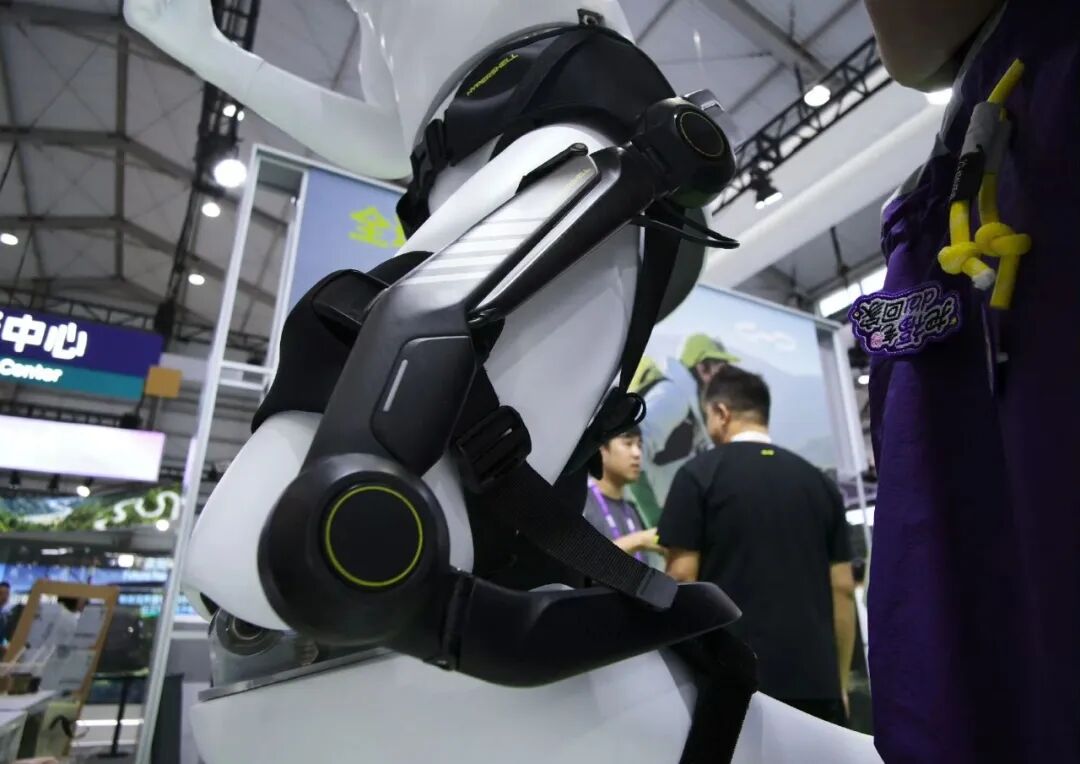
What really accelerates this industry is AI.
The rapid development of AI has solved the biggest pain point of early exoskeletons: how to change from a "passive tool" to "active intelligence".
Through real-time sensing, edge computing and algorithm models, exoskeletons can obtain the user's speed, acceleration, balance state, heart rate changes, and even electrical signals generated by muscle contraction, and then judge through multi-modal data whether the user is about to step, accelerate, climb uphill, or lose balance.
Therefore, some AI-equipped products can already complete gait recognition after the user walks a few steps, and automatically adjust the assistance parameters according to the posture, stride length and behavior habits. Users do not need long-term manual debugging, and the device does not have to work in a fixed mode. It will gradually adapt to different people.
This real-time adaptation capability has changed the rigid and lagging user experience of traditional exoskeletons. Some products are also equipped with posture perception and airbags to prevent falls and deal with sudden imbalance, which is completely different from early exoskeletons without AI.
At the same time, the application boundary of exoskeletons is also expanding. This year, for the first time, the policy side listed exoskeleton robots as a "frontier direction for elderly care technology exploration", requiring active exploration of exoskeleton robots, brain-computer interfaces and other technologies.
From "who needs it" to "I want to try it too", exoskeletons are crossing an important cognitive threshold. But whether exoskeletons can grow from a novel technological equipment to a truly mass product depends on whether technology, price and business model can continue to work properly.
2
Why Consumer-Grade?
The story of exoskeletons can be traced back to the Hardiman project jointly developed by General Electric and the US military in 1960. At that time, the exoskeleton could amplify the wearer's strength by 25 times, but it weighed 650 kg, walked at a speed of only 0.6 m/s, and had extremely poor response and human-computer interaction, so it was not a success.
China did not start early. In 2016, there were only 5 to 10 doctoral dissertations related to exoskeletons in China every year. By 2025 and 2026, the number of master's dissertations has increased to 150 to 200 per year, and the maximum number of doctoral dissertations has reached 50.
The acceleration of talent reserve has spawned a prosperous ecosystem. According to 2026 statistics from the Prospective Industry Research Institute and combined with data from platforms such as Tianyancha, there are currently about 80 domestic exoskeleton robot companies focusing on complete machines. Together with university-derived start-ups and internal projects of large companies, the total number of related enterprises exceeds 200.
With so many companies crowding in, there is a change worth noting: consumer-grade products have broken through the circle first.
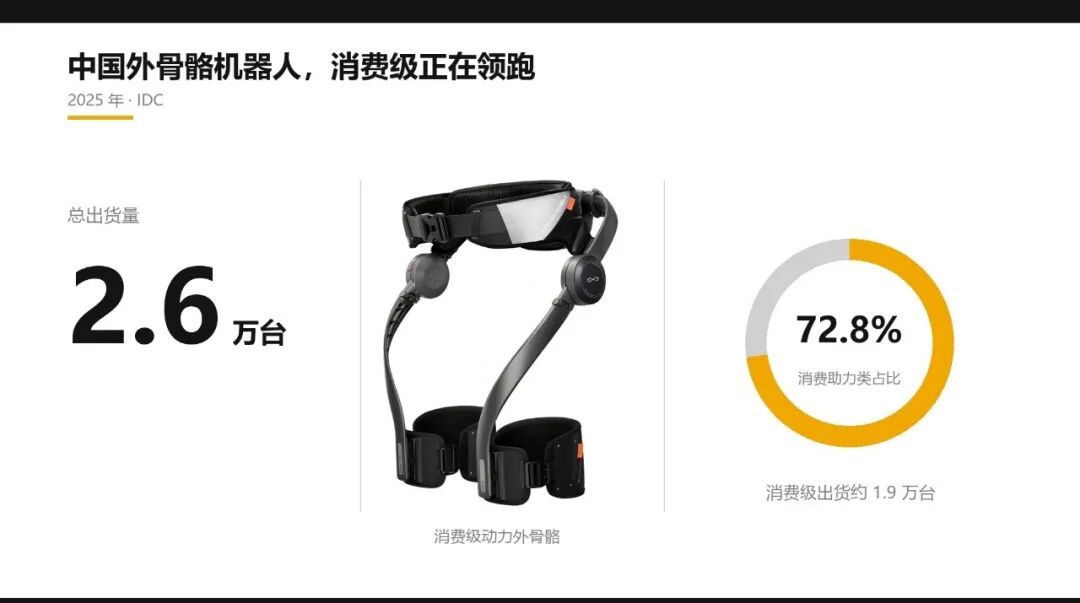
IDC data shows that the total shipment of China's exoskeleton robots in 2025 was about 26,000 units, of which consumer assistance products accounted for 72.8%, close to 19,000 units; Ministry of Commerce data shows that in the first half of 2026, the demand for intelligent exoskeletons increased by 458.4%. According to JD Retail big data information, the transaction volume of exoskeleton robots in the first half of 2026 increased by more than 1500% year-on-year.
But a more thought-provoking question is: Why consumer-grade?
The answer may lie in the situation of three types of players.
The medical rehabilitation grade is the first category of exoskeleton robots to be commercialized and landed, and it also has the highest access threshold. Products need to obtain the NMPA medical device registration certificate, and mainly serve hospitals, elderly care and rehabilitation institutions. The industrial grade requires small batch customization according to scenarios, and the logistics, workshop, fire protection, and military industries have their own needs. The market is still in the early stage with limited scale.
And the consumer grade is a path that can "go light".
First of all, it does not need to go through the registration certificate cycle, and benefits from the maturity of the humanoid robot industrial chain. The prices of servo motors, reducers and other components have been decreasing all the way, and the price of the whole machine has dropped from hundreds of thousands of yuan to several thousand yuan.
In addition, consumer-grade exoskeletons are no longer high-precision equipment in hospitals and laboratories, but have found landing scenarios that can truly integrate into the daily life of the public, such as scenic spots and outdoors. It is a piece of equipment that ordinary people can use when climbing mountains or hiking. Renting it for a few hours or buying one can really save some effort.
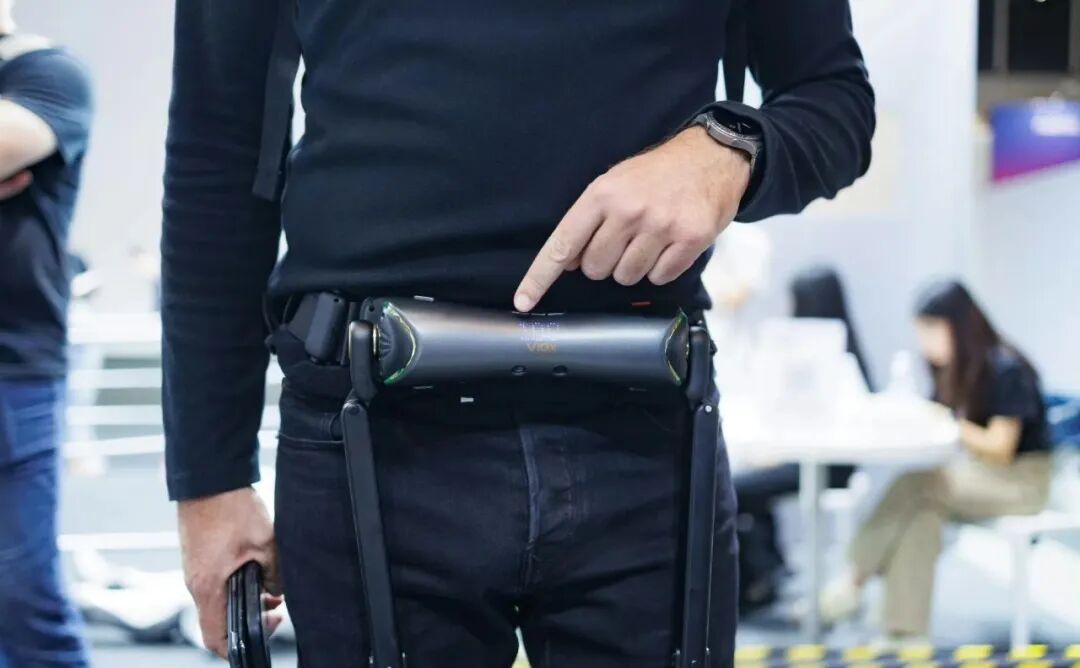
The significance of this step does not lie in the price, but in releasing the exoskeleton from professional thresholds.
Along this entry, a number of players are rising rapidly.
Jike Technology is currently a leading player in global consumer-grade exoskeleton sales, with products covering more than 70 countries. Its Series B financing was backed by Ant Group, Meituan Dragon Ball, HSG and other investors. According to an interview disclosure from LatePost, its shipment volume in 2026 has crossed the threshold of 20,000 units, leading the market share of the category;
There is also Kenqing Technology, founded in 2015, which takes the full-stack self-research route, masters servo drive control and self-learning motion enhancement AI algorithms. Its products range from the "π series" for mountain climbing assistance, to the walking assistance "H series" for the elderly that supports single-leg assistance adjustment, and then to industrial-grade waist load bearing and knee joint protection. In mountain scenic spots such as Mount Tai and Mount Heng, the main models rented by tourists are its "π series" with a unit price of six to seven thousand yuan.
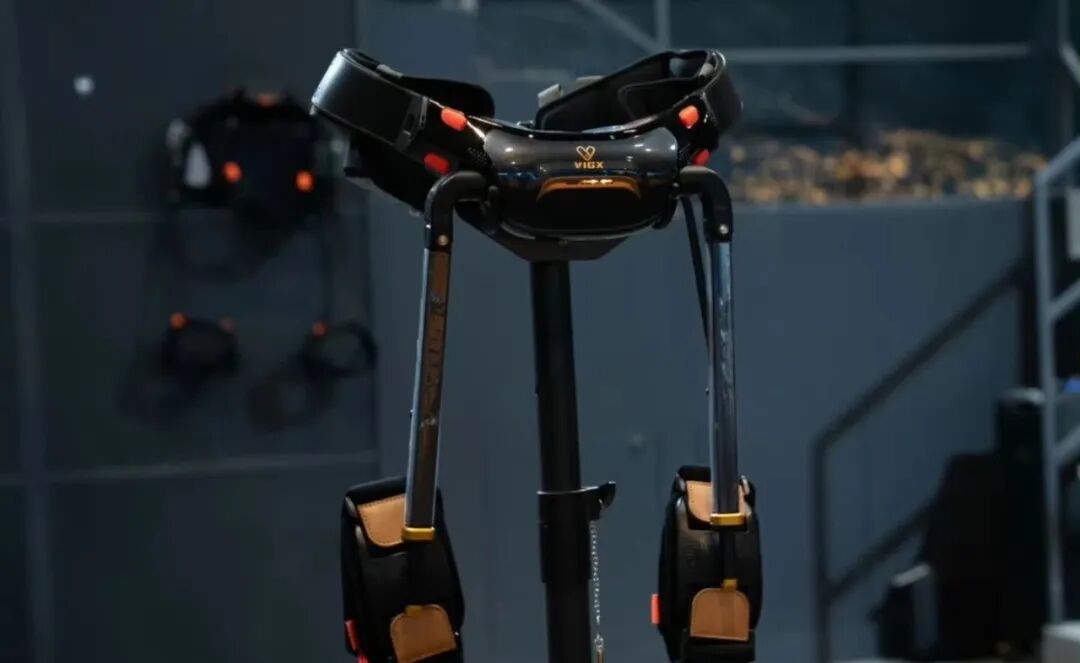
In addition to them, there are a number of cross-border players entering the market. The "Tashan" exoskeleton from Zhiyuan Research Institute has been deployed in more than 50 cities across the country. Haier has opened experience stores in Beijing and Shanghai. Even Toread, which started as an outdoor apparel brand, has launched exoskeleton products.
When a former medical device has become an outdoor gear in China, the narrative of this category is being rewritten.
3
For Exoskeletons to Become Popular,
There Are Three More Questions to Answer
From the perspective of the history of science and technology, exoskeletons mean "combining human intelligence with the physical strength of machines". Compared with humanoid robots that pursue creating a machine that looks like a human, exoskeletons aim to make machines help people become stronger. The former is more grand, while the latter is more pragmatic, and the two paths are not superior to each other.
However, the pragmatic road is not easy to take. The structure of the human body is extremely complex and precise. Even with the blessing of AI, exoskeletons still need to integrate multiple disciplines such as materials, drive, control, sensing, ergonomics, and anatomical biology. They are typical products of interdisciplinary integration. There are still many lessons to be learned in both technology and business, especially for consumer-grade products, there are many lessons to make up, but the three that really determine whether it can enter the public life are as follows.
The first is how to reverse public perception.
Exoskeletons first appeared as medical assistive devices, and it is not surprising that the public has the inherent impression that people wearing them are "different". For a new category that has just moved from professional scenarios to the public, it is an excessive demand to expect it to be fully accepted like a mature product as soon as it appears.
But for people who really need it, the value is real. Those who want to climb mountains and see the world on foot but are unable to do so can walk further wearing it, which is like fulfilling a long-cherished wish. And bringing more people to the outdoors is the most real meaning of consumer-grade exoskeletons.
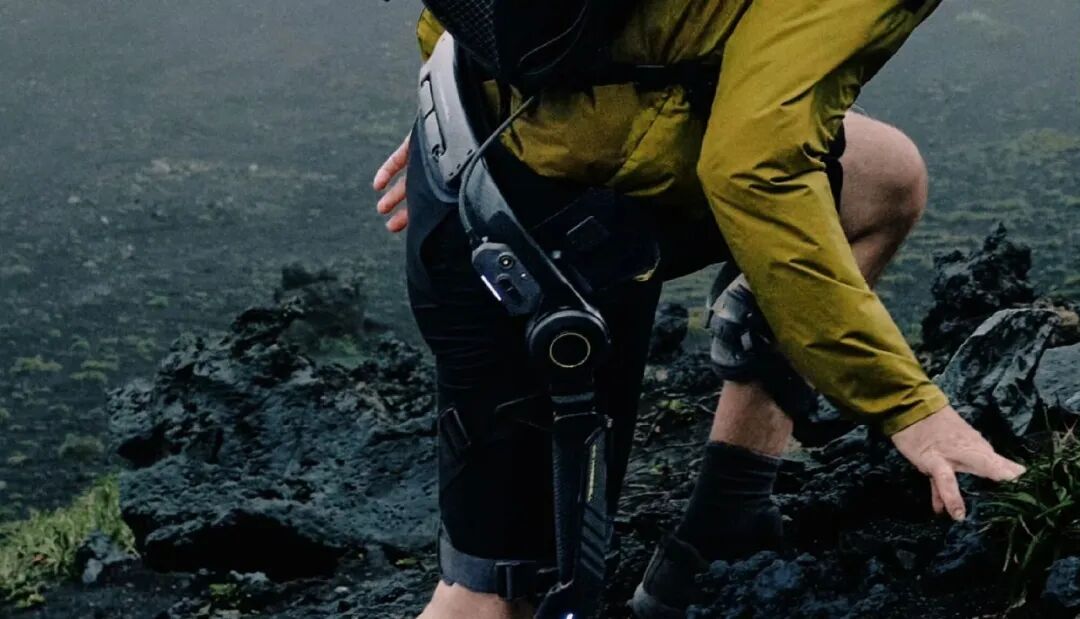
However, cognition will not automatically change just because of this value.
When healthy people wear it, others will still guess that they can't keep up physically; people with good physical strength are even more reluctant to wear it, which seems like admitting publicly that they are "not capable". Thus a cycle is formed: the fewer people wear it, the more different it looks; the more different it looks, the fewer people dare to wear it.
To reverse cognition, it is necessary to truly push the equipment to more people. When it enters daily life and so many people wear it that everyone gets used to it, cognition will naturally be rewritten