A major province in northern China has been shortlisted into the "100-billion-yuan R&D Investment Club"
The *2025 National Statistical Communiqué on Science and Technology Funding Investment* released on October 16 shows that in 2025, China's total investment in research and experimental development (R&D) exceeded 3.9 trillion yuan (RMB, the same below), reaching 39288.2 billion yuan, up 8.2% year on year. This total volume ranks second in the world, only after the United States, 3.4 times that of Germany (the 3rd place) and 3.5 times that of Japan (the 4th place).
Enterprises, government-affiliated research institutions and institutions of higher learning are the three major executing entities of R&D activities in China. In 2025, the R&D funds of these three executing entities reached 30394.4 billion yuan, 4572.3 billion yuan and 3407.3 billion yuan respectively, up 7.7%, 8.1% and 11.1% year on year. Among them, the R&D funds of enterprises exceeded 3 trillion yuan for the first time, accounting for 77.4% of the total R&D funds of the whole society, and became the main force driving the growth.
The leading role of regional innovation highlands is prominent. In 2025, the R&D funds of the Beijing-Tianjin-Hebei region, the Yangtze River Delta region and Guangdong Province reached 5368.2 billion yuan, 12219.1 billion yuan and 5510.4 billion yuan respectively, up 10.3%, 8.7% and 8.1% year on year. The total R&D funds of the three major innovation highlands accounted for 58.8% of the national total, 0.4 percentage points higher than the previous year, and the leading role of international science and technology innovation centers became more prominent.
As an important part of national innovation, regional innovation is the fundamental support for realizing innovation-driven development and solving prominent contradictions in current economic development. In 2025, the number of provinces in China whose R&D funds exceeded 100 billion yuan reached 13. Hebei joined the "100-billion-yuan club" with 1029.0 billion yuan, being the only new member added that year.
For Hebei, this can be regarded as "handing in the assignment on schedule". The *Action Plan for Accelerating the Construction of an Innovative Hebei (2023-2027)* issued as early as 2023 clearly proposed that the whole-society R&D funds of the province would exceed 1000 billion yuan by 2025. Data shows that during the 14th Five-Year Plan period, the average annual growth rate of R&D funds in Hebei reached 11.13%, outpacing the national average level.
Looking at the broader picture, the 13 members of the "100-billion-yuan club" include Guangdong, Jiangsu, Beijing, Zhejiang, Shandong, Shanghai, Hubei, Sichuan, Anhui, Hunan, Fujian, Henan, plus the new member Hebei. If demarcated by the Qinling Mountains-Huaihe River Line, there used to be only three provinces in northern China that crossed the threshold, namely Beijing, Shandong and Henan, and Hebei is the fourth one.
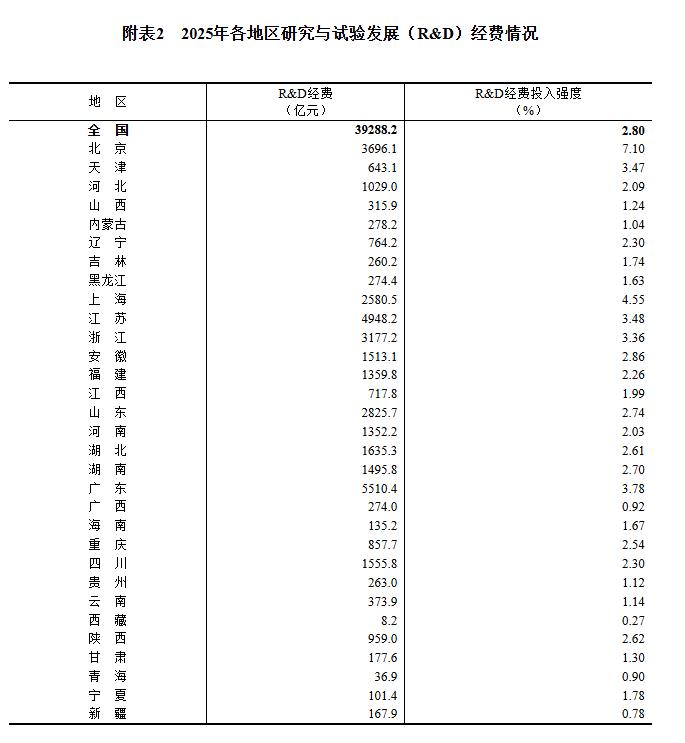
Interestingly, the economic aggregate and R&D scale of Hebei rank at the same position. In 2025, Hebei's GDP reached 49305.2 billion yuan, ranking 13th in the country; its R&D funds hit 1029.0 billion yuan, also ranking 13th. In a sense, the scale of R&D investment is a mirror of the economic aggregate.
What further illustrates the situation is the investment intensity: in 2025, the R&D investment intensity of Hebei was 2.09%, ranking 16th among 31 provincial-level regions, and the second from the bottom among the 13 provinces with R&D funds exceeding 100 billion yuan, only higher than Henan (2.03%). The national average level is 2.80%, and Hebei is 0.71 percentage points behind.
At present, the Beijing-Tianjin-Hebei region is jointly building an international science and technology innovation center. In this coordinate system, the gap is more intuitive. Beijing's R&D funds stand at 3696.1 billion yuan with an investment intensity of 7.10%, Tianjin's at 643.1 billion yuan with an intensity of 3.47%, and Hebei's at 1029.0 billion yuan with an intensity of 2.09%.
Hebei has set a higher goal for itself. In accordance with the above action plan, the province's R&D investment intensity will reach 2.5% by 2027. From 2.09% to 2.5%, it still needs to increase by 0.41 percentage points within two years.
In a sense, breaking through the 100-billion-yuan mark is more like completing a phased task for Hebei. Looking upward, in terms of R&D fund scale, Guangdong with 5510.4 billion yuan and Jiangsu with 4948.2 billion yuan are far ahead, and Hebei's R&D funds are less than one fifth of Guangdong's. When innovation becomes the main battlefield of regional competition, the scale determines the standing position, and the intensity determines the quality — Hebei, which has just crossed the threshold, still has a long way to go.
This article is from the WeChat official account "City Evolution", written by Yang Huan, and published with authorization from 36Kr.