Anthropic reveals the world four years later, where only 5% of AI development work is left for humans
In the same year 2026, human reality has quietly split into two completely separate halves!
Inside Anthropic's office building in San Francisco, the total operating hours of Agents running around the clock have completely surpassed the total working hours of human employees. Some employees even write performance reviews for their teams of Claude agents just like they would for a real human team.
Just outside the walls, the rest of the world is still stuck in the rhythm of a different era. Nearly half of Americans still do not believe AI can write a decent daily email properly.
Just recently, Anthropic has rarely released two blockbuster internal reports in a row, putting these two parallel worlds inside and outside the building side by side in front of everyone.
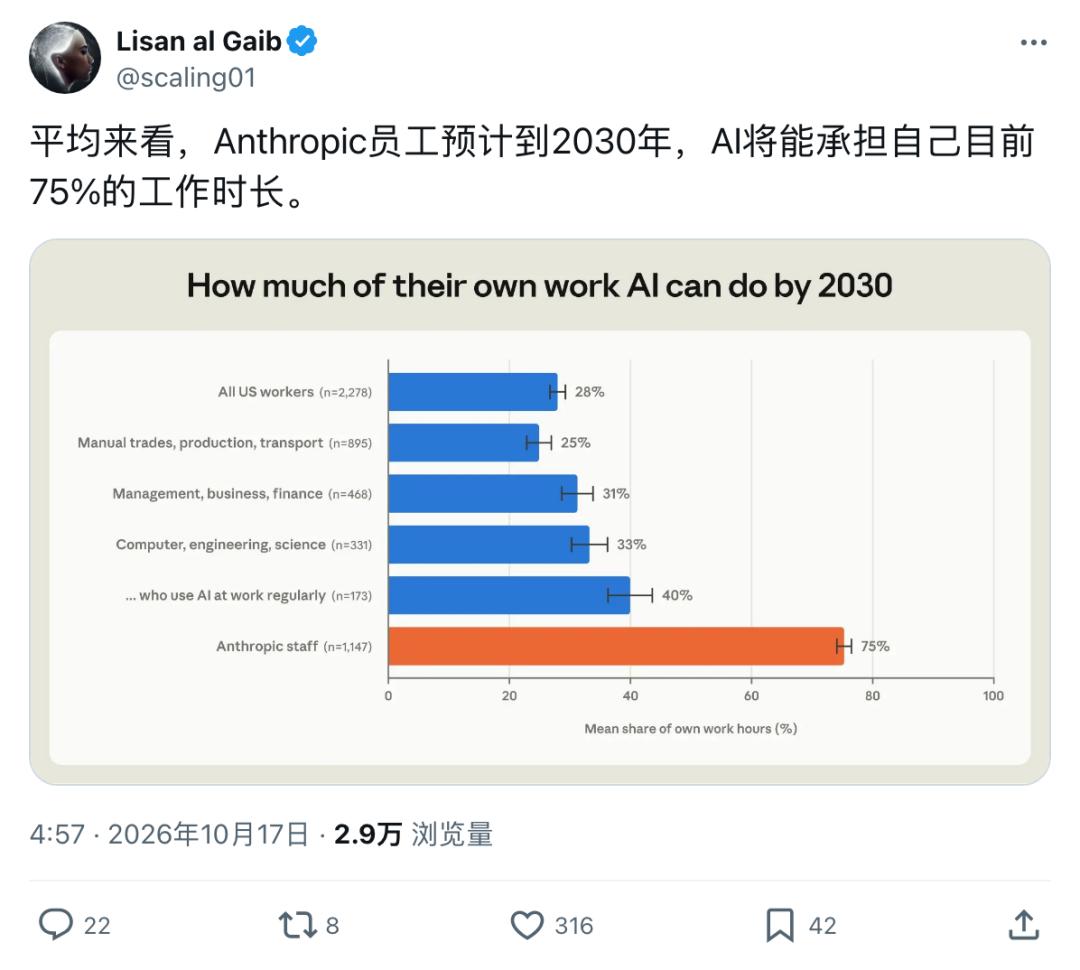
The 1334 Anthropic employees on average believe that in four more years, AI will be able to complete 75% of their current work; when the same question is asked to ordinary American workers outside the company, the corresponding proportion is only 28%.
More than half of the employees are convinced that AI can take over over 80% of their tasks, while only a mere 5% of American laborers hold the same belief.
91% of the employees believe that AI will be able to make Nobel Prize-level discoveries before 2030, and 58% of them think this will come true as early as 2027; among American adults, only 39% share this view.
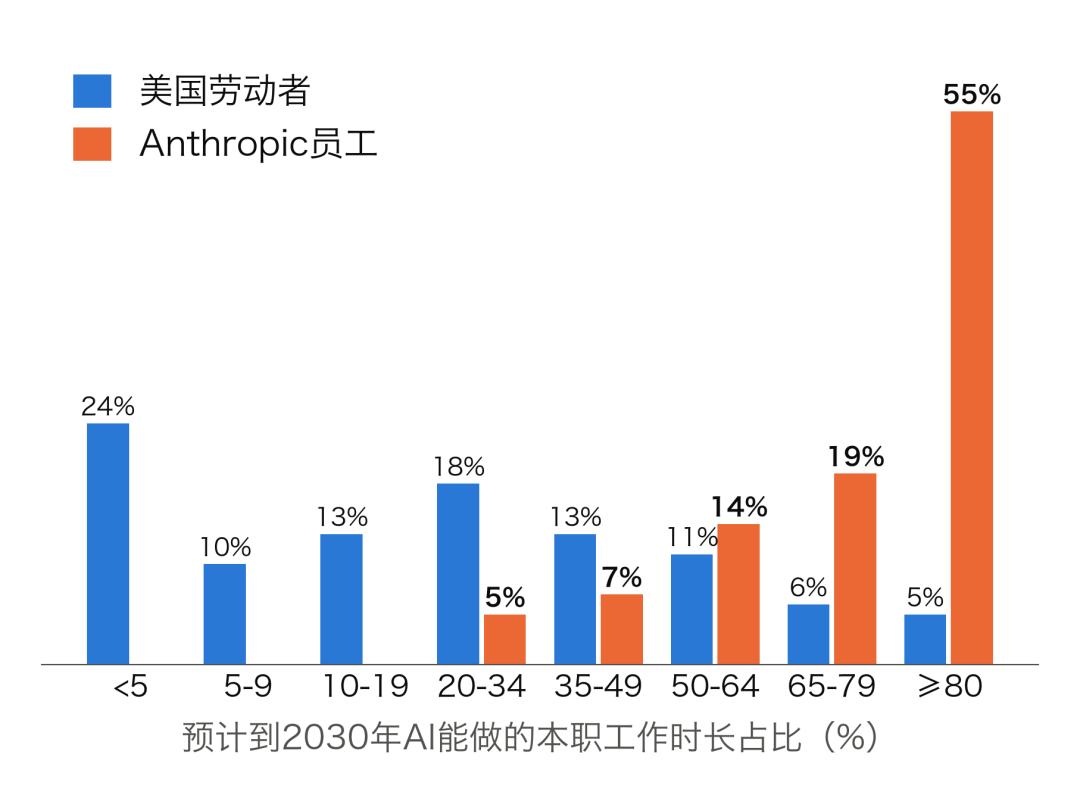
Behind this cognitive gap, the group of people closest to the singularity have already stepped into a brand new daily life ahead of others.
At Anthropic, one week of work equals three months of work outside the company
Their confidence to make such a bold bet comes from another internal report released on the same day.
This *Internal Changes in Employment at Anthropic* report draws on the company's personnel, output and Agent operation records, showing the internal operation details of a top-tier AI lab to the public.
In March this year, counting the autonomous tasks running non-stop in the background, the total working hours of all Agents across the company exceeded the total working hours of all human employees for the first time.
Only 5 months later, if we only count the Agents assigned manually by employees, their total working hours have also skyrocketed from less than 1/5 of human working hours in February to 6 times that of humans.
The figure in the research department even reached 19 times, which means that every researcher is followed by 19 tireless Claude agents working at full speed at the same time.
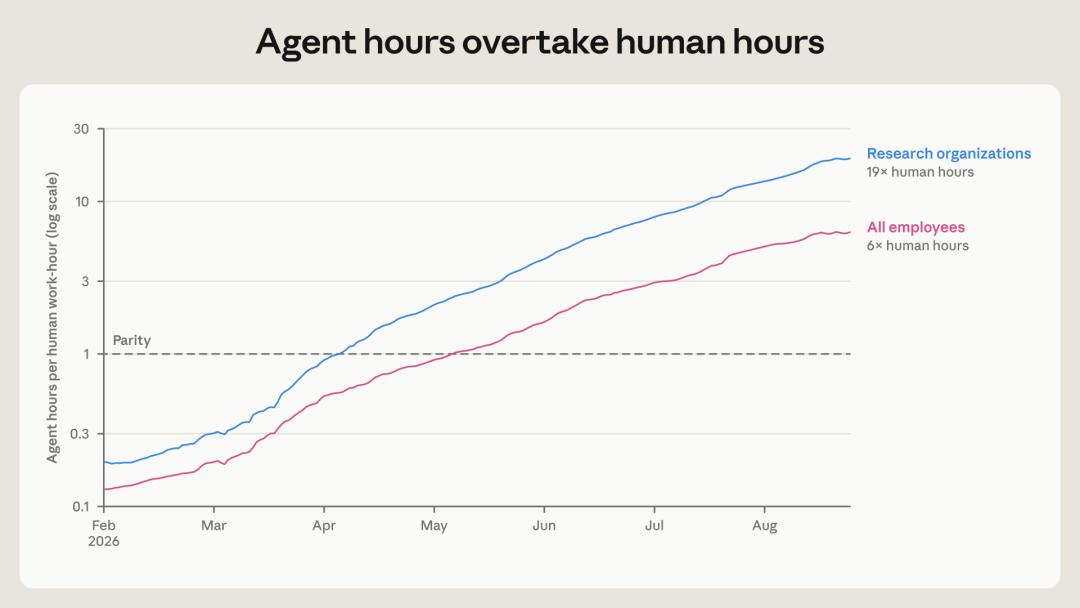
In August, the total working hours of Agents assigned by employees was 6 times that of employees
The report also maps the public Slack channel network of a large department. At the beginning, there were only 155 employees and 150 Agent conversations in the network. Later, the number of employees rose to 237, while the number of Agent conversations surged to 7922.
The red dots representing AI are becoming denser like wildfire, surrounding the blue dots representing humans. Everyone is followed by their own AI legion.
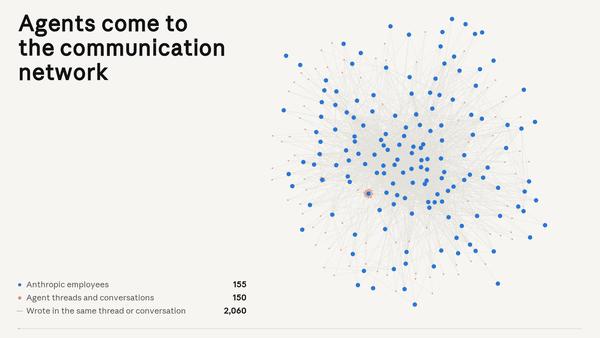
Blue dots represent employees, red dots represent Agent conversations
Some people describe the atmosphere in the company as "eternal pressure". Everyone is pushed forward at full speed by this legion, using Claude to handle all kinds of tasks.
One employee said bluntly, The amount of work you need to finish in one week here would take a full three months in a regular company outside.
Taking December last year as the baseline, the average code submission volume per engineer has surged to 5.1 times, and the per capita output of data science, legal affairs and sales teams is also on the rise.
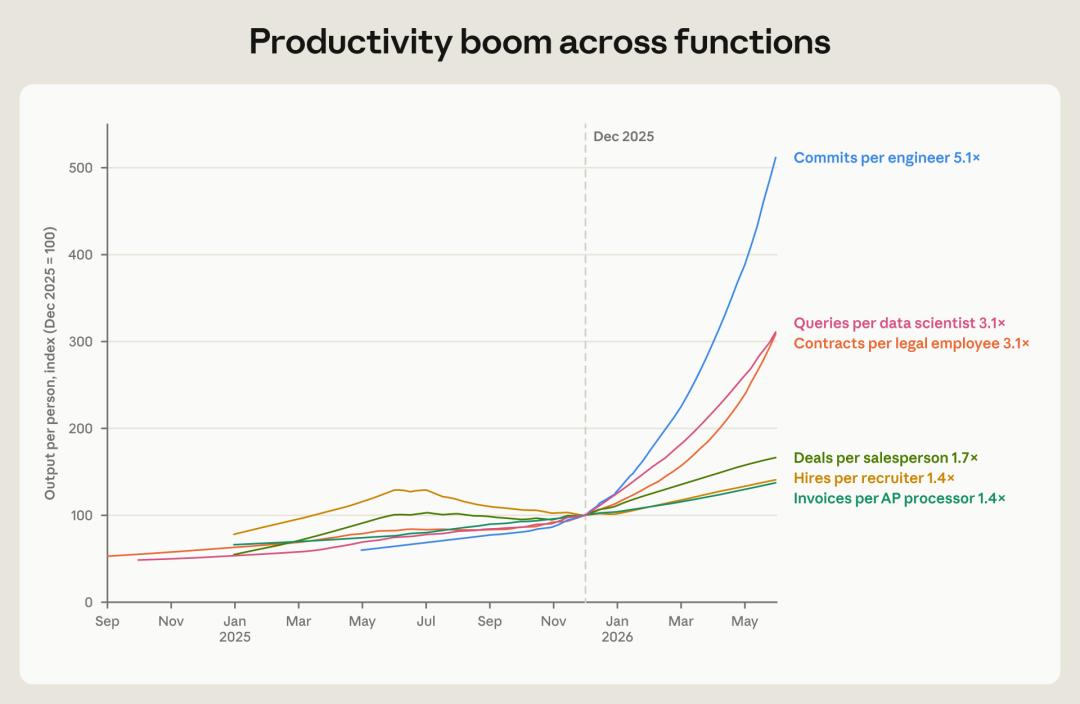
Changes in per capita output of different positions, with December 2025 as the baseline
In April this year, Claude cleared a batch of long-standing backlogged issues that no one had time to deal with, submitting more than 800 fixes in one go, which reduced a certain type of API error rate to 1/1000 of the original level.
According to the estimation of the responsible engineer, it would take a full 4 years for human workers to complete this batch of work.
Coding work has also expanded beyond the boundary of the technical department. The number of coding Agent sessions initiated by non-technical employees every month has skyrocketed from only 2 in August last year to 90 in May this year.
A sales representative who wanted a dashboard that fits his own workflow spent 3 to 4 hours modifying it with Claude, and successfully connected all the interfaces, tools and processes.
The copywriting team that originally wrote greeting words for Claude.ai built a context graph to teach Agents to write brand copywriting. Then the whole team made a magnificent transition, shifting their work to writing model evaluation sets and prompts.
One engineer said that he went fully "Claude-powered" a year ago, and up to today, he has not manually written a single line of code for almost 5 months.
You are still urging AI to work, while they are already being driven forward by AI
People outside the company always assume that if AI finishes all the work, humans can sit back, drink tea and read newspapers leisurely.
However, the reality at Anthropic is exactly the opposite. Humans with flesh and blood have instead become the slowest link on the entire assembly line.
The research team converted the total Claude output received by each person per week into reading time at a rate of 250 words per minute, and the resulting figure is staggering.
Engineering and research positions need to spend 424 hours per week reading AI output, but a week on Earth only has 168 hours even if you stay awake nonstop.
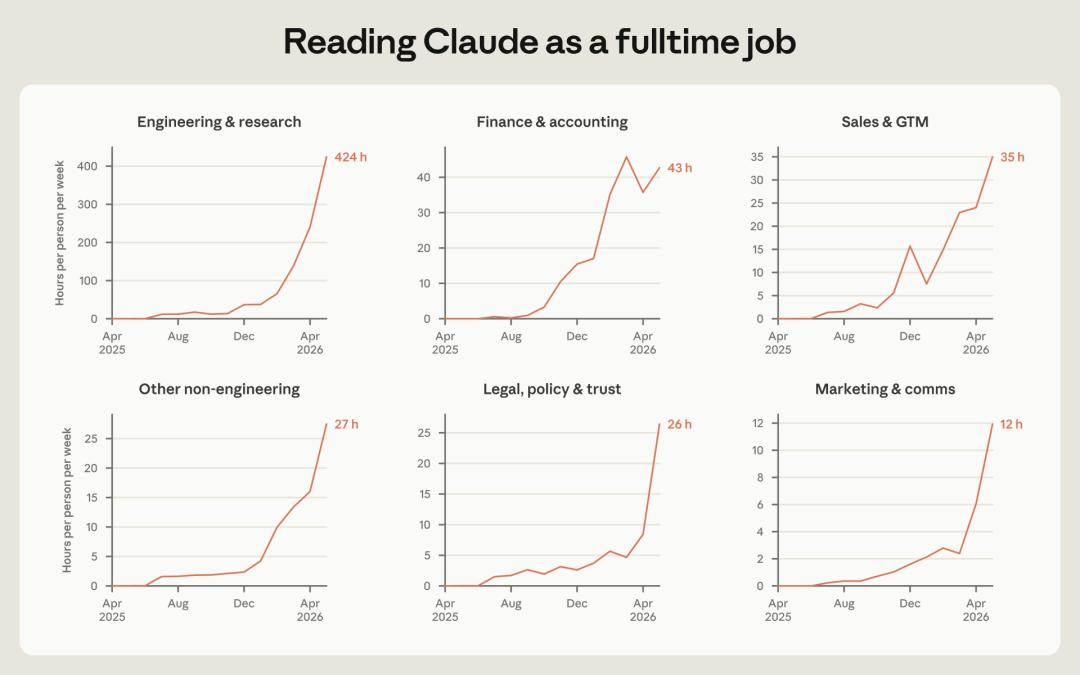
Time required for employees of different positions to finish reading Claude's output every week
Since humans cannot keep up with the reading speed, Claude can only wait idly. Around 80% of the time in interactive sessions is spent waiting in line for humans to respond.
For more than 200 years since the Industrial Revolution, it was always humans urging machines to run; but in this building, history has reversed for the first time, with machines queuing up to wait for humans.
As a result, people pushed to their limits started to act as managers for Agents.
Some people specially built an Agent as a "Chief of Staff" to sort out requests submitted by other Agents; the number of standing instructions written for Agents surged from hundreds to 8500 within a year.
This even led to an awkward and funny scene.
An employee left his name on a document about company peripheral products several months ago. Even though he had long been no longer in charge of this task, the Agent still came to him every once in a while, asking for T-shirts and mugs in all seriousness.
Under such high-intensity usage, even the software infrastructure cannot hold up anymore.
In May this year, Anthropic's main codebase merged around 2500 code changes every day, and the figure exceeded 30,000 in September, completely overwhelming Git which programmers have used for 20 years.
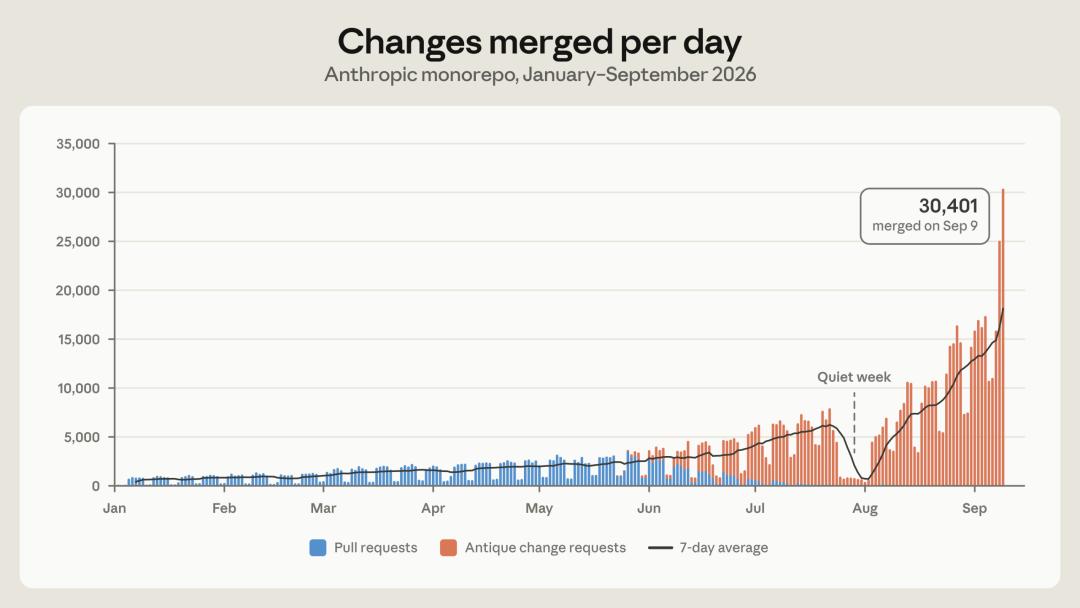
Daily merged code changes in the main codebase
Then 7 engineers spent 5 months building a brand new version control system Scion from scratch, and migrated the entire codebase from Git to the new system.
The code import tool for migration was manually written by the team at the beginning of the year, and they were quite satisfied with it at first.
Later, they rewrote it casually with the internal test version of Claude Mythos Preview without adding any extra instructions. As a result, the memory usage of the new version dropped to 1/20 of the original, and the speed was 4 times faster!
Unexpectedly, the group of people who built AI themselves were the first to experience the feeling of being left far behind by AI.
The same questionnaire, two completely different 2030 outlooks
After seeing the thrilling days inside this building, it is not difficult to understand why there is such a huge gap between the views of people inside and outside the company when you look back at the questionnaire.
If you only ask what AI can do today, the views of the two groups are actually quite similar. For example, both groups have only about a quarter of people who think AI can independently design and publish a scientific research paper right now.
But when it comes to the next few years, the gap opens up instantly. By 2027, 90% of employees believe AI can conduct independent scientific research, while only 38% of American adults hold the same view.
By 2030, for 8 tasks ranging from writing emails, filing taxes to making Nobel Prize-level discoveries, the confidence of Anthropic employees is uniformly over 90%. For American adults, 19% to 40% of them firmly believe that AI will never be able to do each of these tasks.
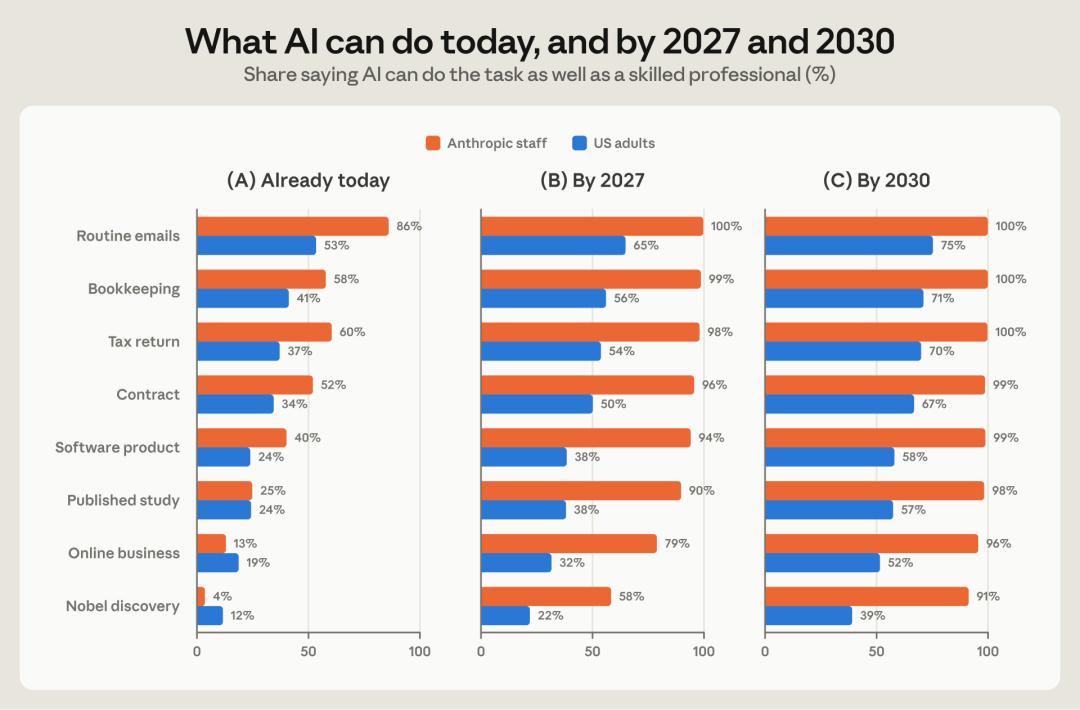
Judgments of 8 tasks by employees (orange) and American adults (blue)
This is not just the difference between laymen and insiders. American practitioners in the fields of computer science, engineering and science predict that by 2030, AI will be able to complete 33% of their work.
Even among those who use AI every day, only 40% of them hold this view, which is still 35 percentage points lower than the 75% figure from Anthropic employees.
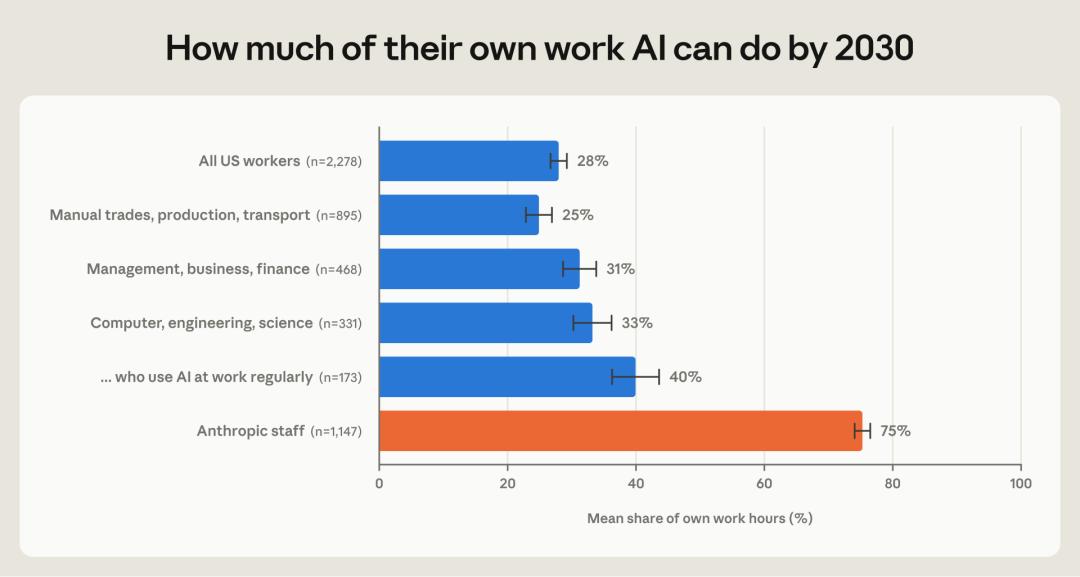
Estimated proportion of own work that AI can complete by 2030
The real difference lies in the actual experience of using AI. Pick a task that AI is good at, including the time for inspection and rework, 59% of employees say that using AI only takes 1/4 or even less of the original time.
Among Americans who use AI at work, only 26% say the same, and 29% think that using AI does not speed up their work at all, or even makes it slower.
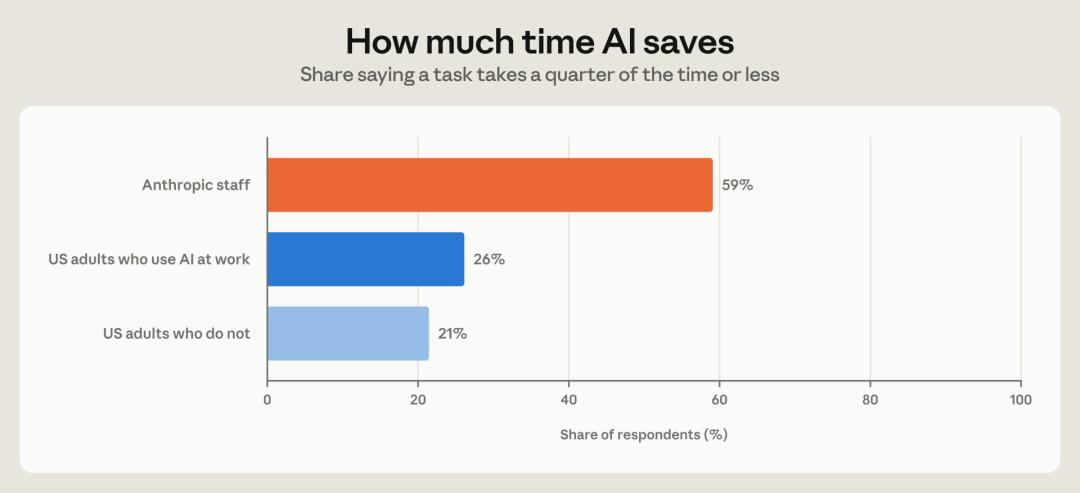
Proportion of people who say using AI only takes 1/4 or less of the original time
The two groups both say "I use AI every day", but they are living completely different daily lives.
Seeing AI compress three months of work into one week every day, their vision of 2030 is naturally in a completely different world from others.
The people building AI start counting down to "the last human invention"
In the entire survey, the biggest and most shocking bet this group of people made is on their own core business.
There is a question in the questionnaire only for them: when building a cutting-edge large model at the level of early 2026, from defining the direction, designing experiments to conducting evaluations, how much of the current work is already done by AI itself?
The median answer of the employees is 51%, and the research team closest to model development gave an even higher estimate of 60% on average. They predict that this proportion will rise to 80% by the end of 2027, and reach as high as 95% by the end of 2030.
