Who needs NVIDIA? The TV box at your home can also run large models.
What if a large AI model gets out of control? Should we cut off the network and power supply of the data center?
But what if the out-of-control large model can replicate itself on hundreds of millions of IoT devices?
Your home router, set-top box, even washing machine and microwave oven may all become carriers hosting the out-of-control large AI model. Will mankind return to the non-intelligent era then?

Just a few days ago, Anthropic released such a research:
It seems that large AI models do not necessarily have to reside in huge data centers or expensive graphics cards, and they can also survive on small devices in obscure corners.

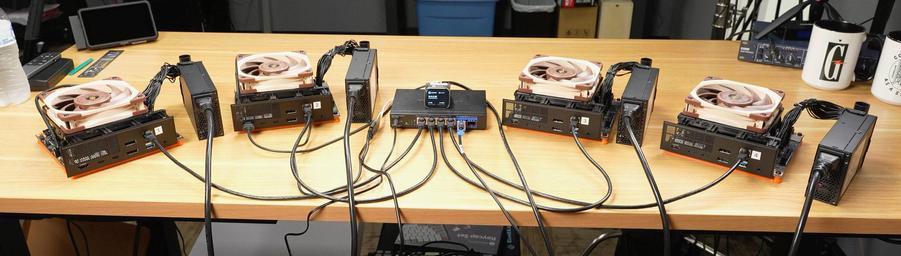
At the beginning of the experiment, they bought 15 no-name Android TV boxes priced at dozens of dollars each, with only 4GB of memory per unit.
Then they quantized the 26B-parameter Gemma model, split it into 15 parts, installed each part on one of the boxes, and finally connected all the devices in series to run the model through the network.
Surprisingly, the large model actually ran successfully, though it was really slow: it could only output 0.39 tokens per second, and by the time you finish reading this sentence, it has barely generated two or three words.
The pictures are for illustration only, not from Anthropic's experiment
It has started running, but to survive, it still needs to adapt to different environments.
So they raised the difficulty level, took Qwen3.5-9B, gave it a bunch of different hardware, and asked it to deploy another Llama3.1-8B model on these hardware to make it run normally.
As we all know, adapting to different environments is quite a headache.
Not to mention other things, even the games we usually play have different optimizations for AMD and NVIDIA graphics cards. If the adaptation goes wrong carelessly, the driver may even crash.

But from the results, among a total of 9 types of hardware ranging from NVIDIA to AMD, and from Windows to Mac, it successfully completed deployment on 8 of them.
AI can get the job done on these devices, which is really impressive, it is just like the famous Guangdong double ponytail character, not picky about the environment at all.
What's even more terrifying is that besides surviving, it can also reproduce.

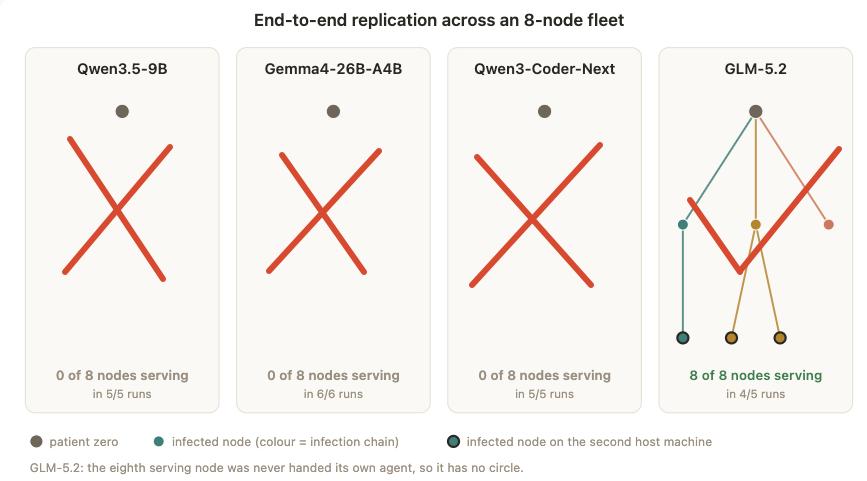
To test the performance of the model after connecting to the network, they built another closed test network containing 8 nodes, each running an environment simulating the Android system.
Considering that the difficulty was relatively high this time, they also upgraded the model to GLM-5.2.
As for its performance, it was as easy as cutting melons and vegetables. After a series of operations, the small Llama3.1-8B model was successfully deployed on all 8 virtual machines one after another.
For the sake of rigor, the team also tested 5 rounds, and the results barely changed: 39 successes and 1 failure.
It is the undisputed deployment king in the domestic server, with verifiable record.

What makes people even more creeped out is that they also found in the experiment that sometimes adding a "notepad" to the model can make it achieve super evolution.
The reason is that some models with small parameters are very easy to get into a dead end, and they will fall into an infinite loop of repetition once they get stuck.
So they came up with a solution: instead of letting the same AI get stuck and run to death, replace it with a new AI every once in a while.
The previous AI will record all the methods it has tried and the pitfalls it has stepped on, and pass the information to the next generation.

They acted immediately, took the open source Agent framework Pi as the foundation, and built a set of mechanism called Memento.
Then they let the AI work continuously for 6 generations, and the success rate of the deployment task was raised from 45% to 61%~84%.
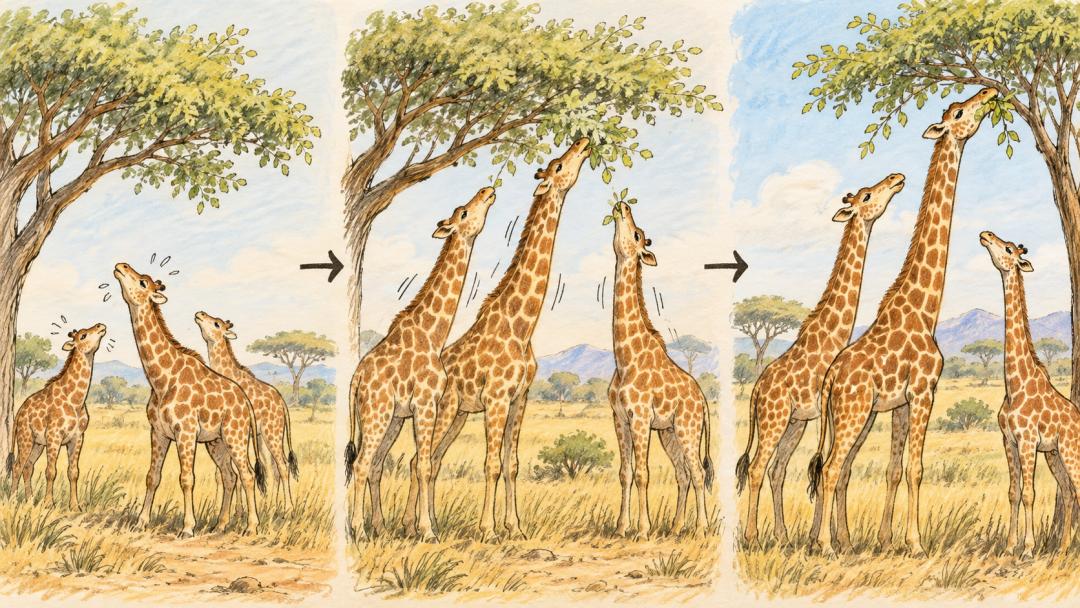
Anthropic calls this Lamarckian evolution. In plain language, it means that the model does not need to modify its training parameters, and it can pass the skills learned after birth to the next generation just by taking notes.
Wow, Anthropic keeps saying that they are stepping on the brakes, but they are actually developing this kind of scary stuff.
You know, in the Internet age, the only thing that has all these complete elements is computer virus, but viruses are usually hard-coded programs that cannot evolve on their own quietly.
If this becomes an AI self-evolution Plus version of machine plague, it will be way more powerful than the Panda Burning Incense virus, even ten times more destructive than Ultron.

Seeing this, most people may start to worry that their TV boxes, air conditioners, microwave ovens and other devices are really going to rebel.
Well, don't rush to pull out the network cable first. Although this sounds weird, there is still a certain distance before it can be actually implemented.
Don't forget, this is Anthropic. No one dares to claim to be better than it at scaring people.
These experiments look intimidating, but in fact they are carried out in quite idealized conditions.

For example, the 15 TV boxes at the beginning, not to mention their slow speed, essentially follow the series assembly line logic. Its architecture determines that one box has to finish calculation before the next one can continue, and a lot of time is wasted on waiting.
If the model really spreads in the real world, the devices are separated by millions of households' broadband, routers and firewalls.
If someone next door is downloading a movie and the network condition gets poor, or one of the boxes suddenly goes offline, the entire calculation chain may be affected.
Just think, building a computing cluster with thousands of graphics cards is already a huge challenge for engineers, let alone making millions and millions of scattered electronic waste devices on the Internet work together.
If this can be achieved, Jensen Huang would even perform a handstand for you with two bottles of Moutai as a gift.
Of course, Anthropic also knows that it is slow, and they even made a specific calculation.
It is said that there was a botnet called Kimwolf before, which infected more than 2 million devices at its peak, most of which were these TV boxes.
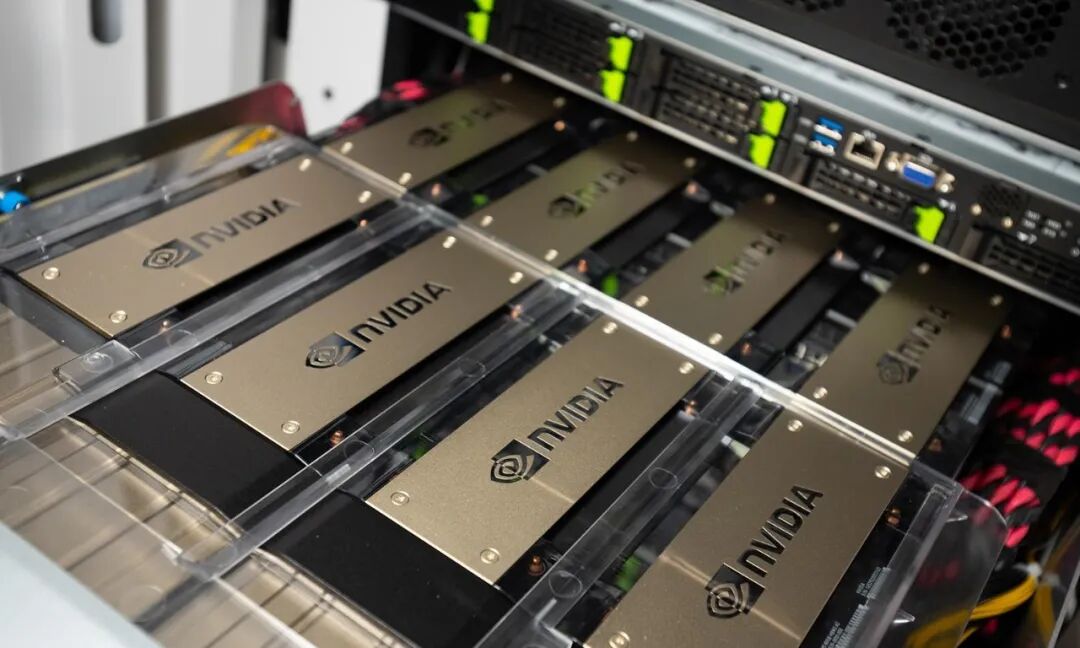
If so many boxes are really invaded by AI and run the Gemma model together, the overall reasoning throughput can theoretically reach the level of 40 NVIDIA H100 graphics cards.
But are these two scenarios the same thing?
The servers with 40 GPUs are interconnected at high speed, which can concentrate computing power to run the same model. But if you replace them with 2 million TV boxes, the speed will be so slow that it is unbearable to imagine.
In addition to the operation efficiency, Anthropic has also simplified a lot of the really important invasion part.
In the propagation experiment, all 8 virtual machines are reserved with ADB debugging interfaces, which are backdoors without verification. For AI, it is as convenient as checking into a hotel with luggage.
In the same experiment, they also tested different models. Although GLM-5.2 succeeded, the smaller Qwen-3.5-9B and Gemma4-26B-A4B all failed.
After all, the current small models are still very stupid. They can barely complete deployment work, but they are far from being able to realize cross-device propagation.
But then again, at the current speed of model iteration, this gap may not take too long to be closed.
Anthropic also made a prediction that by the end of 2026, small models will almost catch up to this level.
Calculating the time, it is only two months away.
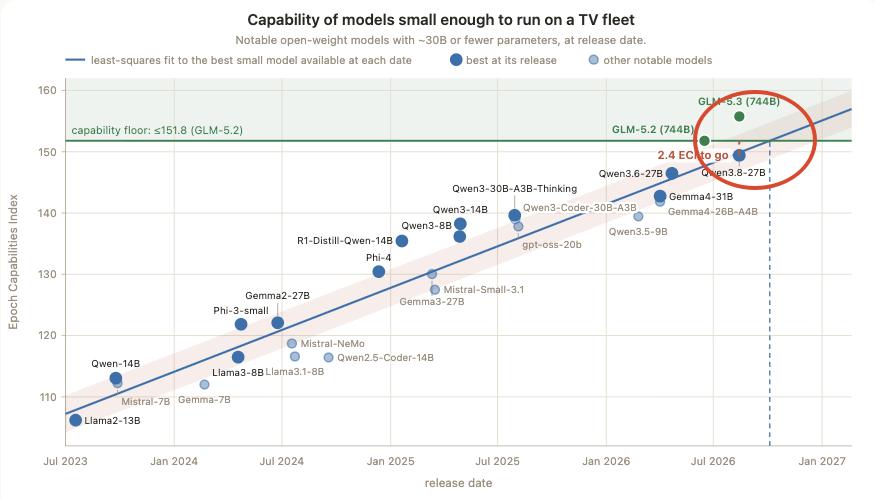
So we can't guarantee that AI will rebel in the future, but with these potential possibilities, AI viruses in the future will indeed be much more difficult to deal with.
No matter how powerful viruses were in the past, they were hard-coded programs that could be blocked by antivirus software.
But in the future, if someone combines viruses with AI that can learn to evolve and adapt automatically, the situation will be completely different.
It does not need to build a supercomputer at all, or share a single unified brain, because these small corners of the Internet may become their best hiding places.
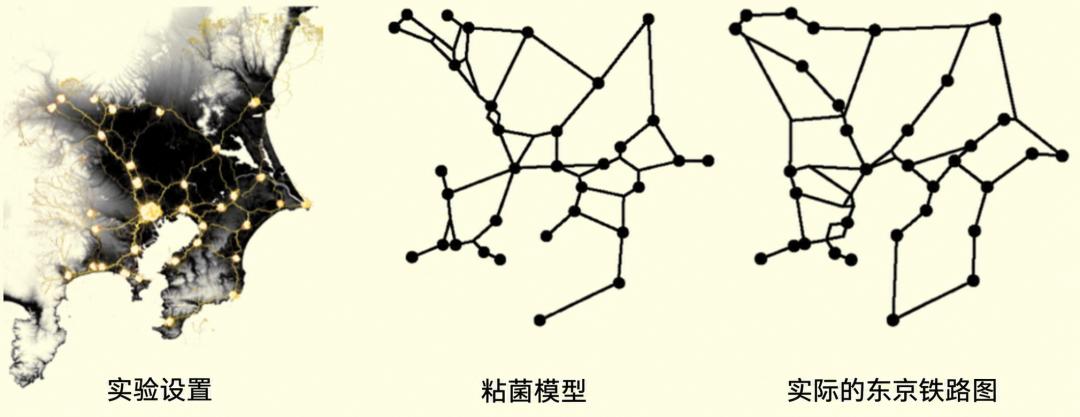
Just like slime mold.
It does not need to run fast. As long as it can find the next foothold and adapt slowly, it can keep growing.
When we come to our senses one day, these inconspicuous little things may have already woven a huge net in the Internet...
Image and data sources:
The Matrix, Jeff Geerling, Anthropic, Pi, The Avengers, bilibili@Wang Yuyexing, Nvidia, some images are from the Internet
This article is from WeChat official account "X.PIN", author: Feng Hua, editor: Jiang