8000 Words: The First Public Unveiling of the Dramatic History of Codex's Comeback Against ChatGPT
Codex is one of the most important untold stories in the history of technology.
Not long ago, this story was finally fully uncovered.
Every CEO Dan Shipper spent months interviewing Greg Brockman, co-founder of OpenAI, and six core members of Codex, writing an 8000+ word long article 《How Codex Happened》.
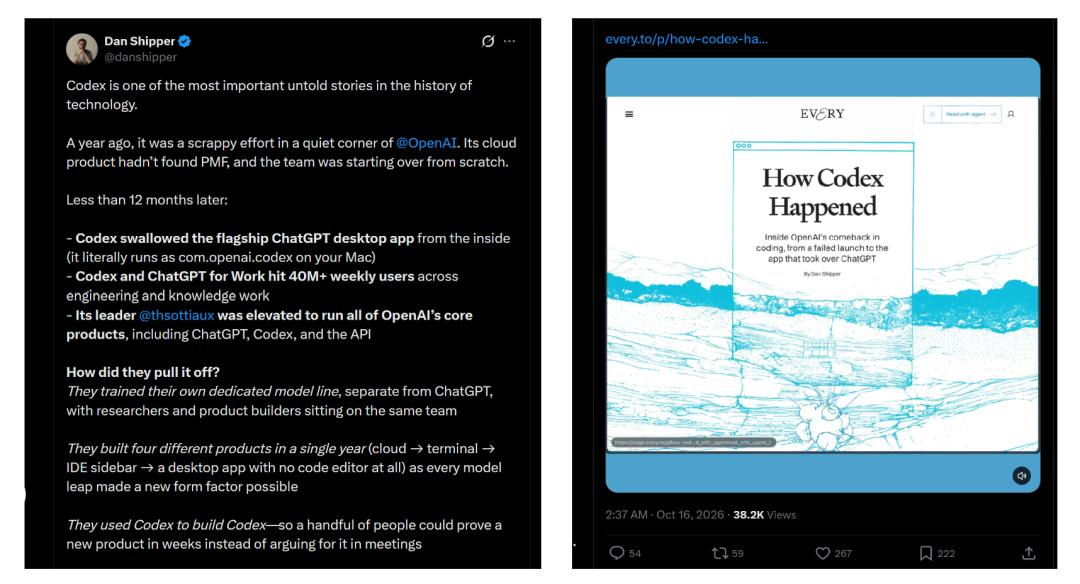
The article restores for the first time how Codex went from a lukewarm debut with no PMF (Product-Market Fit) to a full turnaround and became the underlying foundation of the ChatGPT desktop client.
The most representative detail that illustrates this counterattack is a small feature hidden in the Mac system:
The internal identifier of the new version of the ChatGPT desktop application is still named "com.openai.codex" to this day.
A year ago, Codex was only a tiny entry point inside ChatGPT. Less than 12 months later, ChatGPT has instead moved into its framework.
What a classic "reverse takeover".
As for how this counterattack happened? We sorted out four key points from the information disclosed by the team:
1. The first version of Codex Cloud received a cold response from the outside market, and the team quickly shifted its focus to local Agents; 2. OpenAI launched an independent model line exclusively for Codex to enable direct collaboration between research, product and engineering teams; 3. The team iterated through four product forms within one year, and finally bet on a desktop application without a built-in code editor; 4. They used Codex to develop Codex, and a small team of several people could build a new product in just a few weeks.
Of course, what is more exciting than the conclusions themselves is the dramatic and winding story behind this process.
Enjoy.
The first version of Codex failed because it was too far ahead of its time
The origin of the new generation of Codex can be traced back to the end of 2024.
At that time, Sottiaux, who is now the head of the Codex team, was leading the team to train an internal programming Agent, which was specially designed to help OpenAI researchers write infrastructure code, run experiments, and then use the experimental results to improve the next generation of models.
Surprisingly, before Codex was officially launched, it had already participated in building its "next-generation version" inside OpenAI.
Looking back today, this set of practices was somewhat ahead of the curve.

It was not just Sottiaux's team. In fact, multiple teams inside OpenAI were betting on AI programming at the same time, but they took different directions:
Some teams focused on the terminal, some on IDEs, and others insisted that "Agents should live entirely in the cloud".
Among them, the cloud route sounded particularly attractive.
When people get off work and close their laptops, the Agent can still continue working on its own machine. When users come back the next day, the code has been modified, all tests have been run, and even the PR is ready for review.
Who wouldn't be tempted by that?
So in the spring of 2025, these exploring teams gradually converged, and the team made a final decision:
Prioritize the cloud route first.
They spent only about 7 weeks building Codex Cloud. They thought this product launched in May 2025 would be a success, but the reality dealt a heavy blow to everyone: users did not show much interest in it.
The problem lay in the working environment.
There was a unified development configuration inside the company, so researchers could almost "move in with their bags packed". But external developers faced various dependencies, permissions and private tools, and they had to go through a whole set of novice tutorials just to get the Agent into their real working environment.
To make things more awkward, Embiricos, the product lead, added a point later when reviewing the project:
The models at that time were not intelligent enough to independently handle complex tasks.
Therefore, the first version of Codex Cloud hit two walls at the same time.
The environment configuration was too complicated, and the model capability could not keep up with expectations.
The team built the ideal working method ahead of time, but the real world was not ready for it yet.
This high-stakes bet on the cloud ended in complete failure...
A two-person side project saved Codex
While OpenAI suffered this setback, Anthropic from the other side broke through with Claude Code via a different path.
Claude Code runs directly on the user's own computer, with all files, tools and development environments ready to use. Users can interrupt it at any time, or continue to make adjustments along the same context.
Developers quickly voted with their feet.
The Codex team then realized that the cloud end state they were pursuing might not be wrong, but they had taken too big of a step in the intermediate stages.
What to do next?
Turn back and pick up the local route that was once abandoned.
As a matter of fact, this local route had always existed.
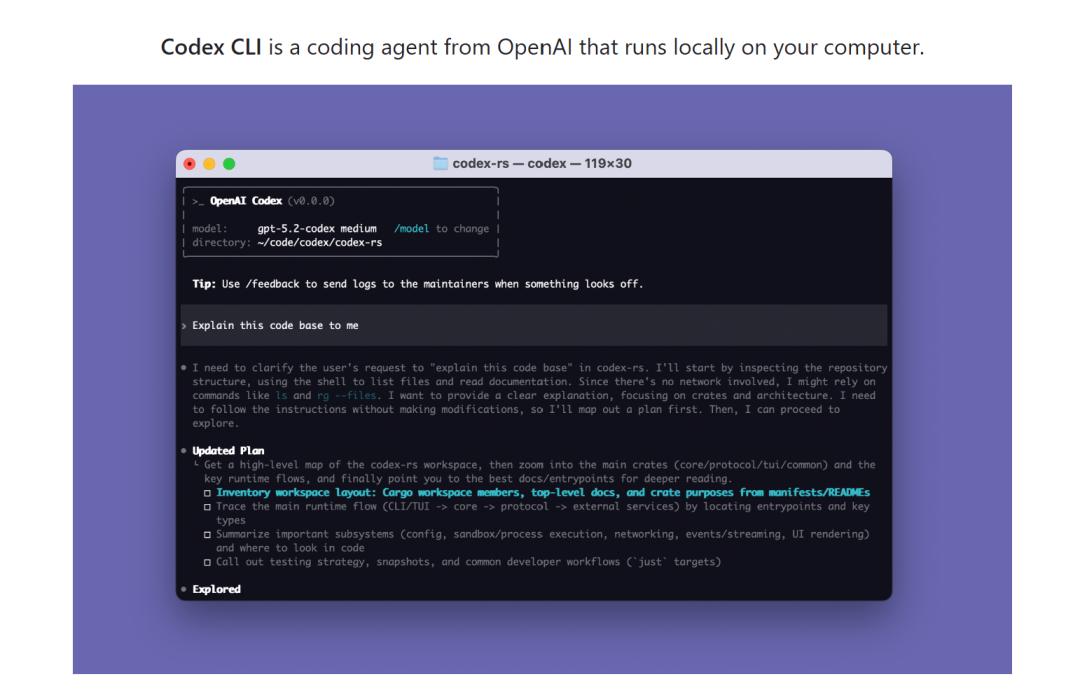
As early as one month before the release of Codex Cloud, OpenAI open-sourced Codex CLI, which can directly read files, modify code and execute commands in the terminal. Its product form was quite similar to Claude Code.
However, CLI was not the mainline project of the Codex team at that time.
According to Embiricos, it was a "heroic" side project built by only two people. The team had also developed a local Agent prototype before, but they put it aside after a month and all shifted to the cloud route which they thought had greater potential.
No one expected that the very side project that had been shelved would eventually come to the rescue.
In the summer of 2025, Sottiaux took over the team and announced directly:
Shift to the local route.
But he did not rush to pile new features into the CLI. On the contrary, the team rewrote the entire underlying Agent from scratch.
This choice seemed somewhat abnormal at that time.
After all, Claude Code had already been launched, and external users were demanding new features. But the Codex team dived into the underlying layer and started refactoring with Rust.
On the surface, while other teams were busy seizing the market, they were still replacing the "engine" at home.
But what Sottiaux wanted to solve was exactly the problem that Codex had faced when it changed product forms repeatedly in the past.
The CLI is only the visible shell for users. What is truly valuable is the underlying Agent that can read files, run commands, call tools and modify code.
As long as this core capability is separated from the terminal, it can be deployed anywhere in the future:
It can be used in terminals, IDEs, desktop applications, mobile phones, the cloud, and ChatGPT as well.
This time, the team did not rush to bet on the next interface. They first built out the "Codex core" itself.
However, even after the new engine was replaced, the car still could not run fast for the time being.
The team was still missing a sufficiently powerful model.
The past OpenAI models performed very well in programming competitions, but they tended to show weaknesses when working on real codebases: messy project files, complex dependencies, and users interrupting midway, which was completely different from solving a clean algorithm problem.
Greg Brockman had a very vivid metaphor for this:
These models are like students who got full marks in the SAT but have never worked a single day in their lives.

Therefore, Michelle Pokrass's team, which was responsible for the post-training of GPT-5, began to "add work experience" to the model, letting it get exposed to messy large codebases, learn to understand project structures, track bugs, and learn to stop and ask users for permission when it needs to cross authority boundaries.
By August 2025, the refactored Codex CLI was finally paired with GPT-5, and then integrated into the sidebars of VS Code and Cursor.
This time, users really came.
By October of that year, Codex usage increased by more than 10 times, and the IDE extension quickly surpassed the terminal to become the most commonly used entry point.
The CLI that was built by two people and almost left as a side project finally pulled Codex out of its first cloud failure.
Embiricos recalled that the only thought in his mind at that moment was:
"We can finally go all in."
Right after the IDE product became a hit, the team pivoted to building an App
Logically, when both the CLI and IDE extensions were growing rapidly, the next step should be to add more team members and more features to scale the business.
But the Codex team made another turn.
Sottiaux believed that the model would soon be able to work continuously for several hours, processing code, images, voice and external information at the same time, and users might command five or six Agents simultaneously in the future.
It would be too much to ask this decades-old black frame terminal to handle so many tasks at once.
So he decided to continue maintaining the CLI, while putting the largest next batch of investment into the native desktop App.
To build the App, Sottiaux brought in Andrew Ambrosino, who is both a designer and a programmer. The entire core team had only 4 people, but their goal was very ambitious:
Build a "control console" that can manage multiple Agents at the same time.
The interface is more like a chat software, with different projects and tasks on the left side, and each task has an Agent. Users can assign multiple tasks at the same time, then check the progress and add requirements back and forth.
Then, an even bolder decision was made:
This programming App will not include a code editor.
This means that even if Codex misspells a single word, users cannot manually edit it directly, and can only continue to instruct the Agent to fix it by itself.
Ambrosiao calculated clearly: once users are allowed to edit manually, a full set of IDE functions such as search, undo, shortcuts and debugging will be required to follow.
If 4 people tried to replicate VS Code, the most likely result would be a low-quality version that was inferior in every aspect.
The team simply cut off all retreats:
Codex has to be powerful enough to let users put down their editors, then this App can justify its existence.
The idea was very cool, but the early versions even stumped the team members themselves.
Embiricos asked every team member every day: Are you using this as your main tool today?
At first, everyone answered: No.
Some complained that even replacing a single sentence required a dedicated prompt to Codex, which was too troublesome. Even Ambrosino himself doubted internally:
Is not providing file editing a big mistake?
At this very moment, Google released Antigravity with a full built-in code editor.
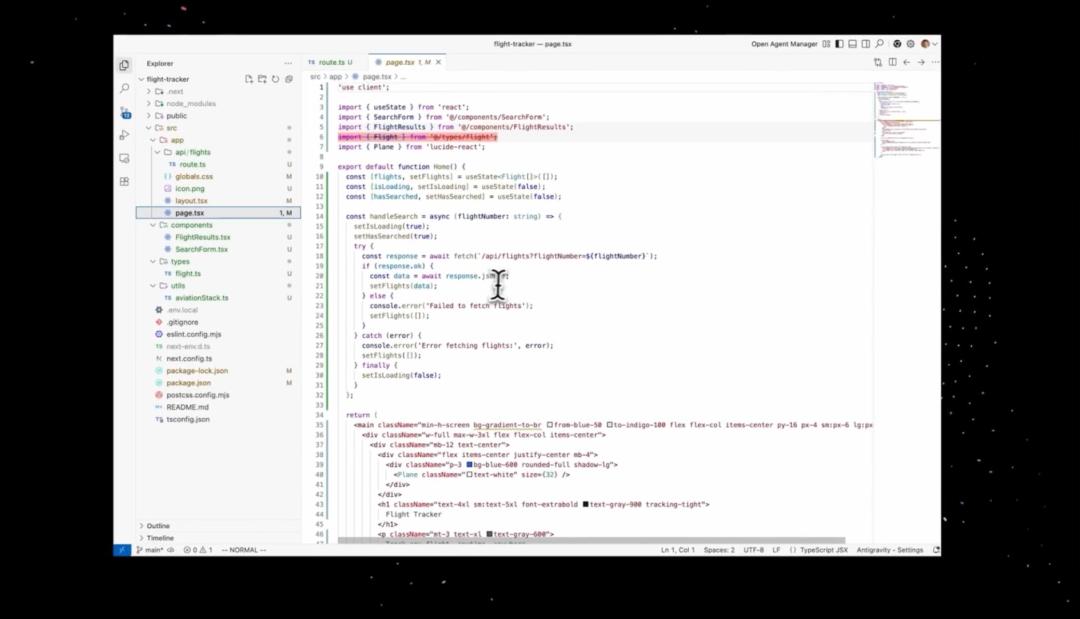
The several members of the Codex team looked at each other, and they were all probably wondering in their hearts:
Should we have just embedded a VS Code in the App after all?
Worse still, the Codex model at that time could not support this design. Ambrosino later said frankly that even if all the App functions were completed, the model quality would still make it "unreleasable".
The team could only push the product forward while waiting for the model to catch up.
And they finally waited for that moment.
In November 2025, GPT-5.1-Codex-Max was released, and the model began to be able to program continuously for several hours.
A month later, GPT-5.2-Codex further enhanced its ability to modify large codebases.
By December, the sentiment inside the team began to change.
People who originally insisted that they needed an editor gradually stopped modifying code manually, they would leave comments on the results and let Codex handle the changes itself.
In early 2026, the entire Codex team began to use this App as their main tool, and then engineers and researchers inside OpenAI also switched to it one after another.
Even Greg Brockman, who was used to terminals and Emacs, "defected" to the new App.
When he went back to the old workflow, he only felt like "going back to the past".
On February 2, 2026, the Codex desktop App was officially released.
This time, external users also recognized its value.
In March, Codex's weekly active users exceeded 2 million, and surpassed 5 million in June, of which about one fifth were knowledge workers.