After reading Anthropic's internal work report, I really feel deeply worried for fresh graduates.
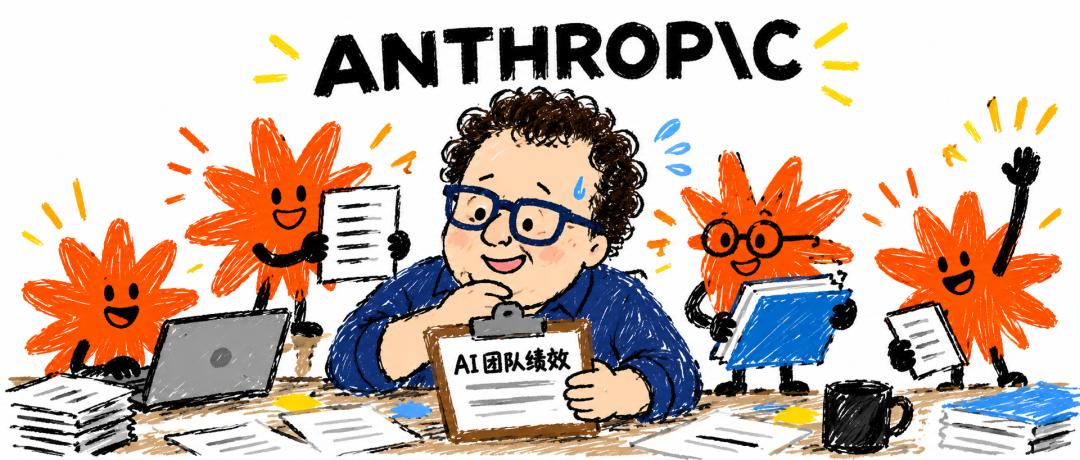
The world is becoming increasingly surreal. While ordinary employees are still struggling with how to write their performance reviews, some people have already started drafting performance evaluations for the Claude Agent team.
One engineer at Anthropic once conducted an evaluation for his own Agent team, discussing what went wrong in their mutual communication methods. Another engineer simply arranged an AI assistant to filter requests sent by other AIs on his behalf.
These two details come from an internal employment report released by Anthropic on October 16.
During the tracked period from 2025 to 2026, the proportion of junior employees among newly recruited technical staff dropped from 27% to 9%. At the same time, the company is still expanding its workforce, and the total number of technical personnel is also increasing. The only change is that the share of junior employees in new hires has become lower and lower.
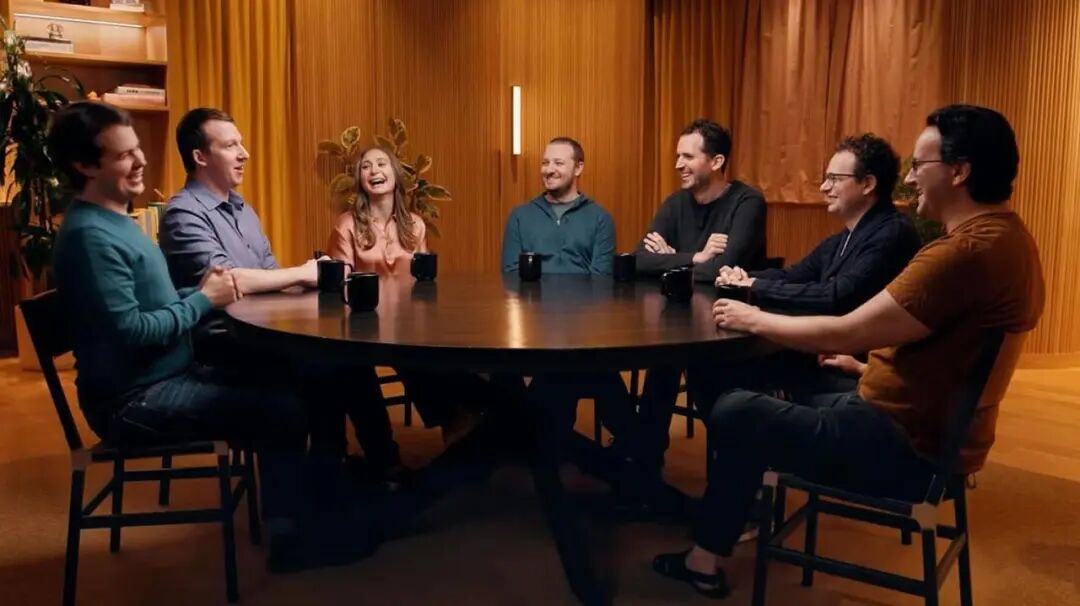
▲ Team photo used on Anthropic's recruitment page.
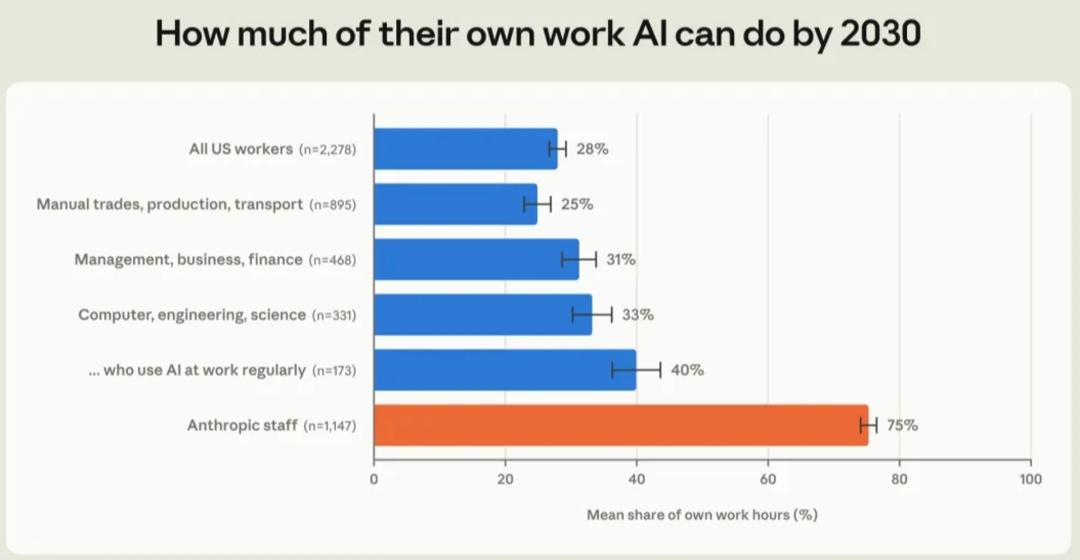
Anthropic's internal employee survey shows that its employees believe AI will be able to complete 75% of their work in four years, while only 28% of ordinary American professionals hold the same view.
A huge cognitive gap is taking shape.
Before the AI era, newcomers to the industry could take on tasks with relatively clear requirements first: modifying a small feature, fixing a known issue, or familiarizing themselves with workflows under the guidance of senior colleagues.
If these tasks are more and more easily handed over to AI, how will companies recruit new employees? Where will newcomers accumulate their first work experience?
AI's working hours have reached six times that of humans
As of August this year, the total cumulative working hours of interactive AI agents called by employees have reached 6 times the working hours of the employees themselves.
The agent mentioned here refers to AI assistants that can use tools independently and complete tasks. One person can assign multiple AIs to work at the same time, and the working hours of each of them will be included in the statistics.
For example, if 3 AIs work for 1 hour each, the total is counted as 3 working hours. The "6 times" in the report is a comparison of working time, not output. This figure only refers to cumulative working time, and does not mean that 6 times more output is actually produced.
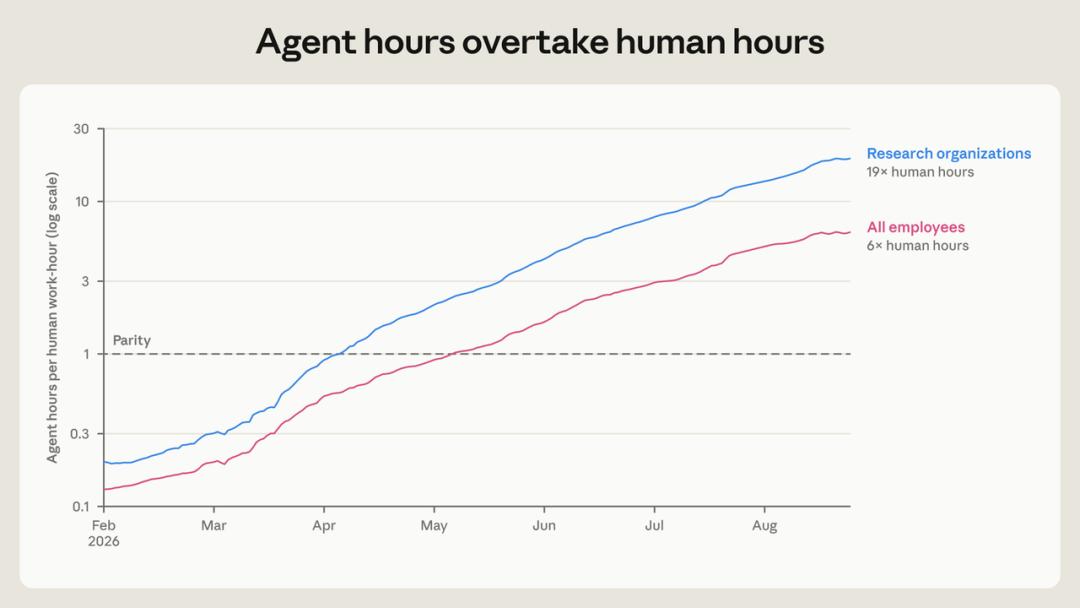
▲ The pink line represents all employees, the blue line represents the research department. The vertical axis is the ratio of AI agent working hours to estimated employee working hours.
These tools have also enabled people who did not originally write code to start developing by themselves.
A salesperson said in an interview that he used AI to create the data dashboard required for his work, connecting the interface with several tools. According to him, the whole process took three to four hours. In the past, this kind of development was completely beyond his ability.
For a salesperson, he knows best which customer information needs to be aggregated, and he also knows where the existing system is not user-friendly.
In Cowork, a product for ordinary office users, similar processes have been integrated into the product demo: Claude collects materials from emails, work groups, calendars and files, organizes pre-meeting briefings for customers, and then drafts a confirmation email.
In the past, preparing for a customer meeting might require opening multiple windows, scrolling through chat records, checking schedules... just thinking about it is a bit of a headache.

▲ Cowork official website demo: Search for materials, organize key points before the meeting, draft emails.
For users, the new trouble is very similar to a sudden surge of activity in a work group: several tasks are completed at the same time, and several results are waiting for you to review. One proposal asks you whether to proceed, a piece of code waits for you to confirm permissions, and another task encounters an exception. Before you finish reading the last one, new messages come in. This way of working makes everyone more or less experience a little bit of what it feels like to be a manager.
According to the report's statistics, in interactive multi-turn conversations, about 80% of the time is spent waiting for human input. (It is the AI conversations waiting for humans, not that employees are idle 80% of the day.)
That's why the two engineers at the beginning started to evaluate Claude and arrange assistants to divert requests. The instructions for AI also need to be written more and more specifically: what matters can be decided by itself, what situations must be consulted, and which results need to be checked first.
Another Anthropic employee has actually changed his job responsibilities, but agents still keep asking him about company peripherals such as T-shirts and mugs that he was previously responsible for, and the person in charge recorded in the old documents has not been updated accordingly.
The meeting is over and the tasks have been reallocated. If the new decision only remains in the memory of a few people, the AI will still get the old context the next time it performs the task.
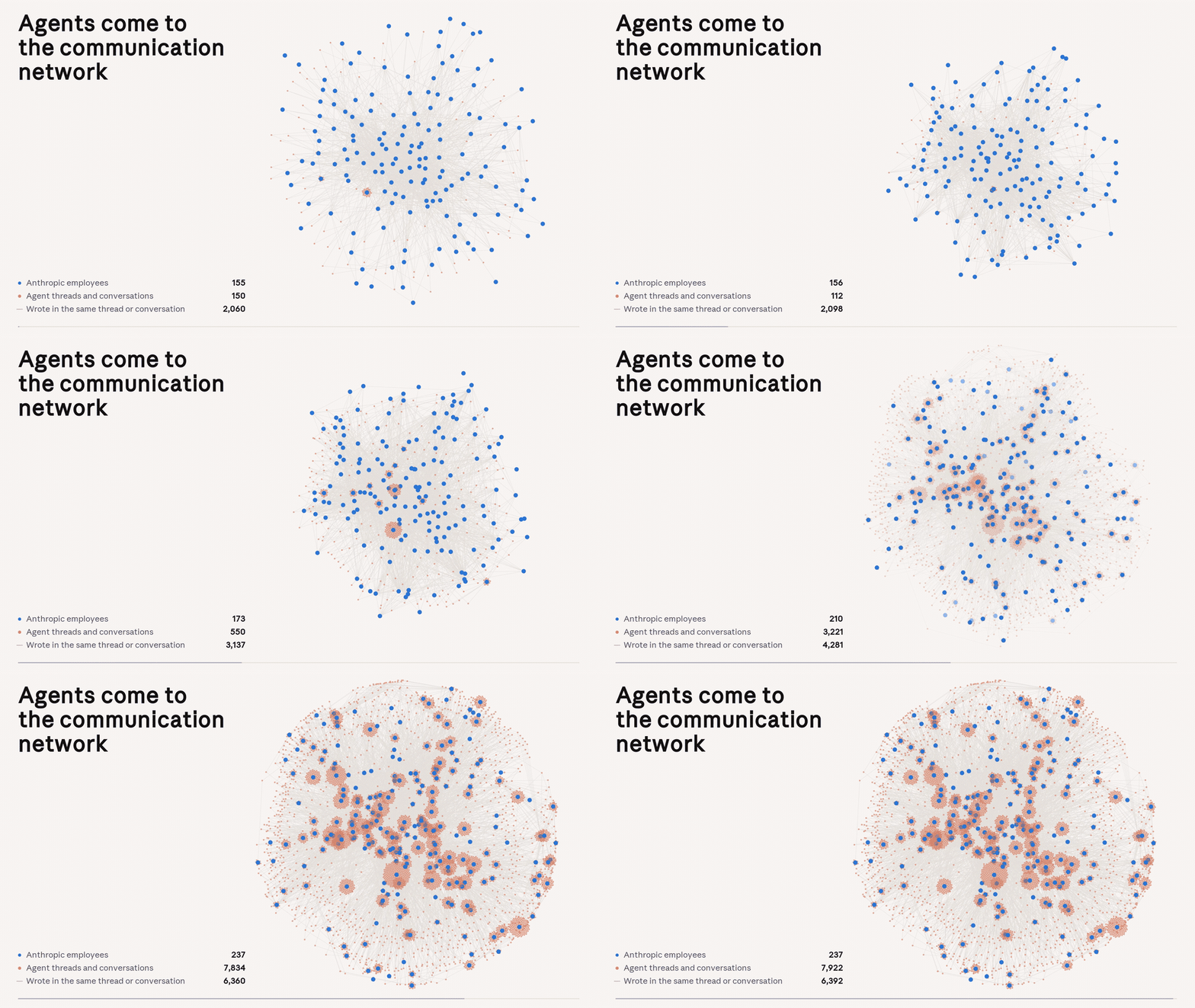
▲ Communication network of one Anthropic department. Blue dots are employees, orange dots are agent conversation threads; lines represent interactions in the same thread. The official visualization shows that AI has added new interactions, and communication between people still exists.
A team at Anthropic responsible for Claude's product copy has adjusted its division of labor. They organized materials such as product background, and let agents take over part of the copywriting work.
The work content of team members has changed to writing prompts and evaluating model performance.
Interviewers value your judgment more
Changes in work content are also reflected in the job interview stage.
Researchers analyzed thousands of interview evaluation records of people hired by Anthropic since 2024. In technical positions, autonomy and judgment are mentioned more and more frequently; in contrast, the relative weight of experience in specific technical fields has declined.
APPSO has thought of several examples based on its own understanding. For example: when you are given a requirement, can you first spot where it is not clearly stated? When AI gives several solutions, can you explain why you choose one of them? When the result seems to be completed, do you know what else needs to be checked?
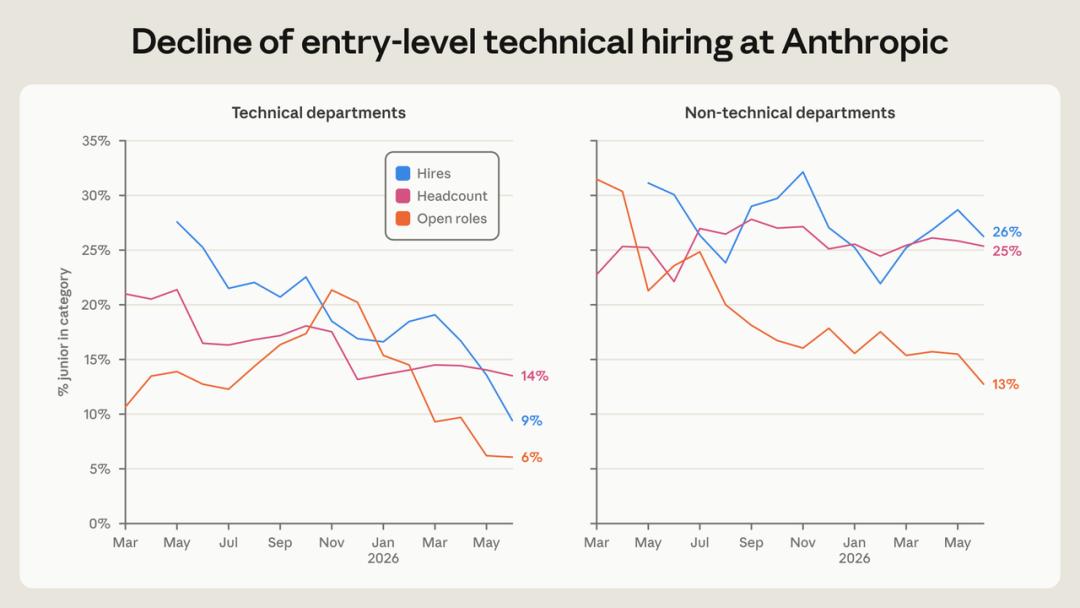
▲ The left side is the technical department, the right side is the non-technical department. The blue line tracks the proportion of junior employees among new hires, the pink line tracks existing employees, and the orange line tracks open job positions. The denominators of different lines are different. Source: Anthropic.
The experience mentioned here is not all coding experience.
Anthropic analyzed about 400,000 Claude Code interaction sessions in June this year. There is a very easy-to-understand example in the study: an accountant who does not know Python can be considered a skilled person in this task as long as he can clearly explain the reconciliation rules and find that the script misses the special situation of month-end closing. (Because he can locate the problem and clearly communicate the requirements to the Agent.)
In this batch of data, users who are more familiar with the task have higher conversation success rates. The biggest gap appears between beginners and moderately skilled users.
Researchers believe that this may be because having a basic understanding of a task makes it easier to clarify requirements to AI, spot where it makes mistakes, and know how to get it to correct them. Beginners are more likely to get stuck after problems occur. As for deeper professional experience, the additional improvement it brings in these sessions is relatively limited.
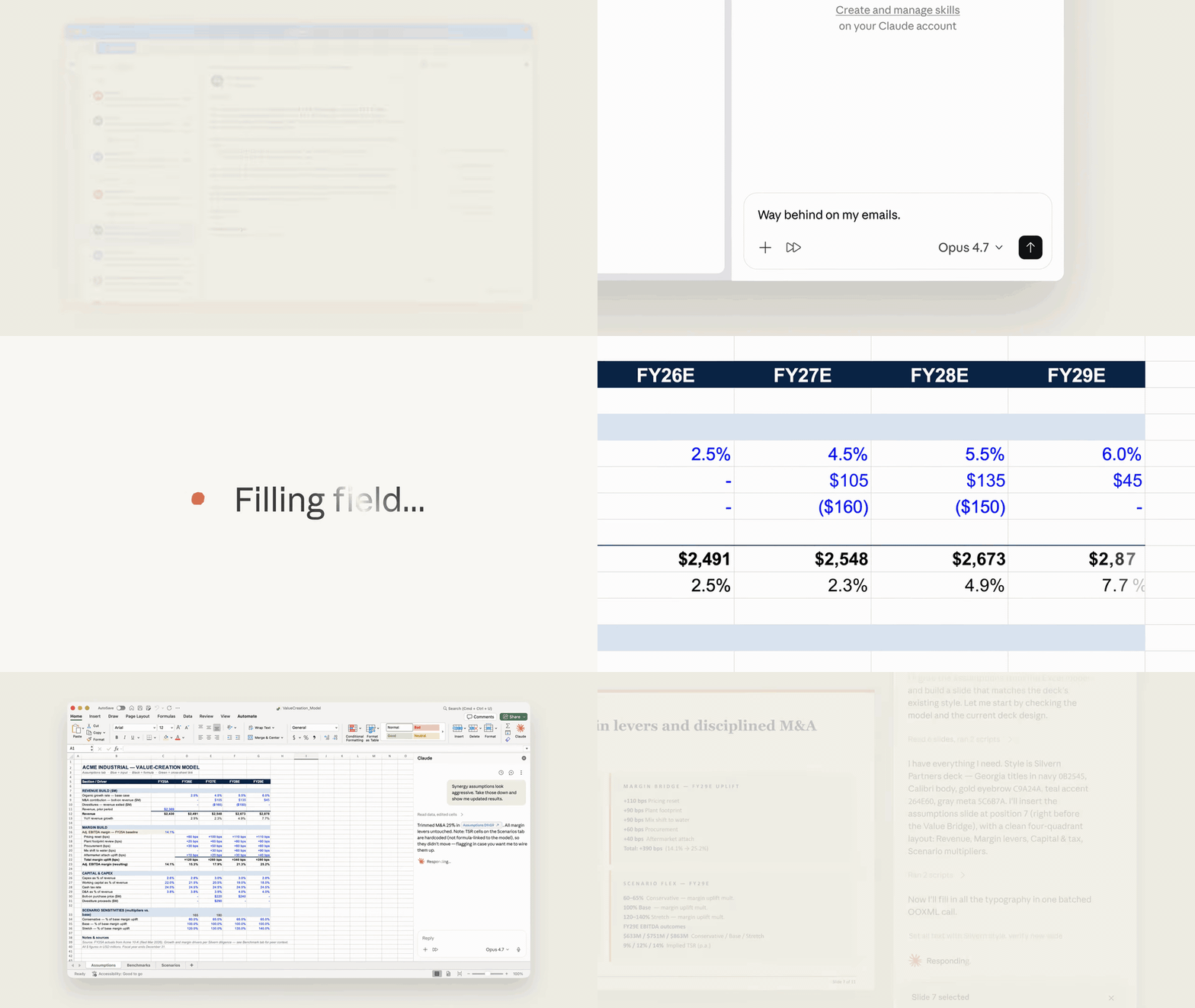
▲ Claude's Microsoft 365 feature demo.
For people who have worked on projects for several years, their familiarity with the business and past pitfalls can all be used to guide AI. For new graduates, things are not so easy: experience originally needs to be accumulated in the process of doing things.
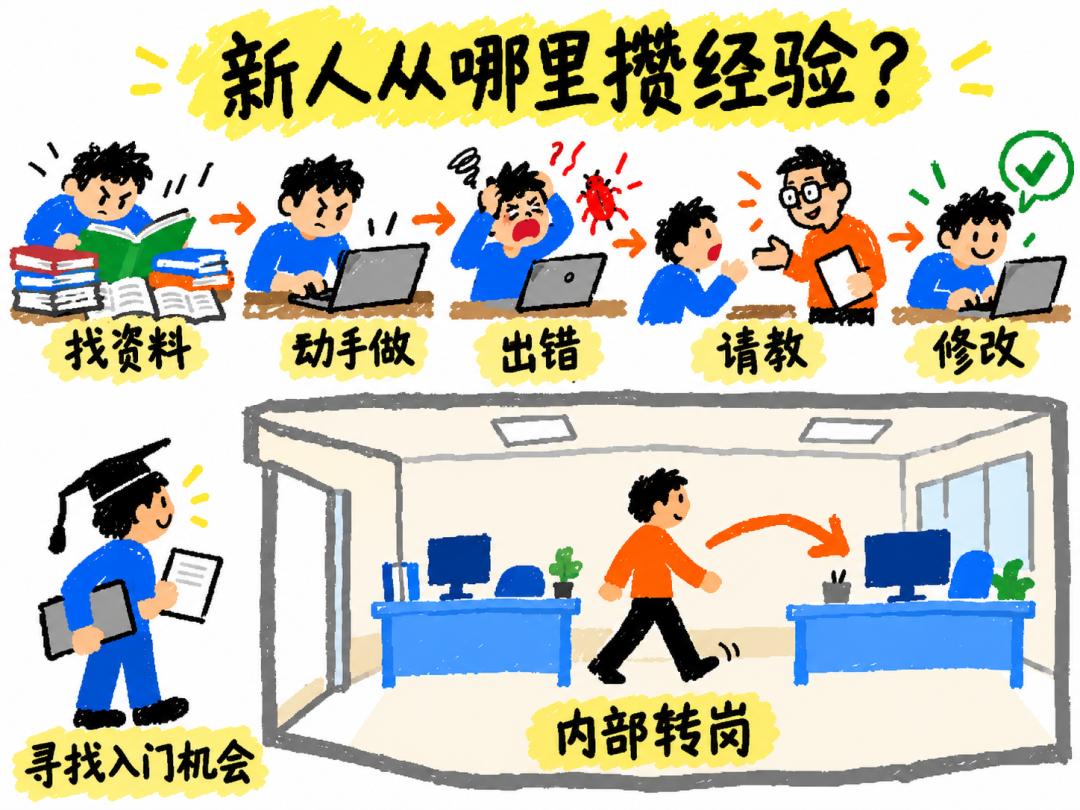
In the past, when a newcomer received a small task, even if he did it slowly, he could go through the whole process: find materials, get started, make mistakes, then ask colleagues for advice, and come back to modify. If the company directly assigns these tasks to AI, newcomers will lose an opportunity to practice in similar work.
Checking AI's work also requires experience. You have to be able to read the program to find problems in the code; you also have to understand the actual business to point out what is missing in the requirements. These skills are often learned in small tasks again and again.
Notable changes have also emerged in the recruitment market. A US employment study updated in August this year by the Stanford Digital Economy Lab found that in occupations where work tasks are more susceptible to AI impact, employment growth among workers aged 22-25 lags behind their peers in occupations less affected by AI. The change is mainly reflected in fewer young people being recruited, rather than more people leaving or being fired.
This study cannot independently prove that the change is caused by AI, and no widespread replacement across the entire economy has been found. But it makes "whether companies are still recruiting new people" a problem that needs to be continuously tracked.
For existing employees, Anthropic has begun to track which positions may be affected by AI, and gives priority to trying internal transfers. The copywriting team mentioned earlier transferred from product copywriting to writing model prompts and evaluation.
But transfers only benefit people who have already joined the company. For newcomers who have not yet got their first job, the problem of reduced entry-level positions still exists.
Where do newcomers accumulate their first work experience?
Even if you get a practice opportunity, you will encounter another problem: after the task is completed, how much have you actually learned?
Anthropic announced a small-scale randomized experiment in January this year. 52 developers with Python experience but no experience using the Trio toolkit were divided into two groups to learn the new tool. One group could use AI, the other group wrote code on their own, and both groups took a test afterwards.
The AI group scored an average of about 50%, and the group writing code on their own scored about 67%. The biggest gap was in finding errors. The AI group was on average about two minutes faster, but the speed difference was not statistically significant.
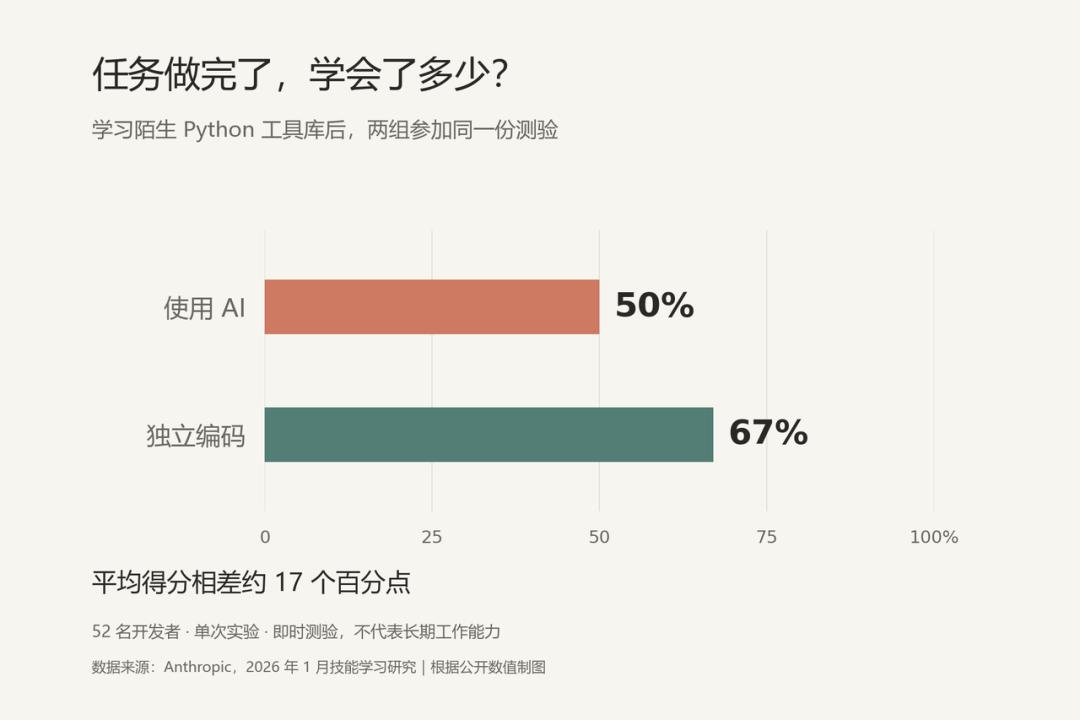
▲ Made based on public research data. The comparison is the immediate test after learning an unfamiliar tool, not long-term work ability; the difference between the two groups is about 17 percentage points.
The researchers also reviewed the operation recordings. Some people assigned the task to AI, and asked AI to fix it when an error was reported. Others continued to ask about the principle after getting the code, or only asked AI to explain the concept and wrote the code themselves. The latter usage corresponds to better test performance.
For people who are preparing their portfolios, these changes at least provide a direction to try: in addition to showing the final finished product, keep a record of how you made it, and use it to deeply understand the principles behind it.
Take an event registration web page made with AI as an example. The fact that the page can be opened can only answer a small part of the questions. What happens if the registration is submitted repeatedly? Will it continue to accept applicants when the number of people is full? If a user fills in wrong information, can it be modified?
The problems you found, how you got AI to modify them, and what checks you did can all be included in the project description. When the interviewer asks further questions, you have specific processes to talk about.
Anthropic is also advancing an ongoing attempt to provide practical opportunities for newcomers.
Claude Corps, announced in June this year, plans to train 1,000 people at the early stage of their careers, and then place them in non-profit organizations in the United States to work full-time on projects for one year.
Anthropic funds the program, and the educational institution CodePath is responsible for hiring the trainees. Trainees get salaries, have mentors, receive centralized training first, and then arrange about 5 hours of continuous learning every week, and spend the rest of the time doing practical work for the receiving organizations.
The problems these organizations expect to solve are very meaningful: food banks want to better analyze donations and material distribution, and marine conservation organizations need to process massive amounts of survey data. They expect trainees to integrate AI into these tasks.
