29-year-old Qiao Mu, first author of a Nature paper, has been revealed to have founded a quantum computing startup.
The fiercely competitive quantum computing track has seen the rise of a formidable new team.
QbitAI exclusively learned that a company named FlipFlop Tuoyuan focuses its business on neutral-atom quantum computing.
According to Qichacha, the company was founded on July 2 this year. We have learned that merely over a month after its establishment, Tuoyuan has successively completed two rounds of financing, with the total amount reaching hundreds of millions of RMB.
The founding team of this company has an impressive background.
Mu Qiao, CEO, holds a doctorate from Tsinghua University and completed postdoctoral research at the French National Centre for Scientific Research (CNRS), and has previously conducted research at the world's top neutral atom laboratory. His co-founder used to be the head of neutral atom quantum computing at an industry giant.

Last year, Mu Qiao, as the first author and corresponding author, published a research finding in *Nature* on the study of doped quantum antiferromagnets using Rydberg atom arrays.
In addition, Mu Qiao has also published findings in *Nature Physics* as the first author and co-corresponding author, which is his core representative work during his doctoral period; in 2022, he also published work results in *Science Advances* as a co-author.
It is worth mentioning that also last year, Mu Qiao started to look for faculty positions in China, and successively received offers including the AP position in the Department of Physics of Tsinghua University.
But he finally chose to start his own business.
VCs quickly followed up.
Industry insiders close to Tuoyuan told us that only two months after its establishment, Tuoyuan completed its seed round and angel round of financing, with investors including active top-tier VCs such as Source Code Capital, Oasis Capital, CICC Capital, etc.
Who is Mu Qiao?
Mu Qiao, born in 1996, studied Environmental Science at Shandong University for his undergraduate degree.
In 2017, he entered the Institute for Interdisciplinary Information Sciences of Tsinghua University to pursue his doctoral degree, under the supervision of Professor Kihwan Kim.
Kihwan Kim is a world-renowned experimental expert in trapped-ion quantum computing. He successively completed his postdoctoral research in two top research groups in the field of ion traps — the Rainer Blatt Group at the University of Innsbruck in Austria, and the Chris Monroe Group at the University of Maryland in the United States.
In 2011, Kihwan Kim joined the Institute for Interdisciplinary Information Sciences (Quantum Information Center, later under the Department of Physics) of Tsinghua University, was promoted from Associate Professor to full Professor, and became an independent PI, and built the top ytterbium ion trap experimental platform in China at Tsinghua University.
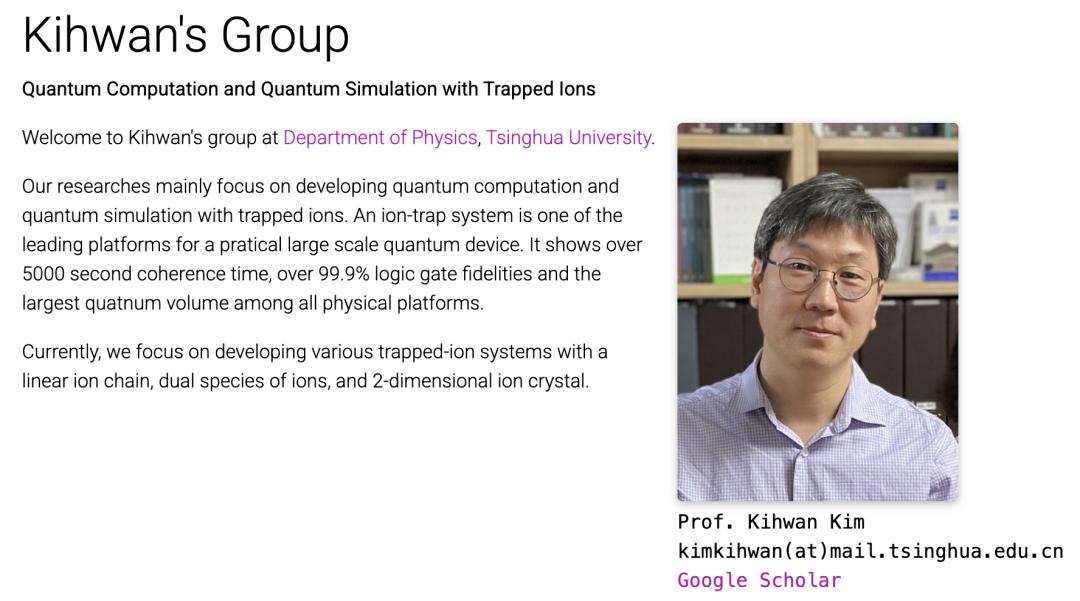
As his supervisor moved to the Department of Physics of Tsinghua University, Mu Qiao's research direction was gradually adjusted from the field of ion trap quantum computing to the neutral atom route around 2022.
During his doctoral period, Mu Qiao participated in research related to two-dimensional ion crystals.
After that, he went to Institut d'Optique in France, joined the Antoine Browaeys research group to carry out postdoctoral research, and further studied Rydberg atom optical tweezer arrays and strongly correlated quantum systems.
In 2024, as the first author and co-corresponding author, he published a paper in *Nature Physics*, which realized tunable quantum spin model simulation using two-dimensional ion crystals, providing experimental verification for two-dimensional ion crystals as a quantum simulation platform.
In addition to the cutting-edge experimental research experience in two quantum computing technology routes, Mu Qiao also has work experience in the industry.
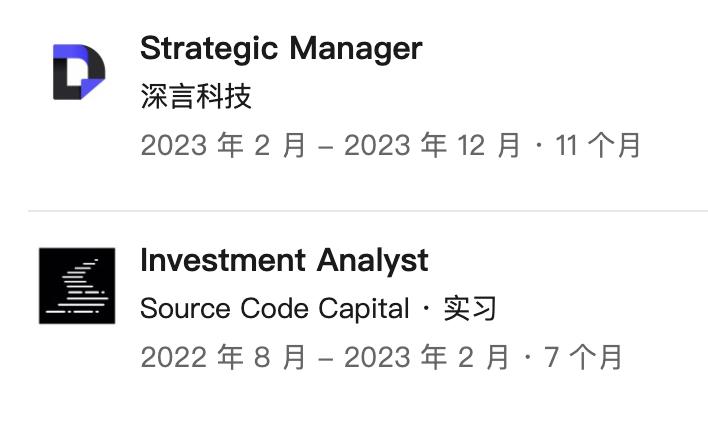
In 2020, Mu Qiao once worked as an investment intern at Source Code Capital.
In 2023, he joined DeepTalk Technology as co-founder and CSO, participating in market and technology judgment, computing power procurement, and communication with IDC and cloud vendors, and was exposed to work related to kilowatt-scale cluster construction.
AI is also one of the motivations for starting the business
The neutral-atom quantum computing that Mu Qiao specializes in is one of the continuously concerned technical routes in the current quantum computing field.
Its basic idea is to use lasers and optical tweezers to capture and arrange atoms, and then realize quantum manipulation through precise control. Atomic arrays have the potential to expand the scale, but from the experimental platform to an available quantum computer, multiple problems still need to be solved.
An investor who participated in the investment of Tuoyuan told us that Tuoyuan chooses to design the whole computer architecture based on the requirements of fault-tolerant computing, and takes the 100-logical-qubit system as an important R&D goal.
And AI is another clue in Mu Qiao's entrepreneurial experience.
It is reported that during his research in France, Mu Qiao tried to develop an autonomous scientific research Agent, hoping that AI can complete literature reading, computational experiment design, data analysis and other work around scientific problems.
As the capabilities of the models continue to improve rapidly, he began to pay attention to the possibility of AI participating in complex scientific research tasks, and further thought about how to introduce AI into real physical experiments.
Tuoyuan hopes to adopt an AI-native R&D method, and gradually introduce AI into links such as experimental design, data processing and equipment control.
Reference Links:
[1]https://www.linkedin.com/in/muqiaophys/?isSelfProfile=false
[2]https://info.phys.tsinghua.edu.cn/kimkihwan/index.html
This article is from the WeChat official account "QbitAI" (ID: QbitAI), author: Heng Yu, published with authorization from 36Kr.