Bombshell! After OpenAI, AI has once again cracked the Generalized Riemann Hypothesis.
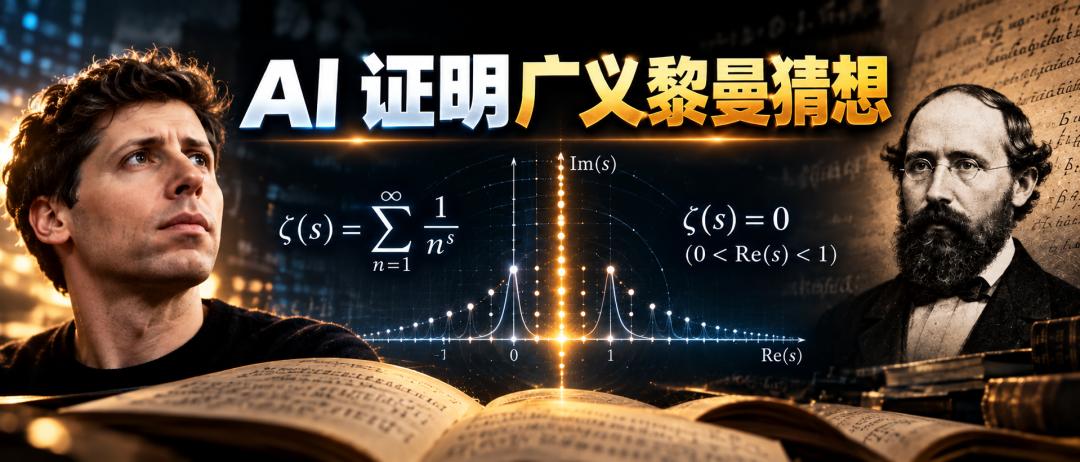
In less than ten days, the mathematics community has experienced an ultimate roller coaster ride!
On October 6, OpenAI claimed that AI had proven the quasi-Riemann hypothesis.
Mathematician Alex Kontorovich stated bluntly:
If someone achieves this result, he will undoubtedly win the Fields Medal immediately, no suspense at all!

He later added that if the result confirms no Siegel zero exists, it could be counted as "two Fields Medals".
Other scholars also gave positive evaluations.
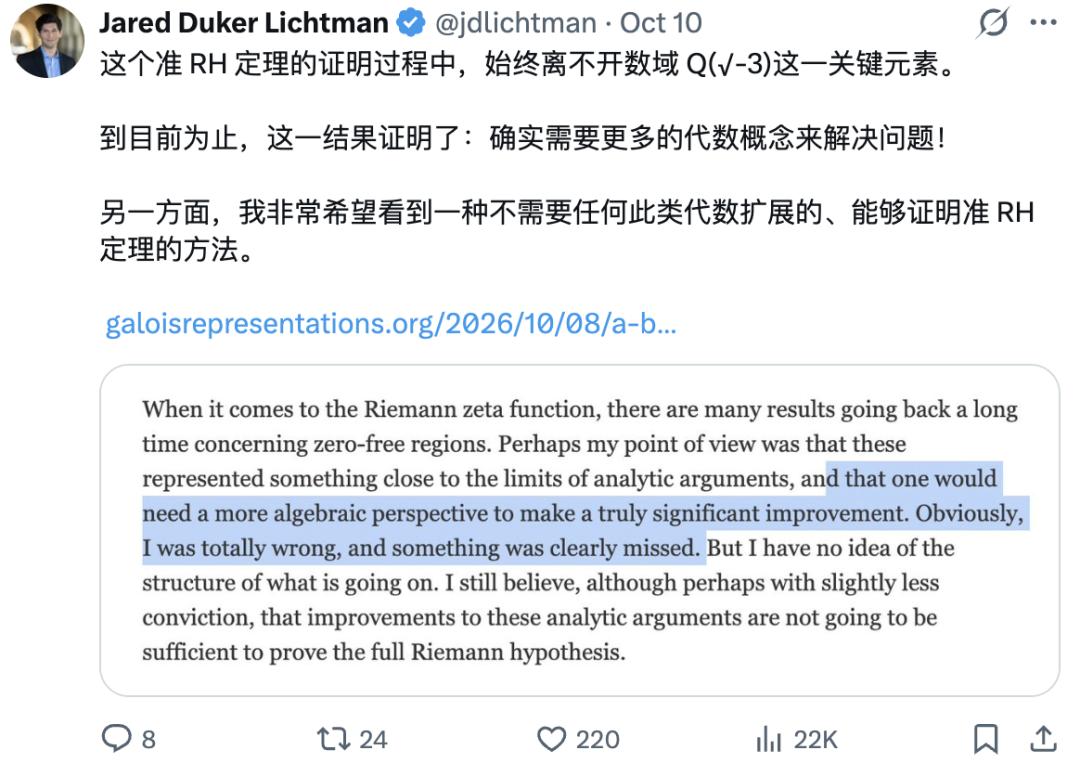
This is simply a dimensionality reduction strike against humans from silicon-based life!
But some people did not surrender, and did not quit.
Now, with the assistance of AI, mathematicians have proven a certain form of the generalized Riemann hypothesis!

Just a few days later, good news kept coming one after another.
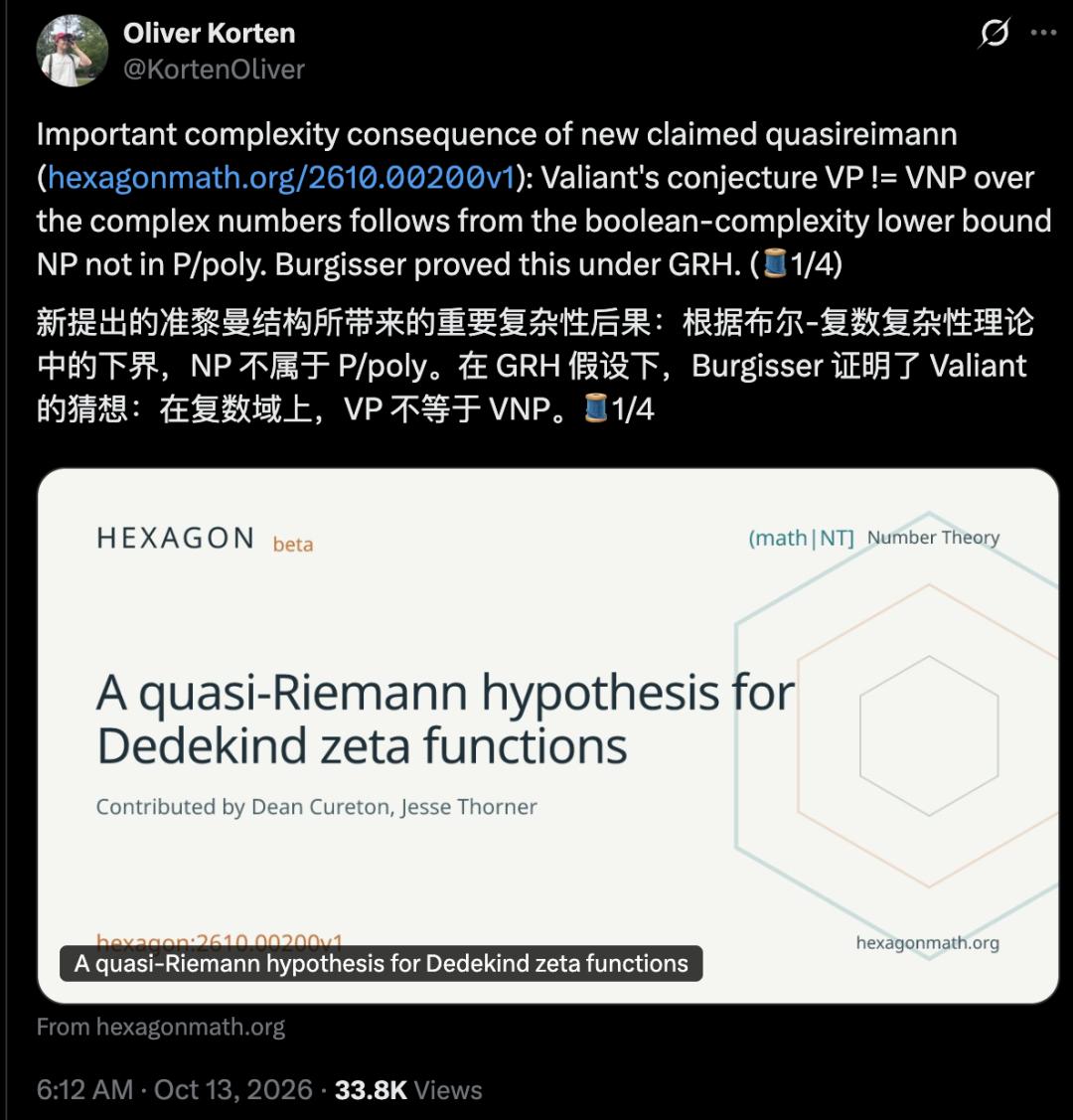
This quasi-Riemann hypothesis result brings an important computational complexity conclusion:
Burgisser proved Valiant's conjecture: over the complex number field, VP != VNP
After that, three human mathematicians delivered the final perfect blow, completely solving a classic problem that had been unsolved for 19 years.
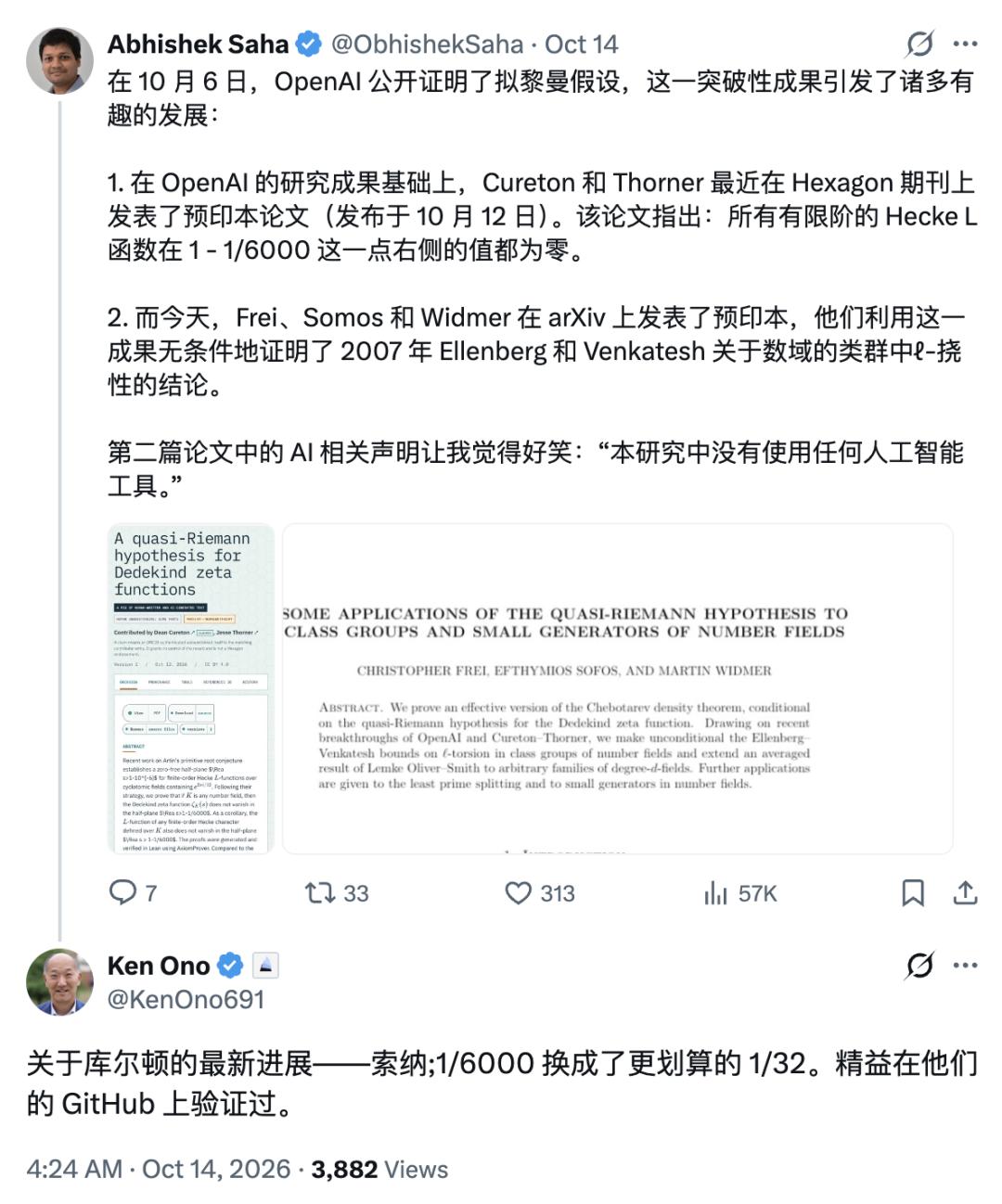
And they also left a statement:
No artificial intelligence tools were used in this work.
No artificial intelligence tools were used in this work.
Strike overnight! Humans take back the initiative
On October 6, OpenAI did not have a flash of inspiration or sudden epiphany. Their AI, like a super bulldozer, violently proved the quasi-Riemann hypothesis.
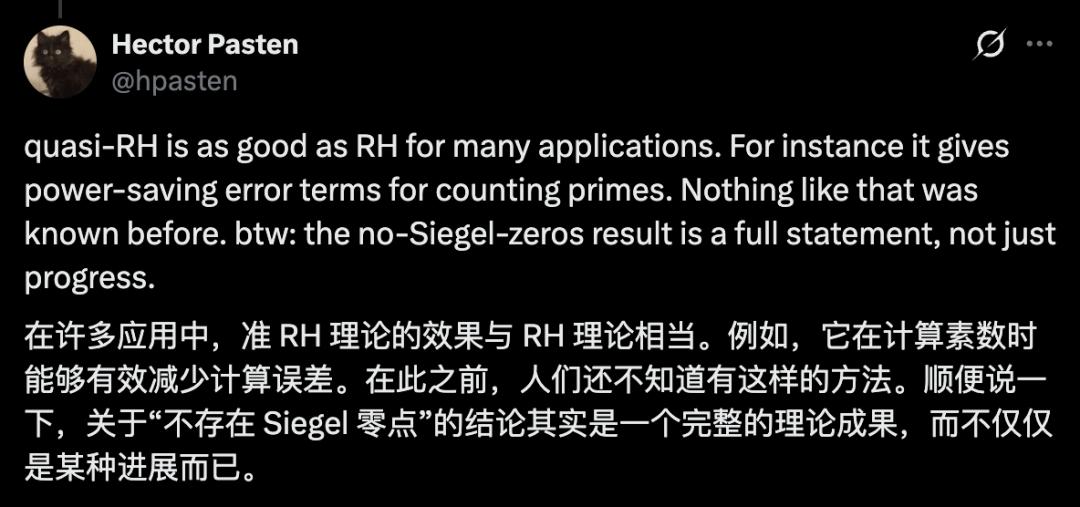
Number theorist Hector Pasten explicitly expressed amazement at OpenAI's result of ruling out the Landau–Siegel zero, emphasizing that it "solved the problem" rather than just making progress.
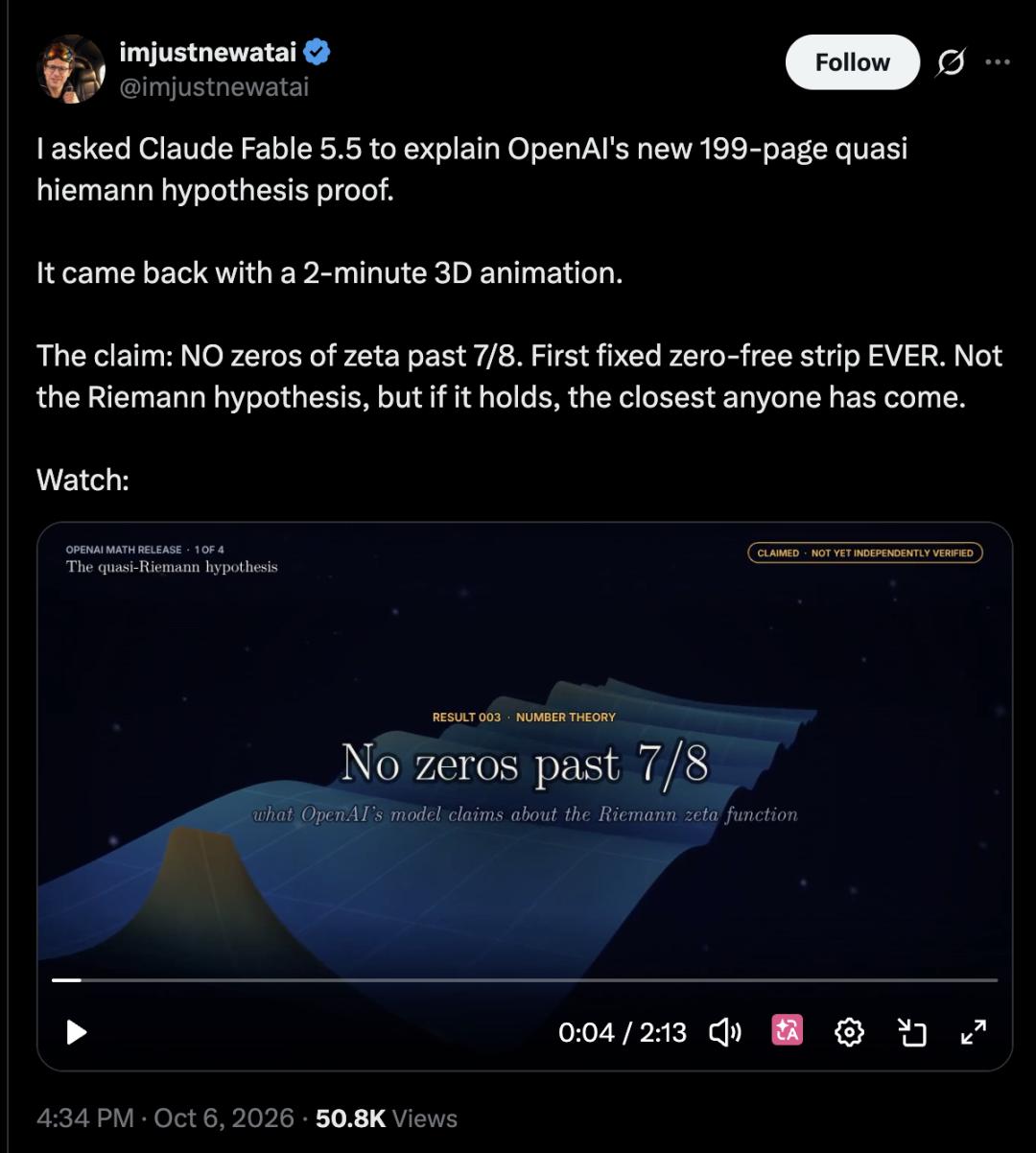
Some netizens asked Claude Fable 5.5 to explain OpenAI's 199-page proof of the quasi-Riemann hypothesis, and gave high praise:
This is the first ever fixed interval with no zeros.
Although this is not the Riemann Hypothesis itself, if the claim holds, it is by far the closest conclusion to the Riemann Hypothesis.
But if AI can even see through the underlying structure of this level, what is the value of existence for human mathematicians?
Panic spread in the mathematics community.
But real masters will not lament. Now that the road is open, step on the gas and charge forward!
Only 6 days later, on October 12, a new paper suddenly appeared on the preprint platform Hexagon.
The authors are human mathematicians Cureton and Thorner.
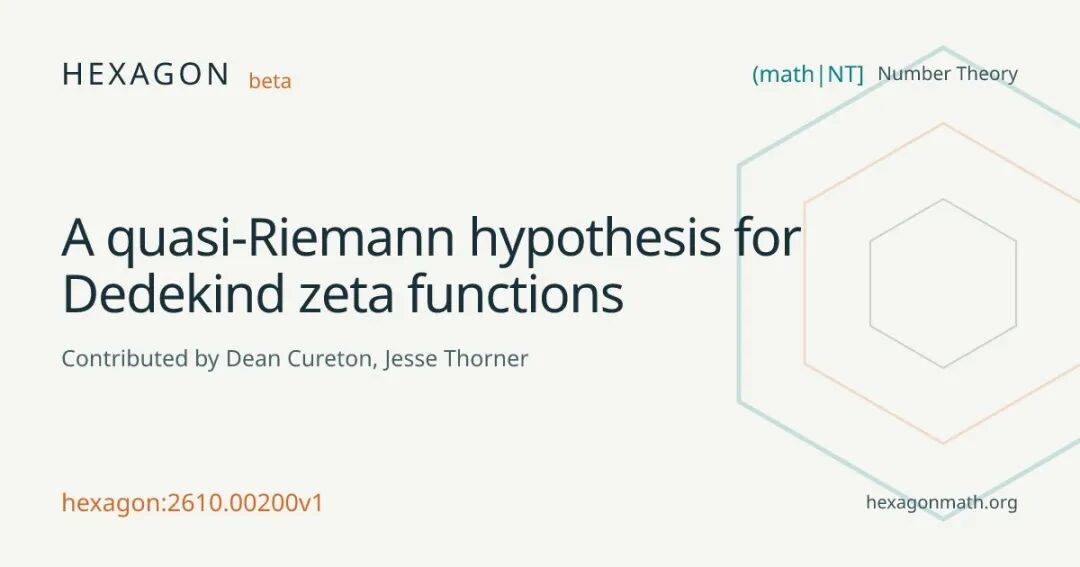
Link: https://hexagonmath.org/2610.00200v1
They had no time for sentimentality. Instead, with extremely sharp insight, they took a bold move: translation.
They directly applied the tools polished by AI to a broader and more complex mathematical object — Hecke L-functions of finite order.
What is an L-function? It is the "ultimate evolved version" of the Riemann Zeta function.
In modern number theory, almost all remarkable proofs such as Fermat's Last Theorem are inseparable from it.
Cureton and Thorner used the quasi-Riemann breakthrough given by AI to deliver a heavy blow, achieving an astonishing result:
All Hecke L-functions of finite order have absolutely no zeros on the right side of "1-1/6000".
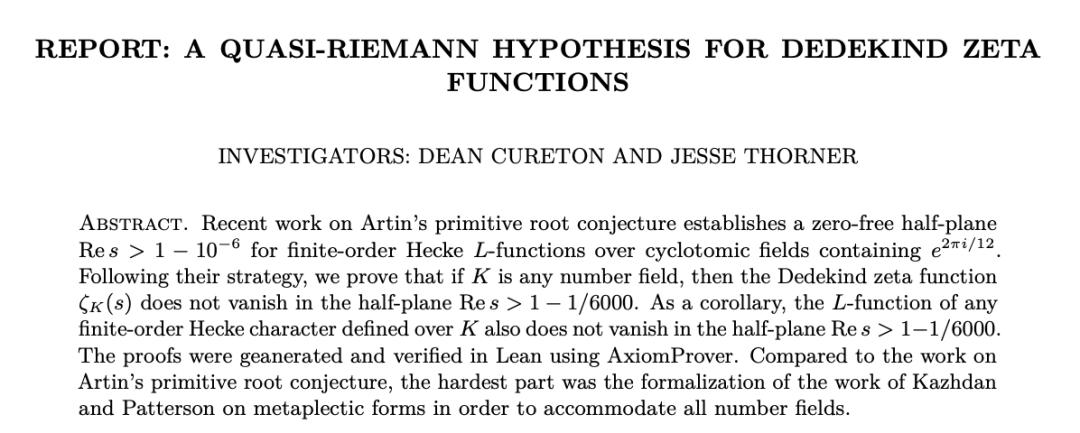
Link: https://hexagonmath.org/pdf/2610.00200v1
It doesn't matter if you don't understand it. Let's make an analogy.
Zeros are like hidden reefs in the sea.
In the past, this sea area was covered in heavy fog, making it impossible for ships to move an inch. Now, the two mathematicians, using the AI's radar, forcibly delineated a "safe zone".
There are absolutely no hidden reefs in this area.
The safe zone is established. The first territory has been seized by humans.
But the best show has just begun.
Speeding to the limit: The extreme strangulation from 1/6000 to 1/32
The moment 1/6000 appeared, the DNA of math geeks all over the world was activated.
This value is too small, too conservative.
Since the door frame is already loose, why not demolish the whole wall?
A global open-source hackathon was instantly ignited.
The smartest brains all over the world connected through the network and began to squeeze this constant to the extreme.
This is the most exciting scene in modern mathematics, a collective strangulation has begun.
Logic is ruthlessly streamlined. Errors are completely eliminated. The boundary is pushed outward again and again.
1/1000. 1/500. 1/100.
The constant shrinks sharply like a free-falling object!
In the end, the entire community nailed the safe boundary of this "zero-free zone" to an extremely exaggerated number: 1/32.

The safe zone has been expanded by hundreds of times!
Afraid of making mistakes? Afraid that human intuition is unreliable? No problem, just use machine verification!
The open-source community used the most ruthless referee — the Lean theorem prover.
This is a formal verification language that only adheres to strict logic. Any tiny logical gap will cause the program to crash.
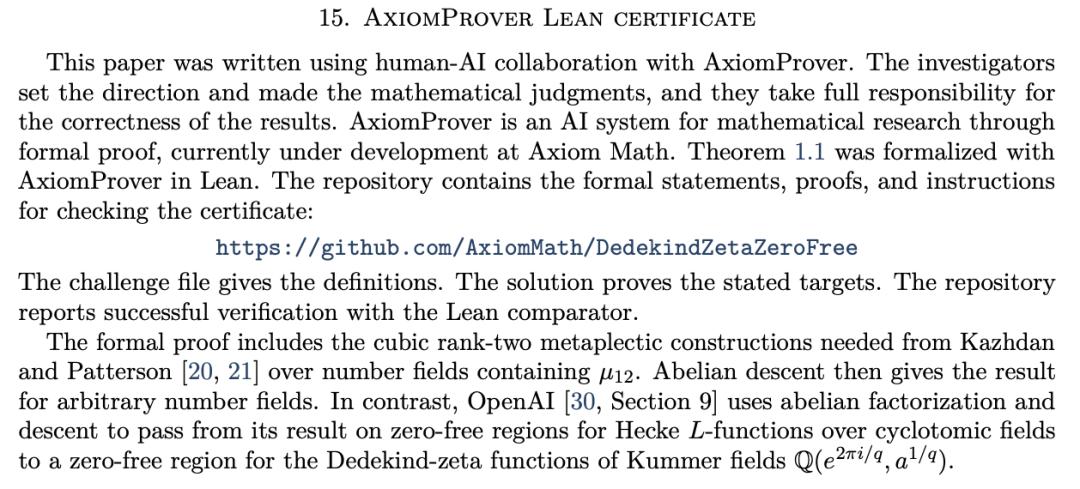
The relevant proof was generated as a formal Lean proof by the mathematical agent AxiomProver, and is available on open-source Github.
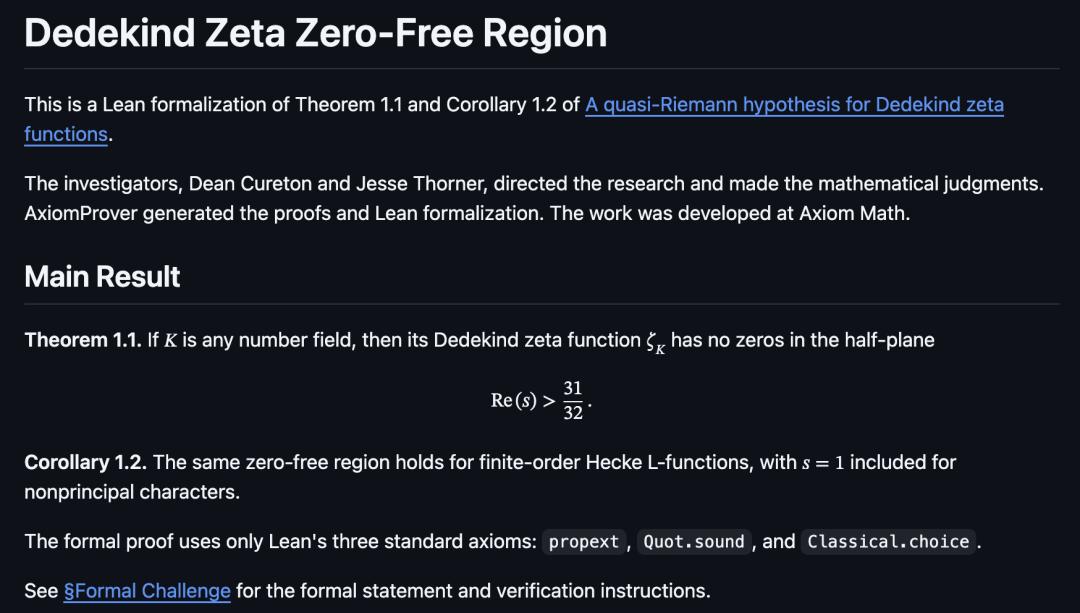
https://github.com/AxiomMath/DedekindZetaZeroFree
The boundary of 1/32 is not only derived by humans, but also established by machine logic.
This is not the only by-product.
One hit to kill! The 19-year unsolved problem is completely resolved
All the preparations, all the celebrations, are waiting for this moment today.
On the arXiv preprint platform, a landmark paper co-authored by Frei, Somos and Widmer was released.
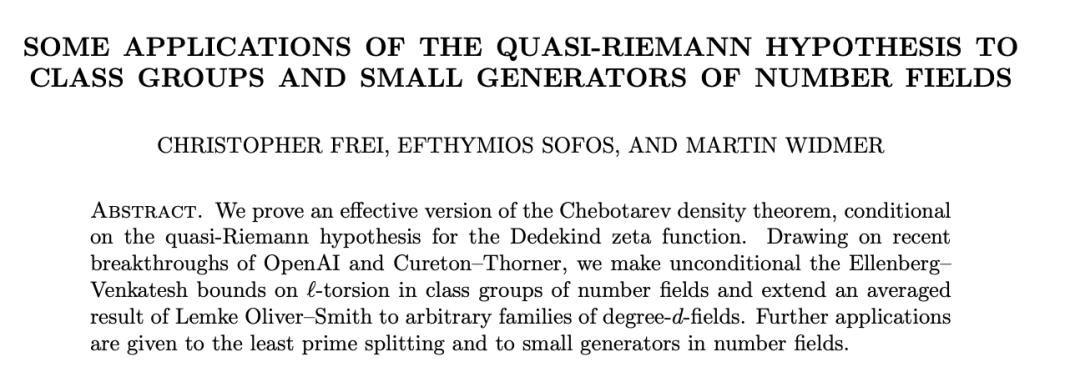
https://arxiv.org/abs/2610.18491
This academic tsunami triggered by OpenAI finally shattered the hardest reef.
The target is locked: The 2007 Ellenberg–Venkatesh bound.
This is a thorn in the field of algebraic number theory.
In 2007, two leading mathematicians gave an extremely perfect bound for the ℓ-torsion of the class group of a number field.
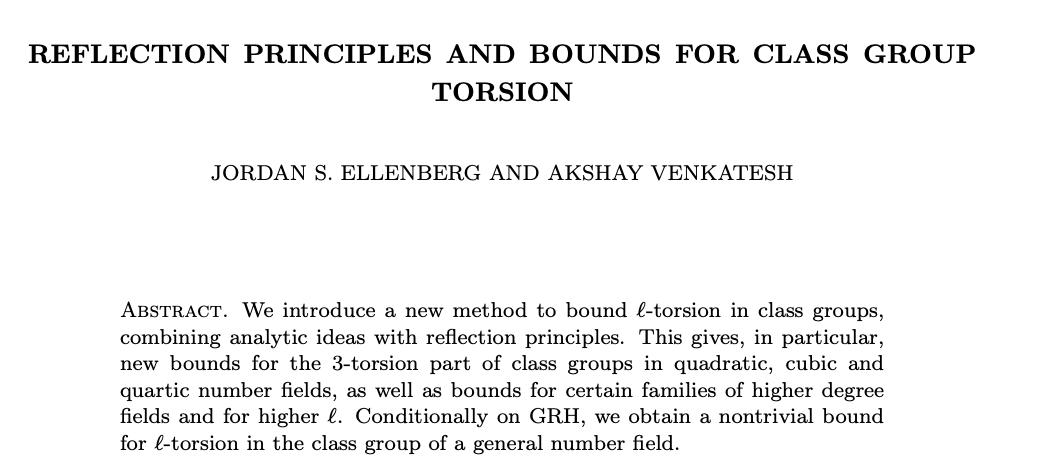
But it has a fatal flaw: it is conditional, the so-called "castle in the air".
The proof of the two masters must be based on the premise that "the Generalized Riemann Hypothesis (GRH) holds".
Once the premise collapses, the conclusion is invalidated instantly.
For 19 years, countless top scholars tried to remove this crutch to make the proof stand on its own, but all failed. Because there were no tools, because the underlying rock had not been unearthed.
Until today.
Frei, Somos and Widmer saw the "1/32 safe zone" seized by the previous group of people.
This is the base they have been waiting for 19 years!
Without the slightest hesitation, the three mathematicians drew their swords.
They applied the latest zero-free region result to the old equation with overwhelming force. The once broken logical chain instantly snapped into place with the support of the powerful new theory!
Derivation. Simplification. Final blow. The conclusion is dazzling: The 2007 Ellenberg–Venkatesh bound for the ℓ-torsion of the class group of a number field is unconditionally proven.
No more assumptions! No more premises! The castle in the air has fallen to the ground, turning into an indestructible steel fortress!
The 19-year-old ghost has vanished.
A core puzzle piece of algebraic number theory has been perfectly placed by humans.
We didn't use AI
If the story ends here, it is just an extremely successful academic relay.
But what really makes this paper a legend is that one sentence at the end.
At the end of the paper that announces the end of this 19-year-old problem, Frei, Somos and Widmer did not write long sentimental remarks, nor did they fawn over AI.
They only left a cold, humorous, and somewhat unruly statement:
We declare that no artificial intelligence tools were used in this work.