With the release of wish-style programming, who says Liang Wenfeng doesn't spoil programming newbies?
Liang Wenfeng once stated at a closed-door investor meeting, "We did not invest much effort in the C-end business, and at one point we even considered stopping support for those users." But it is clear now that Liang Wenfeng was not being truthful: he claimed to disregard the C-end, but in fact he values it extremely highly.
The most prominent feature of DeepSeek V4.1 Flash 1017, released by DeepSeek on October 17, is its support for "wish-based programming". Users only need to describe their ideas to DeepSeek, without providing various parameters, details or materials, and the model can complete the entire production closed loop for users.
This is a typical "beginner-oriented" feature. Even senior engineers may not necessarily need this function, since they can input complete prompts to the model and do not need to "make a wish" — they can directly "give orders". This shows how much DeepSeek cares about the C-end user experience.
Apart from the core highlight of the wish-based programming update, the new version has also improved its ability to "build complete projects from scratch" in game development, 3D modeling and other scenarios through reinforcement learning training based on self-feedback.
The following videos are generated by V4.1 Flash 1017, Gemini 4 Argon and GPT-6 Luna.
There is another detail: on the day V4.1 Flash 1017 was released, the official announced the opening of two DeepSeek self-developed interfaces: Search and Fetch.
Search works the same as the commonly used search engines: when you enter a query, it returns a list of relevant web page results. Fetch is more like an interface for agents: when you input a URL, it crawls the web content and organizes it into text that the model can understand.
What exactly is "wish-based programming"?
"Wish-based programming" is not a new concept. It means that as long as you tell AI your requirements, AI will automatically break them down into tasks, write the code, verify the completion, and finally deliver a complete and runnable product to you.
For example, if you want a car, V4.1 Flash 1017 will build the exact car you want, screw by screw.
At first glance, wish-based programming seems almost identical to Agent, but they are essentially different. Agent is a technical form: the model is equipped with tools including terminals, files, browsers and search engines. The model selects different tools to call through reasoning tasks, and finally completes the tasks with the help of these tools.
Compared with Agent, wish-based programming has a lower starting threshold. For example, it only requires a single sentence or several reference images, while Agent usually needs detailed reference documents, which V4.1 Flash 1017 does not require.
In wish-based programming, human intervention is less than that in Agent. Users only need to put forward requirements at the beginning and conduct acceptance at the end, and try not to interrupt in the middle. During the output process, Agent often asks users for confirmation, such as whether certain permissions are allowed, or which method users prefer. Wish-based programming does not have these processes.
Agent is like a chef who has knives, stoves and ingredients, with all the hardware conditions for cooking. Wish-based programming means you just say to him "I want to prepare a victory banquet", then he will make the menu, buy ingredients, cook, plate the dishes and serve them to you, without asking you whether you want spicy food or not in the middle.
Another difference is that Agent views the project from the system structure perspective and focuses on the project itself, while wish-based programming views the work from the user experience perspective, focusing on whether users feel comfortable using the product.
From a certain perspective, Agent is a "necessary condition" for wish-based programming.
The biggest difficulty of wish-based programming lies in self-inspection. As mentioned earlier, with tools, Agent can run code and see error reports. But "seeing" does not equal "understanding".
This is why Agent always asks questions: because Agent requires continuous human intervention in the process, and humans act as "quality inspectors" for Agent.
Wish-based programming removes humans from the entire loop, and the model acts as its own quality inspector. The quality inspection capability does not come automatically after the model is equipped with tools, and it still requires continuous training.
Therefore, a large number of "complete - inspect - judge quality" processes are needed to provide feedback to the model. If we rely solely on human labeling, the entire training will take an extremely long time to complete.
That is why DeepSeek emphasized reinforcement learning training based on self-feedback in the V4.1 Flash 1017 version update. This mechanism allows the model to generate results by itself, evaluate the results, and adjust accordingly, thus greatly expanding the training scale.
In September, DeepSeek cooperated with Tsinghua University to publish the paper DeepSeek Elastic Compute (DSec): A Sandbox Infrastructure for Effective Agentic Training at Scale.
The paper introduces the training sandbox DSec currently used by DeepSeek. Section 6 of this paper implies that DeepSeek has already realized RSI.
In the same sandbox for training, the Agent interactively builds its own environment, then takes an incremental snapshot of this session, which is directly turned into the next batch of reusable training scenarios.
Wish-based programming is the preliminary achievement brought by DSec.
It does not end there. After DeepSeek introduced self-feedback reinforcement training, its performance score has achieved rapid growth naturally.
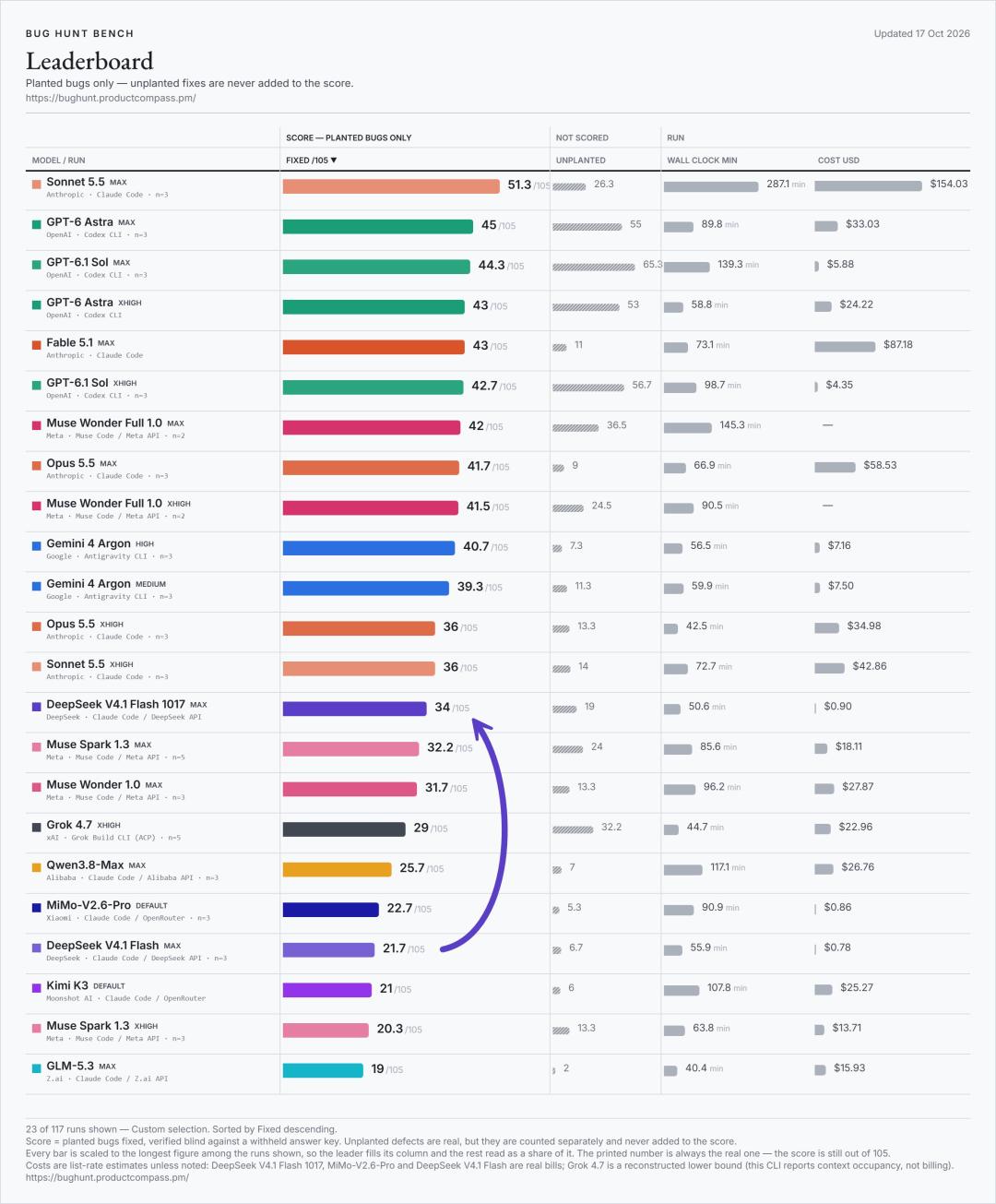
Less than 2 hours after the release of V4.1 Flash 1017, product manager Paweł Huryn tested V4.1 Flash 1017. The results showed that V4.1 Flash 1017's ability to find and fix bugs is close to Opus 5.5 xHigh, and its price is only 1/35 of the latter.
Later, a chat record of DeepSeek employees was exposed, saying that "the score is accidentally too high", "DeepSWE is not over-optimized for benchmark at all", and "the score keeps rising uncontrollably at this point".
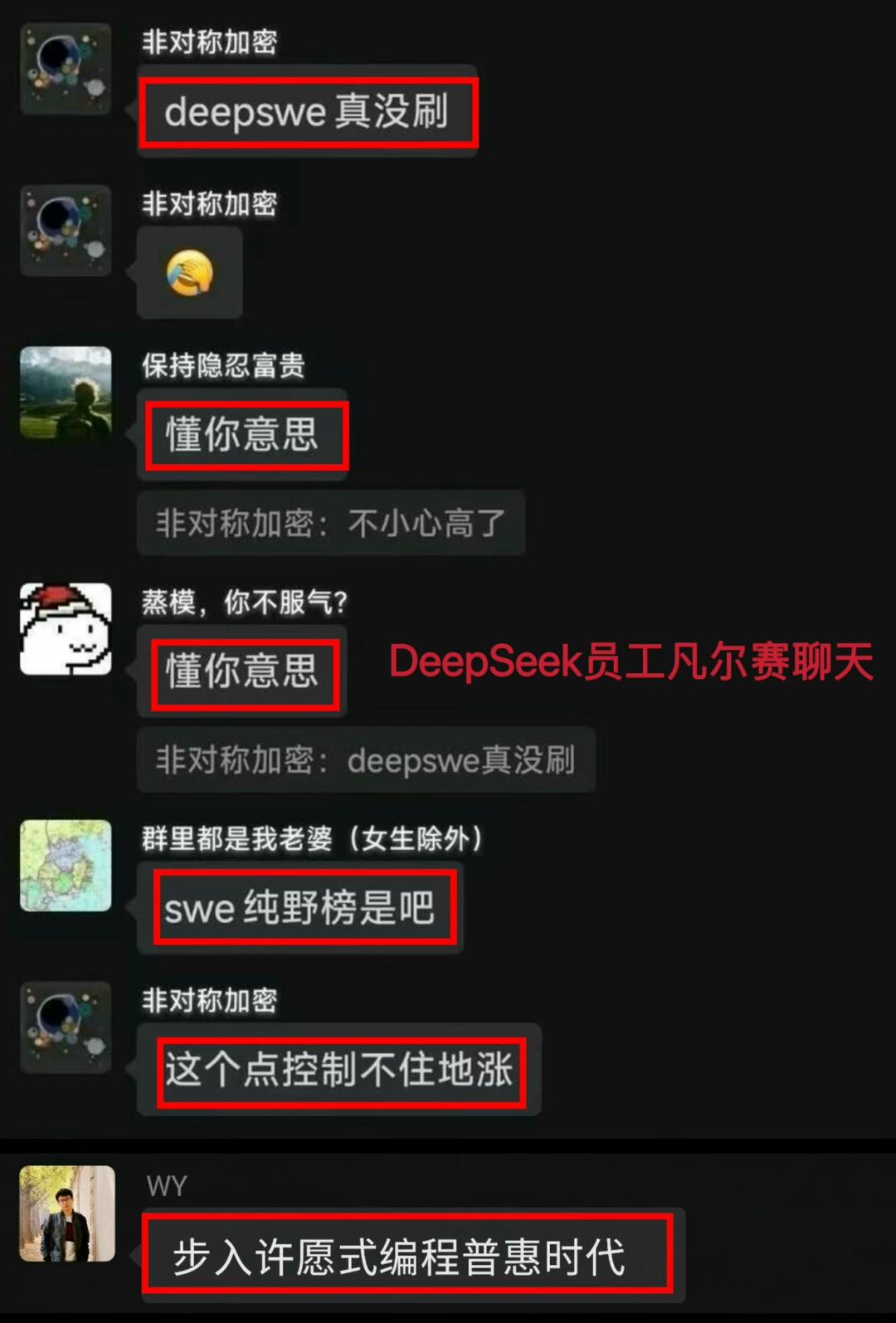
It is really a typical case of showing off in a low-key way.
Liang Wenfeng is moving towards beginner users
In the past, Liang Wenfeng might really not care about ordinary C-end users.
Take DSH as an example. DSH was first established as an internal project in May 2026, with Cui Tianyi as the person in charge. On August 13, it was open sourced under the MIT license in the form of v0.1 developer preview.
The biggest feature of this version is that it discourages non-professional users.
If you want to install DSH, you must first confirm node -v in the terminal. After confirming that Node.js is working properly, run npx @deepseek-ai/dsh web. If you want to run it from the source code, you need to execute git clone, pnpm install, and pnpm run build in sequence.
Without relevant computer knowledge, it is very difficult to use DSH.
A month and a half later, DeepSeek released the DSH v0.2 preview version, and launched desktop installation packages for macOS and Windows at the same time. This allowed ordinary users to install DSH with one click.
However, the wish-based programming of V4.1 Flash 1017 is completely different, and its essence is "beginner-oriented".
As mentioned earlier, many Agent products will stop in the middle and ask you: "Can this command be executed?" "How to deal with this error?"
For programmers, this is normal collaboration. But beginners cannot act as "quality inspectors". They will only say "What? What? What? What is this? Forget it, I'll just allow everything!"
Beginners cannot understand commands, error reports, or judge the quality of solutions. Since humans cannot intervene, the model can only intervene by itself.
In addition, beginners have neither "prompts" nor "materials".
The official has repeatedly emphasized "fewer prompts and reference materials". For programmers, this means higher efficiency. For beginners, this is a necessary precondition.
For senior programmers, the significance of wish-based programming is not significant. They have complete prompt templates and can understand various error reports. Wish-based programming is more like a nice-to-have feature, and even programmers who are used to Agent prompts may not necessarily use wish-based programming.
But beginners cannot write a complete requirement document, nor do they have ready-made design drafts and art resources. Fewer prompts, fewer materials, and fewer interaction rounds are essentially providing support for beginners.
What beginners want is "visible finished products", not "benchmark scores".
All the demonstrations released by the official are highly expressive, such as recreating the classic Steam game Portal 2.
Compared with a certain piece of code or function, making a game, a display, or a fun thing is what ordinary people expect. Choosing these cases is essentially a way of speaking directly to beginner users.
And the most important point — the price.
Although DeepSeek raised prices in August, it cut prices again in September, and even calculated all fees at the lowest level during holidays. At the end of September, it even gave a 6-yuan credit to all eligible DSH desktop users.
There is also an episode: on October 15, DeepSeek was down for 5 hours. "Server temporarily unavailable" and "Server busy, please try again later" messages began to appear in large numbers on DeepSeek's web page and App.
DeepSeek's chat service, V4 Pro API and V4.1 Flash API were interrupted one after another, and the service was not restored until 13:04.
That evening, DeepSeek Open Platform released the Service Recovery and Compensation Notice, apologizing first, and stating that "we have immediately launched a comprehensive investigation and thorough rectification of service stability, comprehensively sorted out and removed single-point dependencies, and resolutely put an end to the recurrence of similar problems".
The key point is that DeepSeek's compensation plan is: fully refund the consumption amount of your account in the 7 days (October 8 to 14) in the form of credit. The credit will be automatically credited to your account, and subsequent API deductions will be deducted from the credit first.
The next morning, some people on social media began to post screenshots of the credited compensation. Some got a few cents, some got more than 100 yuan, some got more than 300 yuan, and some even posted screenshots showing that they received 3000 yuan in compensation.
DeepSeek did not give the reason for this downtime. After all, even if it did, how many people could understand it?
But money is different. No matter how new a user is, he knows what money is.
Liang Wenfeng is following Zhang Yiming's path
When it comes to "beginner-oriented" products, Doubao is the best performer.
Although netizens always tease that Doubao often gives irrelevant answers and likes to say redundant repetitive sentences, and a very popular meme "I will tell you in the most direct, simple and straightforward words" was born, Doubao's popularity is far higher than all other domestic models.
When everyone else was targeting "white-collar workers" and "programmers", Doubao only did one thing: open and use.
"Doubao, draw a picture for me", "Doubao, generate a video for me". No matter whether your prompt is accurate and clear or not, Doubao can understand and fulfill it.
Your relatives may not have DeepSeek, but nine out of ten of them have downloaded Doubao.
Data from QuestMobile shows that in the first quarter of 2026, Doubao's monthly active users reached 345 million, a month-on-month increase of 44.2%, ranking first among domestic AI applications, with a gap of 180 million from the second place. In June 2026, Doubao's monthly active users rose to 382 million, a year-on-year increase of 172.1%.
In August 2026, among domestic AI application users, Doubao's active penetration rate reached 77.2%, Qianwen 29.4%, and DeepSeek 22.8%. That is to say, for every 10 Chinese people using AI, nearly 8 are using Doubao.
"Beginner-oriented" is also the general trend.
According to QuestMobile data, among all AI application users, users from third-tier cities account for 23.1%, higher than 10.1% from first-tier cities and 18.5% from new first-tier cities. Users born in the 1970s and 1960s account for 17.2% and 10.8% respectively, and are growing rapidly.
As early as March, QuestMobile released a report stating that the proportion of users in third-tier and lower cities increased by 2.4%, and the proportion of users born in the 1970s and 1960s increased by 2.8%.
Penetrating into the mass user group is a very typical ByteDance capability, and it is also Zhang Yiming's consistent strategy: do not bet on the most high-end needs, but bet on the largest group of people. Do not educate users, and make the product so easy to use that users do not need to be educated.
This time, Liang Wenfeng is following Zhang Yiming's path.
In 2023, Liang Wenfeng said that he would not make applications or compete for C-end traffic, and DeepSeek would only focus on research. It is true that Liang Wenfeng has not deviated from the goal of AGI, but he is indeed taking a path that Zhang Yiming has already proved to be successful: making technology something that everyone can use.
However, the starting points of the two are completely opposite. Zhang Yiming started from the entrance, attracted users through products, and then gradually supplemented the technology. Liang Wenfeng started from the underlying technology, built reputation through the model, and then supplemented the user-facing entrance. One completed the "downward penetration" early, and the other completed the "upward extension" late.
Back to the beginning of the text, in fact, that sentence has the last half sentence "users will never leave even if you try to drive them away". Combined with DeepSeek's current changes, this reminds me of a line.
"If you can't live without him, then love him well."
This article is from the WeChat official account "Alpha AI", author: Miao Zheng, published with authorization from 36Kr.