With its 4549 stores expanding at breakneck speed, Pizza Hut ended up stumbling badly over a single cockroach.
The follow-up call was received just a few minutes after the takeaway was delivered.
This is not the first time Wang Lili has ordered from Pizza Hut, but every time the store staff will call to inquire carefully about the dining experience and collect optimization suggestions, demonstrating the brand's attitude of refined service.
Yet the exact same service presents two completely different stories for different consumers.
Lin Li, a consumer in Foshan, will never forget the durian pizza delivered to his doorstep on the eve of the Mid-Autumn Festival. The outer package was intact with a note attached to the outside of the box, but when he opened the lid, a flattened cockroach was lying right inside the pizza box.

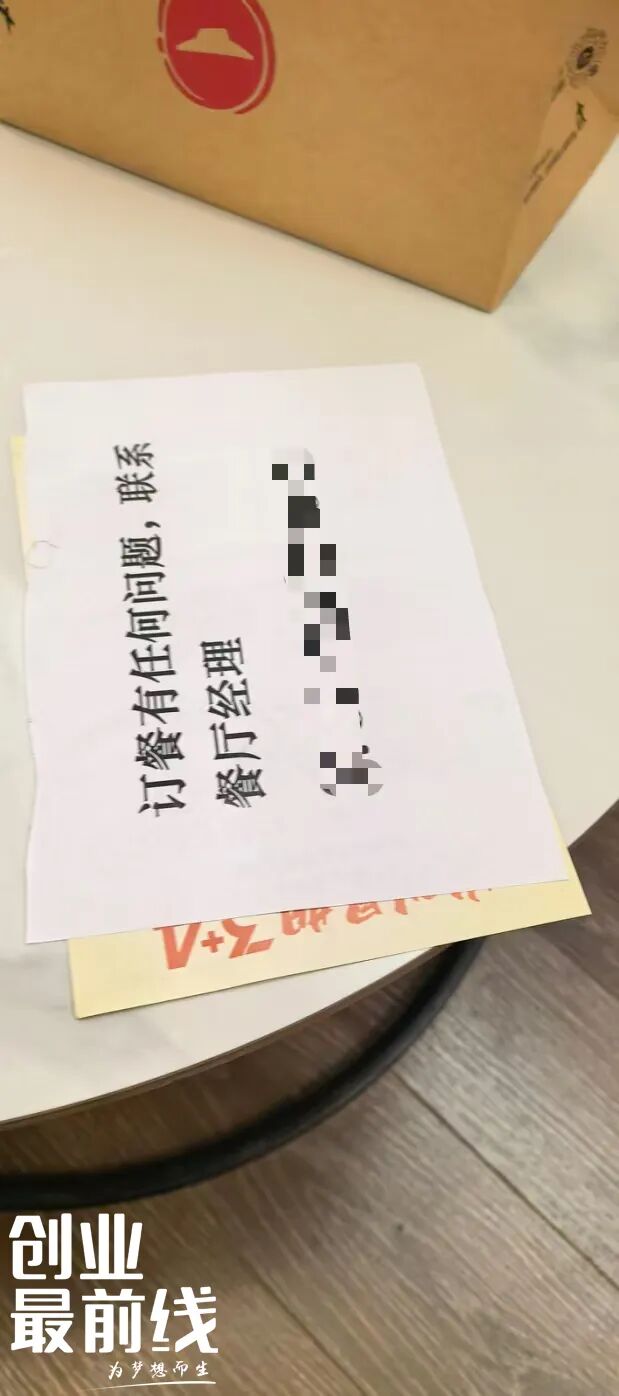
Figure / Pizza Hut service reminder note
It was this very ordinary note that made him think the worst: Are similar hygiene issues a constant problem at this store? "I originally trusted this large chain brand, but now I have to question whether the store's back-kitchen environment and quality control management have been properly implemented."
As of June 30, 2026, Pizza Hut has operated 4,549 restaurants in more than 1,200 towns across China, and Yum China (the owner of the Pizza Hut brand in China) has even set the goal of "rebuilding a new Pizza Hut in five years".
But while the scale is expanding rapidly, there have been thousands of complaints related to Pizza Hut accumulated on the Black Cat Complaint Platform, a large number of which point to problems such as undercooked ingredients, mixed foreign matter, and stale ingredients.
As more and more stores open, how to manage thousands of stores under its banner and ensure standardized management across all outlets remains the ultimate challenge facing Pizza Hut.
1 The Cockroach Mixed in the Pizza
On the eve of the Mid-Autumn Festival, Lin Li made a last-minute decision to order a Pizza Hut durian pizza. It was supposed to be a simple dinner before he set off from Foshan to Guangzhou, but he never expected that this takeaway from the chain brand would bring him a long, drawn-out rights protection process full of disputes.
"I rarely order Pizza Hut takeout on weekdays, I just craved durian pizza that day," Lin Li told iStartr Frontline. The order was delivered at 18:49, and the rider placed the meal on the shoe rack at his door as requested. As soon as the rider left, he picked up the takeaway immediately. "The outer package was intact, no signs of damage, leakage or opening, nothing looked unusual on the surface."
Lin Li opened the drink, chicken fillet, and the most anticipated durian pizza in sequence, but spotted a flattened cockroach inside the pizza box at first glance.

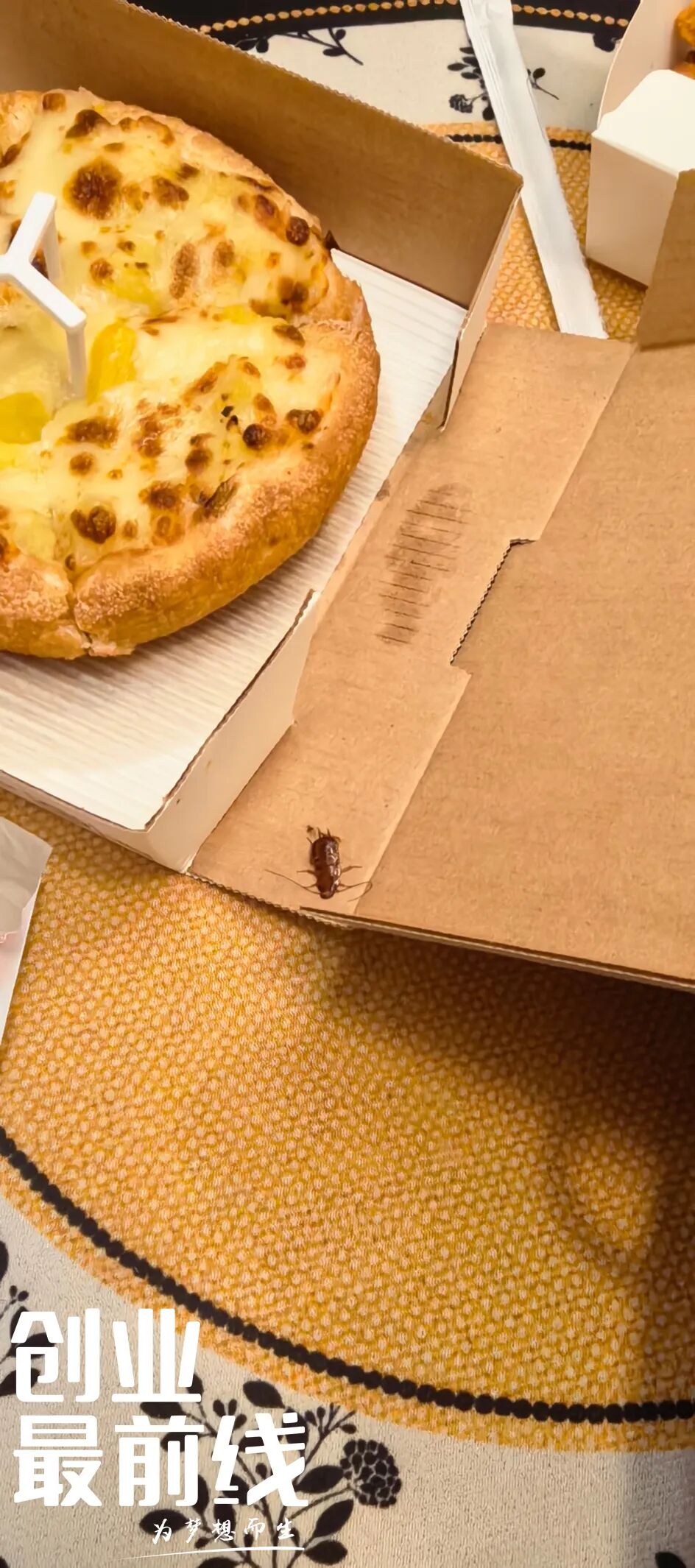
Figure / The cockroach found in Pizza Hut takeaway
Shocked, Lin Li stopped eating immediately and took photos to preserve evidence, the timestamp of the photos showed it was 18:53.
Right after that, he submitted a refund application on the takeaway platform and wrote in the refund reason that there was a cockroach in the meal. But to his surprise, the Pizza Hut store directly rejected the refund application. The merchant later explained that the rejection was triggered by the platform's automatic mechanism.
Helpless, Lin Li applied for intervention from the Taobao Flash Purchase platform. After verifying the order, the platform completed the refund, and based on the "Food Safety Protection" benefit attached to the order, paid an additional compensation of 29.9 yuan. But the platform also stated that matters such as additional compensation and apology required further communication between the consumer and the Pizza Hut store.
Thinking the issue would be properly resolved after the platform intervened, the subsequent communication with the Pizza Hut store made Lin Li furious. He called the store to report the foreign matter issue, and the first reaction of the store staff was "impossible", telling Lin Li that an internal investigation was needed.
After waiting for a while, the store gave an unacceptable statement: the store did not find any surveillance footage that could prove there was a cockroach in the meal, and put forward a speculation that the takeaway was placed on the shoe rack at the door, so the cockroach might have crawled into the pizza box from the shoe rack.
Lin Li completely disagreed with this statement.
"It only took four minutes in total from the rider putting down the takeaway to me bringing it indoors. In such a short time, a cockroach could never crawl into the well-sealed pizza box on its own and get flattened inside it." The store never showed him the relevant surveillance video, and only based on verbal speculation, attributed the problem to the consumer's home environment.
Lin Li, who was in a hurry to go to Guangzhou, proposed that the store send someone to pick up the problematic meal for their own investigation, and give him a reply after the investigation was completed. After the store took away the meal, there was no news, and they never took the initiative to contact him again.
After repeated ineffective communications with the store, Lin Li filed a complaint to Pizza Hut's headquarters. The headquarters replied that they would arrange for the store to follow up and handle the issue. But the store still stuck to its original statement and refused to admit that there were problems at the back-kitchen side. Later, the headquarters called to give the final plan: the order had been refunded, and an additional pizza coupon would be provided as compensation.
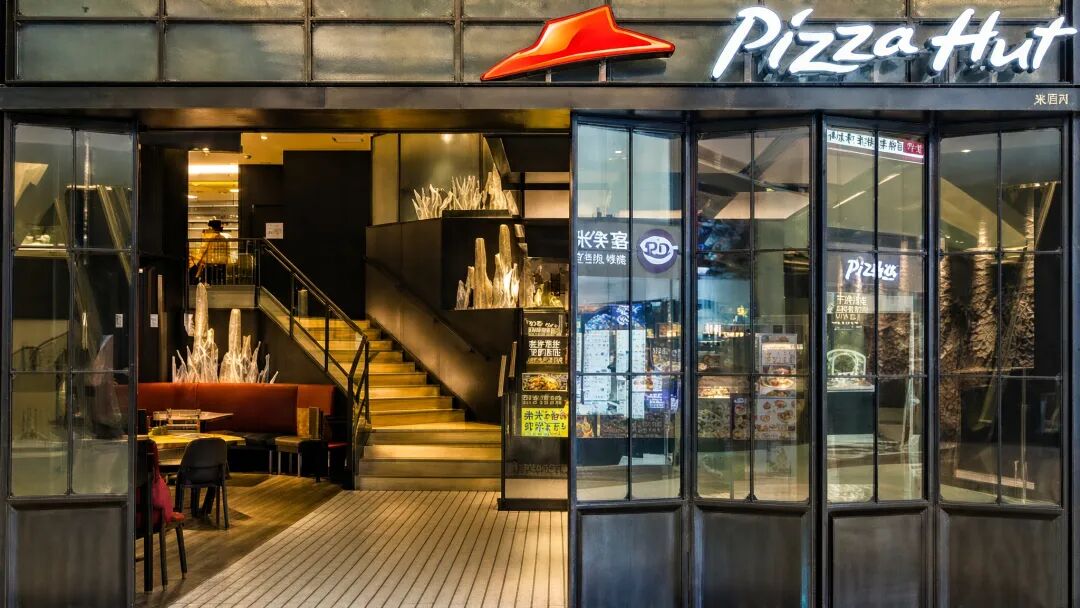
Figure / Pizza Hut official website
This solution was far from what Lin Li expected. He put forward two demands: first, the store issue a written apology, and second, give reasonable compensation in accordance with the relevant provisions of the Food Safety Law. According to Article 148 of the Food Safety Law, if foreign matter is mixed in food, in addition to a refund, the consumer can claim compensation of ten times the price of the product, and the compensation shall be 1000 yuan if the amount is less than 1000 yuan.
The negotiation reached a deadlock, Lin Li chose to submit a complaint and report to the 12315 platform. "My demands are very clear, the full refund has been completed, I want a written apology from the store, compensation in line with regulations, and the regulatory department to send staff to inspect the store's hygiene conditions."
Recently, the Foshan government service platform replied to Lin Li's complaint. The platform stated that it has contacted the involved merchant to carry out communication and mediation, but the merchant clearly stated that they cannot meet the consumer's demands, the two sides failed to reach an agreement through negotiation, and this mediation is terminated. According to Article 23 of the Provisions on the Handling of Market Supervision Complaints and Reports, consumers are advised to claim their rights through judicial channels.
2 Out-of-control Quality Control Under Expansion
"I have no objection to the platform side, but I am completely dissatisfied with the merchant side." Lin Li said that the most unacceptable part of the entire rights protection process was that the involved store kept making excuses and unilaterally attributed the suspicion to the consumer.
In his opinion, as a national chain catering brand, Pizza Hut built consumer trust by relying on standardized back-kitchen and quality control systems. But when a foreign matter problem actually occurs in the meal, the store's first reaction is not to check the back-kitchen hygiene, but to pre-set various external possibilities and try to shift the responsibility to outside parties.
Lin Li said that the involved Pizza Hut store could not provide any evidence to support its speculation that "the cockroach came from the shoe rack", and refused to provide the consumer with the surveillance footage of the back-kitchen packing process. The whole handling process was dragging, and the store kept repeating the same set of excuses.
In fact, as of now, there are a total of 5,635 complaints related to Pizza Hut on the Black Cat Complaint Platform, the vast majority of which are related to food safety, such as undercooked ingredients, mixed foreign matter, and stale ingredients are all frequent complaint issues.

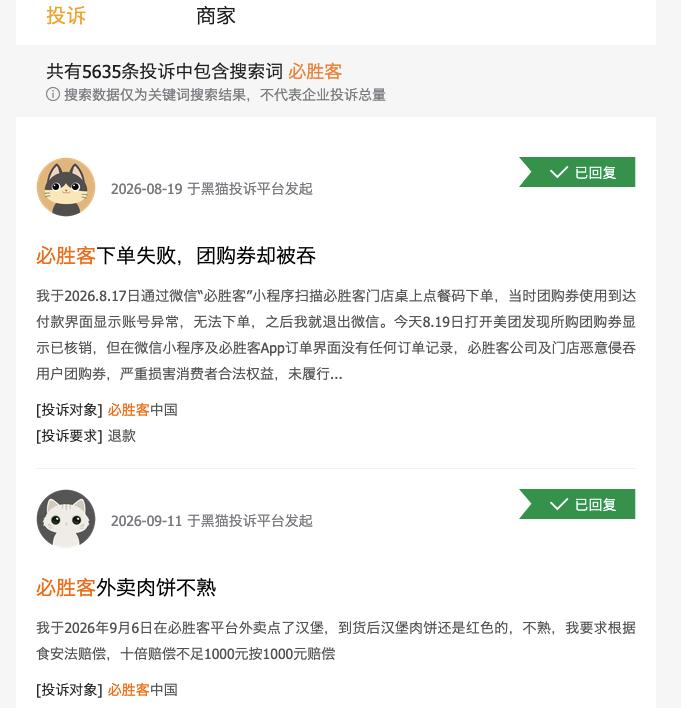
Figure / Black Cat Complaint Platform
While the store is trapped in consumer disputes, Yum China is planning a new growth blueprint for Pizza Hut.
At the investor conference in November 2025, Kuai Jun, General Manager of Pizza Hut China, put forward an ambitious goal — "rebuilding a new Pizza Hut in five years", by 2029, the profit of the entire brand will strive to double compared with 2024.
To achieve this goal, Pizza Hut has formulated a clear expansion plan: add more than 600 net new stores every year, and the total number of stores will exceed 6,000 by 2028. Kuai Jun emphasized that this goal is "not simply pursuing the number of stores, but ensuring both quality and quantity".
Since then, Pizza Hut has pressed the acceleration button for expansion.
From 1990 to 2023, Pizza Hut took 33 years to open 3,000 stores; and it only took a little more than two years to grow from 3,000 stores to 4,000 stores. As of June 30, 2026, Pizza Hut operates 4,549 restaurants in more than 1,200 towns across China.
To adapt to different market demands, Pizza Hut has continued to explore diverse store formats in recent years, including the cost-effective small store concept "Pizza Hut WOW", the high-end boutique pizzeria positioning "Pizza Hut PIZZERIA", and it has also tested a new hamburger product line "Pizza Hut Burger", continuously expanding its business boundaries.
In August 2026, Yum China completed the $1.2 billion acquisition of full ownership of Pizza Hut in mainland China, officially transforming from an exclusive franchisee to the brand owner. This acquisition completely resolves the historical disputes between Pizza Hut China and its parent brand, giving it full operational autonomy.
Yum China said that after the transaction is completed, Pizza Hut China no longer needs to pay the previously applicable franchise fee to Yum! Brands Inc. in the United States, and the resulting cost savings are expected to increase Pizza Hut's restaurant profit margin and operating profit margin after value-added tax deduction by 2.8%.
In the view of Joey Wat, CEO of Yum China, in addition to the direct cost savings on the books, the full ownership of Pizza Hut (Mainland China) will give Pizza Hut greater strategic flexibility, enabling it to continuously promote innovation in menus, store formats, new modules, operation management and other aspects.
Yum China's 2026 half-year report shows that Pizza Hut's brand revenue increased from $1.149 billion in the first half of 2025 to $1.248 billion in the same period of 2026, a year-on-year increase of 8.6%.
But on the other side of expansion, food safety, back-kitchen management and after-sales response are the unshakable foundation for chain catering. When the brand focuses on the transformation of store profit model and large-scale store opening, it is questionable whether the quality control standards of front-line stores are implemented synchronously, and whether grassroots stores have the corresponding food safety management capabilities.
It is never easy for big brands to build consumer trust. A foreign matter incident in a meal, coupled with the long, drawn-out after-sales dispute, will not only damage the dining experience of one customer, but also erode the brand's reputation accumulated over years.
The scale dividend brought by expansion can be easily consumed by repeated food safety incidents and improper after-sales handling step by step.
"I will not consider Pizza Hut even if I want to eat pizza in the future," Lin Li said.
For Pizza Hut, the optimization of the store economic model cannot only focus on revenue and cost. Food safety and consumer rights protection are the underlying foundation for the long-term operation of the store model.
3 Fierce Competition in the Pizza Market
Pizza originated in Italy and developed in the United States. In the 1990s, Pizza Hut, Domino's, Papa John's and other companies successively entered the Chinese market, and with their unique business strategies and brand characteristics, they first became popular in densely populated areas of China's first-tier cities.