After its market value plummeted by 95%, she sold the listed company.
The business targeting single men and women is no longer easy to run.
This week, dating app giant Bumble announced that it will be acquired by Ithaca Holdings in an all-cash deal at a valuation of 1.3 billion US dollars (equivalent to more than 8 billion yuan).
This is a social app popular among international students, white-collar workers in large tech companies and foreign enterprises. In 2014, Whitney Wolfe Herd, who had participated in the development of Tinder, left to found Bumble and quickly rose to prominence. It was the only "female-first" dating platform at that time, and even attracted investment from Blackstone.
After its listing in 2021, Bumble's market value once surged to 14 billion US dollars (nearly 100 billion yuan), and this female head also became the youngest female CEO on Nasdaq at that time. No one could have imagined that the current acquisition price is less than one-tenth of that year's peak. Times have changed, which is quite thought-provoking.
She built the "ace" in the dating industry, with a market value of 100 billion yuan once
Bumble was once all the rage among young men and women.
The story starts with its founder Whitney Wolfe Herd (Wolfe for short). Born in 1989, she once participated in building Tinder, which was extremely popular among singles and is the prototype of TanTan familiar to domestic users, creating the social matching mode of "swipe left and swipe right".
After leaving Tinder in 2014, Wolfe spotted the long-standing pain point in online dating: after matching, men could take the initiative to start a conversation, while women often received a large number of harassing messages. She began to conceive a women-exclusive social network.
At that time, Andrey Andreev, the founder of Badoo which also operated social business, invited her to join his company MagicLab (later renamed Bumble Inc.). The two joined forces, and Bumble was thus born.
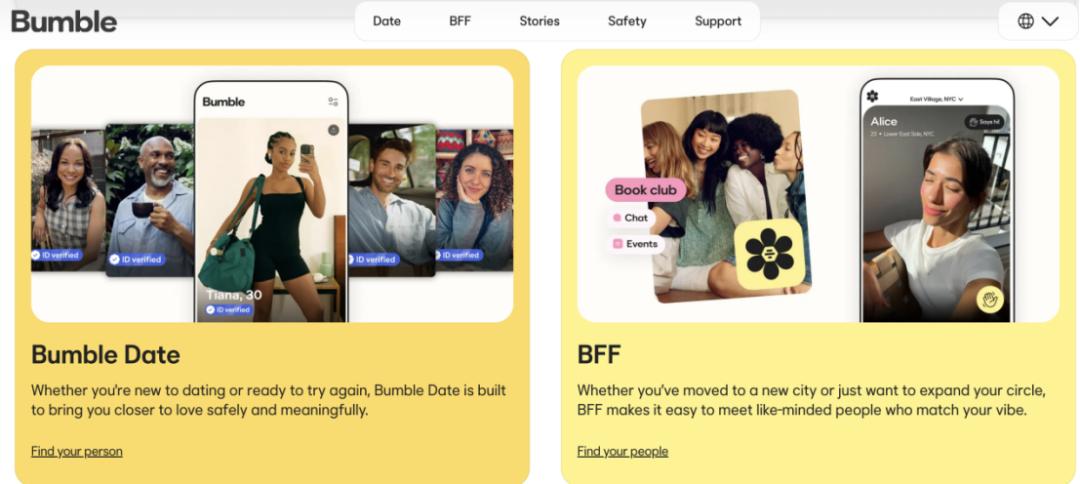
Different from mainstream dating apps such as Tinder, Bumble set a subversive rule: after a heterosexual match is successfully made, the woman must send the first message first, and the man can only wait for a response; if no conversation is initiated within 24 hours, the match will expire directly.
This tiny rule change reconstructed the power relationship in online dating, and also quickly gave Bumble a differentiated label: the number of downloads exceeded 100,000 in the first month of launch; by the end of 2015, the number of conversations exceeded 15 million, the number of matches exceeded 80 million, and the retention rate of female users was significantly higher than that of similar products.
In 2016, Bumble was no longer limited to romantic dating, and launched the BFF section for finding purely platonic friends; later, Bumble Bizz was added for expanding professional connections. The product expanded from a single dating app to a multi-scenario social platform covering three types of needs: romance, friendship and career development.
The turning point came in 2019. Bumble launched a Super Bowl ad, invited a famous tennis player as its spokesperson, and pushed the concept of "women taking the first step" to the public, further boosting its popularity, with the user scale reaching about 75 million. In November of the same year, Blackstone Group bought about 14% of the shares of Bumble's parent company at a valuation of 3 billion US dollars.
Just over a year later, Bumble was successfully listed. In February 2021, 31-year-old Wolfe rang the IPO bell with her 18-month-old son, and the market value once approached 14 billion US dollars on the first day of listing.
That was the highlight moment of Bumble, and also the highlight moment of this female leader. With Bumble's listing, Wolfe became the youngest female CEO in the history of US IPOs, and also the youngest female billionaire in the world at the same time.
Market value plummeted by 95%, and it was eventually sold
But the highlight faded soon.
After the end of the pandemic, offline socializing resumed, the growth of dating apps began to slow down, and competitors such as Tinder and Hinge continued to compete for users. Bumble's popularity dropped significantly, and its stock price also fluctuated greatly.
But the real problem is that young people are starting to get tired of it.
The data feedback is the most direct. For the whole year of 2025, Bumble's paying users fell by more than 11% to about 3.7 million, and its revenue dropped by nearly 10% to about 966 million US dollars. In the first quarter of 2026, paying users plummeted 21.1% year-on-year to 3.2 million, and total revenue decreased by 14.1% year-on-year.
User aesthetic fatigue, declining willingness to pay, and the shift of young people's social habits, multiple pressures came one after another. In March 2025, Wolfe, who stepped down as CEO in 2024, returned to the position, and then announced layoffs of about 240 employees, accounting for 30% of the total global workforce.
To cater to more users, Bumble tested a new AI matching assistant, and even cancelled the 12-year-old rule of "women sending the first message" in August this year, allowing either party in a match to take the initiative to start a conversation. This core setting that once differentiated Bumble from all its competitors was finally abandoned in the face of user loss.
Although a series of remedial measures were taken, the downward trend was still not reversed. Now Bumble's market value is less than 800 million US dollars, down more than 95% from its peak, and Blackstone also decided to liquidate all the shares it holds.
In contrast, it is inevitably quite lamentable.
Bumble had to look for a buyer for itself. The final acquirer is Ithaca Holdings, a newly established holding platform dedicated to acquiring long-term tech assets. The two core operators are well-known figures in the tech investment circle: Ravi Gupta used to be a partner of HSG, and John Hegeman once served as Chief Revenue Officer of Meta.
After the transaction is completed, the two will serve as co-CEOs of Bumble. Founder Wolfe will continue to retain some related ties, but will no longer be in charge of the daily operation of the company.
In this way, the social upstart that was once sought after by Wall Street finally exited in a low-profile manner. The era that belonged to it has turned the page.
Is AI the ultimate destination of social networking?
This scene must be deeply felt by players in the stranger social networking sector.
Overseas, the number of paying users of Tinder has declined for several consecutive quarters, and the market value of Match Group has fallen by more than 70% from its peak. Domestic competitors are also in an unfavorable situation: the number of paying users of Momo and TanTan has continued to shrink from the tens of millions level in the peak period. Although Soul has told a new story of "spiritual socializing", it is still exploring the path of commercialization.
Where is the problem?
The New York Times summarizes the current situation of dating apps as a kind of "cycle of despair": users download the app, swipe repeatedly but get no results, uninstall it after feeling tired, and reinstall it a few months later. The number of matches has increased, but the difficulty of finding a suitable partner has not decreased. Once users find a stable relationship and return to offline life, the most direct choice for them is to uninstall the app.
In this case, the platform is always trapped in a dilemma: it has to help users find the right person, but also retain users.
Many people think that the solution to social networking is more matches, more chats, and longer online duration. But the reality is not the case. The screen is only a temporary bridge, and the end of all online socializing points to real offline interaction. Texts, photos and algorithmic tags can only complete the initial screening. A real relationship will eventually grow slowly through meeting, talking and running in with each other.
In the AI era, stranger social networking has been reshaped. Almost all mainstream social products are embedding AI into every link including matching, ice-breaking and security review, trying to make the connection between real people more efficient.
But a more noteworthy change is that AI itself has begun to become a social object.
"My best friends are DeepSeek, Doubao and ChatGPT." Similar remarks can often be seen on social platforms. AI will not bring the uneasiness before meeting, can answer questions and solve doubts, and there is no conflict and entanglement in interpersonal communication. It is online all day long, and firmly takes in all emotions.
This is a situation that social products have never encountered in the past two decades.
Admittedly, AI can never replace those clumsy, heart-fluttering and unpredictable precious moments in real human interaction, and the social business will never come to an end. But the realistic trend is that more and more people are willing to accept this kind of less "real" companionship brought by AI.
Perhaps the one that defeats you in the future will not be a human, but AI.
This article is from WeChat Official Account "Investment China" (ID: pedaily2012), written by Zhou Jiali, authorized for release by 36Kr.