To become the second largest in the global market, Uniqlo's answer is no longer China.
Text by He Zhexin
Edited by Qiao Qian
From 8,000 Square Meters to 2,800
At the end of this month, Uniqlo Shanghai Global Flagship Store will reopen at No.755 Middle Huaihai Road. A few hundred meters away, the 13-year-old old store at No.887 Middle Huaihai Road will also close down.
The Uniqlo Shanghai Global Flagship Store at No.887 Middle Huaihai Road opened in 2013. It remains the largest Uniqlo store worldwide to date, spanning from the first basement level to the fifth floor above ground, with a business area of more than 8,000 square meters. The new site to be relocated to covers an area of approximately 2,800 square meters, less than half of the original site.
On the eve of the opening, Tadashi Yanai personally traveled to Shanghai for media interviews, where the goal of "3,000 stores" was put forward. On the opening day, all Fast Retailing executives attended the ribbon-cutting ceremony. Pan Ning, CEO of Uniqlo China, stated that this marked Uniqlo entering a "new stage of development" in China.
More than a month after the relocation was announced, Fast Retailing released its financial results for fiscal year 2026: the combined revenue of Uniqlo's North America and Europe businesses reached approximately 877.5 billion yen, surpassing that of the Greater China region for the first time. Their respective proportions of the group's revenue reached 22.1% and 18.3%, meaning the Europe and North America regions also outperformed the Greater China region for the first time.
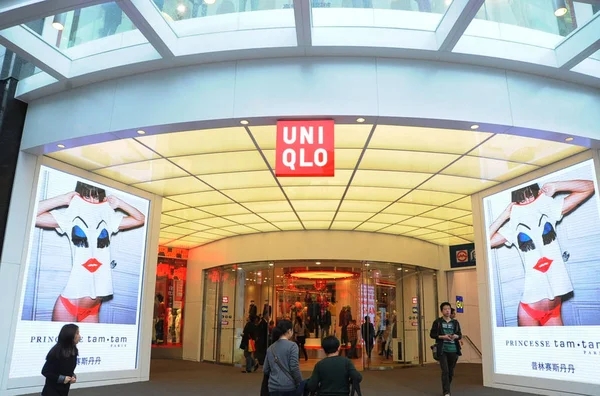
Driven by the strong momentum of the global flagship store on Middle Huaihai Road, Fast Retailing, the parent company of Uniqlo, saw its total global sales exceed 1 trillion yen for the first time in fiscal year 2013
For a long time in the past, the Greater China region has been Uniqlo's most important "cash cow" outside Japan: in fiscal year 2021, it contributed a quarter of Fast Retailing's revenue, and about 90% of the operating profit of Uniqlo's overseas business also came from here. Five years ago, the Greater China region accounted for 57% of Uniqlo's overseas revenue, but now this proportion has dropped to 30%. In the past five years, Uniqlo's revenue in Europe and the United States has expanded to about 3.6 times, while the Greater China region including Hong Kong and Taiwan has only increased by about one third.
The rapid growth of the European and American markets has also allowed Fast Retailing to surpass H&M in annual sales for the first time, making it the world's second largest apparel retailer, second only to Inditex, the parent company of Zara.
After more than a year of sluggish performance, the Greater China region returned to growth in fiscal year 2026, with revenue increasing by 11.3% year on year. However, calculated in RMB, the growth rate of the Chinese mainland market is only 3%, and its former role as an engine is difficult to return. In the next ten years, the European and American markets can not only take over the baton, but Tadashi Yanai also publicly stated that "there is still much room for a substantial increase in market penetration in Australia, India and Southeast Asia."
After the pandemic, Uniqlo once announced that it would open "80 to 100 new stores" in China every year and sink into lower-tier cities. The number of Uniqlo stores in mainland China peaked at 926 at the end of fiscal year 2024.
The effect of this strategy is not very good, because discounts and substitute products are more prevalent in lower-tier markets. In fiscal year 2025, Uniqlo's Greater China revenue fell by 4% and operating profit fell by 12.5%, the first decline after the pandemic. Subsequently, Uniqlo began to shrink its store network, proposed the strategy of "closing small stores and opening large stores", and downplayed the goal of 3,000 stores and the number of new stores opened each year. A retail industry insider pointed out that the size of the store is not the real standard. In fact, Uniqlo's move is to close stores with poor efficiency, and prioritize e-commerce in lower-tier cities.
Tadashi Yanai did not publicly talk about China in the latest earnings season, and his latest public statement dates back to 2025. At that time, he criticized the practice of "headquarters giving orders and taking unified actions across the country" in Chinese stores, arguing that the extensive operation must be transformed into independent operation of each individual store.
In his view, the quality of Chinese employees and operators is very high, and it is with the advantage of chain operation that the business has reached its current scale. "But the current situation is that stores have a strong tendency to act in a uniform manner according to headquarters instructions, failing to create product mixes and sales floors suitable for customers in different regions." To break this situation, "each store must use its own brain to run its own business and transform to individual store operation."
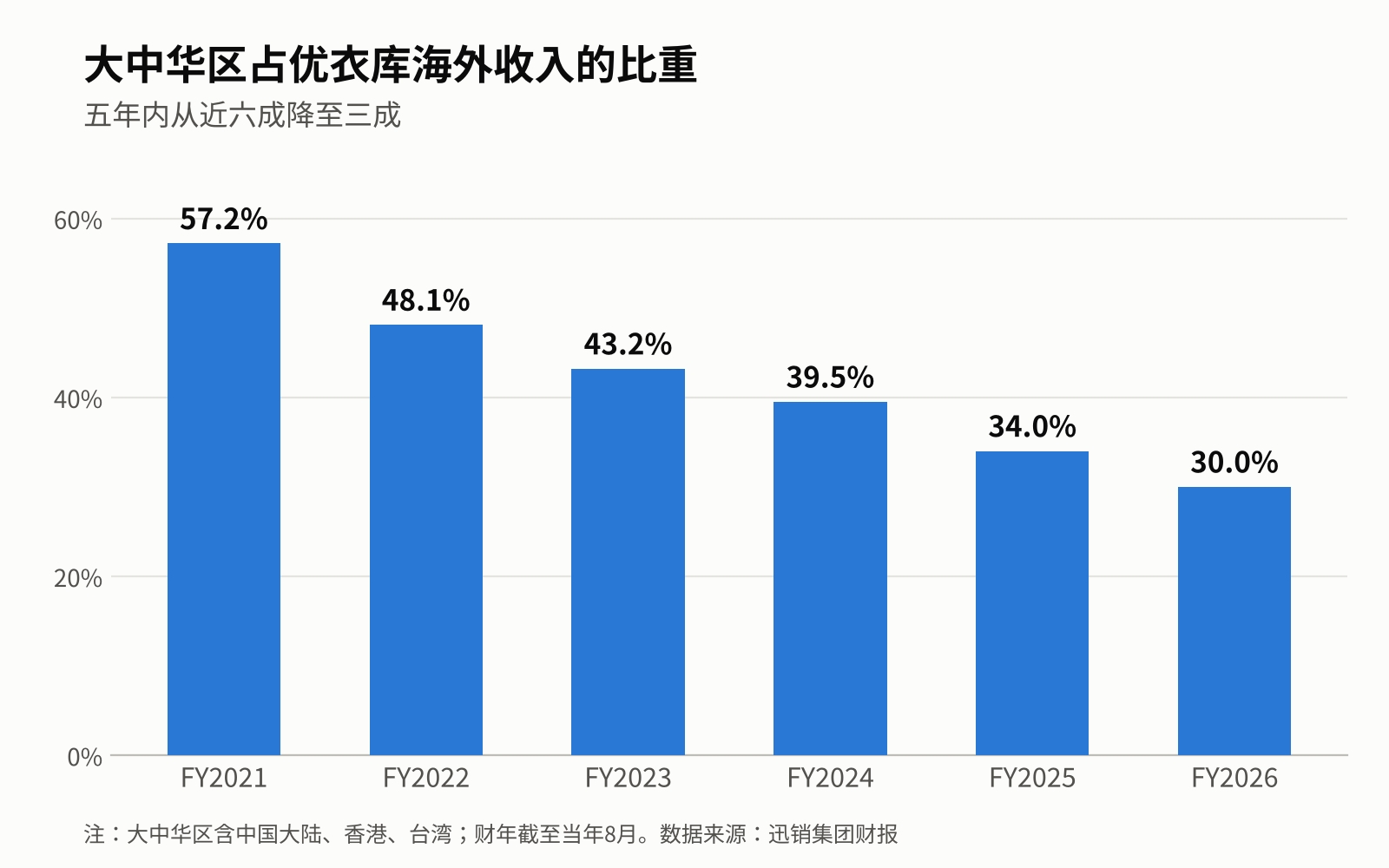
Illustration by 36Kr
A retail analyst pointed out to 36Kr that for offline retail brands, the era of seizing channels by opening more stores is over. "Opening stores is still useful, but it has changed from a main growth driver to an auxiliary method."
He gave two reasons. First, fewer and fewer new shopping malls are being built. If too many stores are opened in the same business district, they will compete for customers with each other, and the incremental revenue brought by a new store is getting smaller and smaller, even not worth the loss. Second, e-commerce, live streaming and private domain channels have taken away more and more business. The purpose of offline physical stores has also changed: they are no longer just places to sell goods, but more places for customers to try on clothes, learn about the brand, or act as warehouses for nearby delivery.
In fiscal year 2026, Uniqlo closed a net of 51 stores in mainland China, bringing the total number of stores down to 851. After a large number of store closures, the annual revenue per store in the Greater China region finally exceeded the 2019 level when calculated in yen. Uniqlo has never publicly disclosed the total business area of the Greater China region, but assuming that as it claims, the closed stores are small ones and the newly opened ones are large ones, the revenue per unit area is feared to be lower than the pre-pandemic level.
All signs indicate that Uniqlo is relying on overseas markets outside China to achieve Tadashi Yanai's repeatedly reiterated ambitious goal of "annual revenue of 10 trillion yen".
The Next Chapter
"There are usually three key points to judge whether the timing of entering a market is mature: whether consumers welcome us, whether the macro and micro environments are the most suitable, and whether we are ready to serve the new market." In 2019, a senior Uniqlo executive in charge of overseas markets told the media.
Now this timing has come — continuous global geopolitical conflicts have led to supply chain disruptions, soaring energy prices, resurgent inflation in European and American countries, and the public continues to cut discretionary consumption, including apparel.
An industry insider told 36Kr that the European and American markets have long lacked brands that are "mid-priced, practical and stylish, not overly chasing trends", and Uniqlo has perfectly filled this gap. Even after a slight price increase due to tariffs and other factors, Uniqlo still has strong price competitiveness.
The author visited the Uniqlo store in the center of Berlin on the spot and found that the pricing of autumn and winter collections is about 1.2 to 1.5 times that of domestic products in China. The pricing of some core items, such as thin down jackets and round tote bags, is basically the same as that in China. Converted by the exchange rate, the per capita disposable income in Berlin is about 2.4 times that of Shanghai, so Uniqlo has full price competitiveness in the local market.
In fact, Europe is also the region with the highest revenue per Uniqlo store, with an average annual revenue of 5.4 billion yen per store; North America ranks second, with about 2.94 billion yen; the figure for the Greater China region is 760 million yen, less than one seventh of that of Europe.
Daisuke Tsukagoshi, COO of parent company Fast Retailing, attributed the success to several items developed for the European and American markets: ribbed curved pants, curved jeans, and mini T-shirts, which are "growing into global bestsellers". But bestsellers are more of a result than a cause. In addition to the obvious exposure and foot traffic brought by flagship stores, Uniqlo has made many subtle but highly effective localizations for the European and American markets.
Take women's wear as an example. Women's wear of competing brands in Europe usually accounts for about 70% of total sales, while Uniqlo's figure used to be only 40%. Since then, Uniqlo has strengthened the development and marketing of women's wear through its London R&D center, increased the styles of dresses and skirts, and raised the proportion of women's wear to about 50%.
The management team, which used to be all Japanese, now has "four out of seven European chief operating officers coming from Europe". Takumasa Morikawa, CEO of Uniqlo Europe Group, also stated that the position of store manager, which is critical to store operation, will also be held by more European employees.
In the spring of 2025, Uniqlo launched its largest automated warehouse in the Netherlands. In the initial stage of operation, the old and new warehouses operated in parallel, which once pushed up logistics costs. This problem has been solved since the third quarter of fiscal year 2026. Coupled with the control of discounts, the profit margin increased by 3.2 percentage points to 17.9%.
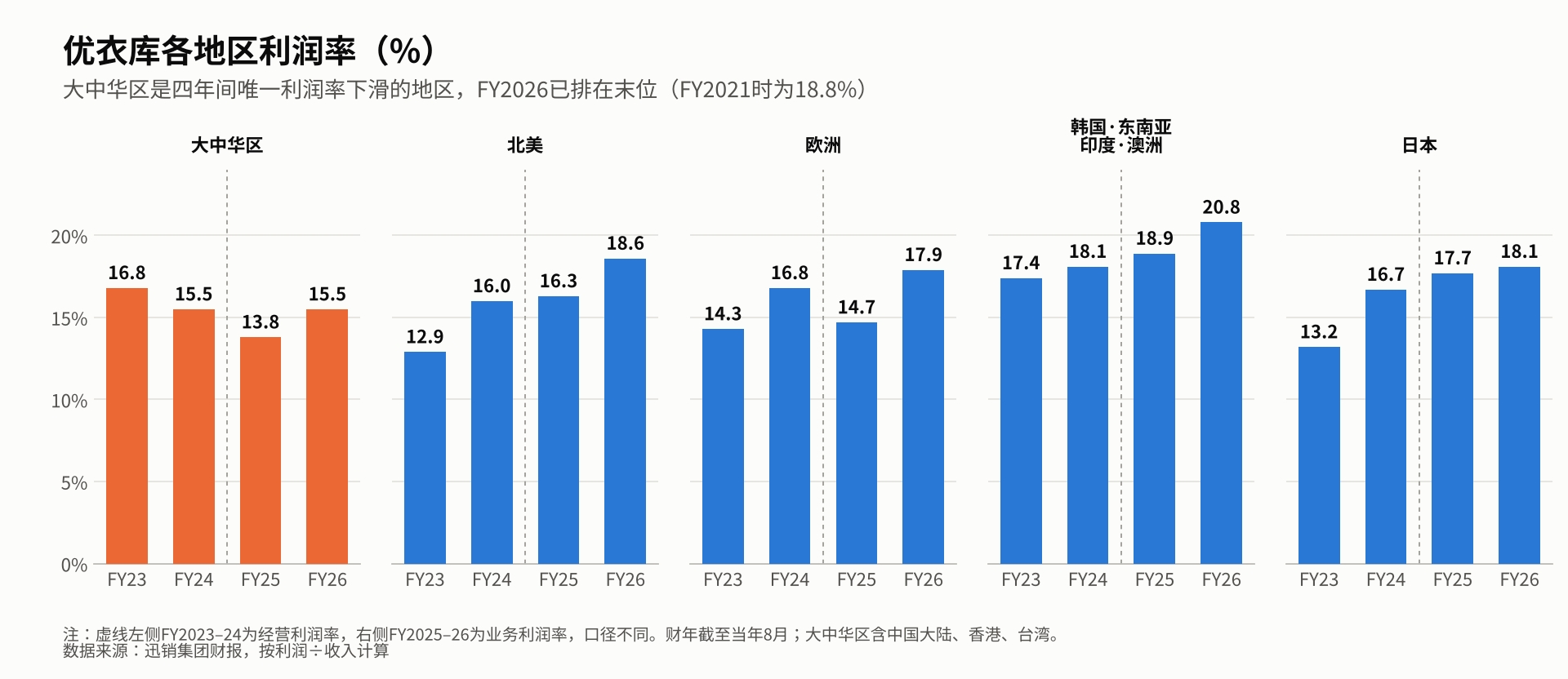
Illustration by 36Kr
Uniqlo North America is more focused on "course correction". After switching from the initial suburban store strategy to the city center strategy, Uniqlo has ushered in long-awaited growth in North America. The practice of opening large stores in central business districts has also attracted more consumers. On October 9, Uniqlo returned to San Francisco's Mid-Market, a business district that has struggled for a long time due to the pandemic, opened a 1,800-square-meter large store, and launched co-branded styles with local artists, attracting many local customers.
In addition, Uniqlo's main "cost-effective" competitors in North America, ultra-fast fashion platforms such as SHEIN and Temu, were forced to raise prices after the United States canceled the tax exemption for small parcels. After the tax exemption was canceled in May 2025, the price of some products on Temu doubled, and the price increase of some individual products on SHEIN exceeded 300%. SHEIN's revenue in the United States in the first quarter of this year fell by 14% year on year, and its prospectus stated that the cancellation of tax exemption had an "adverse impact" on U.S. sales.
Fast Retailing has set a target of 1 trillion yen in annual revenue for North America and Europe respectively within about five years, which means Europe needs to double its current revenue, and North America needs to grow to nearly three times its current level. To achieve that goal, Daisuke Tsukagoshi believes that expanding the supply of "non-seasonal" clothing is one of the key points.
Uniqlo has long relied on winter products such as fleece, HEATTECH and down jackets, but increasingly warmer autumn and winter seasons are eroding this core business. In the fourth quarter of fiscal year 2026, the temperature in Europe remained high, and the demand for autumn and winter products was sluggish, so the full-year revenue of Uniqlo's overseas business was slightly lower than the expectation given in July.
"We used to plan our product lines around the four seasons," said Daisuke Tsukagoshi, "but now the boundaries between seasons are changing."