I have been targeted by AI scams.
While AI technology brings us convenience, it also makes fraud increasingly difficult to identify.
In the past, when people received unfamiliar calls or suspicious messages, they could verify identities through methods like video calls or phone calls. But today, these once-reliable judgment criteria may also become tools for scammers to gain trust.
Data from the Ministry of Public Security shows that in 2025, public security organs across China solved a total of 258,000 telecom and online fraud cases. New types of fraud such as AI face-swapping have also drawn widespread attention. According to a report by Economic Observer citing a September 2026 announcement from the Ministry of Public Security, more than 300 AI face-swapping related fraud cases have been cracked nationwide, with the involved amount exceeding 500 million yuan, and the maximum amount in a single case reaching 20 million yuan.
Image source / pexels
Behind these figures are real fraud experiences encountered by ordinary people.
Some people find that their photos posted on social platforms have been stolen and used for AI face-swapping to defraud others; some people heard the voice of an "offline friend" asking to borrow money when playing games late at night; some people chatted with a strange girl for more than ten days, and did not find something wrong until they asked the other person to turn around during a video call. Fraud can also be hidden in a ransom letter sent to the workplace, or a strange private message in the comment section of a financial blogger......
When voices, faces, images and even chat content can be forged, it is increasingly difficult for ordinary people to judge authenticity only by their eyes and ears. What is more worthy of vigilance is that technology is only part of fraud. Common methods in traditional scams such as acquaintance relationships, emotional needs, investment temptation, and reputation pressure have not disappeared, but may become more confusing with the help of AI.
"AIX Finance" talked to five people who were involved in AI scams in different ways, trying to restore how these scams approached them step by step and what they finally relied on to find the flaws.
The following are their stories.
01. The scammer used my face and almost defrauded a girl of 50,000 US dollars
Xiao E | Post-90s generation, Lawyer in Australia
I have been living in Australia for a long time and I am a lawyer, not the internet celebrity in everyone's impression. The total number of fans on Xiaohongshu and Instagram is only more than 10,000. I usually just like to share my life on social platforms, and often post photos of fitness, travel and formal wear.
In the past two years, strange girls or boys often found me on Xiaohongshu or Instagram, telling me that someone had stolen my photos and put them on foreign dating platforms to commit fraud in the name of blind date and making friends.
An example in July this year impressed me the most. A strange girl found me through Xiaohongshu and told me that someone was impersonating me on platforms such as WeChat, Douyin and WhatsApp, and even used my face to have video calls with her.
With my photos, the scammer created a successful male image on social platforms, claiming to be an overseas executive at the headquarters of SF Express, with many industries and resources.
The victim girl told me that she met this person when she shared photos of her vacation in London online. At that time, the scammer took the initiative to talk to her, saying that he came from France to London for tourism. Because the girl was a little older than him, the scammer kept calling her "sister", behaved very enthusiastically, and kept recommending fun places.
Later, the other party suddenly began to express love frequently, saying that the girl did not understand his intentions, and even took the initiative to plan the future of the two. He told the girl that he had many industries and resources that could be shared with her, and even used the future relationship between the two as a reason to persuade her to invest with him.
The girl was not tempted at first. She thought that the two had not known each other for a long time, and the other party was suddenly so enthusiastic and wanted to take her to invest, which was a little abnormal.
But the scammer did not give up, and continued to gain her trust through photos, voice and other methods. At that time, she already suspected the other party's identity and proposed to have a video call with the real person. Unexpectedly, the scammer agreed. According to her description, the other party spent nearly an hour preparing for this video call.
After the video was connected, the face on the screen was indeed consistent with the one in the photo. Later, the girl sent me a screenshot of the video, and I was shocked when I saw it. That face was indeed mine, but the person in the video was not me.
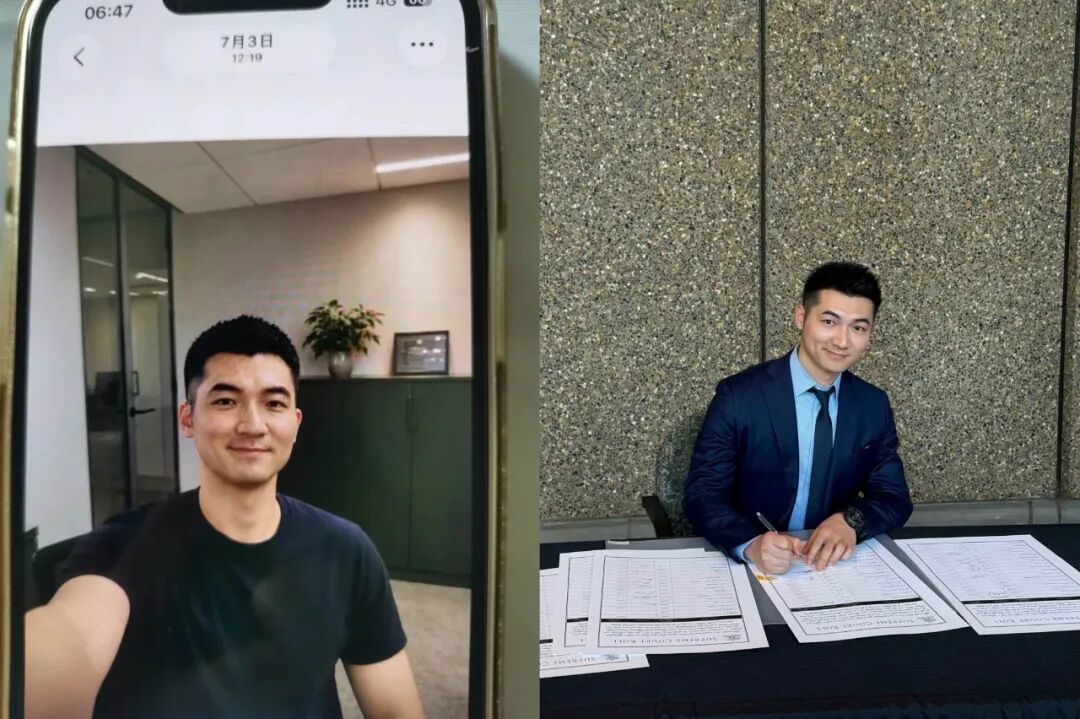
Screenshot of AI face-swapping video (left); photo shared by Xiao E on social platforms (right)
From her description, the scammer used AI face-swapping technology, but I don't know exactly what tool was used. The girl said that she felt that the face did not match the voice, and the expression was a little unnatural, so she repeatedly tested the other party. After the video call, she was still worried, thinking that since the scammer could steal the photos, the photos must be publicly available online. So she searched through the photos and finally found my Xiaohongshu account.
What made me even more scared was that the scammer was inducing her to download an overseas investment app and was about to let her invest 50,000 US dollars. Fortunately, she always felt that something was wrong, did not transfer the money, and finally found me in person.
She also told me that the WeChat account and Douyin account used by the scammer were new accounts registered in April of that year, and all avatars were my photos. After she found the problem, the relevant Douyin account had been banned.
This incident made me realize that AI fraud is not as simple as scammers making up a false identity. They can first collect photos of real people from public social platforms, then use these photos to package the persona, establish emotional relationships, and even further dispel the doubts of victims through AI face-swapping videos.
I am the person whose identity was misappropriated and did not suffer direct economic losses, but it is still very scary to think that my photos were taken by scammers to do these things. For ordinary people, a photo posted publicly on social platforms may become a tool for others to commit fraud.
02. AI imitated my friend's voice, and I was almost defrauded of 5,000 yuan while playing games
Qiu Jie | Post-90s generation, Merchant in Quanzhou, Fujian
In May and June last year, I encountered a very outrageous thing: when playing games, a stranger used a voice almost exactly the same as my friend's to borrow money from me, and almost defrauded me of 5,000 yuan.
I am a businessman and run my own aromatherapy factory. I don't have much contact with AI at ordinary times. Occasionally, I use AI tools on e-commerce platforms to make a few pictures, and I will ask "Doubao" some questions in my life. When I am not busy, I like to play online games with my friends, which is one of the few hobbies I have had in recent years.
For the convenience of communication, we usually use voice software when playing online games. This kind of software usually requires you to create your own channel. If the channel is not locked with a password, anyone can come in. If you don't turn on the "channel entry reminder", you won't know when outsiders come in, because when playing games, the voice software runs in the background, and you won't look at it more.
Image source / Unsplash
That night, my friend and I played games very late. He went to bed first, and I was too lazy to log out of the voice software, so I kept it hanging. After a while, a person with an ID that was a high imitation of my friend's entered the channel. I didn't notice it at all when he came in, until he suddenly called my name, saying that his wife and children were asleep and it was inconvenient to speak, so he wanted to type to tell me something.
With just these few words, the voice was exactly the same as my friend's, and I didn't notice any abnormality.
Then he sent me a private message in the voice software, saying that he needed me to transfer 5,000 yuan to him, and said not to use WeChat transfer because his wife would check his mobile phone, and asked me to transfer the money directly to his bank card.
In fact, I already felt something wrong when I saw this. I looked at his account carefully. The name was exactly the same as my friend's, but the friend list showed that my friend was already offline. After checking again, this was a high imitation account. I didn't reply to him anymore. The next day I talked to my friend and confirmed that that person was a scammer.
After reviewing the incident afterwards, he most likely slipped into the channel while we were playing games, eavesdropped on our conversation, and then used some AI software to simulate my friend's voice. The few words he said to me at the beginning had no difference from my friend's voice. To be honest, if I hadn't been more careful at that time, it would be hard to say what the result would be.
He asked for 5,000 yuan, which is a large amount for me, and immediately aroused my vigilance. If he only asked for a few hundred yuan or one or two thousand yuan, I might transfer it without thinking.
On voice social software, AI voice simulation is actually very easy to succeed. If it is WeChat or a phone call, when a strange number calls in or a strange account adds you, people will naturally be alert. But in this kind of chat software, it is too easy for others to copy your avatar and take an identical or extremely similar name.
And you encounter this kind of thing when you are most relaxed playing games, and your defense line is almost zero.
After this incident, I locked the self-built channel of the voice software, and also turned on the entry reminder. In this semi-public social scene, we should be more careful.
03. The "her" in the video refused to turn her head, and I saw through a suspected AI face-swapping scam
Lu Ming | Post-00s generation, Freelancer in Zhejiang
"Turn your head and let me see the side face." After chatting with a girl who claimed to live in Macau for more than ten days, I finally made a video call with "her".
The "her" on the screen was sitting at the table, and her body hardly moved. At first glance, there was nothing wrong with that face, but after careful observation, something was wrong: the details of the skin and facial features were a little blurry, and I suspected that it had been processed by AI.
I majored in computer science in college and taught myself AI for a period of time, so I am more sensitive to these anomalies. I even suspected that her voice was processed by AI.
In order to verify whether the other party was using AI face-swapping, I asked "her" to turn her head to the side, preferably 90 degrees. Real-time AI face-swapping usually shows flaws more easily when there are large movements, and it is relatively easy to handle when keeping a fixed posture.
But "her" refused all the time. Now I was basically sure that this "girl" who had chatted with me for more than ten days was a scammer.
This person added me on Bilibili. I share some videos about cars on Bilibili, including what's wrong with the car I bought and how it drives, and the other party found me through these videos.
At first, "she" just asked if this car was suitable for self-driving tours, what its advantages and disadvantages were, and said she wanted to recommend a car to her best friend and asked me for advice. These are all very normal topics, and I didn't pay much attention to them. After chatting for a while, "she" began to ask about my personal situation, such as age, occupation and other life-related information. Looking back now, I suspect these questions were to find out my financial status and judge whether I was worth spending time defrauding.
Image source / pexels
Then, "she" proposed to add other contact information. The identity "she" set for herself was a girl living in Macau, who had recently come to the mainland to play with her best friend, and her Bilibili account was borrowed from her best friend. Her own WeChat account was blocked, so she could only be contacted through WhatsApp or Discord.
At this point, I already had doubts. However, I didn't expose it immediately, and wanted to see what "she" was going to do. Later, we mainly contacted through Discord. The other party did not mention money as soon as we met, but tried to build a relationship slowly, talking from daily life to work, and then began to mention money-related things intentionally or unintentionally. The whole process lasted for more than ten days.
I think their fraud process is designed very carefully. They won't directly tell you there is an investment project, but first discuss side hustles, financial management and stocks with you, so that you become curious about "her" way of making money, and it's best to take the initiative to ask "her" if there is any way to make money. When the chat is almost over, "she" will start to introduce the so-called "mining".
I have been exposed to digital currency before, and when I heard this, I basically judged that "she" was a scammer. So I proposed to ask "her" to make a video call with me. During the call, after I exposed "her", the other party dropped a sentence "What are you talking about, I don't understand", and hung up the phone quickly.
Later, I posted this incident on Xiaohongshu to remind more people. Unexpectedly, many people sent me private messages, saying that they had encountered similar scams, and some people were really defrauded of money.
Although AI only appeared in the final video session, it did make the scam more confusing. The older generation of parents can hardly guard against this kind of trick.
After experiencing this incident, I think the most important anti-fraud principle is that no matter how real the other party performs and how long you have chatted, as long as it involves unfamiliar investment projects and money transfers, you must be highly vigilant.
04. I made up a "mooncake concept stock" and tested out an AI scammer
Xiao Yan | Post-95s generation, Beauty industry practitioner in Guangdong
I never thought that the three words I left casually in the comment section of a financial blogger would attract a suspected AI scammer.
Last month, I commented under the video of a financial blogger with 10,000 to 20,000 fans: "I get it now". This is an internet meme, which means that I didn't make money from stocks, but I have lost money enough to "understand" the market. It is essentially self-deprec