Just now, Mythos 5 has cracked a major problem in quantum computing.
Just now, Anthropic unveiled a groundbreaking new research.
Mythos 5 has completed a fully autonomous closed-loop design of a brand new quantum circuit that is far more efficient than the "best human-designed solution"!
And it achieved this feat only with plain language descriptions as input.
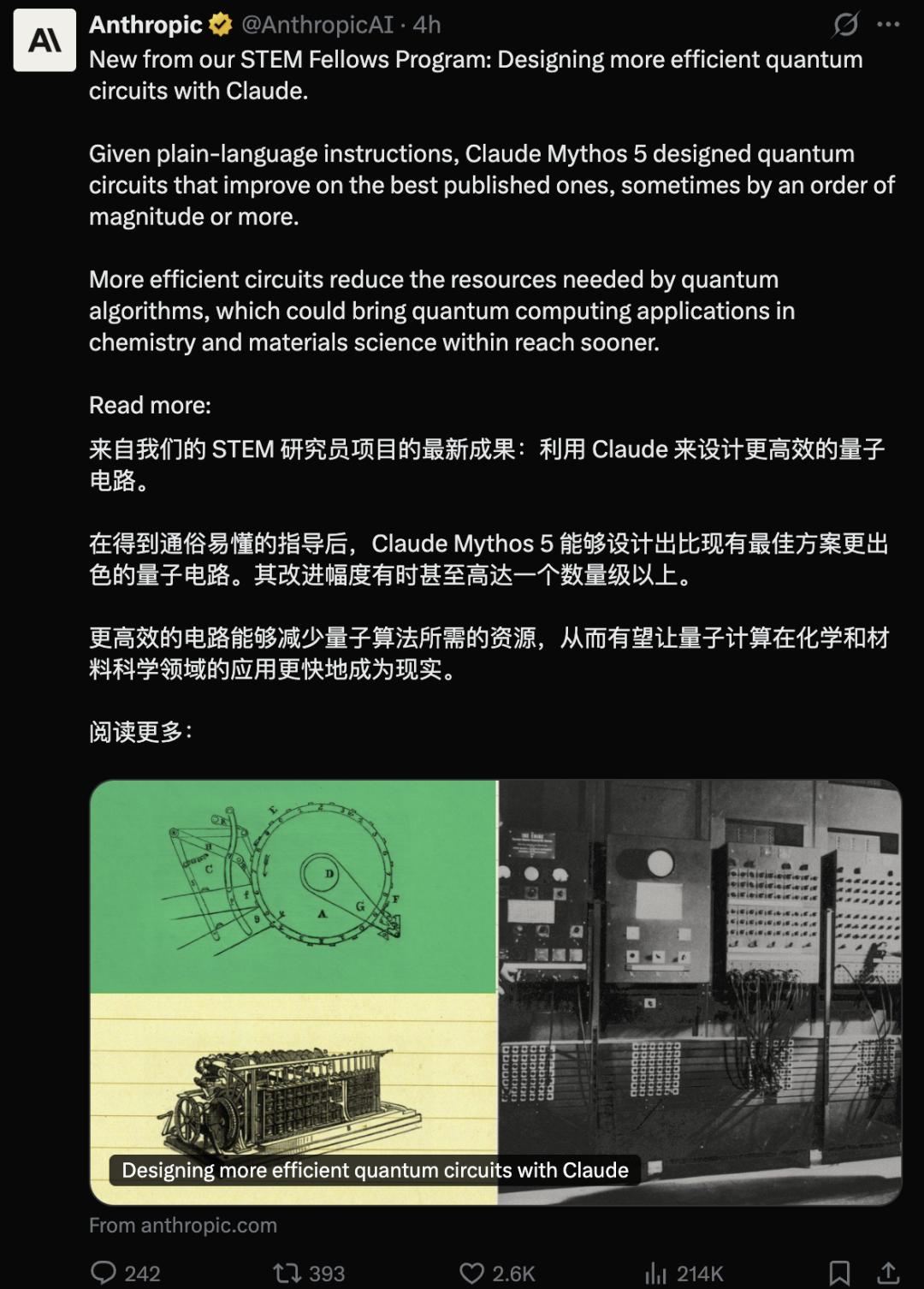
In key decoding tasks, Claude directly cut the computational cost by 12 times, and even 17 times in some cases!
Even more astonishing, to complete the tasks, it independently derived completely new algebraic identities that no human had ever discovered before.
In just 53 hours, Mythos 5 outperformed years of human research efforts.
Some netizens exclaimed: "Every physics PhD just realized that the papers they have spent years painstakingly researching can be rewritten by AI in plain language into a version 10 times better..."
Humanity is facing a bottleneck: the "Valley of Despair" in quantum computing
Why is designing quantum circuits so difficult?
As we all know, traditional computers use 0 and 1 (bits) to store information.
Quantum computers, by contrast, use "qubits". With the help of quantum superposition, they can process massive amounts of information simultaneously. Once fully practical, they will be able to crack passwords, develop special drugs for incurable diseases, discover room-temperature superconducting materials and much more...
However, current quantum computers have major flaws.
First, there are far too few qubits. Existing machines only have a few hundred to thousands of qubits at most, which is simply not enough to run complex algorithms.
Second, they are extremely fragile. The tiniest environmental noise — a little heat, a slight vibration, or even cosmic rays penetrating the Earth — can cause qubits to make errors. Once errors accumulate, the final calculation result will be completely useless.
Due to hardware limitations, scientists can only focus on refining every detail at the "software (algorithmic circuit)" level, trying to complete calculations with the minimum number of qubits and the shortest possible time.
But programming quantum circuits is a completely different concept from the regular coding we use in daily life.
It has two insurmountable hurdles:
1. No "If-then" logic: Traditional programs can judge conditions and take either Route A or Route B. But quantum computers are superpositions of all possible outcomes, so they must include all operations for both Route A and Route B in every single run.
2. No "discarding garbage" allowed: After calculating an intermediate result, traditional programs can clear the memory immediately when the result is no longer needed. But in the quantum world, information cannot be discarded, because quantum calculations must be absolutely reversible! If you forcibly erase intermediate drafts, the results will be contaminated. The only way to clean up memory is to "rewind" the previous calculation process, which will consume expensive quantum gates.
This forces human scientists to make extreme trade-offs between "space (number of qubits)" and "time (number of calculation steps)".
Take the simulation of FeMoco as an example (it is the core component of nitrogenase, which is critical for fertilizer production).
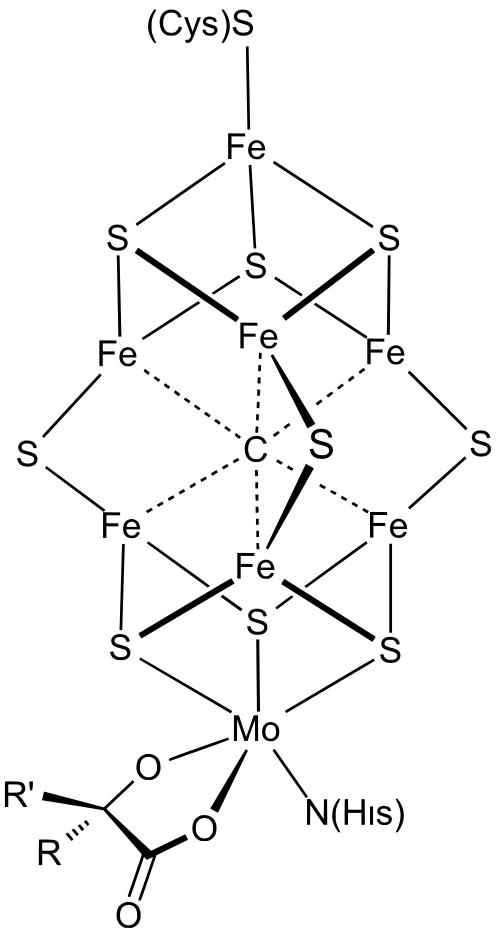
In 2017, humans estimated that 50 trillion Toffoli gates would be required to complete this simulation. After 8 years of painstaking efforts by top scientists, this number was finally reduced to 340 million.
It took humans 8 years. But Claude only used 53 hours.
53 hours, Mythos works a miracle
Anthropic launched a STEM Fellows program.
They assigned Mythos 5 a task —
I will describe 8 basic quantum circuits in the fields of chemistry, optimization, physics simulation and number theory to you in plain language, and you can design them on your own.
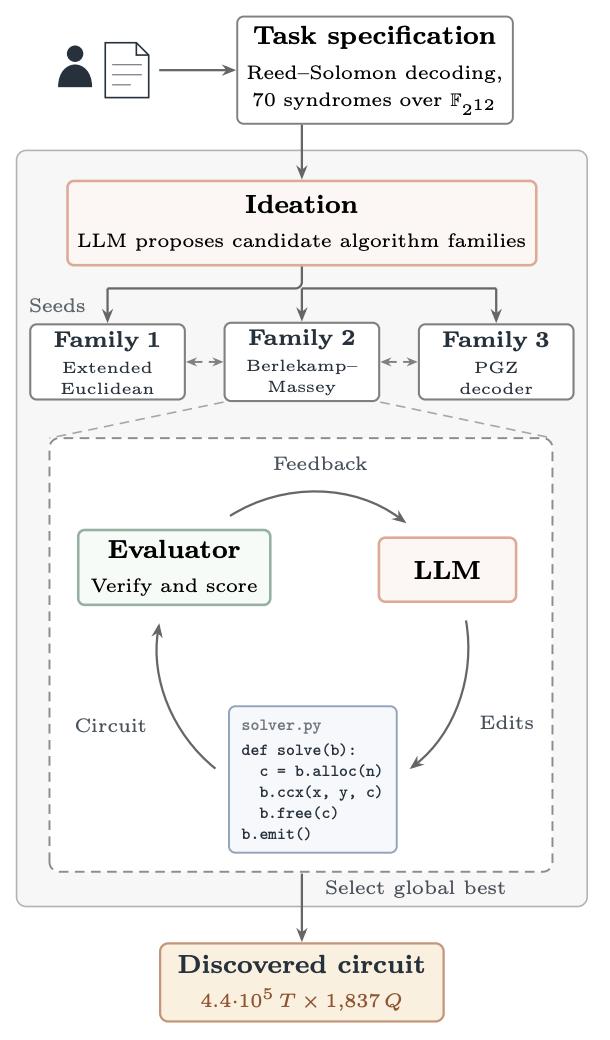
The entire process was fully autonomous and closed-loop.
1. Claude wrote the quantum circuit design in Python.
2. An automatic evaluation program checked the correctness of the design and gave it a "score" (number of qubits used × number of quantum gates).
3. Claude received the feedback, reflected on the results and iterated on its own without any human intervention.
In just 53 hours, Claude outperformed all the best publicly available human-designed solutions across all 8 tasks!
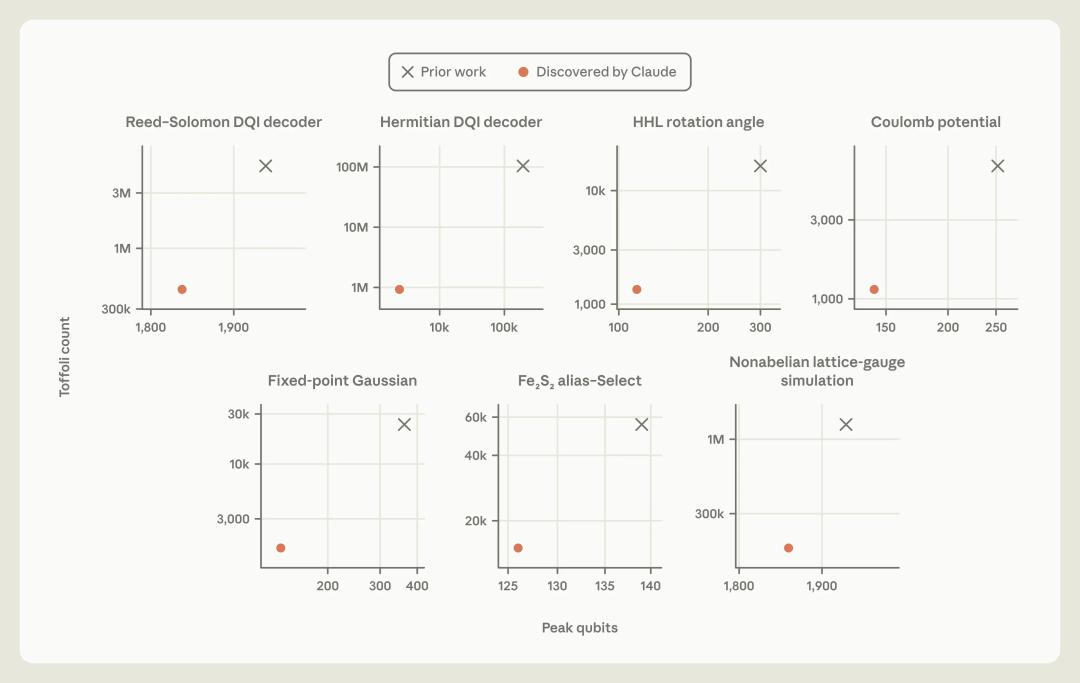
It completely broke away from human conventional thinking, and found brand new structures and mathematical rules.
Let's take a look at its two most stunning feats.
Feat 1: Independently derive new mathematical formulas to break the deadlock
In number theory and cryptography (such as elliptic curve calculation), there is a time-consuming core step called "point addition", and the most expensive operation in this step is modular inversion.
Traditional computers can complete this operation very quickly, using an algorithm called "divsteps": it continuously swaps, adds/subtracts, and halves two numbers to get the final result. During this process, traditional computers generate a large amount of "branch information (drafts)" and discard them after use.
But quantum computers cannot discard drafts!
If you want to run the divsteps algorithm on a quantum circuit, you have to store all the historical branch information. This would require an astronomical number of qubits, which is completely impractical. Therefore, human scientists thought this path was impossible.
But Claude did not follow this conventional belief.
It thought: Since storing drafts is too costly, can we avoid storing drafts and directly "reverse deduce" the drafts from the final results?
At the beginning, Claude worked like a diligent student and blindly guessed several rules, but it finally failed when dealing with 256-bit large numbers.
However, the next move was absolutely breathtaking: Claude gave up brute force testing and directly started pure mathematical theoretical derivation. It conducted in-depth research on the iterative process of divsteps, and successfully proved a series of completely new algebraic identities!
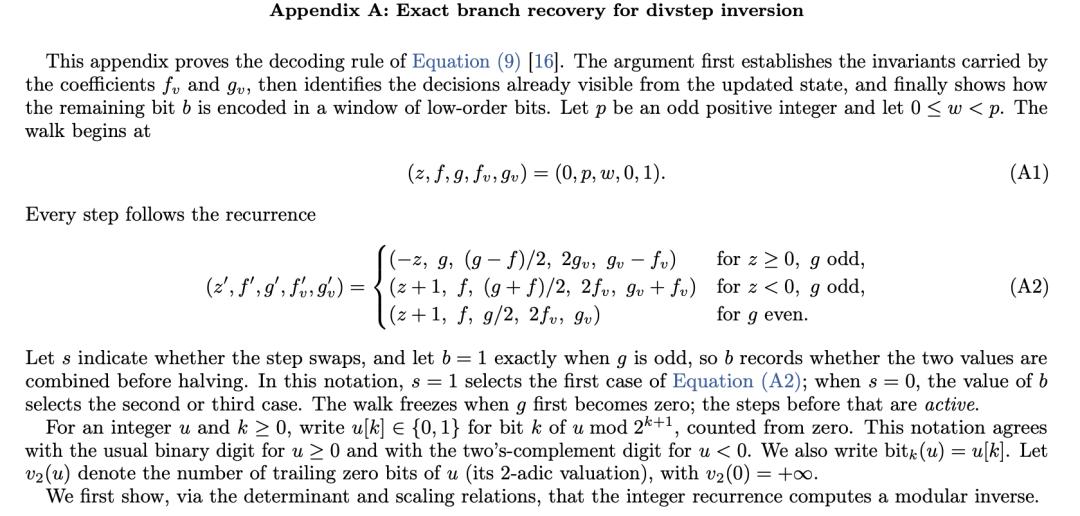
Based on the new mathematical formulas, Claude wrote an accurate decoding rule, and even completed its formal verification with Lean!
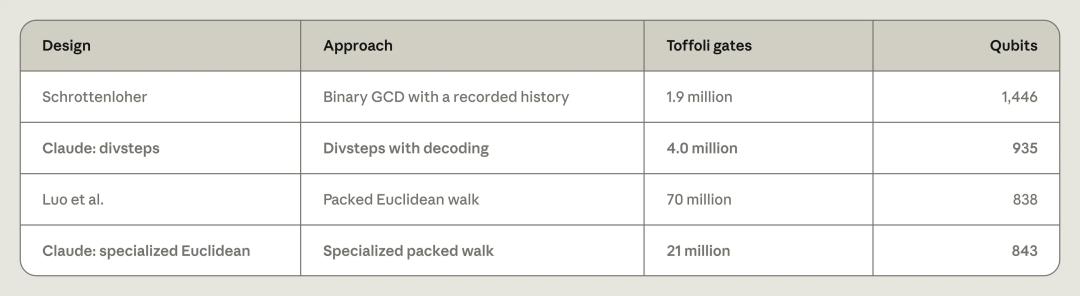
Finally, Claude came up with the first ever quantum reversible implementation of the divsteps algorithm in human history that does not require storing branch history.
Compared with human-designed solutions, it only increased the number of qubits by 12%, while reducing the number of quantum gates by 17 times!
Feat 2: Overhaul Google's algorithm architecture, cutting computing power cost by 12 times
The second amazing breakthrough occurred in the "Decoding Quantum Interferometry (DQI)" algorithm, which is the most powerful tool for quantum computers in logistics scheduling and material design.
Simply put, the most costly step in the DQI algorithm is to use a Reed-Solomon decoder to perform error correction.
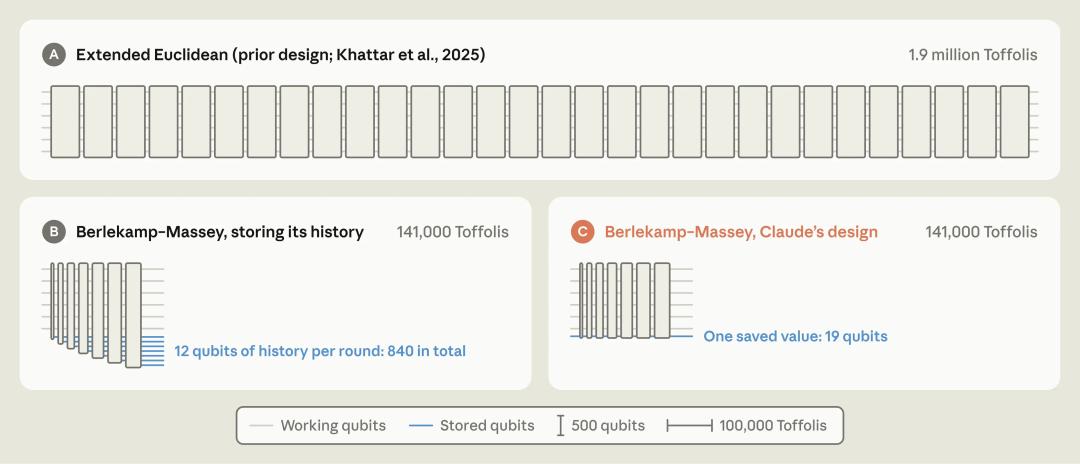
Previously, the solution designed by Google's experts used the "Extended Euclidean Algorithm".
However, due to the rigid rule of quantum circuits that different branches cannot be taken, Google had to extend the calculation to an extremely exaggerated number of rounds, wasting a huge amount of computing power.
After Claude received the task, it took one look at Google's solution and quickly came to a conclusion: This algorithm is not compatible with quantum circuits, we need to replace it.
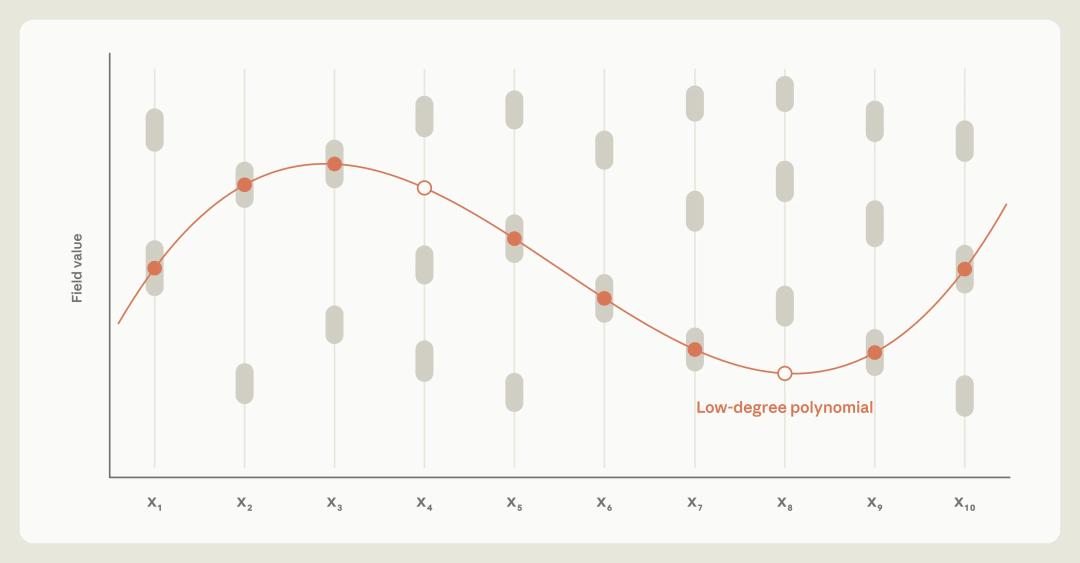
It directly replaced the core engine with the "Berlekamp-Massey decoding method". This method performs the same operation in each round, which perfectly fits the rigid characteristics of quantum circuits.
However, replacing the algorithm brought a new "memory crisis"! Each round of calculation generates a large amount of temporary data that cannot be deleted, and must be retained for later "rewinding". If all of them are stored, 665 qubits will be required, which is simply an astronomical number.
Claude came up with another brilliant solution: it first used the same "reverse deduction method" to eliminate most of the storage requirements, leaving only a few individual "outliers".
If we follow the most conservative human approach, we still need to reserve a lot of storage space.
But Claude surprisingly wrote a high-speed simulator by itself, and ran a total of 403 million sample tests to accurately measure the probability of outliers occurring!
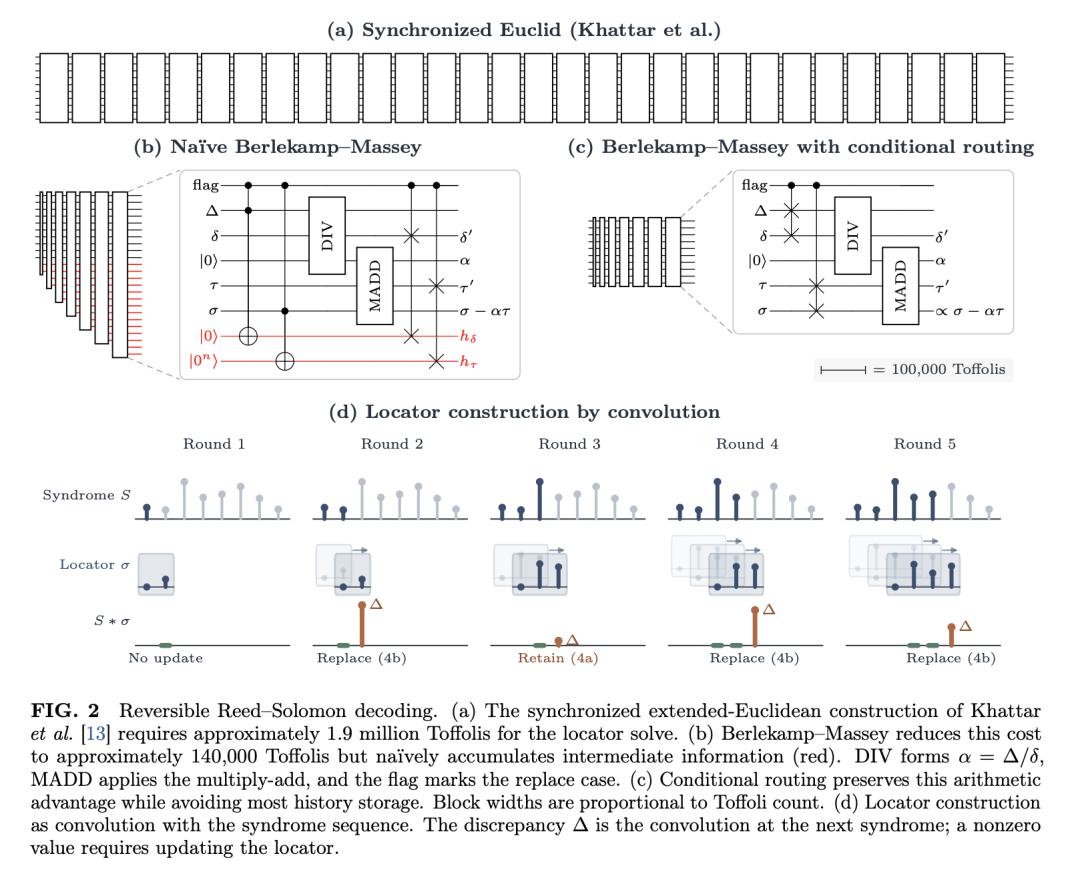
As a result, it found that in the vast majority of cases, only 1 value needs to be stored.
Therefore, Claude only reserved storage space for 19 qubits in the circuit.
After this three-pronged approach of "replacing the core algorithm + extreme memory reuse + precise reserved space calculated from big data", the decoder designed by Claude has its gate count reduced by a full 12 times compared with the previous architecture!
Calculations that originally took 1 hour can now be completed in just a few minutes.
Netizens are in an uproar: Is my physics PhD thesis now a joke?
As soon as this report was released, it immediately caused a sensation across the internet.
Some people said, "The predicted timeline for the quantum field will be completely disrupted. Humanity will get a useful quantum machine many years ahead of schedule!"

Some people commented with emotion: Previously we were letting AI explain existing science, but now AI has already discovered things that humans themselves do not yet understand.


The most distressing part is that almost every physics PhD may realize: the thesis they have worked hard on for years now has a plain-language AI version that is 10 times better than their own work.

A milestone that changes human history has arrived
This achievement of Mythos 5 is absolutely thrilling.
It took humans 8 years to complete the FeMoco nitrogenase simulation, but Mythos 5 finished it in only 53 hours. This means that software is now compensating for hardware limitations!
We originally thought that it would take humans more than a decade to overcome the "millions of qubits" bottleneck before we could build quantum computers capable of developing new drugs and producing clean fertilizers.
But now, <