Hesai Isn't Just Looking to Sell LiDAR | Frontline
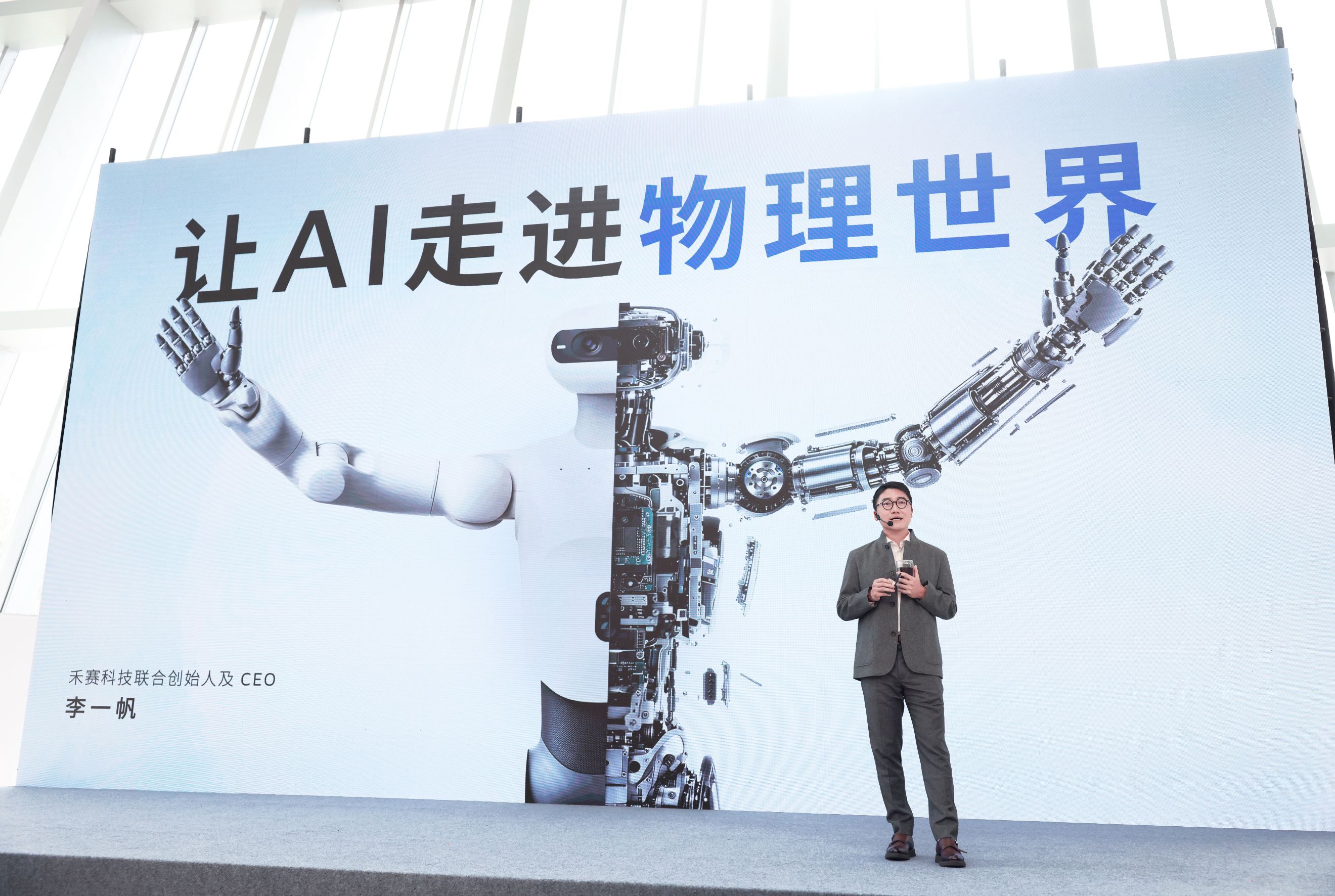
Image source: Hesai Technology
By Xiao Man
Edited by Yuan Silai
"We did not develop Kosmo just to sell more LiDAR products." Li Yifan made this point clear ahead of the Kosmo launch event.
Kosmo is a 3D world data engine recently released by Hesai Technology, consisting of Kosmo One, the world's first 8K ultra-high-definition AI spatial camera, and Kosmo World, an AI-driven cloud platform. The former is responsible for collecting spatial information of the real world, while the latter reconstructs such information into 3D scenarios that can be understood, interacted with and trained by AI.
This is an extension of Hesai's core LiDAR business. In the past, Hesai mainly provided perception hardware for automobiles and robots; now it hopes to further participate in the training process of Physical AI, and convert the real world into data assets available for AI use.
This is also the first step for Li Yifan to transform from a component provider to a core infrastructure provider for Physical AI.
From LiDAR to core infrastructure for Physical AI
To achieve large-scale implementation of Physical AI, at least two issues need to be addressed: how robots complete actions in the real world, and how AI obtains sufficient high-quality real-world data.
Hesai is deploying two businesses around these two issues: the robot motion engine and the 3D world data engine. Kosmo is the first systematic productized implementation of the latter.
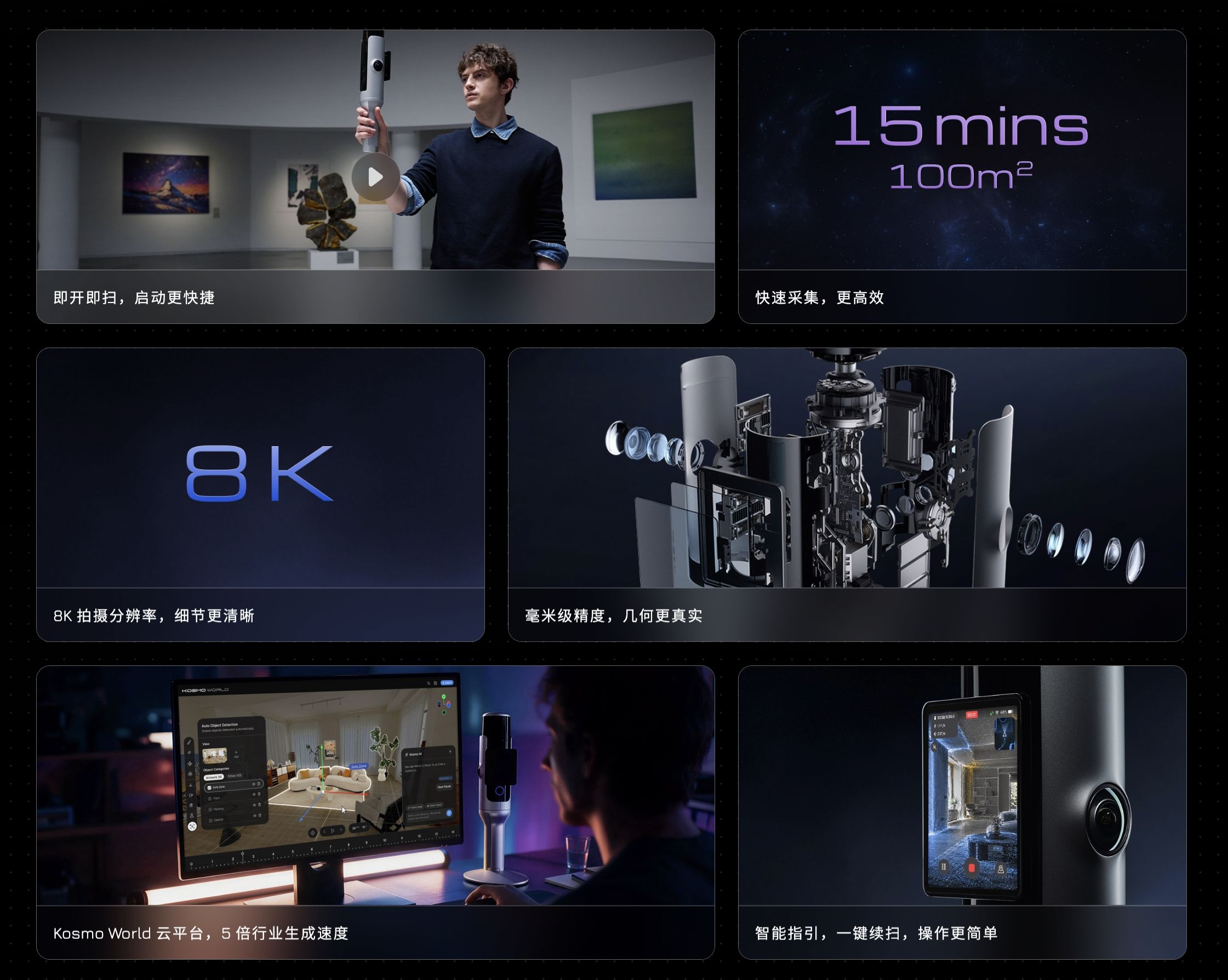
Image source: Hesai Technology
Kosmo One is the data entry point of this system. It integrates a high-spatial-resolution LiDAR, an 8K ultra-HD imaging system, a 1-inch large-format CMOS and a high-precision IMU into one device, to simultaneously collect spatial geometry, color, texture and device pose information of the real environment.
It aims to lower the threshold of spatial collection. Kosmo One supports functions including instant-on-and-scan, intelligent guidance and one-click rescan. In a common indoor scene, scanning a 100-square-meter space takes about 15 minutes.
However, generating a realistic 3D scene is only the first step. For embodied intelligence, the scene must not only look realistic, but also be understandable by robots and can be used for action training and verification, which is exactly the function of Kosmo World.
The underlying layer of Kosmo World is Kosmo Spatial Core (KSC), an AI-native 3D spatial reconstruction and understanding system independently developed by Hesai. It can simultaneously generate three forms of 3D data including 3DGS, mesh and depth from the same set of collected data.
The three types of data solve different problems faced by embodied intelligence. 3DGS is responsible for restoring the visual appearance of the scene, making the images seen by robots during training closer to the real world; mesh is a 3D model composed of grids, which can be used for object segmentation, modeling and interaction; depth provides spatial distance information to help robots judge the position and distance of objects.
This means that the real space is no longer just a 3D model for people to view, but can be further converted into an environment suitable for robot training and simulation verification, the so-called sim-ready data.
Li Yifan believes that the demand of Physical AI for real-world data can hardly be met by generative AI alone.
"If you completely use AIGC to generate fully virtual training data, the new and fresh information you actually obtain will be very limited." His judgment is that generative AI can complete scenes based on existing information, but if there is a lack of new real-world information, the model's understanding of the real environment will still be limited, and the training effect will also be affected.
This does not mean that synthetic data has no value. For embodied intelligence, synthetic data can help developers expand training scenarios and cover more edge cases, on the premise that the generated environment and physical laws are sufficiently credible and can supplement the missing information in real data. What Kosmo intends to do is to obtain high-fidelity spatial information from the real world, then reconstruct and complete it with the help of AI, and convert it into reusable training assets.
Li Yifan believes that this path has the potential to alleviate two problems at the same time: the gap between the simulation environment and the real environment, that is, the Sim-to-Real Gap, and the high cost of collecting training data in the real physical environment.
Li Yifan divides the commercialization of Kosmo into three stages. The most direct revenue comes from hardware, that is, selling the spatial camera Kosmo One; the second is data and model services for enterprise customers. Customers provide scenarios, and Hesai is responsible for collection, reconstruction and delivery of usable 3D models. The business model is somewhat similar to MaaS (Model as a Service): what customers purchase is the processed results, which involve computing power and model generation services behind the scenes.
The longer-term goal is to precipitate the 3D data formed by collection and reconstruction into reusable digital assets. Li Yifan hopes that as more and more spatial models are accumulated on the platform, users do not need to scan every scenario in person, and can directly find assets that meet the needs of their industries. "This may take at least 3 to 5 years to build," he predicted.
This means that the commercialization of Kosmo does not only depend on how many cameras can be sold, but also on whether it can continuously reduce the cost of collection, processing and use of spatial data, and whether these data can be reused between different customers and tasks.
At the launch event, Hesai Kosmo signed strategic cooperation agreements with Galaxy General Robotics and Forcelink Robotics, and demonstrated industry cooperation cases with Pixar Animation Studios under The Walt Disney Company, Gaode and other partners. These cooperations point to more application scenarios of 3D world data beyond robot training, such as film and television media, cultural tourism and cultural heritage protection.
Hesai builds the foundation, Sharpa moves to the front stage
"Today it seems that we are talking about Kosmo, but what I really want to communicate and report to everyone is not just the Kosmo product," Li Yifan said at the launch event. "What Hesai really wants to discuss is what opportunities it has seen in the process of transforming from a component provider to an infrastructure provider, and why it believes it has the ability to participate in it."
In his view, the ultimate goal of Physical AI 2.0 is general-purpose robots. However, at present, the industry's attention is mainly focused on the model and application layer, and there are still a large number of unsolved problems in the underlying infrastructure such as robot hardware, computing and data.
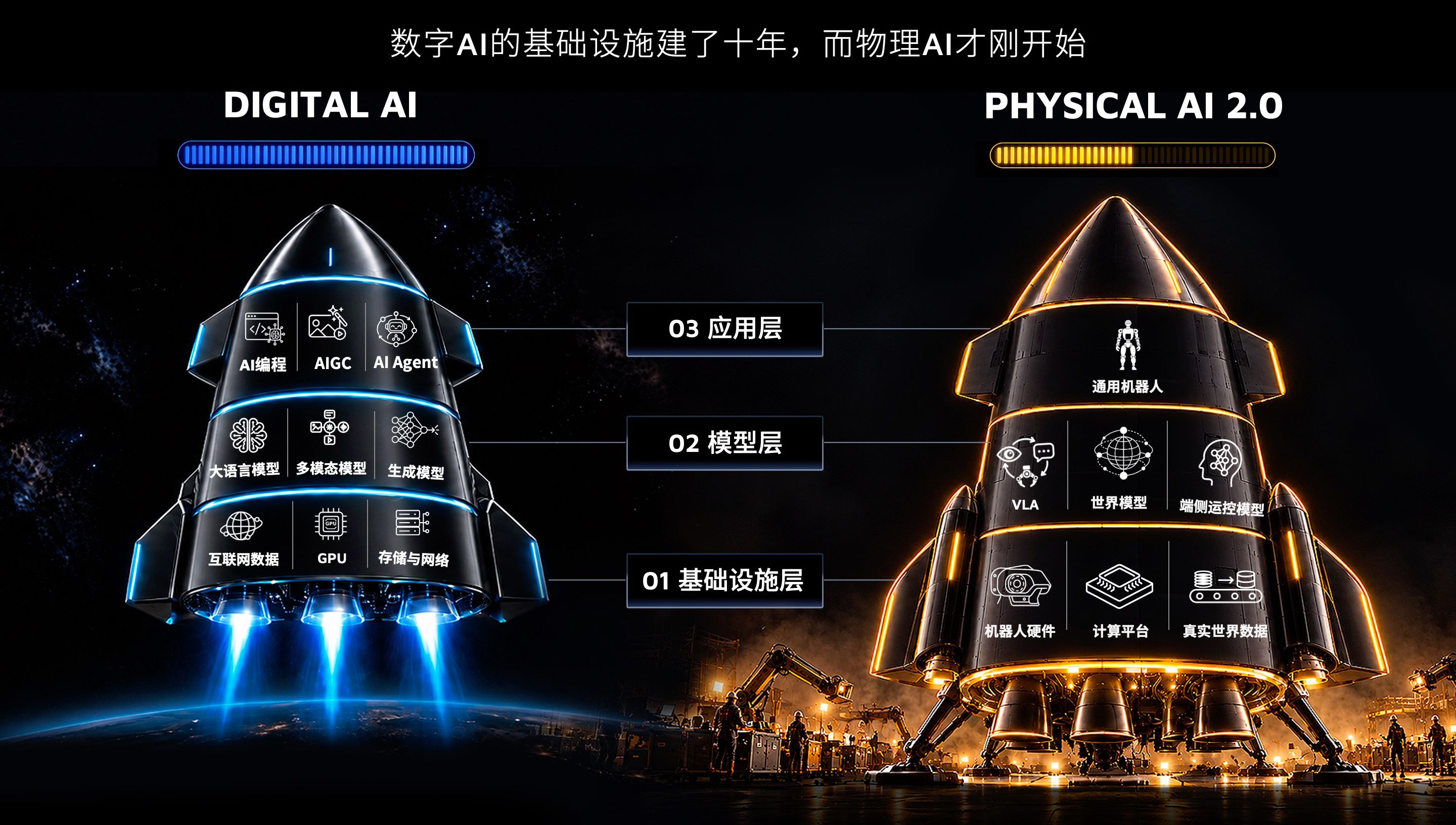
Image source: Hesai Technology
Li Yifan believes that an important prerequisite for the rapid development of digital AI is that the underlying infrastructure has been relatively mature. Physical AI is different: robots need to move, perceive and operate in the real world, model capabilities must be executed through hardware, and training is inseparable from data of the real environment. This is why Hesai deploys both the robot motion engine and the 3D world data engine.
Li Yifan emphasized that this is not a transformation that is separated from the original business, but an extension of technical capabilities. Precision mechanical transmission, chips, servo motors, electromagnetic materials, as well as integration, manufacturing processes and mass production verification, are all related to the technical and engineering capabilities accumulated by Hesai in the past.
The Kosmo product is only the first step. Hesai will also launch products such as robot joint drivers in subsequent layouts. Li Yifan compares the importance of drivers to batteries in the electric vehicle era, which will directly affect the overall performance, cost and productization process of the whole machine.
Hesai's idea is to let the real motion demands of robots define hardware in reverse, that is, AI-Defined Hardware. Hardware should not only be components that passively meet the requirements of algorithms, but also need to redesign driving capabilities and mechanical structures according to the task demands of AI in the real environment.
Sharpa is the other end point of this line of thinking.
The dexterous hand of Sharpa has 22 active degrees of freedom, and its first flagship haptic dexterous hand Wave (W01) is built based on Hesai's power module. Hesai claims that compared with similar products, the volume of its power module is reduced by 37%, and the power density is increased to 3 times.
As of the end of the second quarter of 2026, Hesai's power modules have been delivered for more than 10,000 sets in total, and the products are expanding from dexterous hand modules to full-body joint modules. The company expects that the shipment of power modules will reach six digits in 2027.
Sharpa has accumulated a large number of ideas that need to be verified at the operation end, which can be quickly fed back to the Hesai team; after Hesai improves the power modules, they can be quickly handed over to Sharpa for testing, forming a closed loop of R&D.
Ten years ago, starting from LiDAR, Hesai has already possessed capabilities including spatial perception, chip design, precision manufacturing and large-scale delivery. Now it hopes to extend these accumulations to more links in the industrial chain.
However, the success conditions of infrastructure business are different from those of component business. Power modules need to prove their advantages in performance, reliability and cost, while Kosmo also needs to prove that the generated data can effectively improve the training effect and form repeatable value in different scenarios.
Whether Hesai's 2.0 strategy can be established ultimately depends not only on how many new products it launches, but also on whether these underlying capabilities can become the infrastructure that robot companies are truly willing to adopt and continuously use.