The 17-year-old core young talent behind Kimi heads to Silicon Valley: China's AI sector is also facing talent anxiety.
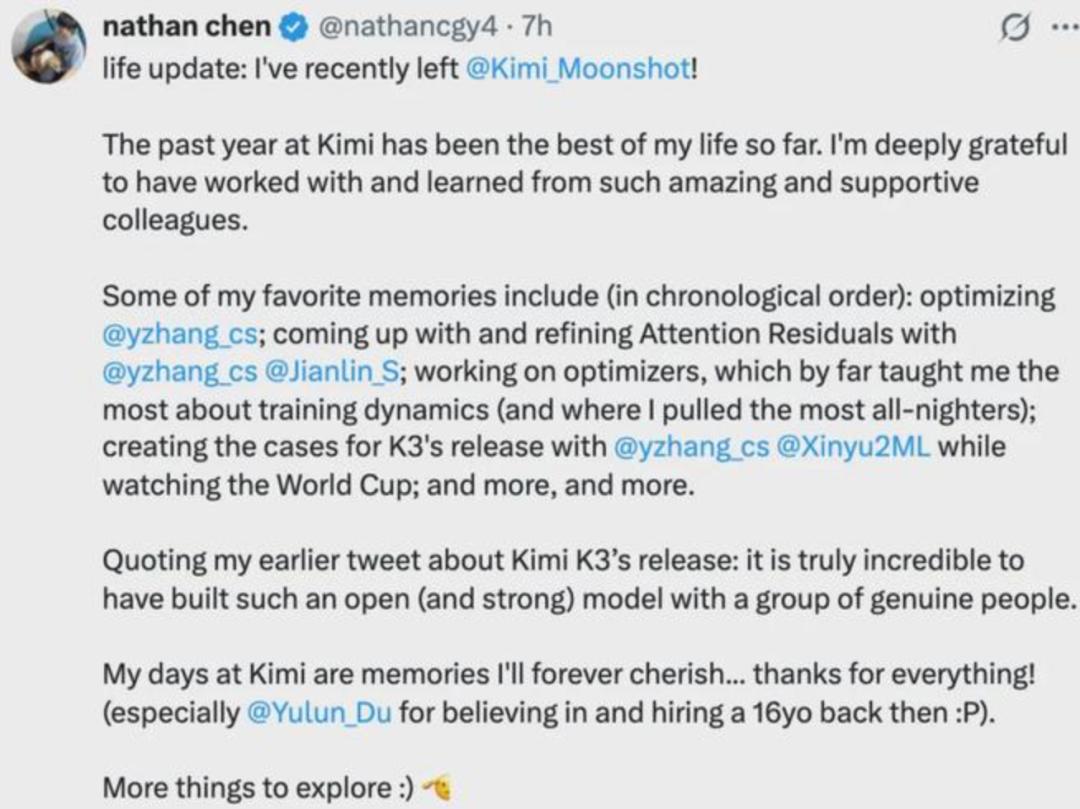
On October 15, Chen Guangyu posted a short resignation note on X.
"My work at Kimi over the past year has been the best time I've ever had," he wrote, noting that he was extremely grateful for the opportunity to work with and learn from such outstanding and supportive colleagues.
He did not explain the reason for his departure, nor did he disclose his next destination. However, industry insiders are fully aware of the significance of this post: Chen Guangyu is only 17 years old, and the Attention Residuals architecture he participated in developing has become one of the underlying technologies of Kimi K3, the world's first open-weight 3T-scale large model.
In the comment section, Sholto Douglas, Head of Scalable Reinforcement Learning at Anthropic, half-jokingly asked: Does your original plan to go to CMU still stand? Would you like to come to San Francisco to work together?
Chen Guangyu replied: Thank you Sholto! I am heading to the Bay Area.
A 17-year-old Chinese teenager, starting from an international school in Huizhou, walked into Kimi's core architecture team in less than two years, then turned around and headed for Silicon Valley.
This is not a cliché "genius teen is incredibly brilliant" story. It is more like a mirror that reflects a deeper anxiety that China's AI industry is going through: we are already able to spot top talents on a global scale, but can our organizations, culture and technical ceilings really hold them?
The 16-year-old intern who stepped into Kimi's core
Chen Guangyu's starting point is far from the stereotype of a "genius teen".
He has no Olympic competition gold medals, no grade-skipping experience, nor is he a child prodigy who started writing code at a very young age. Born in Shenzhen in 2009, he studied at BASIS international schools in Huizhou, and attended classes and took exams step by step like most high school students.
The turning point came in April 2024. Chen Guangyu, then a first-year high school student, made a decision: to suspend all things he disliked and focus on learning AI.
His learning method is highly characteristic of the times — he uploads papers to Gemini and asks questions over and over again, and he later referred to Gemini as his "mentor" in his blog.
In May 2025, he posted a technical blog about DeltaNet on a social platform. DeltaNet was a cutting-edge linear attention architecture at that time. The post was replied to by Yang Songlin, MIT PhD and key contributor to this field, and later discovered by the CEO of Tilde Research, a Silicon Valley AI startup, who took the initiative to arrange a call with him.
In the summer of that year, 16-year-old Chen Guangyu flew alone to Palo Alto, California, and started a seven-week internship. He stayed in the office for 15 hours every day, participating in the memory-optimized Mixture of Experts model project MoMoE.
The significance of this experience goes far beyond an internship certificate. It gave Chen Guangyu his first exposure to the world's top AI research environment, where people whose names he had only seen in papers might be sitting at the workstation next door, which also laid the groundwork for his later choices.
After the internship, Chen Guangyu received an offer from Moonshot AI. In November 2025, he joined the Kimi team as a machine learning researcher, and he was only 16 years old at that time, working as an intern.
After joining Kimi, Chen Guangyu won the championship of the internal 48-hour hackathon, and further entered the core research circle.
What really made him widely known was the Attention Residuals paper published in March 2026.
The weight of co-first authorship
The Attention Residuals paper is the key to understanding Chen Guangyu's technical value.
In simple terms, it improves the residual connection mechanism that has been used in the Transformer architecture for nearly a decade. Traditional residual connections are like layers of stacked notes, with new information added at each layer, but after the number of layers increases, the early useful information will be diluted.
The original idea of AttnRes was proposed by Su Jianlin (the proposer of Rotary Position Embedding RoPE). After Zhang Yu (the first author of the Kimi Linear architecture) and Chen Guangyu joined, they conducted verification on larger-scale models.
The most critical engineering breakthrough is Block AttnRes (block-wise attention residual) jointly proposed by Chen Guangyu and Zhang Yu. It divides hundreds of layers of networks into several blocks, maintains low-cost basic accumulation within the block, and only performs fine-grained attention aggregation between blocks. In this way, the video memory complexity is reduced from the level of the number of layers to the level of the number of blocks, and only about 8 blocks are needed to recover most of the performance of the full version.
The measured data is very solid. When trained with 1.4 trillion tokens on the Kimi Linear 48B model, AttnRes only requires about 80% of the computing power of the benchmark model to achieve the same effect, and the incremental inference delay is less than 2%. GPQA-Diamond score increased by 7.5 points, Minerva Math score increased by 3.6 points, and HumanEval score increased by 3.1 points.
On the day the paper was released, half of the AI circle in Silicon Valley was shocked. Karpathy, co-founder of OpenAI, commented: "It seems that we have not taken the sentence 'Attention is All You Need' literally to the fullest." Elon Musk left a comment: Impressive work from Kimi.
It was at this time that people noticed that among the three co-first authors, there was a 17-year-old intern.
But Chen Guangyu repeatedly emphasized one thing: do not deify him. He said that the achievements belong to the team, and he hopes the outside world will see the underlying problems that the research itself tries to solve. Su Jianlin also wrote in his review article that the training team once thought the solution was not feasible enough, and the reason was very straightforward — to put it bluntly, it was simply due to insufficient computing resources.
This detail is very important. AttnRes is not a sudden flash of inspiration from one person, but an innovation forced out by the whole team under the constraint of computing power. Chen Guangyu is a key link, but not the whole.
More importantly, this achievement has been integrated into Kimi's production environment. Kimi K3 released in July 2026 has a total parameter count of 2.8 trillion, which is the world's first open-weight 3T-scale model, and AttnRes is exactly one of the underlying technologies supporting it.
The paradox of Wild Card
A month before Chen Guangyu resigned, Kimi had just launched an ambitious recruitment plan.
On September 9, Kimi announced the recruitment of 7 "Wild Card" talents — people who cannot be defined by regular job descriptions. At the same time, it launched the "Traverse Program" with no restrictions on majors, no restrictions on internship grades, no academic qualifications or seniority as the main threshold, and outstanding candidates can obtain options.
This set of recruitment logic is almost a template that matches Chen Guangyu's experience: find the person first, then decide what problems he can solve, look at the upper limit first, and then fill in the job title.
This is almost the common attitude of current Chinese AI companies: breaking conventions, making special hires, recruiting genius teens, recruiting talents through hackathons... everyone is competing for the smartest minds.
But the question arises: after recruiting them, what then?
Chen Guangyu's departure reveals the other side of this model.
The TMTPost report quoted words from Yulun Du, a researcher on the Kimi team: "He had several long conversations with Chen Guangyu about his decision. It is 'very sad and heartbreaking' to see him leave, but at this age, exploring as much as possible and following new curiosity may be the best choice for him."
This paragraph contains a lot of information. It does not explicitly state why he left, but the wording of "exploring new curiosity" implies a core contradiction: the growth rate of atypical talents may be faster than the organization's promotion channels.
For someone who can make technical contributions at the level of co-first author at the age of 16, where will he be two years later?
If he is in Silicon Valley, he may join OpenAI or Anthropic, work with the top teams to solve the most cutting-edge problems. If he stays in China, what is his promotion path? Continue to be a researcher? Get promoted to supervisor? Manage a team?
For real top talents, none of these are the most attractive. What they want is — the hardest problems, the best colleagues, and the greatest leverage.
Kimi is one of the best large model companies in China, but if we broaden our perspective to the global level, there is still a gap with Anthropic and OpenAI in terms of basic research depth, talent density and cutting-edge nature of problems.
This is not a problem of Kimi, but the current situation of the entire Chinese AI industry.
The paradox of the Wild Card model is here: you use the most open attitude to recruit the top talents, but if your technical ceiling, organizational complexity and cultural inclusiveness cannot keep up, they will eventually leave.
The deeper contradiction is that atypical talents are often not adapted to standardized organizational life. They need higher-density communication, faster feedback, and larger room for trial and error. They may not adapt to reporting lines, and may not be willing to move up along the traditional career path.
However, even the most innovative Chinese AI companies mostly adopt the traditional model of organizational management — job levels, promotion, performance, reporting. These are efficiency tools for regular talents, but they may be shackles for Wild Card talents.
Chen Guangyu going to the Bay Area is most likely not for money. The salary that Anthropic can offer can also be offered by Kimi. What he wants may be something else, a kind of soil more suitable for the growth of unconventional players like him.
Talent anxiety is not limited to the large model circle
The reason why Chen Guangyu's story is worth paying attention to is that the talent anxiety it reflects does not only exist in large model companies.
The automotive industry is going through the same growing pains.
XPeng, Li Auto, NIO, BYD... every car company is frantically competing for intelligent driving talents — large model algorithm engineers, end-to-end intelligent driving architects, data scientists. Salaries are rising rapidly, and for algorithm engineers with three years of experience, an annual salary of one million yuan is the starting point.
But can the recruited talents be retained?
The organizational culture of automotive companies is completely different from that of Internet and AI companies. Clear hierarchy, cumbersome processes, relatively slow pace — these are the norm for traditional automotive engineers, but for AI algorithm talents, they may be intolerable inefficiency.
The head of the intelligent driving department of a leading car company privately said a very harsh word: "Half of the people we poached from Internet companies with twice the salary left in less than a year. It's not that the money is not enough, it's that they can't stand our processes."
This is essentially the same problem as Chen Guangyu's story — organizational capabilities cannot keep up with talent density.
Looking at the robotics industry, the talent problem is more acute.
Embodied intelligence is an interdisciplinary subject that requires compound talents who understand large models, robot control, hardware, and software at the same time. There are not many such people in the whole world.
AgiBot, Unitree, Galactic General... every company is competing for the same group of people. Salaries are getting higher and higher, but there are only a limited number of people who can actually do the work. Moreover, compared with large model companies, robotics companies are still at a disadvantage in terms of technical depth and brand attractiveness — top talents usually prioritize large model companies as their first choice.
What is more severe is that the brain drain in the robotics industry not only flows to Silicon Valley, but also flows within the industry. An engineer just trained by one company may be poached by another with double the salary. The whole industry is competing for talents, but few people seriously think about: how can I retain people?
The answer is certainly not just raising salaries.
What can truly retain top talents are three things: problems worth investing in, smart enough colleagues, and clearly visible room for growth.
Problems determine the meaning of work: are you doing things that change the industry, or are you doing marginal patchwork?
Colleagues determine the density of work: working with people smarter than you leads to exponential growth; working with mediocre people will only drain you.
Growth space determines the future of work — you can see where you will be in three years, where you will be in five years, instead of spinning around in the same position.
Measured by these three criteria, how many Chinese AI companies, automotive companies and robotics companies can truly meet the standards?
From discovering talents to being worthy of talents
Chen Guangyu's departure is not a failure of Kimi.
On the contrary, Kimi was able to discover, trust and give core projects to a 16-year-old high school student before he became famous, which is already better than the vast majority of Chinese companies.
But Chen Guangyu's departure does raise a question that the whole industry needs to answer:
When we have learned to spot the top talents on a global scale, are our industry, our companies, and our organizations ready to catch them?
The answer to this question determines the next decade of China's AI industry.
Over the past decade, the progress of China's AI has been obvious to all. We have players like Kimi and DeepSeek that can compete with the world's top companies. We have first-tier embodied intelligence enterprises like AgiBot and Unitree. We have new intelligent vehicle forces like XPeng and Li Auto.
But if we shift the competitive dimension from products to talents, the gap is still obvious.
Silicon Valley's advantages never only lie in money and technology. Its advantage is that it has a complete ecosystem that makes the smartest people willing to come, able to grow after arriving, and willing to stay after growing. This ecosystem has the best universities in the world, the most active entrepreneurial culture, the most mature capital system, and the greatest tolerance for "eccentrics".
When Chen Guangyu goes to the Bay Area, he is not only facing the company Anthropic, but the entire Silicon Valley ecosystem — where there are peers as smart as him, the most cutting-edge problems, the fastest feedback loops, and the largest stage.
In contrast, China's AI ecosystem is still under construction. We have good companies, but not enough; we have good universities, but the integration with the industry is not close enough; we have capital, but it pursues short-term returns rather than long-term value.
In the final stage of the talent battle, what is competed is not who pays higher salaries, but whose ecosystem is more attractive.
For the automotive intelligence and robotics industries, this problem is more urgent. Because these industries have larger AI talent gaps, fewer compound talents, and higher difficulty in organizational transformation.
What car companies need is not just to recruit a few algorithm engineers, but to transform the entire organization from "automotive thinking" to "software thinking" — moving from hierarchy to flattening, from process-driven to problem-driven, from following the beaten track to rapid iteration.
What robotics companies need is not just to poach a few large model talents, but to build an environment that enables deep collaboration between hardware and software talents — so that mechanical engineers and algorithm engineers can truly communicate instead of working separately.
All these changes are far more difficult than raising salaries.
But only by achieving these can Chinese technology companies truly retain people like Chen Guangyu.
This article is from the WeChat official account "Super Electric Robot", written by Zaizhou, and published with authorization from 36Kr.