Streamline organizational structure and add value to products: Why does ByteDance's office Agent retain two entrances?
After the National Day holiday, a TRAE developer found that he had to take an extra step to return to the familiar programming interface.
He had been using TRAE IDE before. After the upgrade, the client opens to the Agent workspace by default. If he wants to continue writing code, he needs to manually switch to IDE and reselect the previous project. What made him more dissatisfied was that the software did not provide a clear setting for the default startup mode, and after closing the window, a persistent tray icon would still remain. He posted on the official TRAE community asking if an option could be reserved for people who only want to use the IDE.
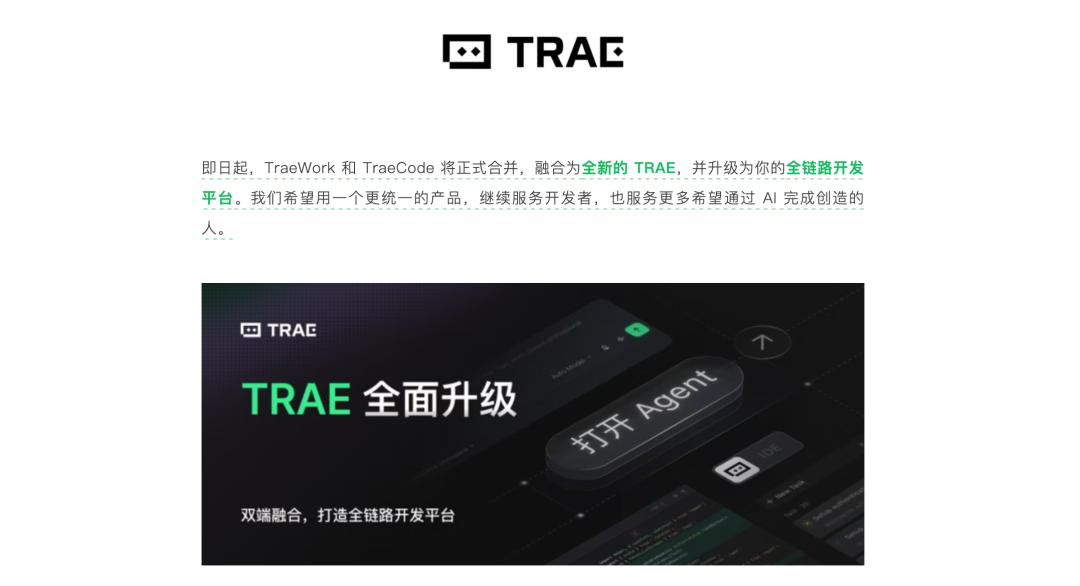
On October 9, TRAEWork and TRAECode were officially merged. The former mainly handles documents, data and office tasks, while the latter serves software development. The merged TRAE retains both Agent and IDE modes, aiming to allow users to go from putting forward requirements all the way through development, testing and delivery without opening two separate clients.
Less than two months ago, ByteDance just completed a round of integration for its AI office business. The TRAE and Kouzi teams were fully incorporated into the Doubao system, with original office capabilities centralized to Doubao, while TRAE IDE and CLI continued to develop as a programming product line. ByteDance responded that the adjustment was made to strengthen the synergy of product and technical resources, and the next day, the unified AI office product "Doubao Work" was officially released.
Earlier on July 30, ByteDance had already integrated the Feishu product team and the Doubao product team, placing them under the management of Liang Qi, the head of Doubao; the sales, marketing and customer service teams of Feishu were integrated with Volcano Engine. These several adjustments point to the same goal: to bring together models, office products and enterprise customer resources that were originally scattered in different teams as much as possible.
ByteDance is streamlining its organization, while TRAE is adding new features to its product. According to the arrangement in August, the outside world had reason to believe that general AI office capabilities would be increasingly centralized in Doubao Work, and TRAE would continue to serve developers. However, the new version in October did not follow this boundary.
TRAE not only retains support for documents, presentations and data processing, but also places the workbench for managing multiple Agents in a prominent position of the product. Doubao Work can also make PPTs, generate web pages and applications, and has begun to support complex task planning and multi-Agent collaboration. A large part of the capabilities of the two products still overlap.
If Doubao Work can already handle these tasks, why does TRAE need to do them all over again? And if the main reason for TRAE to stay is programming, why add so much work outside of programming?
Doubao Work can do these jobs, why does TRAE need to repeat them?
TRAE was originally an AI programming tool for developers.
In January 2025, the international version of TRAE was launched. Half a year later, it began to try to let AI take over more programming steps. The SOLO mode launched on July 21 can understand projects according to requirements, generate code, call tools, run programs and check results.
Originally, developers wrote code while AI gave suggestions alongside. In SOLO mode, users can directly assign a task, let AI decide what to do first and what to do later, and then people come back for inspection.
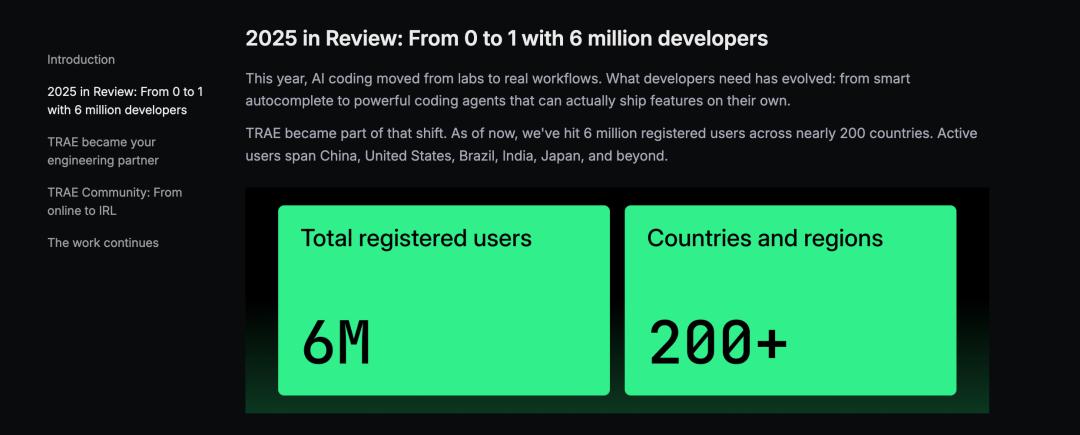
TRAE has thus accumulated a group of developers with very high usage frequency. The 2025 annual report released on December 26 last year showed that TRAE had more than 6 million registered users worldwide, with over 1.6 million monthly active users. Throughout the year, about 6,000 users spent more than 200 days writing code using TRAE.
The problem also arises from here, when AI starts to take charge of completing a development task, writing code is only a part of it. In its product introduction in October, TRAE cited the example of an event registration website. Developers need to first sort out the registration rules, determine what content the page should have, and how to process the forms filled in by users, then write code, test functions, and finally prepare the instruction document.
If the website is only for demonstration at a meeting, generating an accessible page may be enough. But after it is actually put into use, the work is not over. When the number of registrants increases, new screening conditions need to be added; when someone submits wrong information, the form needs to be modified; when the event rules change, the original code also needs to be adjusted accordingly.
In the past, this kind of work was scattered in different software. TRAEWork could handle office tasks such as documents, spreadsheets and PPTs, while TRAECode was responsible for code editing and debugging. For a project to go from requirements to software, and then to deliverable results, users often have to switch back and forth between the two clients. Requirements are in one place, code is in another, and test results may remain in a certain chat history.
For developers, the real trouble of switching tools is that they have to figure out exactly where they left off last time.
The merger on October 9 first aimed to solve this problem. The new TRAE puts the Agent workbench together with the IDE. Users can manage multiple projects in Agent mode, letting different Agents handle requirements, code, testing and documents respectively; when they need to check the program carefully, they can enter the IDE to view files, modify code and debug operations. Automated tasks, templates and project outputs are also integrated into a unified workflow. Code changes, HTML, Word, PPT and reports can all be viewed centrally in "My Outputs".
From this perspective, TRAE did not suddenly decide to enter the office market. The development work it originally serves is becoming increasingly inseparable from office scenarios. But these capabilities are not unique to TRAE. Doubao Work released on August 25 can already complete documents, PPTs, data analysis and lightweight application generation. Users can operate the computer and call external services within the authorization scope, and also let multiple Agents complete tasks separately.
On September 23, Doubao Work launched the "Goal Mode" and "Plan Mode". The former allows users to set acceptance conditions in advance, and the Agent will check the results before delivery; the latter will first generate a task plan, and execute it after the user reviews, modifies and confirms it. Both modes are trying to reduce deviations when Agents perform tasks for a long time.
If it is only about sorting out requirements, generating web pages, and preparing a presentation material, both products already have the corresponding capabilities.
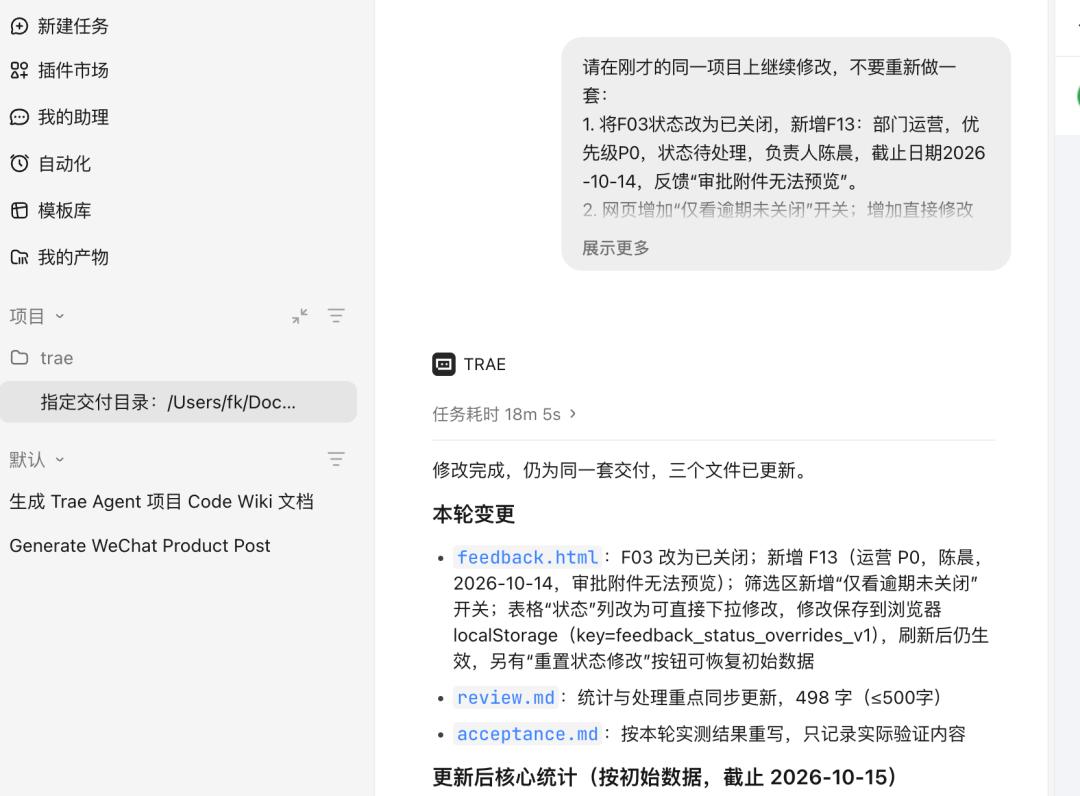
New Position submitted 12 pieces of simulated employee feedback to Doubao Work and TRAE respectively, requiring them to make an offline management dashboard and deliver review instructions and acceptance records. Both sides used the same materials and instructions, retaining their respective initial modes.
The client shows that Doubao took 3 minutes and 45 seconds in the first round, while TRAE took 19 minutes and 25 seconds, and the statistics, search and screening results all passed independent checks. Subsequently, we added the same set of modifications: close old feedback, add new feedback, add overdue filtering, and make status modifications retained after refresh. Both sides completed the task, Doubao took 4 minutes, and TRAE took 18 minutes and 5 seconds.

TRAE conducted browser tests on its own and fixed a missing overdue label; Doubao did not perform actual browser tests, but independent checks after delivery passed these functions. For leaders who only want to sort out feedback and prepare for review, Doubao Work has already delivered an available and continuously modifiable small tool faster.
At least for this small tool with only 12 pieces of simulated feedback, the professional development environment has not yet shown irreplaceable advantages.
If sorting out requirements, generating web pages, modifying functions and preparing review materials can all be completed faster by Doubao Work, to what extent do developers need to take the project before they need to open TRAE?
After generation, what else can TRAE retain?
The test of New Position only carried out two rounds of tasks. Although the feedback dashboard passed the function check, it only had 12 pieces of simulated data, was not connected to the real business system, and did not need to process the accounts and permissions of different employees. If it is actually handed over to a department for use, the problems to be solved next may be far more complex than generating a web page.
For ByteDance, retaining two entrances at the same time is not necessarily an unreasonable thing. Although the two products can complete similar tasks, they have accumulated different resources originally, and the problems users want to solve when entering the products are also different.
The advantage of Doubao Work is not only that it can call models. When the Feishu product team was integrated with Doubao on July 30, ByteDance explicitly stated that existing Feishu products and services would remain unchanged. At that time, the enterprise version of Doubao was already in internal test with some Feishu customers, supporting the use of information such as Feishu documents, spreadsheets, meetings and group chats within the authorization scope. On September 15, Feishu launched Doubao Work Partner, trying to let Agents have independent identities, permissions and memories to directly participate in team collaboration.
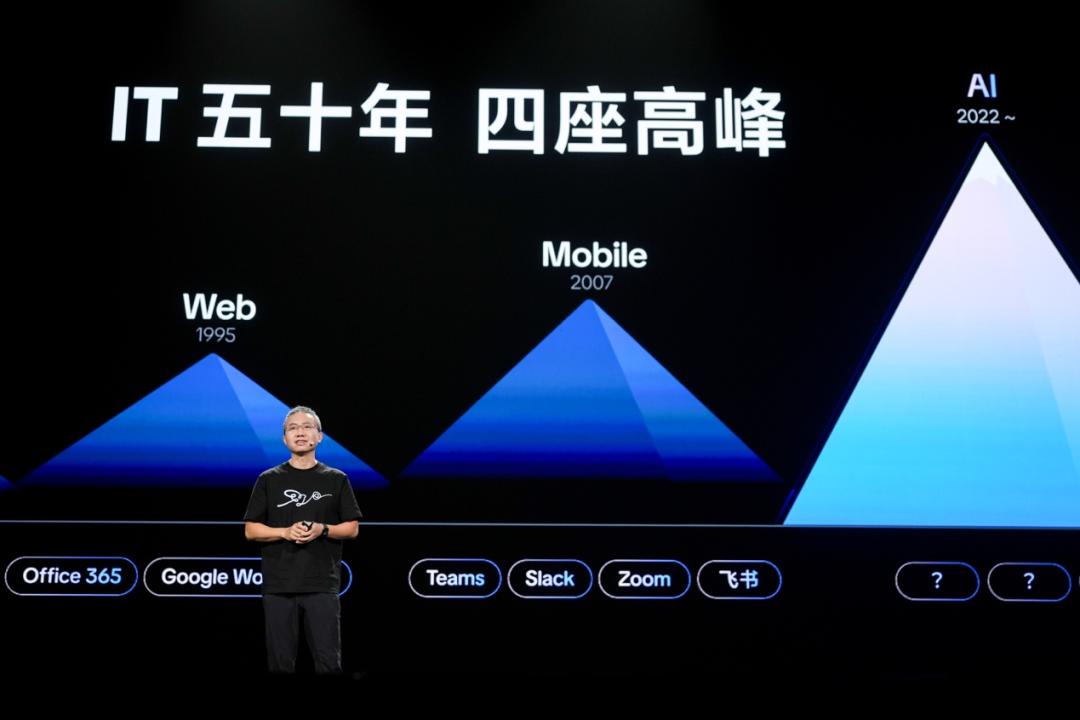
Liang Rubo also explained the reason for integrating Doubao, Feishu and Volcano Engine at the Feishu Future Infinite Conference & Doubao Work Kick-off Conference. He believes that after Agents enter the available stage, models, Agents and collaboration environments must be combined more closely.
This gives Doubao Work a type of resource that TRAE was not good at originally: the accumulated working relationships that enterprises already have.
Take the feedback dashboard tested by New Position as an example. If it is actually connected to a company's work system in the future, employee feedback may come from Feishu spreadsheets, or be scattered in group chats and documents. Which feedback is handled by whom, and which content can only be viewed by managers, often have corresponding account and permission rules already in place.
If the Agent can read these materials within the existing permissions of employees, there is no need to re-upload files and explain business backgrounds every time. After the feedback processing is completed, it can also stay in the original collaboration environment for relevant colleagues to view and modify.
Users do not necessarily need to build a new set of office environments from scratch. What they need is for AI to know how the company originally works, and then help them complete part of the work. The accounts, member relationships, business materials and permissions accumulated by Feishu for many years are exactly what Doubao Work can leverage.
But being able to read the company's materials does not mean that this dashboard can be used in the company for a long time. After employees submit new feedback, can the data be updated automatically; when an administrator closes a feedback, will the pages of other people change synchronously; if the business department puts forward new statistical requirements, how should the original program be modified?
When these things are added one after another, the small tool that only needs to be demonstrated may become a software project that requires continuous development. The original development environment of TRAE can reflect more value here.
Developers can start from the Agent workbench, and when the project becomes complex, enter the IDE to check code, modify files and run tests. If a modification affects other functions, they can also go back to the original project to locate the problem, instead of regenerating a new set of web pages.
However, having a professional IDE does not necessarily mean that the project can be maintained better. In the test of New Position, TRAE conducted browser tests, while Doubao Work did not perform the same steps, but both finally passed the function check. Two rounds of tasks are not enough to judge which product is more reliable when the project needs to be modified continuously for several months.
The boundary between the two products has become blurred not only in development capabilities. According to the official TRAE documentation, after user authorization, users can directly read materials such as cloud documents and multidimensional spreadsheets through Feishu CLI, and can also modify the corresponding content. Developers can even read the requirement documents in Feishu in TRAE, generate code and test cases, and then write the development progress back to Feishu.
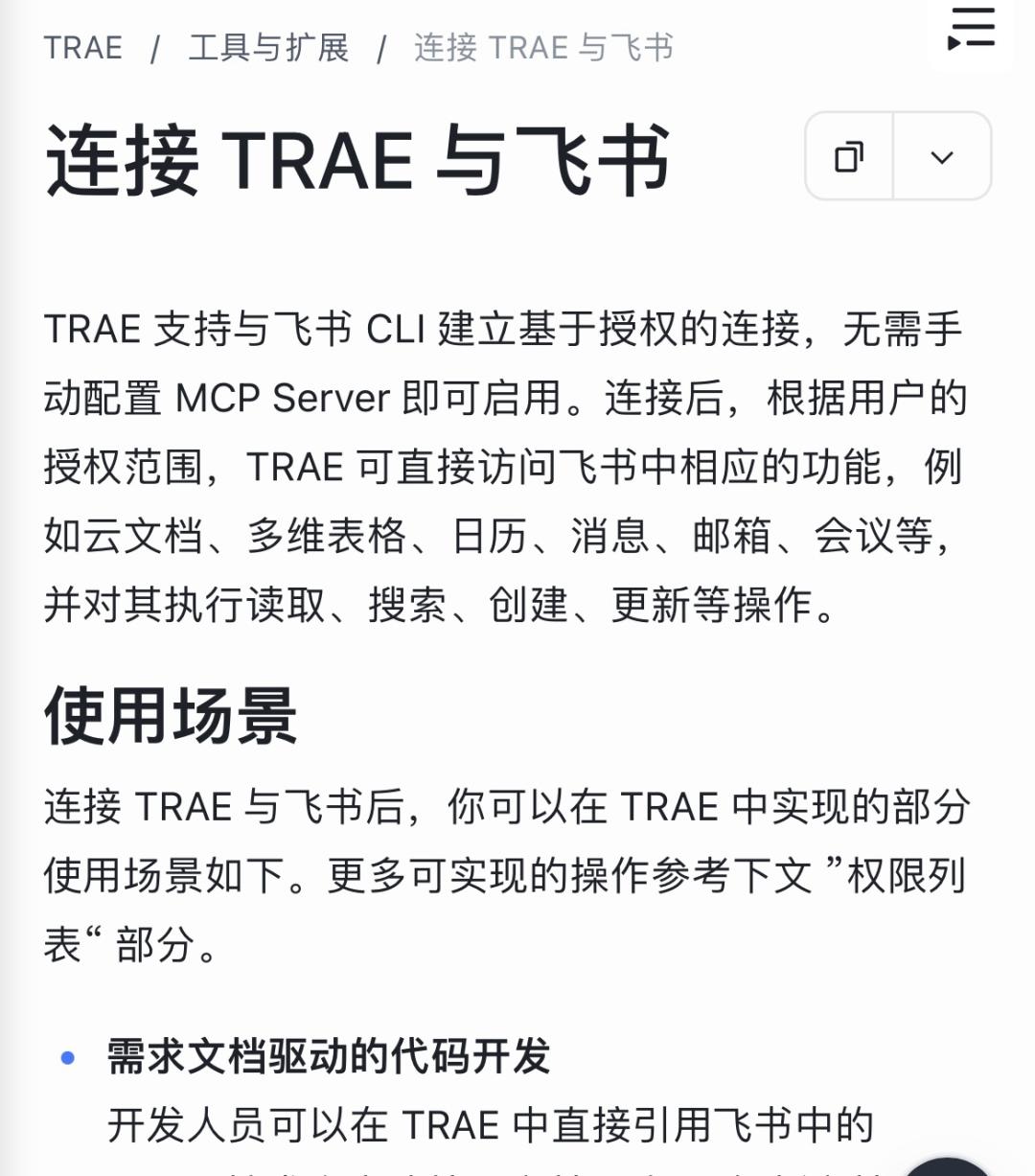
Doubao Work is starting to take over development tasks, and TRAE is also starting to enter the enterprise office environment. The two products are approaching each other from different directions.
But being able to access the same materials does not mean that they can continue each other's work. If an employee sorts out the requirements in Doubao Work, a developer then modifies the program in TRAE, and finally hands it over to the business department for acceptance in Feishu, this process not only involves several files, but also involves task records, code versions, and which content different employees can view and modify.
TRAE can already operate Feishu materials within the authorization scope, but public materials are not enough to prove that the task status, chat history and project files between it and Doubao Work are fully interoperable.
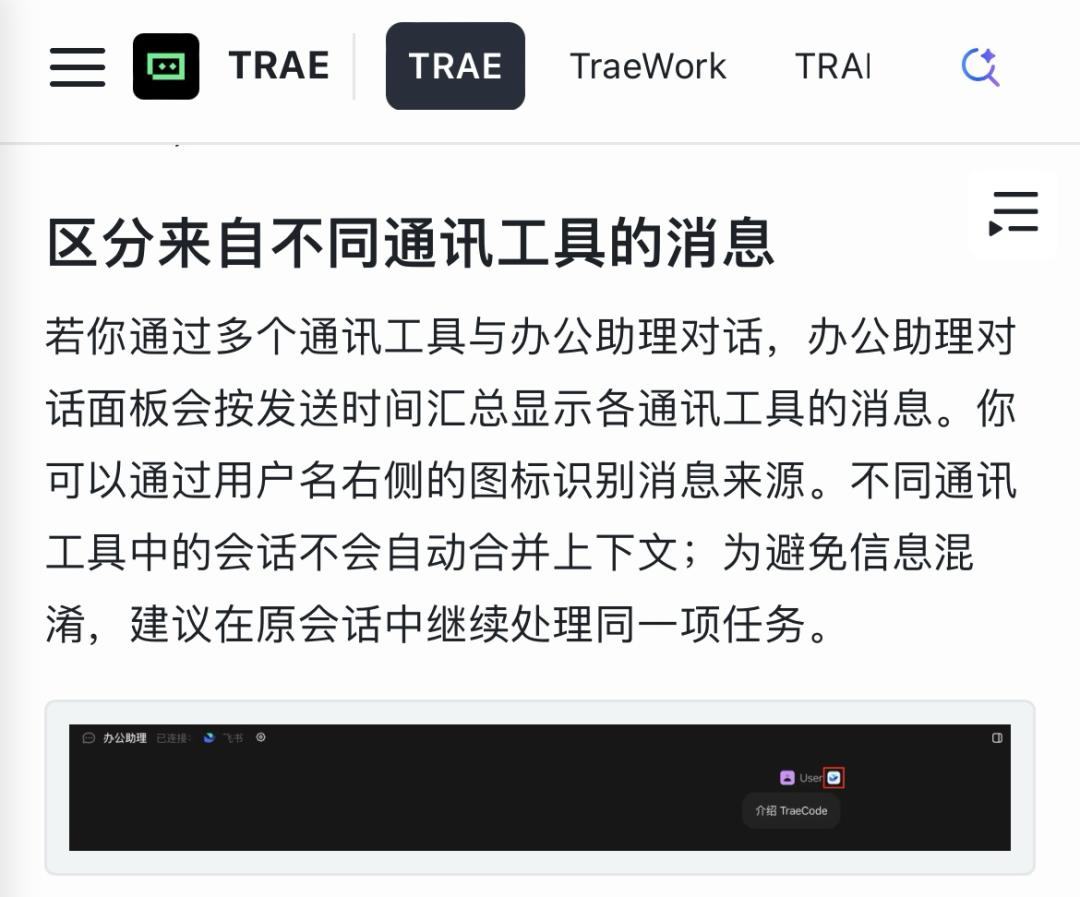
Even in TRAE's own office assistant, this connection has restrictions. Official documentation shows that sessions initiated through different communication tools will not automatically merge contexts. In group chats, currently only the creator of the office assistant can delegate tasks, and other members can only view records.
Doubao Work Partner tries another way: let Agents have independent identities, permissions and memories, and act as a collaboration object in the team. However, this product capability still needs to be tested in more real enterprise environments. Being able to send instructions to TRAE from Feishu is a completely different matter from letting TRAE actually take over a team's work.
ByteDance has brought